 How to resolve AdBlock issue?
News
The service will develop a proposed rule to reclassify this species as priorities allow. The finding of “warranted but precluded” will have no practical effect on protections for the delta smelt, existing federal actions, or water flows in the delta smelt habitat.
Delta smelt are fish native and only found in the San Francisco Bay and Sacramento–San Joaquin Delta Estuary in California, found only from the San Pablo Bay upstream through the Delta in Contra Costa, Sacramento, San Joaquin, Solano and Yolo counties.
Their historical range is thought to have extended from San Pablo Bay upstream to at least the city of Sacramento on the Sacramento River and the city of Mossdale on the San Joaquin River.
They were once one of the most common pelagic (living in open water away from the bottom) fish in the upper Sacramento–San Joaquin Estuary, which is where Clear Lake's water travels to via Cache Creek and the Yolo Bypass.
The delta smelt was first listed as threatened under the ESA in 1993 due to habitat loss, drought, introduced species, and reduction of food items.
Critical habitat was designated for the species in 1994. The most recent estimate of delta smelt is the lowest ever recorded – about one-tenth the level it was in 2003.
In addition, a 2005 population viability analysis calculated a 50 percent likelihood that the species could become extinct within the next 20 years.
There are several primary threats to delta smelt, including the direct entrainments by state and federal water export facilities, summer and fall increases in salinity and water clarity, and competition with introduced species.
Additional threats are predation by striped and largemouth bass and inland silversides, entrainment into power plants, contaminants, and small population size. In addition, existing regulatory mechanisms are not adequate to halt the decline of delta smelt since the time of listing as a threatened species.
The service reported that it's still unable to determine with certainty which threats or combinations of threats are directly responsible for the decrease in delta smelt abundance.
However, the apparent low abundance of delta smelt in concert with ongoing threats throughout its range indicates that the delta smelt is now in danger of extinction throughout its range.
Therefore, based on a review of the best scientific and commercial information available, the service finds that the delta smelt meets the definition of an endangered species under the Act, and that it warrants reclassification from threatened to endangered.
However, the service will not begin a formal rulemaking to reclassify delta smelt at this time.
Reclassification of delta smelt is considered a lower priority than other actions needing attention, because the species is currently listed as threatened, which receives certain protections under the Act. Service regulations prohibit take for threatened species in the same way as endangered species.
Other protections include those under section 7(a)(2) of the Act whereby federal agencies must insure that any action they authorize, fund, or carry out is not likely to jeopardize the continued existence of any endangered or threatened species.
For the complete 12-month finding on the petition to reclassify the delta smelt from threatened to endangered, please visit http://www.fws.gov/cno/ .
For more information on the delta smelt provided by the service, go to www.fws.gov/sacramento and open the Delta in the Spotlight box on the home page to begin.
Follow Lake County News on Twitter at http://twitter.com/LakeCoNews and on Facebook at http://www.facebook.com/pages/Lake-County-News/143156775604?ref=mf .

You’ve already thought about it and figured out the celebrity that I think best represents Chardonnay, haven’t you? Yes, you are right, Chardonnay is completely Kim Kardashian. It’s almost a no-brainer.
When I talked to winemakers about doing a celebrity comparison they tended to comment that Chardonnay would be hard to compare to just one celebrity since Chardonnays are so vastly different from winery to winery just one celebrity wouldn’t be able to represent them all.
To be completely accurate for this comparison I did my usual “cyber-stalking” of Kim Kardashian, looking for any and every fact that I could about her. I even watched several episodes of “Keeping up with the Kardashians,” to be thorough. Everything I learned just reinforced my belief that I made the right wine/celebrity comparison this week.
Kim Kardashian is an actress, consultant, businesswoman, model and spokesperson. She’s actually far more hard working, intelligent and talented than most people give her credit for. Chardonnay is the same way, in that people have become accustomed to a shallow, uninspired Chardonnay.
Chardonnay is classified as one of France’s “noble grapes,” and the term means a grape that produces a high quality wine. America doesn’t have a nobility class but our celebrities, like Kim Kardashian, are essentially our nobility.
Let’s face it: trend-wise, Chardonnay has had its moment in the limelight. These days if you admit that you like Chardonnay it’s like admitting that you watch “Keeping up with the Kardashians” – you expect people to look at you, make an odd face, and say “Really? Why?” One recent description about Chardonnay mentioned how people currently like to “diss on it” and that it’s getting “blinged out” (what can I say, Gary Vaynerchuk can be very entertaining).
But how can you not think the same thing about Kim Kardashian as being “Dissed on” and “Blinged out”? Like Chardonnay, we love to hate her. But I think it’s time to look at both with fresh eyes and give them the benefit of the doubt.
Looking at a glassful of Chardonnay or at Kim Kardashian is almost dreamlike. It’s like they both give off more light than they take in, and trying to describe them is like describing something made of light. In my opinion Kim Kardashian is one of the most beautiful women in the world, and I couldn’t imagine improving her in any way.
A talented winemaker can do the same thing with the Chardonnay grape, making the most perfect wine you can imagine with no ideas how to improve on it. The problem with Chardonnay’s reputation is that in the past winemakers followed the public’s taste for more oak in the wine but took it too far, to the point where it could attract termites.
Consumers have become so accustomed to heavy oak in Chardonnay that I once saw a person try to send a wine back claiming, “This isn’t a Chardonnay!” because it wasn’t oaky. Chardonnay grapes don’t taste like oak. People eventually grew tired of that quality and moved away from it, but still equate Chardonnays with an oaky flavor.
That’s the same problem with Kim Kardashian. People formed an opinion about her and have fused it in their minds. Both Chardonnay and Kim Kardashian have had awkward things happen to them, but they have both moved on. Unfortunately, the general public hasn’t changed it’s opinion on either of them.
I personally look at Chardonnay as a litmus test for a winemaker. I will taste a Chardonnay and, I admit it, I still look for “the oak monster” myself. If it’s not too heavily oak flavored I then examine the complexity of the wine, and how much of the chardonnay grape comes through as opposed to how much of the winemaking process comes through.
If I like the Chardonnay then I look forward to the rest of the wines at the winery. It’s as if my subconscious is soothed with “The winemaker did Chardonnay well, so they can probably do anything well.”
Still, both Chardonnay and Kim Kardashian get inaccurate and untruthful press now-a-days, even though most of the information is not true. Spousal abuse, bad relationships, they’re all inaccurate; poor Chardonnay. Then there are the rumors about Kim Kardashian ...
Descriptors you will find for Chardonnay can be butter, cream, nuts and minerals. Those are all staple flavors you will find in most Chardonnays, but individual wines could have more specifically: almonds, apple, apricot, banana, burnt wood, buttered popcorn, candied ginger, canned corn, caramel, citrus, crème brule, crème frais, custard, flint, green leaves, golden pear, jasmine, “Jolly Rancher” candies, kaffir lime, kiwi, lemon, limestone, melon, nutmeg, ocean, oranges, passion fruit, peach, pear, pie crust, quince, smoke, pineapple, toasted marshmallow, tropical fruit, vanilla, walnuts and
of course, wood.
Chardonnay is a full-bodied wine that’s big both coming and going, in comparison to Kim Kardashian who … has nice eyes.
Keep your eye out for a less oaky Chardonnay. Instead of aging entirely in oak barrels and additional oak chips, look for a wine that’s aged partially in oak and partially in steel, or you can even find Chardonnay aged entirely in steel without a hint of oak.
Just like Kim Kardashian Chardonnay might not be what you are expecting, so give them another try.
Lake County Chardonnay
Ceago Vinegarden
Cleavage Creek Winery
Langtry Estate and Vineyards
Ployez Winery (Chardonnay Wine and Chardonnay Sparkling Brut)
Robledo Family Winery
Rosa D’Oro Vineyards
Shannon Ridge Vineyards and Winery
Steele Wines
Terrill Cellars
Tulip Hill Winery (Lake County Winery, not a Lake County wine)
Wildhurst Vineyards
Ross A. Christensen is an award-winning gardener and gourmet cook. He is the author of "Sushi A to Z, The Ultimate Guide" and is currently working on a new book. He has been a public speaker for many years and enjoys being involved in the community. Follow him on Twitter, http://twitter.com/Foodiefreak .
Follow Lake County News on Twitter at http://twitter.com/LakeCoNews and on Facebook at http://www.facebook.com/pages/Lake-County-News/143156775604?ref=mf .
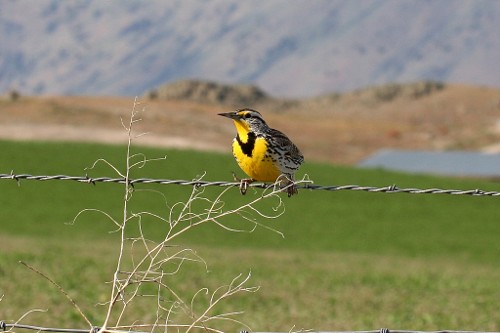
Fine, clear, dazzling, morning, the sun an hour high, the air just tart enough.
What a stamp in advance my day receives from the song of that meadow lark perch’d on a fence-stake twenty rods distant! Two or three liquid-simple notes, repeated at intervals, full of careless happiness and hope. With its peculiar shimmering slow progress and rapid-noiseless action of the wings, it flies on a way, lights on another stake, and so on to another, shimmering and singing many minutes.
Walt Whitman – Specimen Days, March 16, 1878
Distinctly a bird of the Americas, the First People often included this singing, long-legged, walking bird in many of their stories and legends, but it wasn’t until Lewis and Clark first noted the yellow-breasted bird in 1805 that it caught the attention of the ornithologists of their day.
Even so, it wasn’t until 1840 that this Western songbird was named. John James Audubon dubbed it neglecta (nee-GLEK-tah; Latin for neglected) because, as he wrote in 1840, although "the existence of this species was known to the celebrated explorers of the West, Lewis and Clark, no one has since taken the least notice of it."
Today the Western Meadowlark, Sturnella neglecta, is an abundant and familiar bird of open country that you can see singing its familiar song from fence posts along roadsides; or you might catch it walking though grasslands and agricultural areas with a few dozen others.
This bird is so well-loved that it is the official state bird for six Western states – Kansas, Montana, Nebraska, North Dakota, Oregon and Wyoming – and there is barely a western movie made that doesn’t have the familiar melodic song of the meadowlark in its soundtrack.
A member of the same bird family as blackbirds and orioles, the meadowlark is distinctly not a “black bird,” having a bright yellow breast and undercarriage, a bold black “V” on its chest, and a back of streaked brown and white (we’ll be forgiven if we think the bird looks like it is sporting a modern suit of clothes).
Meadowlark legs are long, and their tails are short, with white outer tail-feathers that are obvious in flight. During the breeding season the yellow and black become more pronounced.
In winter you can see meadowlarks in groups, or with other blackbirds and starlings. In early spring, they will be doing their dance of mating.
The male will begin singing continuously, a beautiful song advertising his presence to the females from shrub tops, fence posts, utility poles or any other high structure. If she notices him and there are no other male meadowlarks around to challenge him a sort of chase will begin, the pace kept by the female.
The male at some point will stop and face the female, breast forward, head up, and if she chooses to pay further attention to him they will mate and the female will then begin making a nest. Successful males will often mate with two (or more) females.
The female will build her nest on the ground, typically under dense vegetation which makes it very difficult to find. The nest will be built mostly from grass that is tightly interwoven, and it will be shaped like a dome, with side entrances. The completed nest will be very waterproof.
She will then lay four to six eggs and incubate them for 13 to 14 days. After the eggs hatch the female will provide most of the food, although the male may help a bit. The young meadowlarks will leave the nest 10 to 12 days after hatching. At this age they still cannot fly but can run very well, and, with the help of shadowy and cryptic feathers, can hide successfully in the grass.
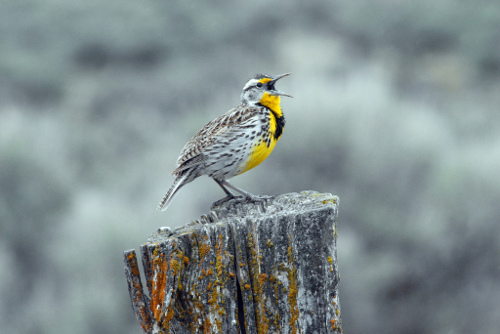
Meadowlarks forage mostly on the ground, probing the soil with their bills, eating grasshoppers, beetles and caterpillars (even the hairy ones) by the thousands. In the fall and winter, seeds and grains become an important addition to their diet.
You will notice as you watch them on the ground that they neither hop nor run but always walk, a style of movement that is comparatively uncommon among birds. You may also notice that immediately upon landing the male will flirt his tale vigorously once or twice, showing the white outer feathers.
Western Meadowlarks are full-time residents throughout much of their range, but when deep snow covers food sources they may move into sheltered valleys. Some populations do appear to be long-distance migrants.
Here in Northern California, as in other parts of their range, Western Meadowlarks are abundant and widespread, but breeding populations have declined somewhat in recent years. Much of this decline can probably be attributed to habitat destruction from livestock grazing, mowing and development, and perhaps as a result of contamination from pesticides.
These birds are extremely sensitive to human disturbance during the breeding season and will abort nesting attempts if they are flushed while incubating eggs.
The meadowlark has a just claim on the affections of people whose fields he adorns.
Debra Chase is the executive director of Tuleyome. She resides on a small family farm in Colusa County.
Tuleyome is a local nonprofit working to protect both our wild heritage and our agricultural heritage for future generations. Past Tuleyome Tales articles are available in the library section of their Web site, www.tuleyome.org.
It’s April. After what seems to have been a very long and wet winter, the flowers are blooming, the lake is almost full and the trees are beginning to bud, even the new trees we have planted at the south side of the Soper-Reese.
We have put enough pear and crepe myrtle trees to eventually provide cooling shade for our outdoor events in the courtyard. It may take a few seasons before they actually grow big enough but they have started.
And we have started to engage the community more and more with an ever-expanding offering of shows at the theater.
On April 9 and 10 we will welcome the first of what may become a series of concerts featuring Christian bands and other artists from around the nation.
The local alternative Christian rock band “Revolution” will be headlining a concert playing music fit for the whole family. Blake Miller will be a featured guest singing along with Sebrina Dolloso lead singer of “Revolution.”
The opening band is the “Pneumati Band,” a national touring family band from Oregon. Proceeds from this series will go to benefit Compassion 2 Help, a not for profit organization providing food, clothing and support for our own needy neighbors here in Lake County.
The Triskela Celtic Harp Trio will return Saturday, April 17, for a concert of traditional Celtic and original harp tunes. They were a near sellout last time they appeared on stage and I am sure they will be well received this time.
The new band “Uncorked” will open for Triskela. Uncorked has been assembled by Eleanor Cook and features the fine talents of Andi Skelton, Don Coffin, Dennis Hadley, Dan Harris, Teale Love and Greg Bushta. What a great lineup for the month of April.
The North Bay Realtor Association enjoyed their last conference so much that they have decided to use our venue the next round of meetings on April 29. Using the Soper-Reese as a meeting place for both businesses and nonprofits helps to anchor it as a much-needed conference venue for Lakeport.
We are also excited to be hosting the 29th annual Spring Dance Festival this year. This major fund raiser for the Lake County Arts Council has longer legs than most of the dancers. This marks the first time that it has been held at the theater.
All of the dance studios in the county are contributing to this display of almost 200 dancers and all
participants are very busy rehearsing for this showcase of the Terpsichorean muse. The Dance Festival is the first weekend in May with a tech rehearsal on the last day of April.
You may have noticed on our posters and on our Web site that we are affiliated with the American Association of Community Theatre.
The AACT is a group of community theaters joined together from around the country sharing resources, experiences, directions and ideas about operating and maintaining performing art centers and theaters.
We are proud members of this organization and rely upon their network of seasoned experts to help us bring a professional live stage experience to the entire community.
Visit our Web site for more details about the Soper-Reese and all of our upcoming shows at:
Bert Hutt is artistic director for the Soper-Reese Community Theatre in Lakeport, Calif.
Follow Lake County News on Twitter at http://twitter.com/LakeCoNews and on Facebook at http://www.facebook.com/pages/Lake-County-News/143156775604?ref=mf .
The closure order covers only the Upper Lake Ranger District and is scheduled to lift the morning of Friday, April 9, conditions permitting.
The OHV trails on the Grindstone Ranger District are still open.
The closure is the result of rain and snow this week that have left trails muddy and, in some places, covered by more than a foot of snow.
Additional storm systems in the current forecast are predicted to bring more rain and snow to the Upper Lake Ranger District and trail system.
Using the trails in their current condition would result in damage not only to the trails, but would also impact other resources including soils, water quality, and wildlife habitat.
“We recognize this is a popular weekend for recreation on the Forest, particularly for OHV enthusiasts,” said Forest Supervisor Tom Contreras. “We appreciate the public’s understanding and cooperation with the temporary OHV trail system closure. By closing the trails now and preventing further damage, we are reducing the risk of longer closures for costly repairs and restoration efforts. Waiting for conditions to improve and the trails to dry out will help us continue to provide quality recreation areas for OHV riders.”
The Emergency Trail Closure for the Upper Lake Ranger District of the Mendocino National Forest is formally referenced under Order Number 08-10-03.
Violation of this closure order is punishable by a fine of no more than $5,000 for an individual, $10,000 for an organization, or up to six months imprisonment or both.
For more information, please contact the Mendocino National Forest at 530-934-3316 or visit www.fs.fed.us/r5/mendocino.
Follow Lake County News on Twitter at http://twitter.com/LakeCoNews and on Facebook at http://www.facebook.com/pages/Lake-County-News/143156775604?ref=mf .