 How to resolve AdBlock issue?
News
LAKEPORT, Calif. – Hungry youngsters are believed to be behind the weekend burglary of a local school.
The Lakeport Police Department received a report early Monday that Terrace Middle School's kitchen area had been ransacked.
A school employee found the evidence of a break-in shortly before 5:30 a.m., and Officer Jim Bell took the report.
Bell said the suspects appear to have pried open a side window to gain entry. They then used paper and plastic bags to cover a window while they were inside.
They ransacked and emptied a cappuccino machine – tossing coffee powder all over the place, he said.
Based on details supplied to Bell by the school, the suspects took 20 fruit snacks, 24 cereal bars, 12 whole grain Pop Tarts, numerous frozen yogurts, eight cans of juice, about 20 bags of baked chips, 10 packs of chile picante and 5 pounds of lunch meat.
A two-way radio stolen from the site later was found, Bell said.
He said he found a few footprints on the stainless steel counters, and also got some smudgy fingerprints.
Bell said he's sure that children are behind the caper.
“It wasn't a professional hit, that's for sure,” he said.
Although he can't be sure exactly when the burglary happened over the weekend, Bell pointed out that homecoming for the nearby Clear Lake High School took place on Friday night, with the homecoming dance on the following evening.
After the burglary was reported Monday, Bell said he did a quick sweep through the Terrace Middle School campus, which is located next to Lakeport Elementary and Clear Lake High School on Lange Street.
“It's amazing to me that these kids did not leave a trail,” he said.
Anyone with information on possible suspects should call Bell at the Lakeport Police Department, 707-263-5491.
E-mail Elizabeth Larson at

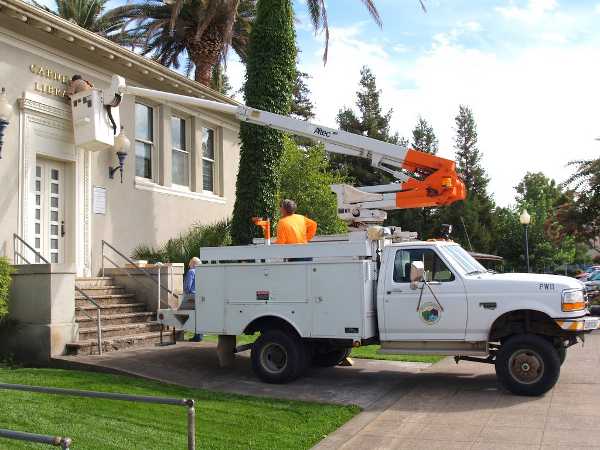
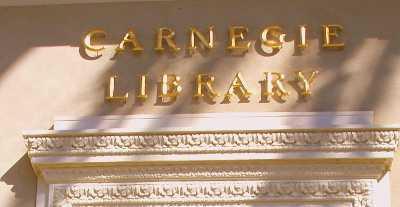
LAKEPORT, Calif. – Lakeport's Carnegie Library recently got some new touches to its exterior signage.
In 2009, vandals broke the historic sign lettering at the Lakeport Carnegie Library.
The Carnegie Library Building, built in 1918, is on the National Register of Historic Places and as such it is required that replacement of the letters be of original style and like-kind materials.
After looking at options, the city selected Sleeper Woods Design in Lakeport to fabricate the new letters.
John Moorhead and Rose Davidson, the owners of the Lakeport-based Sleeper Woods Design, specialize in such projects. The business' motto is “Honoring Tradition with Technology.”
After coordinating with city staff, Sleeper Woods Design began the process of fabricating the redwood letters in a style consist with the original lettering, no easy task.
It was decided that Sleeper Woods Design would fabricate two sets of redwood letters reinforced with plastic backing to ensure longevity.
Created from tight-grained old growth redwood, these isometric letters were carved with a CNC router, then adhered to an 1/8-inch plastic backing using marine epoxy.
A golden burnishing sealant was then applied as an undercoat, followed with the bright 23k gold leaf.
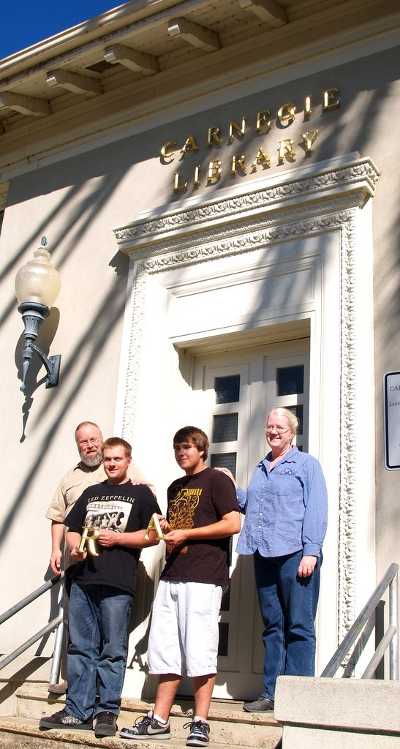
Ben Mansell and Travis Costs, students at Clear Lake High School, participated in the project as part of a job shadowing program.
The students reviewed the proposal with the city of Lakeport and assisted in the production of the replacement letters.
They observed the CNC operation, cutting out the letters, and also assisted in sanding – lots of sanding – and the application of the gold leaf, under Davidson's direction.
Moorhead, the woodworking instructor at Clear Lake High School, sourced and prepped the redwood for cutting and worked with Mansell and Costs in the job shadow program.
On Sept. 17, with the help of the Lakeport Public Works Crew, Moorhead and Davidson installed the new lettering and restored the Carnegie Library Building to its full glory.
Funding for the sign lettering project was provided by the Lakeport Redevelopment Agency.
The city of Lakeport is very pleased to have worked with Sleeper Woods Design and the students of Clear Lake High School on this great example of historic preservation and community involvement.
Richard Knoll is Lakeport's community development and redevelopment agency director.
Follow Lake County News on Twitter at http://twitter.com/LakeCoNews and on Facebook at http://www.facebook.com/pages/Lake-County-News/143156775604?ref=mf .
The two projects, both located in California, are the first in a series of renewable energy projects on public lands under final review by the Department of the Interior that would potentially provide thousands of U.S. jobs and advance U.S. clean energy technologies.
“These projects are milestones in our focused effort to rapidly and responsibly capture renewable energy resources on public lands,” Salazar said in signing the final Records of Decision for the initiatives.
Salazar said the projects advance President Barack Obama's agenda for stimulating investment in cutting-edge technology, creating jobs for American workers, and promoting clean energy for American homes, businesses and industry.
Gov. Arnold Schwarzenegger applauded the development.
“Today’s announcement only further cements California’s national leadership in renewable energy development – and it couldn’t have been done without our federal partners,” Schwarzenegger said. “Our great partnership is helping to improve public health, grow our green economy, promote energy independence and strengthen our national security.”
Salazar’s approval grants the U.S.-based companies access to almost 6,800 acres of public lands for 30 years to build and operate solar plants that could produce up to 754 megawatts of renewable energy, or enough to power 226,000 to 566,000 typical American homes. The projects will generate almost 1,000 new jobs.
The projects Salazar approved will employ two different types of solar energy technology. The Imperial Valley Solar Project, proposed by Tessera Solar of Arizona, will use Stirling Energy System's SunCatcher technology on 6,360 acres of public lands in Imperial County. The plant is expected to produce up to 709 megawatts from 28,360 solar dishes, enough to power 212,700 to 531,750 homes.
The Chevron Lucerne Valley Solar Project, proposed by Chevron Energy Solutions of California, will employ photovoltaic solar technology on 422 acres of public lands in San Bernardino County, and will produce up to 45 megawatts from 40,500 solar panels, enough to power 13,500 to 33,750 homes.
The project has also gotten support from national environmental groups, including the Natural Resources Defense Council.
Johanna Wald, the group's senior attorney, called the permitting of the projects “a major milestone in renewable energy on public lands and a down payment on America’s transition to a clean energy economy.”
She added, “Perhaps most importantly, the process provided valuable lessons that careful planning, siting and designing up front will lead to renewable projects that are smart from the start.”
Wald said the Natural Resources Defense Council, Wilderness Society and Defenders of Wildlife played “an instrumental role in getting these projects to where they are today, and encouraged important mitigation measures to minimize their impacts on diverse wildlife, precious water supplies and other key desert resources.”
In April of 2009, Interior’s Bureau of Land Management (BLM) committed to helping the nation reach its clean energy future by guaranteeing coordinated processing, full environmental analysis and public review for specific renewable energy projects where the companies involved demonstrated they were ready to advance to the formal environmental review and public participation process.
“We’re confident that our solar program is smart from the start. With something as momentous as the introduction of large-scale solar development on the public lands, we have one chance to do things right,” said BLM Director Bob Abbey. “That's why we did complete environmental analyses on both these projects with expanded opportunities for public participation.”
The “fast track” program is part of the administration’s overall strategy to spur a rapid and responsible move to large-scale production of renewable energy on public lands.
Through the American Recovery and Reinvestment Act of 2009, renewable energy developers that have their projects under construction by the end of 2010 or meet one of the program’s safe harbor provisions can qualify for significant funding.
The recovery act’s payment for specified energy property in lieu of tax credit program makes Tessera and Chevron eligible for approximately $273 million and $31 million, respectively.
Each project has undergone thorough environmental review, including public scoping, draft environment impact statements (EIS) and final EISs.
The companies have undertaken extensive mitigation efforts to minimize any impacts to wildlife, water and other resources. State and federal agencies have set up a joint compensation fund operated by the National Fish and Wildlife Foundation to ensure that impacts are mitigated.
“There are 11 million acres of public lands in the California Desert, and a large majority of those lands are managed for conservation purposes,” Salazar said. “These projects, while a significant commitment of public land, actually represent less than one-hundredth of 1 percent of that total area. Given the many benefits, the extensive mitigation measures, and the fair market value economic return, approval of these projects is clearly in the public interest."
Salazar also praised the unprecedented partnership between Interior and the State of California in encouraging renewable energy projects. On Oct. 12, 2009, Salazar and Schwarzenegger signed an agreement directing Interior agencies and California state agencies to create a unique federal-state initiative to advance development of environmentally appropriate renewable energy on U.S. lands in California.
The Imperial Valley Solar Project is one of the projects being jointly processed through the BLM and the California Energy Commission cooperative model.
“Our collaborative approach shows how separate government processes can be streamlined, without cutting any corners or skipping any environmental checks and balances in the process,” Salazar said. “I commend Governor Schwarzenegger and the people of California for their leadership and partnership on these important renewable energy projects.”
Schwarzenegger reported that there are more than 250 renewable energy projects interested in building and running facilities in the Golden State.
The California Energy Commission approved six large-scale solar projects totaling nearly 3,000 MW in clean, renewable energy which are expected to start construction in California by year's end. Those include the world’s largest solar energy project, which is expected to reach 1,000 MW.
The projects are part of a group of nine solar thermal projects scheduled to go before the California Energy Commission for decisions by the end of the year in order to qualify for federal stimulus dollars, the Governor's Office reported. If all nine projects are approved, more than 4,300 MW of solar power will be added to our grid, providing more than 8,000 construction jobs and more than 1,000 operational jobs.
Additionally, there are 12 other large wind and photovoltaic projects working to break ground in California, the Governor's Office reported.
On top of being home to the world’s largest solar energy project, California is also home to the world’s largest wind energy project, the Alta Wind Energy Center, officials said.
Follow Lake County News on Twitter at http://twitter.com/LakeCoNews and on Facebook at http://www.facebook.com/pages/Lake-County-News/143156775604?ref=mf .
Caltrans issued the reminder to all candidates registered in the upcoming election, their representatives and campaign personnel, and campaign workers for ballot measures of the policy regarding placement of “temporary political signs” within view of a state highway.
According to Caltrans, Section 5405.3 of the State Outdoor Advertising Act allows an exemption for the placement of the temporary political signs along certain state highways.
But the law requires the signs not be placed within the state highway right-of-way, and if they're within view of a state highway candidates are required to file a statement of responsibility form with Caltrans.
To meet the temporary political sign requirements, the signs have to encourage a particular vote in a scheduled election, be placed no sooner than 90 days prior to the scheduled election and removed within 10 days after that election, be no larger than 32 square feet and have a statement of responsibility form filed with the Department of Transportation certifying a person who will be responsible for removing the signs, Caltrans reported.
Caltrans spokesman Phil Frisbie said they don't track how many signs belonging to specific candidates are taken down.
“We do track when we have a call to remove large signs but that is very rare and most of those are other advertising signs, they're not political signs,” he said.
Figuring out just where the right-of-way is, however, can be a challenge, he said.
“The right-of-way varies a lot throughout Lake County,” Frisbie said. “It depends upon where it's at, how old the highway is at that section.”
In some places, the right-of-way is about 10 feet from the edge of the pavement, in other places it extends as much as 80 feet from the road's edge, he said.
“If they're not sure, a general rule is in most places if there is some sort of fence off the road, generally that fence is on the right-of-way line,” he said.
Hanging the signs on fences also isn't allowed, he said, because the fence is still considered the right-of-way.
Because most people aren't aware of the right-of-way's location, illegal signs are a year-round problem, Frisbie said.
Not allowing the signs in certain areas has several reasons behind it, according to Frisbie.
“It's visibility and safety, but also it's an inappropriate use of state property,” he explained.
State law directs Caltrans to remove unauthorized signs. Maintenance crews will pull the signs when they can, although Frisbie said the removals are a low priority compared to other duties.
Because the signs are removed during the normal course of road work, the removal costs are insignificant, he said.
If someone calls to look for the signs, Frisbie said Caltrans crews will make arrangements to get them returned, with no charge.
Frisbie said candidates and their representatives can call him at 707-441-4678 to get more information on how to retrieve signs.
“We would much prefer that they call us rather than have to go out and remove an improper sign,” he said. “That inconveniences both of us.”
Candidates also can get a copy of the statement of responsibility form for temporary political signs at www.dot.ca.gov/oda/political_signs.htm .
E-mail Elizabeth Larson at

KELSEYVILLE, Calif. – Students in Kelseyville are showing their community spirit by collecting toys for children facing traumatic circumstances.
Riviera Elementary School's Friday Night Live Club sponsors a stuffed animal drive, according to teacher and club advisor Deanna Madeson.
Det. Mike Curran with the Lake County Sheriff's Office recently picked up a number of the stuffed toys that he said the school had had since the end of the school year.
Curran said the students make two toy donations annually.
“The stuffed animals are used at our office to give to kids for comfort during uncomfortable topic interviews, at the Child Interviewing Center located at Victim Witness, accident scenes and by our civil division on occasions,” Curran said.
Madeson said the students also collect stuffed toys as part of their October Red Ribbon Week celebration, which this year takes place from Oct. 25 through 29.
The Red Ribbon Week events focus on themes, such as “Hugs Not Drugs,” Madeson said.
Students are encouraged to bring with them stuffed animals from home, and also are asked to donate toys.
“It's the whole entire school that gets involved,” she said.
She explained that the club, founded in the 1980s, encourages children not to do drugs.
At Riviera Elementary, the fourth and fifth graders are involved with the club. “We try to do a lot of promotion at school and in the community by getting the kids involved,” she said.
Activities include poster contests, service to community members including projects for rest homes, and the annual “Peacemaker Essay” that takes place around Martin Luther King Day in January.
Find out about the California Friday Night Live Partnership at www.fridaynightlive.org/.
E-mail Elizabeth Larson at
Education
Health
Business
Obituaries
Veterans
Recreation
Religion
Arts & Life
Government & Politics