 How to resolve AdBlock issue?
News
Acknowledging that the dismal job market is a factor, and that the Post-9/11 GI Bill is becoming a great tool to draw volunteers, the Army, Navy, Air Force and Marine Corps announced Oct. 12 they had met or exceeded their recruit targets at levels not seen since the Cold War ended.
But recruit command leaders also struck a cautionary tone on challenges ahead as the economy improves, as budgets tighten, and as the proportion of youth who can serve continues to slide as youth obesity rises.
Clifford Stanley, undersecretary of defense for personnel and readiness, unveiled the outstanding recruiting results for fiscal 2010 at a Pentagon press conference, with service recruiting chiefs at his side.
He did so against a backdrop of a force under enormous strain and some disturbing recruiting patterns, described by his boss, Defense Secretary Roberts Gates, in a very candid lecture two weeks ago at Duke University.
Gates noted that “no major war in our history has been fought with a smaller percentage” of citizens in uniform, just 2.4 million active and reserve members out of a country of more than 300 million, or less than one percent.
So few have been fighting for so long, Gates said, that it brings “dilemmas and consequences.” One is the enormous stress from long, multiple deployments, especially for junior and mid-level officers and sergeants in ground combat and support specialties.
They are “the most battle-tested, innovative and impressive generation of military leaders this country has produced in a very long time,” he said. But the strain on them and on their families is causing more anxiety and distress for their children, more domestic strife, higher divorce rates “and, most tragically, a rising number of suicides.”
While noting that all services are meeting recruiting and retention goals, Gates said that four decades of an all-volunteer force “has reinforced” demographic and cultural shifts affecting “who is most likely to serve and from where.”
Citing studies recruiting officials don’t usually discuss publicly, Gates said the biggest factor affecting propensity to serve is “growing up near those who have or are serving. In this country, that propensity to serve is most pronounced in the South and the Mountain West, and in rural areas and small towns nationwide…[T]he percentage of the force from the Northeast, the West Coast and major cities continues to decline.”
Military basing and recruiting patterns have reinforced this “growing concentration” or imbalance among certain regions and families, Gate said.
“With limited resources, the services focus their recruiting efforts on candidates where they are most likely to have success – with those who have friends, classmates and parents who have already served. In addition, global basing changes in recent years have moved a significant percentage of the Army to posts in just five states: Texas, Washington, Georgia, Kentucky, and here in North Carolina…Many military facilities in the northeast and on the west coast have been shut down, leaving a void of relationships and understanding of the armed forces in their wake.”
He noted that Alabama, with a population of less than five million, has 10 Army Reserve Officer Training Candidate programs versus only four ROTC programs in the Los Angeles metro area of 12 million and three in the Chicago area with a population of nine million.
Personnel chief Stanley was asked Tuesday whether he and service recruiting commanders have begun to address the recruiting effort’s imbalance across geographic regions described by Gates.
“We continue to focus in all areas of our nation, but we know that we have pockets, we have things, that we can do better,” Stanley said.
Location of reserve officer training, he said, “is not as diverse as it should be or could be, not as representative of different colleges [and] universities, so we are focusing on that.”
The aim, Stanley added, is for “a force that represents our nation. We are doing that very well in some areas, but we know we need to improve.”
The military tracks recruit quality by test scores and by high school graduation rates. Ninety-nine percent of recruits last year had diplomas. That surpassed DoD’s benchmark of 90 percent of recruits with diplomas.
The recruit benchmark on test scores is at least 60 percent scoring above the 50th percentile for youth nationwide. All services exceeded that goal. The Air Force led with 90 percent of new recruits scoring at or above average versus 83 percent for Navy, 72 for Marines and 64 percent for Army.
“Our economy has something to do with this but not everything,” said Stanley. The most common motivation, he said, is still youth desire to serve.
The recruiting service commanders all agreed the new GI Bill, which doubles the value of veterans’ education benefits and drops a $1200 contribution requirement, has helped pull in more quality for recruiters.
Rear Adm. Craig S. Faller, head of Navy recruiting, called it “one of the most positive things that I’ve seen for in my time in service…It really has helped us attract higher quality recruits.”
His counterpart, Maj. Gen. Donald M. Campbell, said the Post-9/11 GI Bill “has made a big difference” in Army recruiting.
“In fact, I’m using it to send my daughter to school,” said Campbell. “And I use my Army story when I talk to young men and women…It’s another great reason to serve their country.”
The new GI Bill “is certainly compelling” to prospective recruits, agreed Brig. Gen. Balan Ayyar, Air Force Recruiting Service commander. But the effect it is having on retaining careerists, given the option to transfer benefits to a spouse or to children, “is really just remarkable,” he said.
To comment, send e-mail to
Follow Lake County News on Twitter at http://twitter.com/LakeCoNews and on Facebook at http://www.facebook.com/pages/Lake-County-News/143156775604?ref=mf .
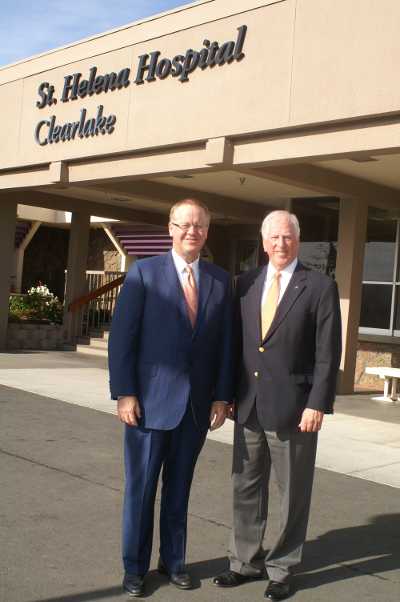
CLEARLAKE, Calif. – Congressman Mike Thompson was the featured speaker at an Oct. 15 gathering of community leaders and hospital representatives celebrating the planned $12.1 million renovation and expansion of St. Helena Hospital Clearlake’s emergency department.
The project is scheduled to begin with a ceremonial “wall breaking” on Nov. 10 at 8 a.m.
Jennifer Swenson, the hospital's vice president of operations, and St. Helena Hospital President and Chief Executive Officer Terry Newmyer also spoke at the Oct. 15 event.
Thompson praised the hospital for its commitment to improving the accessibility and quality of health care to area residents.
“This important project will help enhance the health and vitality of our community,” Thompson said, noting that the renovation will also help the local economy by adding jobs and boosting support for local businesses.
In addition to Thompson, community leaders attending the event included Clearlake Mayor Judy Thein; Supervisor Jeff Smith; Sheriff Rodney Mitchell; Lake County Fire Protection Battalion Chief Willie Sapeta; Jim Dowdy, Kelseyville Fire Department.; St. Helena Hospital Clearlake Governing Board members Arthur Bikangaga, MD, Mark Cooper, DDS, Fred Poucher, Jr., and Marc Shapiro, MD; and hospital executive medical staff members Paula Dhanda, MD, and Michael Shepherd, MD.
“Today is about building for the future,” Swenson told the gathering. “We are transforming care from the inside out by establishing a program that allows our physicians to remain inside the hospital to attend to the needs of our patients; implants the high quality standards that St. Helena Hospital in the Napa Valley has known for years; and provides an environment that supports clinical innovation, education and partnerships for our staff. We are also replacing old equipment with new, state-of-the-art equipment.”
The renovation will add five state-of-the-art patient monitoring rooms, bringing the total number of private rooms to 12. Two of the new rooms will be for trauma patients.
The project also will improve the configuration of the emergency department, providing a private ambulance entrance, a welcoming entrance for walk-in patients and visitors, and a pleasant, comfortable environment in the larger remodeled waiting area.
The triage area will be redesigned so that patients can go directly from the emergency department lobby to a private bed, if necessary.
Follow Lake County News on Twitter at http://twitter.com/LakeCoNews and on Facebook at http://www.facebook.com/pages/Lake-County-News/143156775604?ref=mf .
THE GEYSERS – The Geysers and Cobb area experienced a 3.5-magnitude earthquake Tuesday morning.
The temblor hit at 10:51 a.m. four miles north of The Geysers and 10 miles southwest of Clearlake, the US Geological Survey reported.
The survey said the quake was poorly constrained and occurred at the earth's surface.
Cobb resident Roger Kinney, a frequent contributor regarding earthquake reports in the area, said he was standing outside when the quake occurred, and that he saw his home shudder as a result of it.
The US Geological Survey received three shake reports – one from Kelseyville, one from Middletown and one from San Jose.
A 3.0-magnitude earthquake was reported at The Geysers on Oct. 4, as Lake County News has reported.
E-mail Elizabeth Larson at

The most famous of all comets, Comet Halley is noted for producing spectacular displays when it passes near Earth on its 76-year trip around the sun.
However, you don't have to wait until 2061 to see a piece of the comet – you can do it this very week.
Halley's Comet leaves bits of itself behind – in the form of small conglomerates of dust and ice called meteoroids – as it moves in its orbit, which the Earth approaches in early May and mid-October.
When it does, it collides with these bits of ice and dust, producing a meteor shower as the particles ablate – or burn up – many miles above our heads.
The May shower is called the Eta Aquarids, as the meteors appear to come from the constellation Aquarius. The October shower has meteors that appear to come from the well-known constellation of Orion the Hunter, hence the name: Orionids.
Orionids move very fast, at a speed of 147,300 miles per hour. At such an enormous speed, the meteors don't last long, burning up very high in the atmosphere.
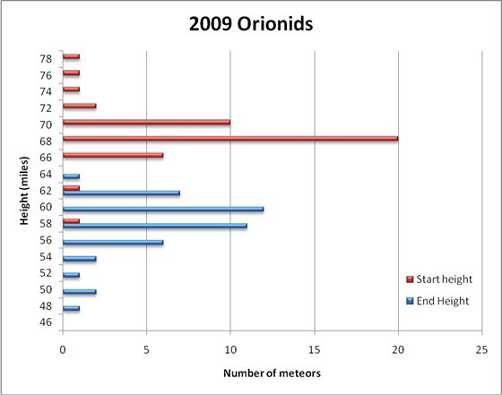
Last year, the National Aeronautic and Space Administration's allsky cameras at Marshall Space Flight Center in Huntsville, Ala., and in Chickamauga, Ga., recorded 43 definite Orionid meteors.
Most of these appeared at an altitude of 68 miles and completely burned up by the time they were 60 miles above the ground, seen in the graph below.
The peak isn't until Thursday, Oct. 21, but the shower is going on now. The NASA camera systems saw their first Orionid on Oct. 15. Unfortunately, the light from the nearly full moon will wash out the fainter meteors, so expect to see fewer than the 30-per-hour rate you might see under completely dark skies.
The good news is that watching Orionids is easy.
Go out into a clear, dark sky after 11 p.m. at night – your local time – and lie on a sleeping bag or lawn chair. Look straight up. After a few minutes, your eyes will become dark-adapted, you'll start to see meteors.
Any of these that appear to come from Orion will be an Orionid, and therefore represent a piece of Halley's Comet doing its death dive into our atmosphere.
Most folks would consider seeing one or two of these a fair exchange for an hour or so of time.
To see a video of an Orionid meteor streaking over western Ontario on Oct. 17, click here: www.nasa.gov/topics/solarsystem/features/watchtheskies/orionids2010.html.
Follow Lake County News on Twitter at http://twitter.com/LakeCoNews and on Facebook at http://www.facebook.com/pages/Lake-County-News/143156775604?ref=mf .
On Oct. 8, Mendocino Community Health Clinic (MCHC) received notice of its $4.9 million award through the Affordable Care Act Capital Development Grant.
The Department of Health and Human Services Health Resources and Services Administration (HRSA), who administers the grant, requires that grant funds be used to support the costs of alteration/renovation or construction of a facility that is consistent with the health center program’s mission – to provide comprehensive, culturally competent, quality primary health care services to medically underserved communities and vulnerable populations.
“You’ve heard the old adage, ‘An ounce of prevention is worth a pound of cure?’ Well, community health centers were founded on this premise,” said MCHC Public Relations Director Jendi Coursey.
Federally Qualified Health Centers like MCHC provide primary care, and they help patients manage chronic diseases so they don’t require more expensive hospital care, Coursey said.
“They’re the best bang for your health care buck,” Coursey added.
In Ukiah, MCHC has provided care at Hillside Health Center on Laws Avenue for 16 years, creatively making the best use of available space. With these grant funds, MCHC will be able to provide patients with more appropriate and comfortable spaces, better privacy and streamlined services.
Temporary modular buildings will be replaced with permanent structures. Cramped waiting rooms will be expanded. Technology infrastructure will be more robust.
Plans include investments at all three health centers: Hillside in Ukiah, Little Lake in Willits and Lakeside in Lakeport.
“We are thrilled to receive federal dollars that will allow us to meet the needs of more patients as health care reform is enacted,” said MCHC Chief Executive Officer Linnea Hunter.
As a result of the grant, MCHC will provide 16 new local construction jobs. Completion of the renovations in 2012 will coincide with the organization’s 20th anniversary.
“Thanks to this grant funding, MCHC will be ready to care for the community for another 20 years,” Hunter said.
During the next two years, health care reform will make health insurance available to more individuals than ever before.
While this is wonderful news for the uninsured, it poses a challenge for health care providers as they prepare for additional patients, Hunter said. “Our buildings and infrastructure need to be updated to meet current and future patient needs.”
“Community clinics are perfectly positioned to become people’s medical home. We provide an integrated approach to health care with medical, dental and behavioral health services for all ages,” said MCHC Medical Director Dr. Michael Carnevale.
He added, “This grant will allow us to invest in technology and building expansions so we can continue to care for everyone in need.”
Follow Lake County News on Twitter at http://twitter.com/LakeCoNews and on Facebook at http://www.facebook.com/pages/Lake-County-News/143156775604?ref=mf .
The group received $3,950.83 for six Garmin Rino two-way radios and a rescue mule litter wheel with handles.
The funds were awarded by the Modesto-based Carole Sund/Carrington Memorial Reward Foundation's Laci and Conner Search and Rescue Fund in an effort to help Lake County Search and Rescue be better prepared and “therefore be more successful in their efforts to safely return missing persons to their loved ones.”
“I am deeply appreciative for all of the volunteers who provide their time and expertise for Search and Rescue operations,” Sheriff Rod Mitchell said. “I would like to thank the Laci and Conner Search and Rescue Fund for awarding us this new equipment. This equipment will enhance our volunteers’ abilities to return loved ones to their families in a safe and timely manner.”
Sharon Rocha founded the Laci and Conner Search and Rescue Fund in memory of her daughter, Laci Peterson, and grandson Conner.
“Many people spent countless hours helping in the search for my daughter, Laci,” Rocha said. “I believe that every missing person deserves to be found and returned to their loved ones. We hope to aid in that effort by providing funds to assist in search and rescue operations.”
The fund's purpose is to provide financial assistance to law enforcement agencies and nonprofit organizations involved in search and rescue operations. These organizations are able to apply for financial assistance for search and rescue training and the necessary equipment in order to improve their search and rescue capabilities.
Since its inception in December 2005, the Laci and Conner Search and Rescue Fund has funded more than $271,000 in grants to 62 organizations in 19 states.
For more information about the foundation visit www.carolesundfoundation.com.
Follow Lake County News on Twitter at http://twitter.com/LakeCoNews and on Facebook at http://www.facebook.com/pages/Lake-County-News/143156775604?ref=mf .