 How to resolve AdBlock issue?
News
The special meeting will begin at 9 a.m. Wednesday, Nov. 3, in the board chambers at the Lake County Courthouse, 255 N. Forbes St., Lakeport.
The commission will consider the draft environmental impact report and draft environmental assessment on the project, which can be downloaded at http://www.co.lake.ca.us/Government/Directory/Community_Development/Bottle_Rock_Power_Draft_EIR_9-16-10.htm .
All written comments must be submitted prior to 5 p.m. Monday, Nov. 1, to Community Development Director Richard Coel,
Bottle Rock Power LLC is seeking a use permit and rezone in order to expand its steamfield, according to county documents.
The project is located within the Binkley Leasehold at 6743, 6825, 7358, 7385 and 7500 High Valley Road, Cobb.
As part of the project, the company wants to build two new geothermal well pads along with an access road, and 1.3 miles of new pipeline to connect to the existing pipeline serving the power plant.
Also part of the proposal is the drilling of 22 production and injection wells on the two proposed
well pads over the life of the project.
The commission hearing's purpose is to review the draft EIR's adequacy, and consider whether or not to direct preparation of the project's final EIR.
Since the plant reopened three and a half years ago, neighbors of the facility have brought forward numerous complaints about permit violations, traffic, environmental impacts and safety.
A number of community meetings in Cobb have been held to address those concerns, with the atmosphere at most of those meetings becoming heated as community members confronted plant officials.
One of the area property owners closely watching the process is Hamilton Hess, chairman of the Friends of Cobb Mountain, a group that formed in 1976 in response to a plan from Unocal to put geothermal wells on Cobb.
Hess said he's read the 750-page EIR, which he called “an immense thing.”
He added, “I think it's a poor document, frankly.”
Hess said he believed the transportation section is faulty, pointing to its statement that the number of vehicles and trips could be mitigated down to causing no impact.
Considering the existing traffic issues for residents along High Valley Road, “That's a very curious and, I would say, untrue statement to make,” Hess said.
He said the impacts on residents so far have been “fairly heavy in several respects,” including odor, traffic, noise and grading work that's been done without proper permits. “It's been a difficult situation.”
Hess also pointed out that there's no assurance that there is even enough steam in the field to justify the project, with the document's median estimate putting it at 26 megawatts below what the plant needs.
“It's a big gamble,” he said.
He said a lot of Cobb residents are planning to attend the Nov. 3 hearing.
“There are strong feelings in the valley about it,” he said.
E-mail Elizabeth Larson at

In honor of Halloween, today’s column will celebrate the odd, the eerie and the out-of-the-ordinary when it comes to fruits and vegetables.
I traipsed to a local supermarket yesterday, camera in hand, hoping to take photos of a few exotic offerings in the produce department. As you can see from the accompanying pictures, I didn’t have much luck! What was there was pretty commonplace, at least from our point of view.
But when I began to view the veggies and fruits through the camera’s eye, it dawned on me that ordinary is really just a matter of perspective. The colorful fresh fare that lines the shelves of the average supermarket produce aisle is anything but ordinary.
The array of colors is amazing, not to mention the varying shapes, sizes and textures of each farm-produced item. It boggles the mind to think that such diversity sprang from the ground … or the branch … or the vine.

Take the avocado, for example. Its hard outer coating is so bumpy and rough that it’s also known as an alligator pear. The skin that hides the rich flesh within is anything but appetizing.
How about the artichoke? Who would’ve thought that we’d consider this bud from a thistle plant such a delicacy, and who had the nerve to eat the first one?
Fuzzy kiwi look like cute little alien creatures, not unlike short-haired versions of the “Tribbles” of Star Trek fame. (Can’t you just imagine them purring?)
Gnarled rhizomes of ginger look more like tree roots than food, and pineapples remind me of hand grenades with wild hairdos on steroids.
Let’s not forget mushrooms, the “fungus among us” which is harvested from light-deprived growing caves.

You may think I’m easily amused, and perhaps I am, but I think of produce as art from a very creative mind. And the best part is that we’re privileged to eat it.
The truth is that many of the fruits and vegetables we now take for granted were once considered rare and exotic. Hot peppers, kiwi fruit and mangoes all fall into this category.
What follows is a fun look at some unique fruits and vegetables from around the world and close to home. They may seem exotic now, but who knows? One day they may be commonplace fare in our local market.
What better plant to celebrate today than the pumpkin tree? These branches with mini pumpkin-like fruit are sold for decorative purposes this time of year. As much as it looks like a pumpkin, the fruit is actually an ornamental eggplant, which is used in Asia in stir-fry dishes.
The dragon fruit’s official name is pitaya. Common in Asia, as well as in Central and South America, it sports a hot pink outer rind, out of which emerge neon green leaves that are reminiscent of tropical fish fins. Its bright white black-flecked flesh is sour, juicy, and refreshing.
Chinese artichokes, also known as crosnes, look like grubs or caterpillars. They have a rich, artichoke-like flavor and are eaten sautéed, pickled or as a garnish.
The grapefruit-sized cherimoya looks almost reptilian, with tight green scales on the outside. Inside is white flesh that’s soft and super sweet. It’s described as having a flavor that’s similar to a combination of banana, strawberry and pineapple.
Durians are popular across Southeast Asia. Green, football shaped, and spiny, they’re known for their strong, unpleasant odor and are banned from being eaten in public in some locations. Despite the smell, their silky, sweet fruit is used in desserts, or sometimes eaten raw in segments.

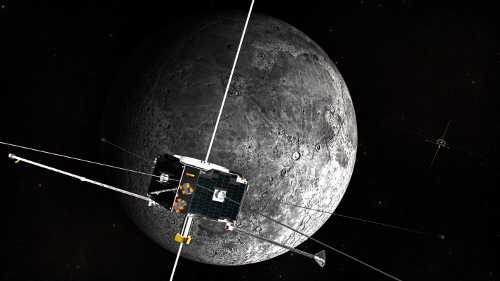
A pair of NASA spacecraft that were supposed to be dead a year ago are instead flying to the Moon for a breakthrough mission in lunar orbit.
“Their real names are THEMIS P1 and P2, but I call them 'dead spacecraft walking,'” said Vassilis Angelopoulos of UCLA, principal investigator of the THEMIS mission. “Not so long ago, we thought they were goners. Now they are beginning a whole new adventure.”
The story begins in 2007 when NASA launched a fleet of five spacecraft into Earth's magnetosphere to study the physics of geomagnetic storms.
Collectively, they were called THEMIS, short for “Time History of Events and Macroscale Interactions during Substorms.” P1 and P2 were the outermost members of the quintet.
Working together, the probes quickly discovered a cornucopia of previously unknown phenomena such as colliding auroras, magnetic spacequakes, and plasma bullets shooting up and down Earth’s magnetic tail.
These findings allowed researchers to solve several longstanding mysteries of the Northern Lights.
The mission was going splendidly, except for one thing: Occasionally, P1 and P2 would pass through the shadow of Earth.
The solar-powered spacecraft were designed to go without sunlight for as much as three hours at a time, so a small amount of shadowing was no problem. But as the mission wore on, their orbits evolved and by 2009 the pair was spending as much as 8 hours a day in the dark.
“The two spacecraft were running out of power and freezing to death,” said Angelopoulos. “We had to do something to save them.”
The team brainstormed a solution. Because the mission had gone so well, the spacecraft still had an ample supply of fuel – enough to go to the Moon.
“We could do some great science from lunar orbit,” said Angelopoulos.

NASA approved the trip and in late 2009, P1 and P2 headed away from the shadows of Earth.
With a new destination, the mission needed a new name. The team selected ARTEMIS, the Greek goddess of the Moon. It also stands for “Acceleration, Reconnection, Turbulence and Electrodynamics of the Moon’s Interaction with the Sun.”
The first big events of the ARTEMIS mission are under way now.
On Aug. 25, ARTEMIS-P1 reached the L2 Lagrange point on the far side of the Moon. Following close behind, ARTEMIS-P2 entered the opposite L1 Lagrange point on Oct. 22. Lagrange points are places where the gravity of Earth and Moon balance, creating a sort of gravitational parking spot for spacecraft.
“We're exploring the Earth-Moon Lagrange points for the first time," says Manfred Bester, Mission Operations Manager from the University of California at Berkeley, where the mission is operated. “No other spacecraft have orbited there.”
Because they lie just outside Earth's magnetosphere, Lagrange points are excellent places to study the solar wind.
Sensors onboard the ARTEMIS probes will have in situ access to solar wind streams and storm clouds as they approach our planet – a possible boon to space weather forecasters.
Moreover, working from opposite Lagrange points, the two spacecraft will be able to measure solar wind turbulence on scales never sampled by previous missions.
“ARTEMIS is going to give us a fundamental new understanding of the solar wind,” predicted David Sibeck, ARTEMIS project scientist at the Goddard Space Flight Center. “And that's just for starters.”
ARTEMIS will also explore the Moon's plasma wake – a turbulent cavity carved out of the solar wind by the Moon itself, akin to the wake just behind a speedboat.
“This is a giant natural laboratory filled with a whole zoo of plasma waves waiting to be discovered and studied,” Sibeck said.
Another target of the ARTEMIS mission is Earth's magnetotail.
Like a wind sock at a breezy airport, Earth's magnetic field is elongated by the action of the solar wind, forming a tail that stretches to the orbit of the Moon and beyond.
Once a month around the time of the full Moon, the ARTEMIS probes will follow the Moon through the magnetotail for in situ observations.
“We are particularly hoping to catch some magnetic reconnection events,” said Sibeck. “These are explosions in Earth's magnetotail that mimic solar flares – albeit on a much smaller scale.”
ARTEMIS might even see giant “plasmoids” accelerated by the explosions hitting the Moon during magnetic storms.
These far-out explorations may have down-to-Earth applications. Plasma waves and reconnection events pop up on Earth, e.g., in experimental fusion chambers. Fundamental discoveries by ARTEMIS could help advance research in the area of clean renewable energy.
After six months at the Lagrange points, ARTEMIS will move in closer to the Moon – at first only 100 kilometers from the surface and eventually even less than that.
From point-blank range, the spacecraft will look to see what the solar wind does to a rocky world when there's no magnetic field to protect it.
“Earth is protected from solar wind by the planetary magnetic field,” said Angelopolous. “The Moon, on the other hand, is utterly exposed. It has no global magnetism.”
Studying how the solar wind electrifies, alters and erodes the Moon's surface could reveal valuable information for future explorers and give planetary scientists a hint of what's happening on other unmagnetized worlds around the solar system.
Orbiting the Moon is notoriously tricky, however, because of irregularities in the lunar gravitational field. Enormous concentrations of mass (mascons) hiding just below the surface tug on spacecraft in unexpected ways, causing them over time to veer out of orbit. ARTEMIS will mitigate this problem using highly elongated orbits ranging from tens of km to 18,000 km.
“We'll only be near the lunar surface for a brief time each orbit (accumulating a sizable dataset over the years),” said Angelopoulos. “Most of the time we'll linger 18,000 km away where we can continue our studies of the solar wind at a safe distance.”
The Dead Spacecraft Walking may have a long life, after all.
See a video about the ARTEMIS orbit at www.youtube.com/watch?v=rcKRk3WdhT0 .
Follow Lake County News on Twitter at http://twitter.com/LakeCoNews , on Facebook at http://www.facebook.com/pages/Lake-County-News/143156775604?ref=mf and on YouTube at http://www.youtube.com/user/LakeCoNews .

Incident occurred early Saturday morning, according to a report from Capt. Kurt Smallcomb of the Mendocino County Sheriff's Office.
Information developed so far has led investigators to believe the attempted home invasion was related to marijuana activities at the residence, Smallcomb said.
At approximately 7:21 a.m. Saturday Mendocino County Sheriff's communications officers were contacted by Jill Cahill, a resident of Steele Lane in Laytonville, Smallcomb said.
He said Cahill reported that just moments before her telephone call three individuals wearing masks and armed with unknown types of firearms forcibly entered into her residence, where gunfire was exchanged and one of the suspects was shot and believed to be deceased.
Deputies and emergency medical personnel responded to the location where they contacted Cahill and two other individuals who were visiting her. Smallcomb said deputies found one of the masked suspects laying just outside the residence, who was confirmed to be deceased.
Cahill advised that the suspects forcibly entered into her residence and sprayed pepper spray at her and her guests. Smallcomb said Cahill also reported that the suspects further displayed an unknown type firearm and shot at least one round inside the residence which struck one of Jill's visitors in the leg.
Armed with a .357 revolver, Cahill reportedly defended herself and her visitors, and a firefight took place inside the residence. Smallcomb said Cahill fatally shot one of the masked suspects, and the other two suspects fled the residence.
Mendocino County Sheriff's deputies, detectives and an investigator from the Mendocino County District Attorney's Office are continuing to investigate the incident, Smallcomb said.
Follow Lake County News on Twitter at http://twitter.com/LakeCoNews , on Facebook at http://www.facebook.com/pages/Lake-County-News/143156775604?ref=mf and on YouTube at http://www.youtube.com/user/LakeCoNews .
LUCERNE, Calif. – A commercial and residential building on Highway 20 in Lucerne sustained several thousand dollars in damage after a wood stove started a fire Friday night.
The fire, reported just before 9 p.m., occurred at 6095 E. Highway 20, next door to the California Water Service water plant.
Several Northshore Fire Protection District engines, an ambulance, two battalion chiefs and a California Highway Patrol officer, who helped monitor traffic around the scene, responded.
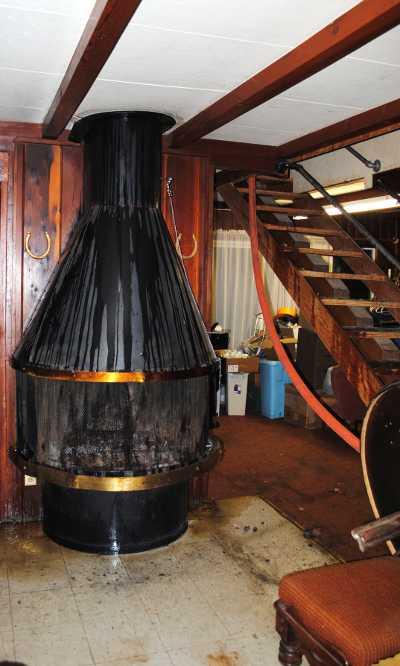
Northshore Fire Battalion Chief Steve Hart said the fire was caused by an improperly installed wood stove.
The stove, located on the first floor, was too close to the wall, he said. Combustible materials ignited and the fire traveled up to the second floor attic.
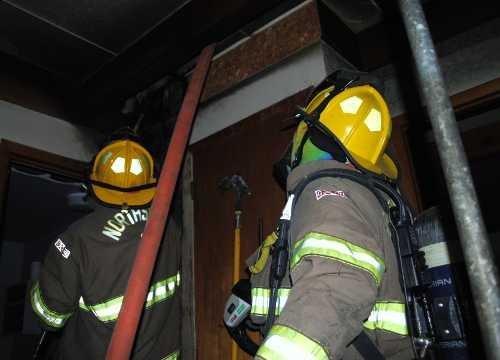
Firefighters opened up the walls to remove charred materials and make sure the fire was out, Hart said.
Battalion Chief Pat Brown brought out a charred piece of wood from inside the wall to show to Hart, noting that it had been burning a long time.
Four firefighters worked on the second story of the building, using a chainsaw to access areas that were burned.
Firefighters were expected to stay on scene until about 10:30 p.m. conducting mop up and overhauling, making sure that there was no chance the fire could reignite, Hart said.
Estimated damage was $10,000 for the structure and $2,000 for the building's contents, which Hart said suffered some smoke damage.
No injuries were reported.
Hart said the winter season brings a lot of problems with wood stoves, especially older installations from the late 1870s and 1980s.
“The codes at that time weren't as good as they are now,” he said.
E-mail Elizabeth Larson at


Sheriff Rod Mitchell said his agency worked with state and federal authorities – including the U.S. Immigration and Customs Enforcement (ICE) agency and U.S Customs – on the search warrant service as part of an investigation involving drugs and weapons.
The investigation grew out of a traffic stop in Laytonville last week in which 100 pounds of marijuana were seized, Mitchell said.
Officials served search warrants simultaneously in Mendocino and Lake counties, he said.
In Lake County, Mitchell said, “It was a very rural, remote location where the warrant was served,” near the Landrum Ranch, which is east of Clearlake Oaks on Highway 20. Staging for the agents and deputies involved occurred at the Moose Lodge in Clearlake Oaks.
“We assisted with getting the search warrant and then the state officials took it over based upon everything we were able to find,” he said.
Late Friday, state Department of Justice officials were not able to provide additional information on the investigation, which was being handled by the DOJ's Bureau of Investigation.
He said at one of the two locations where warrants were served, 37 guns were seized.
Along with large amounts of cash – specific numbers were not immediately available – Mitchell said eight arrests resulted.
Seven of the suspects were taken by ICE to Yuba County for detention, while one was to be booked locally, he said.
The teams of agents and deputies remained at the locations late in the day, he said.
Based on the results of the search warrant seizures, Mitchell said it was anticipated that further warrants would result.
E-mail Elizabeth Larson at
Education
Health
Business
Obituaries
Veterans
Recreation
Religion
Arts & Life
Government & Politics