 How to resolve AdBlock issue?
News
Congressman Mike Thompson (D-CA), a senior member of the House Committee on Ways and Means, was among those who voted for the bill, which made it through the house following weeks of haggling over the debt ceiling.
“I voted for the compromise legislation to avoid defaulting on our nation’s debt,” Thompson said in a statement issued in his office Monday evening.
He added, “Given that our nation was hours away from defaulting on its obligations, I felt a responsibility to vote yes.”
Thompson, who had criticized previous proposals – including a bill put forward by House Speaker John Boehner – didn't offer further comment on the bill.
As the House of Representatives was voting on the bill, Thompson's friend and colleague Rep. Gabrielle Giffords (D-Ariz.), shot seven months ago while holding a meeting with constituents, returned to the House for the first time to cast her vote for the legislation.
Thompson's Facebook page later featured the message, “Welcome back Gabby!”
Follow Lake County News on Twitter at http://twitter.com/LakeCoNews, on Tumblr at www.lakeconews.tumblr.com, on Facebook at http://www.facebook.com/pages/Lake-County-News/143156775604?ref=mf and on YouTube at http://www.youtube.com/user/LakeCoNews.

Sixteen-year-old Haasan Ford was abducted from Antioch at 3:50 p.m. Monday, Aug. 1, according to the alert.
Ford is described as a black male, with black hair and brown eyes, 5 feet, 4 inches tall and 110 pounds. He was last seen wearing black jeans, a red coat and red Cincinnati Reds baseball hat.
The suspect in the kidnapping is a black male with black hair and brown eyes, 5 feet, 7 inches tall, 25 years old and weighing 180 pounds. He was reportedly wearing oversized black jeans, blue jean jacket and a blue knit cap with a white stripe.
Officials said the suspect was armed with a sawed-off shotgun and was last seen driving a stolen black two-door GMC Yukon with shiny rims, a “Harley Davidson” sticker on the rear window and “GT” in orange on the side of the vehicle, with a California license plate of 4WAY944.
If they're seen call 911.
Follow Lake County News on Twitter at http://twitter.com/LakeCoNews, on Tumblr at www.lakeconews.tumblr.com, on Facebook at http://www.facebook.com/pages/Lake-County-News/143156775604?ref=mf and on YouTube at http://www.youtube.com/user/LakeCoNews.
On Saturday the Habematolel Pomo of Upper Lake received the go ahead for construction of the new Running Creek Casino in Upper Lake, according to Tribal Chair Sherry Treppa of the Habematolel Pomo of Upper Lake Executive Council.
The Department of Interior’s authorization is the final action the tribe needed to move forward with the compact, which was first signed by Gov. Jerry Brown in March, as Lake County News has reported.
“This is truly a significant achievement and a major victory for the people of Habematolel Pomo of Upper Lake,” said Treppa. “The compact and the DOI’s determination are long, long overdue.”
She added the the approval “is the critical component we needed to open our small casino and ensure the tribe’s ability to become self sufficient, provide job opportunities and improve the overall quality of life for our people and our future generations.”
Treppa said the casino will provide badly needed jobs for the local community and mitigation funds directly to county agencies through various memoranda of understanding.
She estimated that work should be able to resume on the project in September, with the new facility opening next spring.
“The tribe has gone well beyond the county of Lake’s expectations in its extraordinary efforts to include county officials and the community at-large in the preparation and planning of its gaming project, over a period of several years,” Lake County Administrative Officer Kelly Cox said in a written statement.
The Habematolel tribe also had faced opposition from some larger California tribes, according to Treppa.
“While we were disheartened that a minority of very large California gaming tribes opposed the Upper Lake Compact it was merely another impediment that was not insurmountable,” she said. “One would hope those wealthy tribes would recognize that their economic ambitions to expand their lush gaming resorts is far different than our tribe’s attempt to build a small casino that will enhance the lives of our entire Indian and non-Indian community.”
Running Creek Casino will be built on an 11-acre site next to the county park on Highway 20 outside of Upper Lake.
In a previous interview Treppa said the casino will include a gaming floor complete with 349 machines, six game tables, sitdown and fast food restaurants, a cocktail lounge, retail shops, a players club and administrative offices. The phased project eventually would include a hotel and total more than 76,000 square feet, according to a tribal fact sheet.
Previous estimates have put the cost to build the facility at $25 million, with the estimated number of jobs to be created at 145.
The compact was ratified by the state in the form of AB 1020, which was signed into law by Gov. Brown on June 13. Assemblyman Wesley Chesbro and state Sen. Noreen Evans sponsored the bill, which passed the Assembly with a unanimous vote of 69-0 on May 23 and passed through the Senate on June 9 with a vote of 40-0.
It was the second compact for the Habematolel that had been approved by the state.
A previous compact negotiated between the tribe and former Gov. Arnold Schwarzenegger in 2009 was turned down in August 2010 after the Department of Interior ruled it violated the Indian Gaming Regulatory Act with revenue sharing requirements that were too onerous, as Lake County News has reported.
That denial nearly ended the tribe’s bid for a casino due to mounting debt, according to the tribe's Sunday statement.
However, compact negotiations began with Brown, with the resulting compact to run through Dec. 31, 2031, and allow a maximum of 750 slot machines at one gaming facility.
Under the terms of the compact, the tribe will share up to 15 percent of annual net win revenues with the state by making tiered payments to the legislatively controlled Special Distribution Fund (SDF) based on the number of devices the tribe actually operates under the compact.
The SDF provides grant funds to local communities for mitigation of local impacts of gaming, funding for the California Gambling Control Commission and Bureau of Gambling Control, as well as providing funding for problem-gambling prevention.
The tribe entered into a local intergovernmental agreement with the county of Lake in 2006 and Treppa said the tribe looks forward to fulfilling its obligations under that agreement in order to mitigate any impact the gaming facility may have in the local community.
Additionally, the tribe has entered into a fire and emergency service agreement with the Northshore Fire Protection District, which provides an annual payment of $80,000 from the tribe to the fire district to offset the cost of potential service calls the district may make to the tribe’s proposed gaming facility.
Other agencies involved in the tribe’s proposed project include the California Department of Transportation and the Lake County Special Districts Administration.
In 2009, the tribe and Caltrans completed a safety corridor improvement project along Highway 20 just east of Upper Lake which provided over $500,000 in highway safety improvements including safety lighting, lane widening, bike lanes and sidewalks.
In 2008, the tribe invested $378,000 with the Lake County Special Districts for wastewater system improvements and service to the proposed facility.
“This tribe has done everything possible to ensure that its gaming project will benefit our community and that there will be a long-standing positive working relationship between the tribe and the county of Lake,” said Special Districts Administrator Mark Dellinger.
In addition to the numerous intergovernmental agreements, the tribe also has cooperatively worked with the county of Lake to ensure the Middle Creek Flood Protection Project adjacent to the Tribe’s proposed gaming site will not be impeded in any manner with the construction of the Tribe’s gaming facility.
Through this cooperative effort, the tribe has set aside over 45 acres that eventually will be turned over to the county of Lake as part of the joint flood protection project.
Treppa said the tribe “has worked tirelessly from the inception of the project to be a good neighbor, to be forthright and honorable with its dealings with county, state, legislature, federal government and other tribes while exercising its sovereign right and duty to provide for and to protect its people and tribal lands.”
Follow Lake County News on Twitter at http://twitter.com/LakeCoNews, on Tumblr at www.lakeconews.tumblr.com, on Facebook at http://www.facebook.com/pages/Lake-County-News/143156775604?ref=mf and on YouTube at http://www.youtube.com/user/LakeCoNews.
While federal legislators and President Barack Obama said late Sunday they had reached an agreement to deal with the nation's debt ceiling crisis, a weekend report showed the potential crisis on the local and state level if an agreement didn't take place.
US Sen. Barbara Boxer (D-CA) released a county-by-county report detailing the impact on California of a default on the nation’s debt.
According to the report, California received $345 billion in retirement, disability, Medicare and other federal payments in 2009, with more than $608 million of that coming to Lake County alone.
If the debt ceiling is not raised – as it has been 89 times since 1939 – the revenue coming into the U.S. government will not be enough to cover its obligations, which could put Social Security, Medicare, Medicaid, veterans’ benefits, military payments, student loan payments and many other government services at risk of being disrupted, Boxer's office reported.
“The consequences of a default would be devastating for every American and could lead to lost jobs, higher interest rates and disruptions in military pay, veterans’ benefits and Social Security checks,” Boxer said.
Residents of each of California’s 58 counties as well as state and local governments could be hurt if the federal government is unable to fund these priorities, according to Boxer.
Nationally, the consequences for seniors who rely on Medicare and Social Security, for veterans who receive benefits, for active-duty military and their families, and for state and local governments could be deep and painful in the case of a default, Boxer warned.
Among the potential consequences concerns that more than 54 million Americans’ Social Security benefits are in danger of being disrupted, the benefits of more than 45 million Americans who rely on Medicare would be put in jeopardy, with U.S. Treasury Secretary Tim Geithner warning Senate Majority Leader Harry Reid in a Jan. 6 letter that Medicare benefits payments “would be discontinued, limited, or adversely affected” if Congress failed to raise the debt ceiling.
If the deal isn't finalized, there also could be ramifications for 22.5 million veterans whose benefits could be disrupted, stoppage of payments to more than 204,000 active duty military personnel, an estimated $8.8 billion in unpaid Pell Grants to students and cuts to local and state services, Boxer's office said.
Follow Lake County News on Twitter at http://twitter.com/LakeCoNews, on Tumblr at www.lakeconews.tumblr.com, on Facebook at http://www.facebook.com/pages/Lake-County-News/143156775604?ref=mf and on YouTube at http://www.youtube.com/user/LakeCoNews.
On busy days that leave me little time for lunch, a half avocado and a spoon are all I need to feel refreshed, nourished and ready to work again.
Slices of avocado layered on whole-wheat toast make for a quick and healthful breakfast that’s immensely satisfying, and bits of diced avocado give a salad richness and body.
My favorite quick and easy salad with avocado includes greens, thinly sliced red onions and fresh orange slices drizzled with some strong extra virgin olive oil and balsamic vinegar.
A topping of diced avocado provides balance for a plethora of favorite dishes. Its freshness lightens up hearty black bean soup, while it provides pleasant “heaviness” to a light and refreshing bowl of gazpacho.
Of course, avocado is perfect for accompanying anything with a Mexico or South American spin, no surprise since they’re a time-honored part of their culinary tradition.
Fish tacos cry out for avocado, and magic is made when avocados are mashed in a bowl with lime, cilantro, cumin and the like for guacamole.
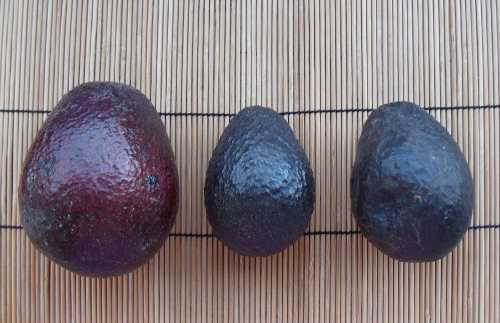
Oval, egg or pear-shaped, these fruits have a luscious, creamy green interior and the dark, pebbly exterior of some cultivars has earned them the nickname “alligator pear” for its resemblance to the skin of that beast.
Native to central Mexico, they grow on a flowering tree related to those that produce bay leaves, cinnamon and camphor. They’ve been cultivated for more than 10,000 years in a wide swath that extends southward from the Rio Grande to Peru.
Mexico dominates the world market for avocado exports, but California is king when it comes to avocados here in the states, growing 95 percent of the crop produced in the nation, the bulk of it in San Diego County.
They’re also widely cultivated in Asia, where they’ve become part of its varied cuisine over the centuries, as well as in South America. This subtropical species needs a climate without frost and little wind, which dehydrates the flowers and affects pollination.
They’re a climacteric fruit, meaning, like the banana, they reach maturity on the tree, but only ripen off of it. They must be picked at the mature stage to ripen properly, and will usually reach optimum ripeness within a few days at room temperature.
In years past, avocados were used in place of butter for seamen who made the long voyage between Europe and the Caribbean, giving rise to one of its more ancient monikers, midshipman’s butter. When compared to butter, however, there’s a vast difference in nutrition.
Two tablespoons of avocado has 50 calories, while the same amount of butter has 204. In addition, that amount of butter has 23 grams total fat (with 14.6 grams of it saturated) while avocado has 4.5 total grams, 0.5 grams of it saturated. The butter has 61 milligrams of cholesterol and 176 milligrams of sodium (assuming it’s the salted variety); the avocado has none of either.
Does that make you want to put avocado in your butter dish? It does me.
Avocados provide nearly 20 essential nutrients, including fiber, potassium (more than potassium-rich bananas), vitamin E, B vitamins and folic acid.
They also act as a nutrient booster because they help the body absorb more fat-soluble nutrients, like alpha and beta-carotene and lutein, in foods that are eaten with the fruit.
While avocados are high in fat (about 85 percent of its calories comes from it), the fat in avocado is unusual and provides research-based health benefits. One fat found in avocados exists mainly in sea plants, being rarely found in those that grow on land.
Similar to olives and olive oil, avocados contain high amounts of oleic acid, a mono-saturated fatty acid that has been shown to be beneficial in preventing heart disease.
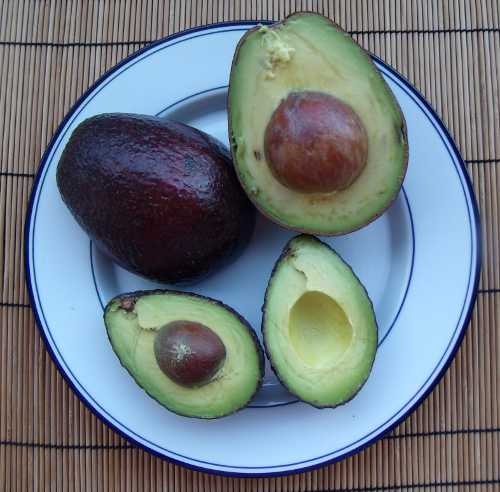
Fats found in avocados also have wide-ranging anti-inflammatory benefits, as well as assisting in regulating blood sugar.
There are many varieties of avocados, ranging in size from the one-ounce “avocadito” (also known as the cocktail avocado) to one that weighs nearly four pounds.
In addition to near-black, thick, pebbly skin, avocados can have smooth bright green or black skin that’s thin, making it difficult to peel. There’s a tiny Mexican avocado that can be eaten like a plum, skin and all.
The world favorite is the Hass avocado, with its high fat content and pleasant-tasting, dense flesh. Fully 85 percent of the avocado crop worldwide is devoted to its cultivation.
Avocados may be stored in the fridge if they’re the desired ripeness (yielding to gentle pressure for typical use or very soft for guacamole); otherwise, leave them at room temperature to ripen up. (The ripening process can be sped up if avocados are stored in a paper bag with a banana, which emits a gas that hastens ripening.)
Since avocados turn brown when exposed to air for more than a few minutes, sprinkle them with a bit of fresh lemon juice if they won’t be used right away.
In various parts of the world, including the Philippines, Brazil, Indonesia, Vietnam and India, avocados are frequently used for milkshakes and in desserts.
Today’s recipe, a fruity tropical salad with a grain base, was inspired by a dish prepared by a friend’s Filipino wife, a sweet dessert made with avocado, mango and condensed milk that she remembers from her native country. While my salad has a bit of natural sweetness from the fruit, it’s not overly sweet and works well as a side dish.
The recipe utilizes quinoa (pronounced keen-WAH), a gluten-free, high-protein grain. Unlike many grains, quinoa is a complete protein, meaning it provides all the essential amino acids. I’ve used two colors of the grain for presentation, but any type of quinoa may be used. Enjoy!
Tropical quinoa salad with avocado and mango
¼ cup red quinoa
¼ cup traditional quinoa
½ teaspoon salt
1 cup water (for cooking quinoa)
Juice and zest of one lime
Juice and zest of ½ orange
2 tablespoons peanut oil
1 small clove garlic, crushed with a pinch of salt
¼ teaspoon cumin
2 scallions, thinly sliced, whites and greens
About 2 tablespoons each of chopped fresh cilantro and mint
½ mango, diced
½ cup diced pineapple
½ avocado, diced
¼ cup toasted almonds, chopped (or toasted slivered almonds)
Combine quinoa, salt, and water in pot and bring water to a boil. Cover pot and simmer until all water is absorbed into quinoa and grain becomes tender, about 10 to 15 minutes. Remove from heat and transfer quinoa to a large serving bowl to cool.
Combine juices, zest, oil, garlic, and cumin in small bowl. Mix well and pour over quinoa while it is still a bit warm.
Add scallions, mint, cilantro, mango, pineapple, and avocado to salad. Toss to mix well.
Just before serving, add almonds to salad. (This helps them stay crunchy.)
If making ahead of time, salad will keep well in fridge several hours. If making the night before, dress quinoa, but add fruit and herbs the next day.
This recipe makes enough for at least four.
Recipe by Esther Oertel.
Esther Oertel, the “Veggie Girl,” is a culinary coach and educator and is passionate about local produce. Oertel teaches culinary classes at Chic Le Chef in Hidden Valley Lake, Calif., and The Kitchen Gallery in Lakeport, Calif., and gives private cooking lessons. She welcomes your questions and comments; e-mail her at
Follow Lake County News on Twitter at http://twitter.com/LakeCoNews, on Tumblr at www.lakeconews.tumblr.com, on Facebook at http://www.facebook.com/pages/Lake-County-News/143156775604?ref=mf and on YouTube at http://www.youtube.com/user/LakeCoNews.
Education
Health
Business
Obituaries
Veterans
Recreation
Religion
Arts & Life
Government & Politics