 How to resolve AdBlock issue?
News
“The law strikes an appropriate, constitutional balance between federal and state authority over the health care system,” Attorney General Harris said. “It establishes federal standards, backed by federal funding, to expand access to affordable coverage while conferring considerable latitude on states to design systems that work best for their citizens.”
Harris, joined by nine other attorneys general, asserted in the brief that the federal health care law bolsters, rather than usurps, state authority to address problems in the national health care economy that the states cannot solve effectively on their own.
According to the brief, the health care law solves a national problem in a way that gives greater power to states by building on a successful model of cooperative federalism.
Further, the brief states that the framework established by the law “empowers states to create enduring solutions to those problems, and to do so with federal support.”
The attorneys general also argue that the minimum coverage provision is a constitutional and integral element of Congress's interstate solution to the health care crisis.
California was joined in this brief along with Connecticut, Delaware, Hawaii, Iowa, Maryland, New York, Oregon, Vermont and the District of Columbia.
In July, the same group of attorneys general filed a friend-of-the court brief in the United States Court of Appeals for the District of Columbia urging that court to affirm the constitutionality of the federal health care reform law.
Attorney General Harris also filed similar briefs in April in the United States Court of Appeals for the Eleventh Circuit, in March in the United States Court of Appeals for the Fourth Circuit, and in January in the United States Court of Appeals for the Sixth Circuit.
The Eighth Circuit case is Kinder v. Geithner, No. 11-1973, United States Court of Appeals for the Eighth Circuit.
Follow Lake County News on Twitter at http://twitter.com/LakeCoNews, on Tumblr at www.lakeconews.tumblr.com, on Facebook at http://www.facebook.com/pages/Lake-County-News/143156775604?ref=mf and on YouTube at http://www.youtube.com/user/LakeCoNews.

MIDDLETOWN, Calif. – The name of a project now under way at The Geysers geothermal steamfield may not roll off the tongue, but Calpine geologists hope that it will prove to be something to shout about.
If successful, Calpine believes the “Enhanced Geothermal System Demonstration Project” will both increase energy production and provide a model for other areas, although it has raised concerns for some community members about the potential for increased earthquake activity.
In a public update at the Cartwright Geothermal Visitors Center in Middletown on Thursday, Aug. 18, geophysicist Craig Hartline and principal investigator Mark Walters presented a slide show and discussed the technology that will be tested in the northwest portion of The Geysers.
The project is a collaborative effort between scientists and engineers from Calpine Corp., Lawrence Berkeley National Laboratory and the Department of Energy, which is co-funding it.
The work involves the creation of an engineered reservoir and injection of cold, treated wastewater into deep rock where temperatures reach 500 to 750 degrees Fahrenheit.
Calpine's goal is to demonstrate the ability to stimulate hot rocks by monitoring their response to water injection.
The desired result: increased fluid flow for producing electrical energy. That is, enough power from a single well to serve 6,000 more homes.
Calpine's demonstration area is 6.5 miles from Cobb and nine miles from Anderson Springs. According to Hartline, the project is situated in the northwest section of The Geysers because the southeast field lacks sufficient temperature contrast.
The company also considered the distance from Cobb and Anderson Springs, where residents have protested expansion of plant operations due to concern about earthquakes.
“One reason this area was picked was due to its location relative to communities,” Hartline said.
A 4,800-foot injection pipeline for the project was completed last December. Next month, the first water injection “step tests” will begin, according to the presentation.
There are two ways to move rock: through heat or pressure. In this case, tiny fractures created in rock will come from thermal effects – heat– rather than pressure.
According to Hartline, the tests will be “well below fracture pressure” and are designed to avoid potentially damaging hydraulic fracturing.
“We want a cloud of fractures,” Walters said – not a single fracture. And that means low pressure. “High pressure would not create a cloud of fractures.”
Walters said they are searching for “the sweet spot,” or optimal rate of injection that will generate the most steam at the surface. They now believe it’s about 500 gallons of water per minute, but the plan is to start small and gradually increase the amount to find the most efficient rate.
“We want 500 gallons per day, per well,” Walters said.
No new water will be added for the project, according to Walters.
Hartline said a major goal, vital to sustain operations, is to put water back to recharge the reservoir. Calpine hopes to “approach 100 percent fluid replacement for sustainable electrical production,” according to the slideshow.
At the end of the talk, Hartline and Walters took questions from the audience.
One attendee asked that if testing is successful, will it include the entire field?
“No,” Walters replied. “We’re trying to prove the concept.”
Another attendee asked about naturally occurring earthquakes versus those triggered by plant operations.
Hartline said that the region is naturally seismic, but since The Geysers began operation in 1960, the number of earthquakes has been increasing and is attributed to the injection of fluids.
“We know the bulk of seismicity at The Geysers is induced,” Hartline said.
He stressed that they are mostly microquakes, however and that there are no known large faults in the work area.
“Anything below 3.0 is considered a microearthquake,” Hartline said.
In regard to earthquakes induced by injection, “the important thing is that they’re not all the same magnitude,” he added.
But the promise of geothermal has also sparked concerns about earthquakes as new drilling technology develops.
In 2009, AltaRock Energy had undertaken an “engineered” geothermal system drilling project in an old Northern California Power Agency geothermal well above Anderson Springs The goal was to fracture bedrock in order to inject water.
That project later was suspended after scrutiny from the national press and the company's announcement that it had “encountered a number of physical difficulties” in drilling the well, as Lake County News has reported.
Calpine told Lake County News in late 2009 that its project – which is “enhanced,” not “engineered” – would not be the same.
Currently, Lawrence Berkeley National Laboratory is conducting studies to understand how injection triggers seismicity.
There are 31 seismic monitoring stations at Lawrence Berkeley National Lab, with several added in advance of injection at The Geysers.
“No potential damage” is expected to occur from the injection in either Cobb or Anderson Springs, but in both locations, strong motion stations are installed, according to the presentation.
Hartline told the audience about a public voice mail hotline for reporting earthquakes (877-4-GEYSER).
In response to calls they’ve received on the hotline, they are doing “some investigation,” he said.
They also are working on improved 3D modeling that will help detect fault and fracture surfaces.
The Geysers steamfield supplies about 25 percent of the state’s renewable energy and 40 percent of U.S. geothermal power, according to Calpine.
“This field is an incredible resource,” Hartline said. “We’re trying to make sure it’s managed into the future.”
Follow Lake County News on Twitter at http://twitter.com/LakeCoNews, on Tumblr at www.lakeconews.tumblr.com, on Facebook at http://www.facebook.com/pages/Lake-County-News/143156775604?ref=mf and on YouTube at http://www.youtube.com/user/LakeCoNews.

LAKEPORT, Calif. – The search for a Clearlake woman who went missing on Saturday in Lakeport had a positive conclusion on Sunday evening, thanks to some sharp-eyed community members.
Lakeport Police officers found Marcia L. Wilson, 62, wandering in a field in the 1400 block of Martin Street shortly after 8:30 p.m. Sunday, according to Sgt. Jason Ferguson.
Ferguson credited calls from the community – which followed a police alert that had gone out Sunday afternoon – for helping lead police to Wilson's location.
She had voluntarily walked away from Quail Run Fitness Center the previous afternoon after going to the health club with her son, Blake Perry, Ferguson said.
Wilson, who is unfamiliar with the Lakeport area, later left the club without notifying Perry, according to Ferguson.
Ferguson said Wilson was found in possession of a Safeway grocery bag, a bottle of water and extra clothing. She told police she planned on spending the night in the field.
As a precautionary measure, Wilson was evaluated by paramedics and found to be in good health before she was released to family members, Ferguson said.
Follow Lake County News on Twitter at http://twitter.com/LakeCoNews, on Tumblr at www.lakeconews.tumblr.com, on Facebook at http://www.facebook.com/pages/Lake-County-News/143156775604?ref=mf and on YouTube at http://www.youtube.com/user/LakeCoNews.
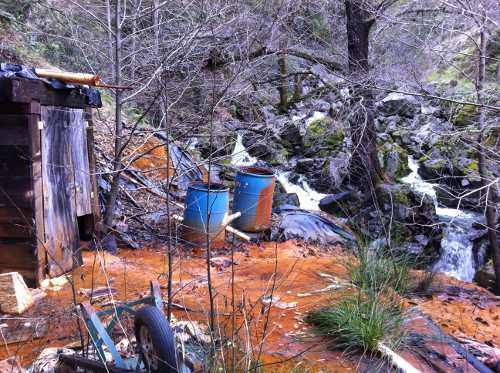
Tuleyome has been awarded a $1.4 million grant by the California Department of Fish and Game to clean up three abandoned mercury/nickel mines in the upper Putah Creek watershed during the next three years.
“We are very excited by this,” said Tuleyome Executive Director Sara Husby-Good. “It is a testament to the hard work that our Senior Policy Director Bob Schneider has done in this field. He has assembled an accomplished and talented team to make this happen. We are particularly pleased that this effort so closely aligns with our mission to protect our 'Deep Home Place.'”
“There is a role for nonprofits in the effort to restore abandon mines in our region,” said Schneider. “We can bring attention and focus to work with public officials and agencies to prioritize this need.”
The grant will be used to clean up the Twin Peaks and Corona mines, which also impact an area near Oat Hill Mine Road, Tuleyome reported.
The landowner originally purchased the property in order to donate it to the Napa County Regional Park and Open Space District as it is a key piece in Napa County's trail system plan.
However, the district found that it could not accept the property with the current mercury contamination. This project is designed to clean up the contamination.
“We are really pleased with this mine cleanup project and the great team that Tuleyome has assembled. This project is a win for the environment, the landowner, and Napa County residents,” stated Napa County Supervisor Diane Dillion.
The team includes Stephen McCord of McCord Environmental; Greg Reller, Burleson Construction, which did the work on Turkey-Abbot Run mine in Lake County and are working at the Sulphur Bank superfund mine site in Clearlake Oaks); Peter Green, UC Davis; Tom Tsukamoto, TKT Consulting; Darell Slotton, UC Davis; Craig Thomsen, UC Davis; Vic Claassen, UC Davis; and, Michael Lozeau, Lozeau Drury LLP.
Tuleyome also will work closely with an archaeological to restore and protect mine relics.
There are an estimated 40 abandoned mercury mines in both the Putah and Cache Creek watersheds that occur on both public and private lands. Clean up and restoration of these mine sites is difficult and demands persistence, collaboration and funding.
The Turkey-Abbot Run mine adjacent to Highway 20 on the southern tip of Walker Ridge is one of the best examples of a successful cleanup effort and the Bureau of Land Management intends to award the contract in August to clean up much of the Rathburn-Petray mine on Walker Ridge above Bear Valley.
The Twin Peaks and Corona mines are located on and immediately adjacent to an abandoned Oat Hill Mine Road easement held by Napa County.
The easement abandonment, which occurred about 30 years ago, includes the provision that the county may reestablish the easement at any time for public purposes.
The southern eight miles of the Oat Hill Mine Road easement, which was also abandoned in the past, was reestablished in 2007 as a nonmotorized hiking, mountain biking and horseback-riding trail.
The northern five miles of the Oat Hill Mine Road easement were not opened to public use at that time due to concerns about public health and safety related to the Twin Peaks and Corona mines.
Opening the northern five miles of the Oat Hill Mine Road to public use is one of the priority projects identified in the District’s Master Plan adopted in 2009.
For more information please contact Bob Schneider at
Follow Lake County News on Twitter at http://twitter.com/LakeCoNews, on Tumblr at www.lakeconews.tumblr.com, on Facebook at http://www.facebook.com/pages/Lake-County-News/143156775604?ref=mf and on YouTube at http://www.youtube.com/user/LakeCoNews.
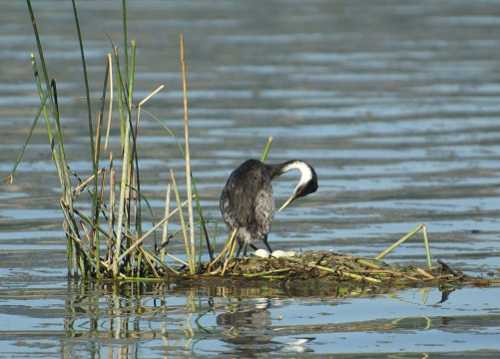
LAKE COUNTY, Calif. – The story that follows is about an unexpected adventure creating a live-action film whose stars departed while the film was in production.
The stars are Western and Clark’s Grebes, birds that breed on Clear Lake in the summer and sometimes stay here year-round.
Lake County residents love watching their courtship displays of “rushing” across the water in synchronized pairs.
Grebes form large colonies of floating nests made from tule reeds, and babies ride on the parent’s back for their first six weeks of life.
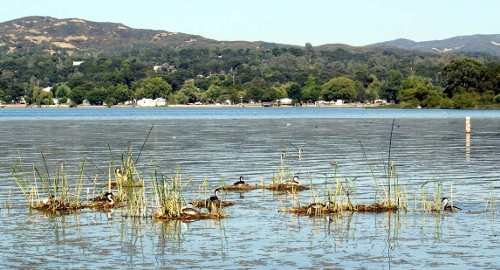
Usually the only people who get to see these very unusual bird behaviors are boaters, fishermen, people living along the lakeshore, or attendees who take the annual Heron Festival boat tours conducted by our local Redbud Audubon chapter.
During the past two weeks Redbud Audubon tried to make these sights available to anyone with Internet access, using a Webcam, which is a video camera linked to a computer and then to the Internet. Viewers anywhere in the world could then watch live action of nesting grebes at a grebe colony.
The chapter undertook this experimental Webcam as part of a public outreach grant to educate the public about the need to protect vulnerable nesting colonies during the grebe breeding cycle.
This Audubon project is in the second year of a four-year grant. Two other Audubon chapters are doing similar outreach campaigns protecting grebes on nearby lakes. Audubon California obtained the grant from the Luckenbach Trust Council.
The grebe colonies on Clear Lake are usually either in open water or secluded coves without nearby homes.

On Aug. 3 Audubon was contacted by John Deiderich about a colony of about 100 nests that happened to be close enough to a row of waterfront homes that a Webcam could view the nest areas. There had not been a colony in this location for at least 20 years.
Audubon staff approached the homeowner nearest to the nest area, and Rich Marquez agreed to allow the camera to be set up out on his second-story deck.
Audubon learned that this colony had already been nesting for three weeks, which meant that chicks could arrive within days (grebe eggs incubate 28 days). After all the chicks hatch, the grebes desert the nests and move out into the lake to feed. Thus it was urgent to get the Webcam up fast.
Over the next six days, Redbud researched and acquired the needed equipment. Invaluable guidance came from Pete DeSimone, manager of the Starr Ranch Audubon Sanctuary in Orange County. DeSimone has set up three nest-cams linked to the sanctuary’s Website – a barn owl nest, hummingbird nest, and black phoebe nest.
DeSimone loaned Redbud a camera, explained exactly what cables and software Redbud needed to buy, advised on uploading the video data with a wireless Internet card and put us in touch with a firm in Arcata that provides an interface between the uploaded data-stream and our Redbud Audubon Web site.
The streaming firm provides multiple servers so that up to 50 viewers can watch the video simultaneously without crashing the Web site.
Amazingly, the Web cam went live on Aug. 11, eight days from the starting point.
For the first few days, the camera focused on seven nests, and viewers were able to watch grebe parents taking turns sitting on the eggs, bringing food and adding to the nests with more tules nesting material.
Then beginning early last week, Audubon started seeing changes at the Webcam nests.
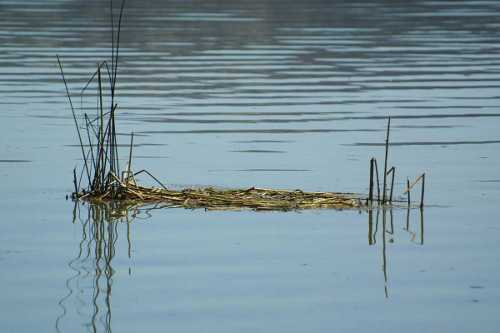
Originally there were seven nests with eggs and sitting grebes on them. Over several days, the grebes began deserting the nests, leaving the eggs unprotected.
On the afternoon of Wednesday, Aug. 17, a new pair of grebes appeared, rebuilt a deserted empty nest, deposited new eggs and began sitting on them.
When the camera was turned on Thursday morning, both the nesting grebe and the eggs were gone.
A possible explanation is that an otter family had been seen swimming in the area on Tuesday, so perhaps after the camera was turned off Wednesday night, the grebe parent deserted the eggs, and the otters found and ate the eggs.
Audubon birders have seen otters attack grebe nests in the past, so this may be a probable cause for the eggs’ disappearance.
But why did the parents desert the eggs before hatching? That question applies not just to the nests being filmed, but throughout the Clear Lake colonies this past week.
On Monday, Aug. 15, Dr. Floyd Hayes discovered that a colony of over 100 nests at Long Tule Point that he monitored last Thursday was now completely deserted. The nests were now pushed together very close to shore, most likely blown there by the winds on the lake this weekend.
Surprisingly, the nests themselves were mostly intact, many with eggs still in them, but no grebes were incubating. The eggs had been deserted by the parent grebes.
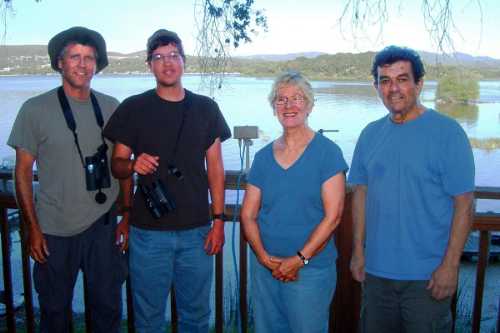
The grebe project team’s sadness and disappointment at this loss was profound. Puzzlement over the cause of this behavior led to a number of email discussions involving Terry Knight and Floyd Hayes.
The most probable explanation is that food sources for the imminent babies was insufficient to sustain them. Somehow, nature senses when this problem occurs, and the birds then do not complete the breeding cycle.
However, there may be good news to come.
Terry Knight reported that silverside minnows – a favorite food for grebes – and baby bass are becoming plentiful in the lake, and Audubon has seen a new grebe colony forming at the north end of the lake.
It is possible that the grebes will start another breeding cycle that can be completed before migration begins. Last year Audubon saw nesting up into early October, so perhaps all is not lost this year.
But for the moment at least, the Webcam is turned off because there is no activity at that colony area.
Redbud Audubon is greatly disappointed because the project team was so excited about being able to share video of newborn chicks being carried on a parent’s back while the other parent brought food to the babies.
For now, that is not going to happen. But Redbud Audubon has learned a lot from this experiment, and will try again if nesting returns to the area where the camera was located.
And, even though this Webcam had a short life, this was the first time anywhere that a nesting bird Webcam focused on grebes.
Marilyn Waits is president of the Redbud Audubon Society.
Follow Lake County News on Twitter at http://twitter.com/LakeCoNews, on Tumblr at www.lakeconews.tumblr.com, on Facebook at http://www.facebook.com/pages/Lake-County-News/143156775604?ref=mf and on YouTube at http://www.youtube.com/user/LakeCoNews.
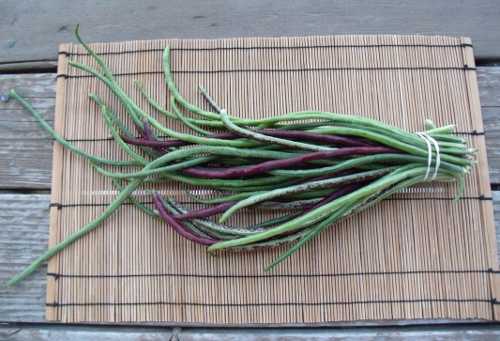
A diverse and colorful array of summer green beans now grace local farmers’ market stalls.
Slender yard-long beans mingle with almost-as-long burgundy and speckled beans.
Traditional string beans share space with Italian flat beans and mottled cranberry beans.
Yes, green beans have arrived, dressed in style, ready for your table.
Green beans are, quite literally, the green, or unripe, fruit of any kind of bean. If left on the vine, the seeds within the pods would dry and harden, becoming like the dried beans found in the pasta aisle of your local supermarket.
Green beans are also known as snap beans, no doubt because of the sound they make when snapped into shorter lengths. String bean is another moniker, although the fibrous string that once ran the length of the bean has long been bred out in most varieties.
Blue Lake green beans, considered a gourmet bean and the standard-setter for the industry, originated in Lake County. Early in the last century this bean was grown in the Blue Lakes area of Lake County as a humble canning bean.
In 1923, the variety arrived in Oregon, where much of its development has taken place. Since that time, it’s become a favorite of consumers and home gardeners.
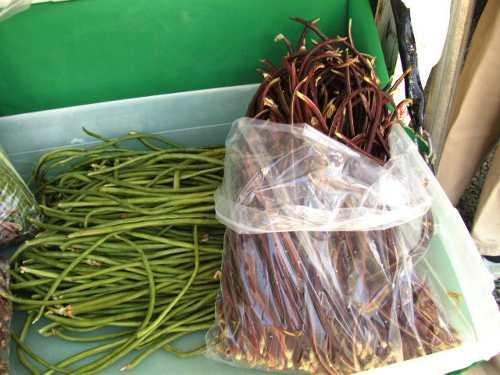
Most markets will advertise the Blue Lake name when carrying it, and recipes have been developed to match its succulent crunch and mild, sweet flavor.
I can’t help but feel a flush of pride when I consider that its roots (literal and figurative) are in our picturesque backyard.
Green beans are a true American food. American Indians grew them in a trio with corn and squash, allowing the beans to travel up the corn stalks, with the low-growing, spreading squash below.
Today’s beans are thought to have evolved from a common Peruvian ancestor, spreading throughout the Americas by migrating Indian tribes. They were brought to Europe in the 16th century by Spanish explorers returning from the New World.
Portuguese and Spanish traders introduced the bean to many other parts of the world, evidenced by the diversity in the world’s largest producers of beans, with India, France, Indonesia, Iraq and the Netherlands among them.
Beans are grown as climbing vines called pole beans or as low shrubs known as bush beans. Many varieties, including Blue Lake beans, have both options available.
When pole beans are grown in backyard gardens, a shaded spot for children or grandchildren may be fashioned by training the vines up poles set in a tipi shape. As the greenery fills in and climbs, leaves and tendrils create a naturally cool play spot.

An added bonus is that children will be tempted to snack on the fresh beans that hang into their space.
Yard-long beans, also known as Chinese long beans or asparagus beans, are a different genus than the common bean, though they look like a super extended version of the green bean. Despite its name, this variety of the cowpea is actually about half a yard long, typically measuring about one and a half feet.
They’re similar in taste to the green bean and are used in much the same way. Popular in Asian cuisine, they’re often cut into shorter lengths and added to stir-fries.
I brought home a lovely bundle of them from the farmers’ market Friday evening, mingled with beautiful burgundy-colored and speckled beans.
The yard-long beans are crisp with a fresh, mild taste, while the other two varieties have a denser texture with a flavor that includes subtle radish overtones.
Haricort verts, also known as French green beans, are a thin variety of green bean that’s crisp and tender, but can be pricey.
The extremely slender pods offer a fresh, mild taste and delicate texture. Traditional green beans cut in half lengthwise are an adequate substitute in recipes if haricort verts prove to be unavailable.
I like to serve any version of these lovely height-of-season beans fresh on my table along with other crunchy raw vegetables, like carrots, radishes and tender white turnips. They’re one of my favorite vegetables to eat raw, rating alongside such favorites as snap peas.
If cooking them, do it lightly to retain color, texture and taste. When I pan sauté green beans, I blanch them quickly in boiling water first until they’re tender-crisp and still bright green. They should then go into the sauté pan for the briefest of times, just long enough to warm through and gather the flavors in the pan.
Beans may be blanched ahead of time and then plunged into a bath of ice water to stop the cooking process. Afterwards, store them covered in the fridge until ready to sauté.
As to flavors in the pan, beans are beautiful with any combination of butter, olive oil, shallots, garlic, thyme, lemon zest and sliced or slivered almonds.

Beans are also fantastic when grilled, which gives them a smoky, caramelized flavor. Toss them in garlic and olive oil prior to grilling. Use a grilling basket if you’ve got one; otherwise, lay them down so they crisscross the grids.
Grill for seven to 10 minutes over medium-high to high heat, turning with tongs or tossing in basket as needed. Once off the heat, finish with a bit of lemon zest and some salt to taste.
Despite their rich green color, green beans provide our bodies with important colorful, health-supporting carotenoids like lutein and beta-carotene in amounts comparable to their red-toned carrot and tomato cousins.
Green beans are high in antioxidants, which contribute, among other things, to good cardiovascular health.
They’re an excellent source of free radical-scavenging vitamin C and manganese, and bone-building vitamin K, and a very good source of immune-supportive, vitamin A; heart-healthy dietary fiber, potassium, and folate; and energy-producing iron.
In addition, green beans are a good source of bone-building magnesium, calcium, phosphorus, and copper; energy-producing thiamine, riboflavin, and niacin; muscle-enhancing protein; and anti-inflammatory omega-3 fatty acids.
Green beans have also been shown to contain valuable amounts of the mineral silicon, and in a form that makes it easier for us to absorb this bone-supportive and connective tissue-supportive nutrient.
Today’s recipe is a more delicately flavored way to serve green beans than the traditional casserole with mushroom soup and fried onions. I tried it at one of my favorite annual events, the Glendi Ethnic Foods Festival in Santa Rosa, Calif., and the recipe is from a cookbook I purchased during one of my visits there.
The festival takes place every third weekend in September, rain or shine, and if you go, these beans may be found at the Serbian foods booth. Or you could try it on your table this Thanksgiving.
If calories or saturated fat is a concern, experiment with lightening up the recipe by using olive oil in place of butter and a reduced-fat sour cream.
Serbian green beans
2 pounds fresh green beans, ends trimmed and cut in 1-inch lengths
Large bowl of ice water
¼ cup bread crumbs
½ cup butter
2 cloves garlic, mashed
¼ cup chopped parsley
½ teaspoon salt
¼ teaspoon freshly ground black pepper
Cup sour cream
Preheat oven to 350 degrees F. Bring a large pot of water to boil. Add beans, return to boil and boil 3 minutes. Drain and plunge into a bowl of ice water to stop cooking.
Melt butter over medium heat in a medium skillet. Add bread crumbs and sauté until lightly browned. Stir in garlic and sauté 2 minutes, being careful not to brown. Turn off heat, add parsley, salt and pepper, and mix well.
In a large bowl, mix beans and breadcrumb mixture. Lightly grease a shallow ovenproof casserole and add beans. Spread sour cream evenly over top. Bake for 25 minutes, or until heated through.
Serves eight as a side dish.
Recipe courtesy of “Glendi Recipes,” published by St. Seraphim of Sarov Church, Santa Rosa, Calif., first edition, copyright 2008.
Esther Oertel, the “Veggie Girl,” is a culinary coach and educator and is passionate about local produce. Oertel teaches culinary classes at Chic Le Chef in Hidden Valley Lake, Calif., and The Kitchen Gallery in Lakeport, Calif., and gives private cooking lessons. She welcomes your questions and comments; e-mail her at
Follow Lake County News on Twitter at http://twitter.com/LakeCoNews, on Tumblr at www.lakeconews.tumblr.com, on Facebook at http://www.facebook.com/pages/Lake-County-News/143156775604?ref=mf and on YouTube at http://www.youtube.com/user/LakeCoNews.