 How to resolve AdBlock issue?
News
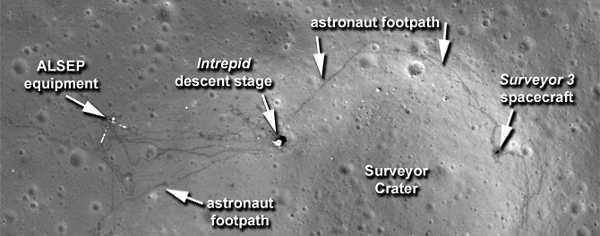
NASA's Lunar Reconnaissance Orbiter has captured the sharpest images ever taken from space of the Apollo 12, 14 and 17 landing sites.
Images show the twists and turns of the paths made when the astronauts explored the lunar surface.
At the Apollo 17 site, the tracks laid down by the lunar rover are clearly visible, along with the last foot trails left on the moon. The images also show where the astronauts placed some of the scientific instruments that provided the first insight into the moon's environment and interior.
“We can retrace the astronauts' steps with greater clarity to see where they took lunar samples,” said Noah Petro, a lunar geologist at NASA's Goddard Space Flight Center in Greenbelt, Md., who is a member of the LRO project science team.
All three images show distinct trails left in the moon's thin soil when the astronauts exited the lunar modules and explored on foot. In the Apollo 17 image, the foot trails, including the last path made on the moon by humans, are easily distinguished from the dual tracks left by the lunar rover, which remains parked east of the lander.

“The new low-altitude Narrow Angle Camera images sharpen our view of the moon's surface,” said Arizona State University researcher Mark Robinson, principal investigator for the Lunar Reconnaissance Orbiter Camera. “A great example is the sharpness of the rover tracks at the Apollo 17 site. In previous images the rover tracks were visible, but now they are sharp parallel lines on the surface.”
At each site, trails also run to the west of the landers, where the astronauts placed the Apollo Lunar Surface Experiments Package to monitor the moon's environment and interior.
This equipment was a key part of every Apollo mission. It provided the first insights into the moon's internal structure, measurements of the lunar surface pressure and the composition of its atmosphere. Apollo 11 carried a simpler version of the science package.
One of the details that shows up is a bright L-shape in the Apollo 12 image. It marks the locations of cables running from the Apollo Lunar Surface Experiments Package's central station to two of its instruments. Although the cables are much too small for direct viewing, they show up because they reflect light very well.
The higher resolution of these images is possible because of adjustments made to LRO's orbit, which is slightly oval-shaped or elliptical.
“Without changing the average altitude, we made the orbit more elliptical, so the lowest part of the orbit is on the sunlit side of the moon,” said Goddard's John Keller, deputy LRO project scientist. “This put LRO in a perfect position to take these new pictures of the surface.”
The maneuver lowered LRO from its usual altitude of approximately 31 miles (50 kilometers) to an altitude that dipped as low as nearly 13 miles (21 kilometers) as it passed over the moon's surface. The spacecraft has remained in this orbit for 28 days, long enough for the moon to completely rotate. This allows full coverage of the surface by LROC's Wide Angle Camera. The cycle ended Tuesday when the spacecraft returned to its 31-mile orbit.
“These images remind us of our fantastic Apollo history and beckon us to continue to move forward in exploration of our solar system,” said Jim Green, director of the Planetary Science Division at NASA Headquarters in Washington.
LRO was built and managed by Goddard. Initial research was funded by the Exploration Systems Mission Directorate at NASA Headquarters. In September 2010, after a one-year successful exploration mission, the mission turned its attention from exploration objectives to scientific research in NASA's Science Mission Directorate.
Follow Lake County News on Twitter at http://twitter.com/LakeCoNews, on Tumblr at www.lakeconews.tumblr.com, on Facebook at http://www.facebook.com/pages/Lake-County-News/143156775604?ref=mf and on YouTube at http://www.youtube.com/user/LakeCoNews.

On Tuesday Assemblyman Wesley Chesbro (D-Arcata) strongly criticized the proposed new fire fee on homeowners in State Responsibility Areas.
Rural homeowners in a SRA would be required to pay $175 for their homes, plus extra fees on other structures, in addition to a fee based on the acreage of land, which could add up to $3,000 per year for some cattle ranchers and other resource land owners, according to Chesbro's office.
In a letter to Assembly Budget Committee Chairman Bob Blumenfield, Chesbro called the fees “grossly inequitable to rural residents.”
“As a member who represents large areas of Sate Responsibility Areas, these bills would be economically devastating to many of the constituents I represent,” Chesbro said. “I find it inequitable to charge someone who inhabits a one-room cabin or mobile home on the North Coast the same fee that would be charged to someone living in a million dollar home in the Southern California hills.”
Chesbro will voice his opposition and encourage his colleagues to vote against the legislation at Tuesday's Assembly Budget Committee hearing at the state Capitol.
The hearing time and location is yet to be announced, but Chesbro's office said it likely will be held upon adjournment of the Assembly Floor session on Wednesday. His office said the hearing may be available on www.calchannel.com or www.assembly.ca.gov.
Follow Lake County News on Twitter at http://twitter.com/LakeCoNews, on Tumblr at www.lakeconews.tumblr.com, on Facebook at http://www.facebook.com/pages/Lake-County-News/143156775604?ref=mf and on YouTube at http://www.youtube.com/user/LakeCoNews.

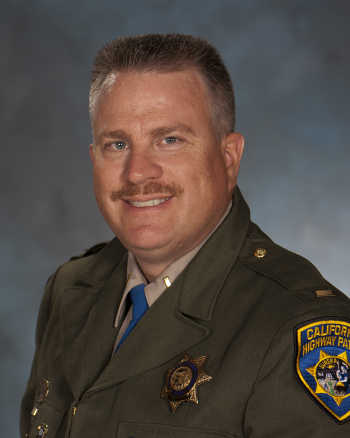
KELSEYVILLE, Calif. – The local California Highway Patrol office has welcomed a new commander, who brings with him an extensive law enforcement background and roots on the North Coast.
Lt. Greg Baarts took over the leadership of the CHP's Clear Lake Area office in May, with his appointment becoming official at the start of July.
The 43-year-old North Coast native and father of three succeeds Lt. Mark Loveless, who accepted a commander position in the Trinity River area, 45 minutes from Redding.
Baarts said his emphasis is keeping local roadways safe and drivers informed, which he hopes will lead to a reduced number of collisions and driving under the influence cases.
“Our job is to save lives,” he said.
Baarts, who has been in law enforcement for 20 years, is a second-generation law enforcement professional.
His father, Mert Baarts, was a 32-year veteran of the CHP, serving as a commander at the CHP's Garberville and Humboldt offices. The senior Baarts worked with Steve Davis and Jerry Mills, now-retired Clear Lake commanders, as well as two current Clear Lake area officers, Sgt. Bill Holcomb and Officer Kory Reynolds.
“It's a small world,” said the new commander.
Baarts' sister is a retired CHP sergeant and his brother is a sergeant with the Ukiah Police Department.
After serving in the military Greg Baarts decided to get into law enforcement, but he said he wasn't sure at first that he wanted to be in the CHP due to its focus on traffic.
He began his law enforcement career as a deputy in the Humboldt County Sheriff's Office. Baarts later served for six and a half years at the Ukiah Police Department, where he worked as a detective and was a drug task force member. He also did a stint with the Mendocino County District Attorney's Office as an investigator.
Eventually, he decided that the CHP was really where he wanted to be. “When I joined the highway patrol I had a lot of prior experience,” he said.
He said the CHP offers its employees the chance to go anywhere in the state, fly airplanes and helicopters or do motorcycle patrol. They also have the opportunity to undertake plain clothes assignments, such as protective details for the governor and other dignitaries; work as an auto theft investigator; or be a drug task force agent.
“It's a very highly respected agency and it's a very professional agency, and that's what attracted me to the highway patrol,” he said.
In 1998 he entered the CHP Academy. The agency doesn't allow lateral transfers from other agencies, so Baarts – at age 30, with wife Teresa and two small children at home – found himself back at school for the 27-week academy.
“It's pretty brutal,” he said of the academy. Although he was in the Army and was an infantryman, “It was harder than that.”
But he passed, and his first assignment was central Los Angeles. “It's a training ground,” he said of the busy Southern California area.
It took him two years to be able to return to the North Coast, when he received an assignment in the Clear Lake office. He was in Lake County from 2000 to 2001 before he was transferred to Ukiah. He promoted to sergeant and was assigned to the Crescent City Area for one year.
From there he spent six and a half years in Garberville before he got the opportunity to promote to lieutenant and return to lead the Clear Lake Area office.
In his new job he'll oversee an office that currently has 21 officers – 25 are budgeted, with four so far unfilled – as well as three sergeants, three clerical staff and one auto technician.
The office continues to pursue grants – like the Five Alive grant that runs out later this month – to reduce drunk driving crashes and motorcycle related crashes. The office's grant writer, Sgt. Dave Stark,
has been successful at bringing grants to the office that help buff up their resources.
Baarts said the Clear Lake office is unique because it has many officers who have been there for a long time, and have roots in the community and a stake in keeping Lake County safe.
“Everybody that's here wants to be here,” Baarts said.
The local office also has a lot of depth both in experience and investigative skills, with Baarts pointing to the office's many talented officers.
While much of Baarts' time will be spent running the office and handling administrative duties, “I try to get out as much as I can” to stay proficient at working the road and keeping his officer backed up. As
such, he worked a recent DUI checkpoint.
One challenge Baarts will have to face is the state budget, which makes an already challenging job harder.
“We're feeling the pain like everyone else but we're getting by,” he said. “If it gets worse I'm not sure what's going to happen.”
Baarts, who has been married for 18 years, has a 17-year-old daughter, a 15-year-old son and a 7-year-old son. He coaches football, and enjoys fishing and camping with his family.
He said he plans to stay in the area for a while, and wants to be actively involved with the community.
“I'm perfectly happy being here,” he said. “This is home for me.”
E-mail Elizabeth Larson at

LAKE COUNTY, Calif. – A local family is asking for the community's help in locating a teenage boy who ran away over the weekend.
Austin Cone, 16, was reported to have run away from his foster home in Kelseyville on Saturday morning, according to his stepmother, Nicole Reimers of Cobb.
Reimers said she contacted the Lake County Sheriff's Office, which issued a “be on the lookout” for the boy.
He is suspected to be in Lakeport with a friend, Reimers said.
His Facebook page showed evidence of updates from him after he ran away on Saturday.
The teenager is described as a white male with blue eyes and reddish-blond hair that is extremely curly. He is 5 feet, 6 inches tall, and weighs 130 pounds.
Reimers said she does not know what clothing he was wearing when he ran away Saturday morning.
She is asking anyone who sees the teen to contact the Lake County Sheriff's Office. Reimers said he may be violent if confronted.
The Lake County Sheriff's Office can be reached at 707-262-4200.
Follow Lake County News on Twitter at http://twitter.com/LakeCoNews, on Tumblr at www.lakeconews.tumblr.com, on Facebook at http://www.facebook.com/pages/Lake-County-News/143156775604?ref=mf and on YouTube at http://www.youtube.com/user/LakeCoNews.
Acting Caltrans Director Malcolm Dougherty told members of the California Congressional Delegation that, without an extension or reauthorization, the department will be unable to continue existing transportation projects across the state.
In the Aug. 29 letter, Dougherty said that thousands of active state and local transportation projects – valued at $23 billion – would grind to a halt within weeks of the end of the federal fiscal year on Sept. 30 without action by Congress to extend the funding.
Matt Rocco, a Caltrans spokesperson, told Lake County News that local projects that could be delayed due to not having the funding are the paving on Highways 29 and 175, the rehabilitation of Highway 53 – which includes a traffic signal at Olympic Drive in Clearlake – and an in-place recycling of pavement on Highway 20 west of Highway 53.
The current surface transportation legislation, the Safe, Accountable, Flexible, and Efficient Transportation Equity Act: A Legacy for Users (SAFETEA-LU), expired in 2009, Caltrans reported.
Congress has extended the act seven times, but the latest extension expires on Sept. 30, according to Caltrans.
The federal government currently provides about $3.4 billion per year for transportation projects across the state.
To read the Acting Director's letter to the California Congressional Delegation, see below or visit www.dot.ca.gov/docs/CaltransDirectortoCalCongress_29August2011_FINAL.pdf.
Follow Lake County News on Twitter at http://twitter.com/LakeCoNews, on Tumblr at www.lakeconews.tumblr.com, on Facebook at http://www.facebook.com/pages/Lake-County-News/143156775604?ref=mf and on YouTube at http://www.youtube.com/user/LakeCoNews.
Education
Health
Business
Obituaries
Veterans
Recreation
Religion
Arts & Life
Government & Politics