 How to resolve AdBlock issue?
News
The National Weather Service issued another wind advisory for Lake County that will be in effect until 6 p.m. Saturday.
Forecasters said northeast winds of 20 to 35 miles per hour with gusts of wind up to 45 miles per hour will be possible. It’s expected to be the windiest during the day on Saturday.
Lake County also is under a hazardous weather outlook for winds and lower temperatures.
The National Weather Service is predicting daytime temperatures in the high 50s and nighttime temperatures in the mid to high 30s into the first part of next week, with nighttime temperatures dipping into the low 30s in the week’s latter half.
The winds that have hit California over the past week have left hundreds of thousands of utility customers without power at various times, including a small number in Lake County, according to Pacific Gas & Electric.
By Friday afternoon PG&E said it had restored power to 90 percent of the 500,000 customers in Northern and Central California impacted by the outages.
However, the company’s last update on Friday said 51,000 of its customers still were without power, mainly in the Chico, Santa Cruz and Fresno areas.
PG&E reported late Friday that as many as 49 customers in the Nice area were impacted by an outage that had started shortly before 5 p.m.
The outage was expected to be resolved by 10 a.m. Saturday once a transformer is replaced, PG&E said.
E-mail Elizabeth Larson at
The CHP said the crash occurred shortly before 3 p.m. on Phillips at 18th avenues in Clearlake.
Children were on the Konocti Unified School District school bus, and although the CHP reported that the children were very shaken up, they were otherwise unhurt.
The CHP – which oversees testing and certifications for all local school bus drivers – were called to the scene to investigate.
The Konocti Unified School District did not return a call late Friday afternoon for more information about the incident or the damage to the bus.
Follow Lake County News on Twitter at http://twitter.com/LakeCoNews, on Tumblr at www.lakeconews.tumblr.com, on Facebook at www.facebook.com/pages/Lake-County-News/143156775604?ref=mf and on YouTube at www.youtube.com/user/LakeCoNews .
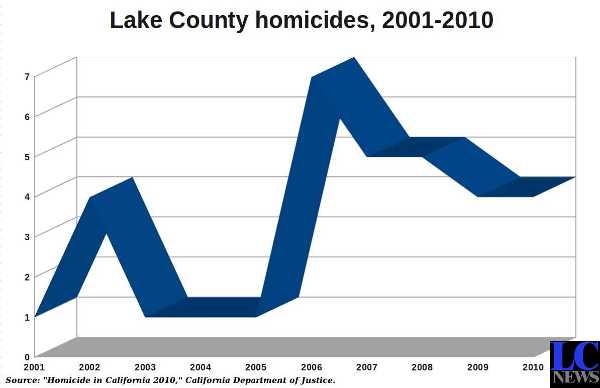
SACRAMENTO – The California Department of Justice on Friday released the annual “Homicide in California 2010” report showing the rate of homicide crimes per 100,000 in population decreased 7.8 percent from 2009.
The total number of homicides declined from 1,970 in 2009 to 1,809 in 2010, the report showed.
In Lake County, the homicide rate remained flat in 2010, at four, the same as in 2009, according to the report. The peak year in the last decade for homicides was 2006, when there were seven in Lake County.
The homicide clearance rate, or percentage of reported crimes that have been solved, has increased for the fifth consecutive year. This year's rate of 63.8 percent is the highest since 2001.
The “Homicide in California 2010” report details information about the crime of homicide and its victims, demographic data on persons arrested for homicide, and information about the response of the criminal justice system.
Also included is information on the death penalty, the number of peace officers killed in the line of duty and justifiable homicides.
Among the highlights:
80.3 percent of homicide victims were male, 19.7 percent were female.
44.5 percent of homicide victims were Hispanic, 29.6 percent were black, 18.2 percent were white, and 7.4 percent were categorized as “other.”
Females were more likely to be killed in their residence, while males were more likely to be killed on streets or sidewalks.
When the victim-offender relationship was identified, 44.4 percent (the largest proportion) involved victims who were killed by friends or acquaintances. However a greater percentage of black victims were killed by strangers than were white or Hispanic victims (47.7 vs. 25.4 and 35.4, respectively).
Of homicides where the weapon was identified, the majority (71.2 percent) involved a firearm.
Of the homicides where the contributing circumstances were known, 36.1 percent were gang-related.
By the end of 2010, there were 709 persons under sentence of death in California. Of these, 34 were sentenced in 2010, 10 of which were in Los Angeles County.
Four California peace officers were feloniously killed in the line of duty in 2010.
The full report can be seen below.
Follow Lake County News on Twitter at http://twitter.com/LakeCoNews, on Tumblr at www.lakeconews.tumblr.com, on Facebook at www.facebook.com/pages/Lake-County-News/143156775604?ref=mf and on YouTube at www.youtube.com/user/LakeCoNews .
The suit was filed by Charles Nichols, president of CaliforniaRightToCarry.org. Nichols filed the suit as an individual; CaliforniaRightToCarry.org is not a plaintiff in this case.
Nichols’ suit names California Gov. Edmund G. Brown Jr., California Attorney General Kamala Harris, the city of Redondo Beach, its police department and police chief.
The defendants have until Dec. 14 to waive service of summons. Those who do not will be served the following day which coincides with the 220th Anniversary of the Second Amendment and the Bill of Rights.
In 1967, the California Legislature made it a crime to openly carry a loaded firearm in most public places in California. Nichols argues that the action was a “knee-jerk reaction” to the activities of the Black Panther Party, which included a band of its members marching into the California State Capitol building openly carrying loaded firearms.
One of the Penal Code sections enacted as a result was California Penal Code section 12031 which makes it a crime to openly carry a loaded firearm in incorporated cities and areas of a county where the discharge of firearms is prohibited.
The opinion of then-Attorney General Thomas C. Lynch was that “... it remains clear that the Legislature did not direct the provisions of section 12031 against all uses of firearms but only at uses of firearms which are inimical to the peace and safety of the people of California.”
Then-Gov. Ronald Reagan was adamant that the legislation not apply to openly carrying loaded firearms through town for peaceful purposes such as hunting.
The lawsuit was intended to disarm the members of the Black Panther Party. Since then, it has been applied to persons which the statute itself exempts such as hunters and persons with loaded firearms inside of mobile residences.
This year, Gov. Brown signed Assembly Bill AB 144 into law, which makes it a crime to openly carry an unloaded handgun as well. That law goes into effect on Jan. 1, 2012.
Nichols argues that, as a result, California has banned a complete class of weapons commonly used for the purpose of self-defense from being openly carried in public. Only unloaded rifles and shotguns may be openly carried after the new year.
The case number is CV-11-9916 SJO (SS). The case has been assigned to Federal Judge S. James Otero.
Funds for the lawsuit are being raised by open carry advocates across the state, including California Right To Carry, Riverside Open Carry Club, Inland Empire Open Carry, California Carry, The2A, Orange County Open Carry, OpenCarryClub.com, Bay Area Open Carry Movement and California Open Carry Movement.
Follow Lake County News on Twitter at http://twitter.com/LakeCoNews, on Tumblr at www.lakeconews.tumblr.com, on Facebook at www.facebook.com/pages/Lake-County-News/143156775604?ref=mf and on YouTube at www.youtube.com/user/LakeCoNews .
Anthony Guidry Sr., also known as “Ant,” 46, of Vallejo, was sentenced on Friday to 220 months in prison, followed by five years of supervised release, for leading a nationwide conspiracy to distribute California-grown marijuana via the mail and common carriers to distribution outlets in approximately a dozen states across the country, including Virginia, according to the US Attorney’s Office.
Neil H. MacBride, United States Attorney for the Eastern District of Virginia; James W. McJunkin, Assistant Director in Charge of the FBI’s Washington Field Office; Daniel Cortez, Inspector in Charge of the Washington Division of the United States Postal Inspection Service; Earl Cook, Alexandria Chief of Police; and Colonel David Rohrer, Fairfax County Chief of Police, made the announcement after sentencing by United States District Judge Leonie M. Brinkema.
“Mr. Guidry led an extensive, nationwide marijuana distribution ring that targeted young markets, especially college campuses,” said MacBride. “He told conspirators that getting caught with marijuana means nothing but a slap on the wrist. Today, he was slapped with an 18-year tour in prison. We are committed to going after traffickers that make millions while placing young people at risk to this dangerous, addictive gateway drug.”
“The FBI continues to work with our law enforcement partners to eradicate drug traffickers who penetrate our communities and ply their illegal trade in our neighborhoods,” said McJunkin.
“This investigation once again puts those who choose to use the U.S. Mail to distribute marijuana or any other illegal narcotics on notice that they will not just get a slap on the wrist. They will be prosecuted to the fullest for their criminal activity,” said Cortez.
Guidry was among 19 individuals charged in June of this year for their involvement in the conspiracy to distribute 100 kilograms or more of marijuana. To date, 18 of those individuals have pleaded guilty, the US Attorney’s Office reported.
According to court documents, Guidry was the ringleader of a nationwide conspiracy to distribute premium California-grown marijuana to high-demand markets across the country.
Guidry focused on extending his enterprise as far as possible, recruiting distributors to help open distribution centers in cities and college campuses in states including Virginia, Georgia, Colorado, Kansas, Missouri, Texas, Louisiana, Florida, New York, New Jersey, and Pennsylvania.
He and several co-conspirators possessed firearms and used threats of violence to further and protect their criminal enterprise.
Over the course of several years, Guidry managed and controlled the distribution of marijuana by co-conspirators. The investigation showed they were able to obtain wholesale amounts of the drug for as little as $1,200 a pound, which they then resold at the retail level for as much as $5,000 per pound.
Members of the conspiracy, including Guidry, controlled numerous bank accounts through which proceeds from marijuana sales were laundered, as well as used couriers to fly around the country to pick up bulk cash payments and return them to California. Investigators conservatively estimate that the conspiracy generated more than $3 million in proceeds.
The arrests of these 19 individuals were a result of an ongoing Organized Crime Drug Enforcement Task Force investigation being conducted by the FBI Washington Field Office, the U.S. Postal Inspection Service, and the Alexandria and Fairfax County police departments. Assistant United States Attorneys Lisa Owings and Sean P. Tonolli are prosecuting the case on behalf of the United States.
Follow Lake County News on Twitter at http://twitter.com/LakeCoNews, on Tumblr at www.lakeconews.tumblr.com, on Facebook at www.facebook.com/pages/Lake-County-News/143156775604?ref=mf and on YouTube at www.youtube.com/user/LakeCoNews .
They are "sold" on that approach, but is it the right decision under present law?
Transferring ownership on the remote chance of receiving Medi-Cal is usually ill advised.
What if one never receives Medi-Cal and one's home is lost? Questions to first ask include: Should I transfer my house, if so when; to whom should I transfer my house; and how should I transfer my house?
Only assets in which a Medi-Cal recipient had some ownership at death are subject to recovery claims.
While one's principle residence is exempt for purposes of determining Medi-Cal eligibility, it is subject to Medi-Cal estate recovery after the Medi-Cal recipient and spouse die. Transferring such residence before death prevents future Medi-Cal recovery.
That said, anyone who expects to receive Medi-Cal soon and wishes to protect their residence should examine their options. One should act while they still have legal capacity to sign a deed. Many hedge their bets by using instructions in their power of attorney and living trust that authorize gifting.
Then there are income tax considerations. Gifting means that all appreciation in the home's value since it was originally purchased may be taxed to the beneficiary when they later sell the home.
If the property were inherited at the owner's death, rather than gifted during lifetime, then any appreciation in the owner's hands is eliminated from income taxation because the death beneficiary gets a so-called "stepped-up" basis for inherited assets.
For example, if someone purchased his home in 1980 for $75,000 and it is worth $175,000 at his death, then when the child who inherits avoids income tax on the $100,000 appreciation when he sells.
Gifting entails transferring ownership. Married persons typically transfer their residence to their spouse; if they are incompetent, then a court order is needed unless legal authority for gifting is already in place.
When children from prior relationships exist, concerns over disinheritance by a step-parent arise. In such case, the home may instead be instead left to their own children subject to a life estate, or right of occupancy, favoring their spouse.
The gift to one's children can either be through a deed to the children, as (equal or unequal) tenants in common, or through a transfer in to a trust for their benefit. Either approach can also be combined with a retained life estate that allows the transferor to continue to live in (or rent) the residence until they die, and for their beneficiaries to receive a "stepped-up" basis at their death.
An irrevocable trust can serve multiple purposes. Like a reserved life estate, it can protect the donor's right to live at home.
In addition, a trust can further allow for the home to be sold and for a new home to be purchased while the donor is alive, and/or for the sale proceeds to go to other beneficiaries, either immediately or over time.
It can also retain and protect the assets of the beneficiaries from their creditors. Again, a
life estate can be used to get a "stepped-up" basis.
Currently, an irrevocable trust is often unnecessary. One can either transfer the home with a reserved life estate or sell the home and gift the proceeds over time ("stacked gifting") without creating any ineligibility period.
Gifting all the proceeds as a lump sum within the present 30 month look-back period, however, creates an ineligibility period.
Eventually, when California implements the 2006 Federal DRA changes all gifting will create an ineligibility period. For now flexibility exists.
Lastly, consult a qualified attorney before proceeding.
Dennis A. Fordham, attorney (LL.M. tax studies), is a State Bar Certified Specialist in Estate Planning, Probate and Trust Law. His office is at 55 First St., Lakeport, California. Dennis can be reached by e-mail at
Follow Lake County News on Twitter at http://twitter.com/LakeCoNews, on Tumblr at www.lakeconews.tumblr.com, on Facebook at www.facebook.com/pages/Lake-County-News/143156775604?ref=mf and on YouTube at www.youtube.com/user/LakeCoNews .