How to resolve AdBlock issue?
Refresh this page
How to resolve AdBlock issue?
Refresh this page
Lake County News,California
  • Home
    • Registration Form
  • News
    • Education
    • Veterans
    • Community
      • Obituaries
      • Letters
      • Commentary
    • Police Logs
    • Business
    • Recreation
    • Health
    • Religion
    • Legals
    • Arts & Life
    • Regional
  • Calendar
  • Contact us
    • FAQs
    • Phones, E-Mail
    • Subscribe
  • Advertise Here
  • Login

News

Space News: The Hubble telescope has shifted into one-gyro mode after months of technical issues − an aerospace engineering expert explains


The Hubble Space Telescope is nearing its 35th birthday. NASA via AP

Imagine keeping a laser beam trained on a dime that’s 200 miles away. Now imagine doing that continuously for 24 hours, while riding a merry-go-round. Seem difficult? Well, that’s basically what the Hubble Space Telescope does.

After months of technical issues, NASA announced June 4 that Hubble would shift into one-gyroscope mode. This essentially means that the telescope will have to rely on just one of the several gyroscopes – devices that measure an object’s orientation in space – it normally uses to track and follow objects in space.

Named after astronomer Edwin Hubble, the Hubble telescope launched in 1990 into low Earth orbit. Here, it’s above Earth’s atmosphere, which interferes with the observations from Earth-based telescopes. During its three decades of operation, it has provided us with stunning pictures of distant galaxies and allowed scientists to look closer to the beginning of the universe.

Hubble takes clear, high-resolution pictures of stars billions of light years away. To collect enough photons – light “particles” – for a high-quality picture, it essentially acts as a very low-speed camera. It keeps its aperture – that is, the opening in the lens that lets light pass through – open for up to 24 hours to take a single picture.

Anyone who has taken a photo at a low shutter speed knows how difficult it is to avoid ending up with a blurry image. Hubble takes this to an extreme. It needs to stay pointed at the same distant point in space with an accuracy within a few milliarcseconds – where one milliarcsecond equals one 3,600,000th of a degree – for up to 24 hours. And it needs to keep this accuracy while orbiting the Earth at 17,000 miles per hour (27,000 kilometers per hour) through extreme heat and cold.

To keep track of its target and generate clear pictures, Hubble uses what aerospace engineers like me call attitude control systems. All spacecraft and aircraft have an attitude control system to help them point in the right direction.

What’s a gyro, anyway?

An attitude control system consists of a suite of sensors measuring the orientation of the spacecraft, a set of actuators – thrusters, reaction wheels or control moment gyroscopes – that move the spacecraft around, and a flight computer. The flight computer takes the measurements from the sensors and generates the commands for the actuators.

A diagram of the Hubble, showing three boxes labeled gyros, three labeled fine guidance sensors and two labeled reaction wheels in its interior.
The gyros work in tandem with fine guidance sensors and reaction wheels to control the telescope’s orientation in space. NASA/STSci

A gyroscope is a device that measures an object’s attitude, or orientation in space. In other words, it measures how much the object has rotated from some fixed point. For Hubble to know where it’s pointing to take a picture, it has to know where it is in space. It needs at least three gyros – one per axis.

Hubble initially had six gyros: three main ones and three more as extras. But after more than 30 years in orbit, four of the gyros have failed from complications related to aging.

From the two remaining gyros, NASA has reserved one as a backup, so Hubble is now operating with a single gyro. But if you need at least three gyros – one per axis – to know where you are, how can Hubble figure out where it is with only one gyro?

One of Hubble’s gyroscopes.

The clever answer that NASA engineers came up with is actually very simple. You can use other sensors on the telescope, such as magnetometers and star sensors, to make up for the lack of gyros.

Gyro stand-ins

Magnetometers measure Earth’s local magnetic field, which scientists understand pretty accurately. You can use the magnetometers to get a rough idea of the attitude with respect to the known magnetic field direction, pretty much the same way you use a compass. A three-axis magnetometer can take measurements of the strength and direction of the Earth’s magnetic field as the satellite moves along its orbit to find its orientation in space.

Or you can use star trackers or sun sensors, which are much more accurate than magnetometers. These sensors use a map of the sky and align what they see with what’s on the map to figure out where they are pointing.

By combining the star trackers, sun sensors, magnetometers and a single gyro, Hubble can maintain a pointing accuracy that is very close to the three-gyro configuration – although the one-gyro configuration will limit how fast Hubble can track objects in space.

Hubble has one of the most accurate pointing attitude control systems ever built, and it has provided people with stunning pictures of the early universe. But losing all but two gyros is just another reminder that Hubble’s days are numbered.

Hubble’s successor, the James Webb Space Telescope, launched on Dec. 25, 2021. It is stationed 1,000,000 miles (1,609,344 km) away from Earth at what is called the second Lagrange point (L2).

At this point, the telescope, the Earth and the Sun are always aligned, and the telescope’s protective sun shield blocks the Sun’s rays. This feature allows its infrared camera to operate at chilly temperatures to provide much better-quality pictures.

While the long-enduring Hubble’s discoveries opened the universe to astronomers, Webb will allow us to look deeper into the cosmos than ever before.The Conversation

Panagiotis Tsiotras, Professor of Aerospace Engineering, Georgia Institute of Technology

This article is republished from The Conversation under a Creative Commons license. Read the original article.
State Parks signs agreement with Big Valley tribe for Clear Lake State Park use, collaboration

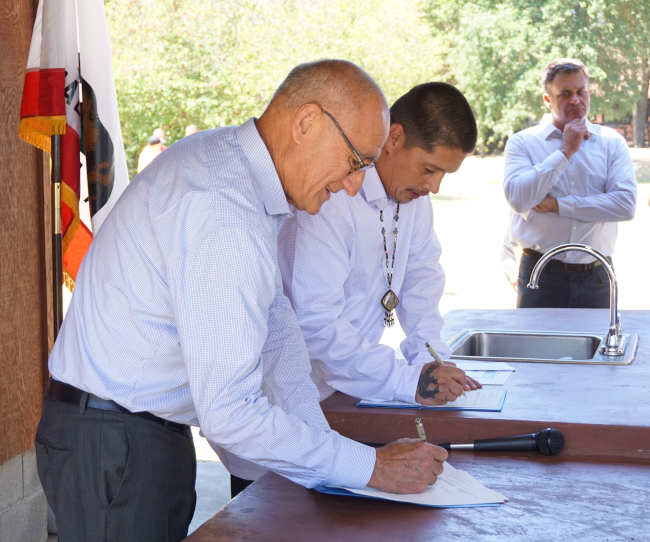
From right, State Parks Director Armando Quintero and Big Valley Tribal Chair Flaman McCloud Jr. sign a memorandum of understanding between State Parks and the tribe as Matt Teague, Northern Buttes District superintendent, looks on during a special event on Friday, June 21, 2024, at Clear Lake State Park in Kelseyville, California. Photo by Elizabeth Larson/Lake County News.

KELSEYVILLE, Calif. — California State Parks officials gathered with members of the Big Valley Band of Pomo Indians on Friday to celebrate a new collaborative agreement meant to support greater use of the park by the tribe, whose leaders said it is part of their original homeland.

The event at the park’s pavilion featured prayers by tribal elders and the signing of a memorandum of understanding, or MOU, which State Parks Director Armando Quintero said formalizes the relationship between the state and Big Valley.

The MOU State Parks signed with Big Valley on Friday is the 12th such agreement the state has entered into with a tribe. Quintero said the agreements vary from tribe to tribe.

The first tribal MOU was between State Parks and the Koi Nation of Northern California. That agreement, signed in April 2017, was for the purpose of collaboration and cooperation, and protecting cultural and natural resources in Anderson Marsh State Historic Park in Lower Lake.

That five-year MOU was renewed on Aug. 30 during a signing ceremony in which Lewis Ridge — reportedly named for Lewis’s woodpeckers that, in turn, are named after explorer Meriwether Lewis — was renamed Mxqawlay’ba Knowin Xyoykith Ridge, which translates to “the grandmothers/ancestors heal on this mountain,” in Southeastern Pomo.

At that time, McVicar Trail — named for a property donor — was renamed Dawa Qanoq’ana, which translates into “south way in front of me.”

Those renaming actions are part of the State Parks Reexamining our Past Initiative, which the agency said “seeks to remove derogatory and inaccurate names and materials from the State Park System while restoring native names and other significant aspects of California's cultural heritage.”

In the case of Clear Lake State Park, State Parks officials said the Big Valley tribe will contribute information on interpretation and resources, and will collaborate on actions around planning.

The MOU also will streamline communications and be a foundational document for care and stewardship.

The 590-acre park on the shore of Clear Lake was founded in 1949. It remains a popular and busy park year-round.

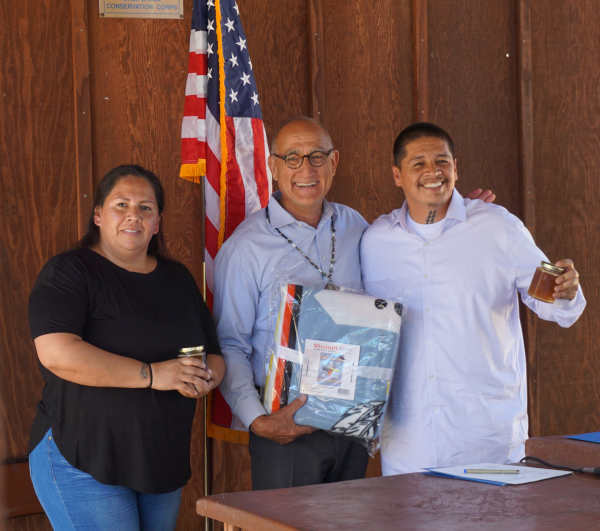
From left, Big Valley Tribal Secretary Vivian McCloud, State Parks Director Armando Quintero and Big Valley Tribal Chair Flaman McCloud Jr. celebrate during a signing ceremony for the agreement between California State Parks and Big Valley Band of Pomo Indians on Friday, June 21, 2024, at Clear Lake State Park in Kelseyville, California. Photo by Elizabeth Larson/Lake County News.

A momentous time for the tribe

Big Valley Tribal Chair Flaman McCloud Jr. offered a prayer at the start of the ceremony. He credited Philip Gomez, his predecessor as tribal chair, for helping start the process to establish the agreement with State Parks. Gomez died in February.

McCloud also welcomed a big group of runners taking part in the 500 Mile American Indian Spirit Marathon, who stop each year at the rancheria and decided to stop in at the ceremony.

“This is a momentous time for our tribe,” said McCloud, explaining their ancestral connection to the land. “This is where our people came from.”

He added, “The goal is to have this as ours,” not a part but the whole thing.

McCloud said they can talk about suffering, but they also have many blessings.

He thanked State Parks staff for working with the tribe to make the agreement happen.

Quintero, who along with McCloud signed the agreement at the event, recognized his own Indigenous heritage, tracing back to the Huichol people of central Mexico.

For Quintero, the event was particularly meaningful since it fell on the longest day of the year, which he said is a pause between the old year and the new one. “For me there is a sense of power and presence.”

He said it’s much more than an agreement. It allows for the tribe to practice ceremonies and gather plants and other materials for their use.

“These are your lands,” he told tribal members.

Tribal Secretary Vivian McCloud, Flaman McCloud’s sister, also credited the previous council — including Gomez — with starting the work that led to the agreement.

She said the tribe is looking forward to the future, and she thanked State Parks for sitting at the table with them.

“There’s so many things to be thankful for when it comes to Big Valley,” she said.

McCloud said she was humbled to be there. “It is an honorable place to be,” adding, “What a day in history, right?”

She said there are a lot of good things happening for the tribe, including the upcoming Tule Boat Festival in July.

The tribe, she said, is a good community partner that stands firm on tribal sovereignty. They have to speak for their ancestors and think about the seven generations to come when making decisions. “It’s not just about now.”

Brian Walsh, the State Parks archaeologist and district tribal liaison, said the agency received its first request from the tribe to work on an agreement in October 2021 and held the first meeting the following month.

After the ceremony, Quintero told Lake County News that the agreement gives full access to the park to tribal members for gathering of plants and minerals. They also will collaborate with State Parks in a full partnership to protect cultural sites.

The agreement also will facilitate the return of ceremonies within the park lands.

“Our charge is to protect cultural and natural history,” Quintero said.

He said it’s important to tell the truth about the history of the tribes.

Quintero referred to the changes at Sutter's Fort State Historic Park, where the master plan has been rewritten to represent the tribes. Now, no improvements at the site can involve putting materials into the ground because the fort was built on top of a village.

“It gives me a very powerful sense of pause,” Quintero said of including tribal history in the planning and understanding of park sites.

A lot of parks are doing fire planning with the tribes as part of safely managing the landscapes, he said.

In the newest state park, Dos Rios in Modesto, they also have included an area with plants for making basketry and other items. Quintero said it’s important to offer a safe place for plant gathering and growing, as most of the plants have been only available along roadsides. Indigenous women use their mouths to work on the materials, and as a result have the highest rate of mouth cancer, which he believes is a result of pollutants from the roadsides.

It’s expected Big Valley will be involved in the general plan update process for Clear Lake State Park that officials said is now getting underway.

Asked about statements made by tribal members about a desire to have the parklands back, Leslie Harzell, State Parks’ cultural resources division chief, department preservation officer and tribal liaison, said the agency doesn’t have statutory authority to return parklands.

Rather, they do consultation on access and capacity for co-management. In the case of the Yurok, in April 2022 the tribe — in partnership with State Parks, Parks California and Redwood National Park — opened the Stone Lagoon Visitor Center, the first tribally operated visitor center within the State Park system.

Hartzell said the California Natural Resources Agency has a grant program for tribes to explore a land back program through acquiring surplus state lands.

Pomo dancers perform following the signing ceremony for the agreement between California State Parks and Big Valley Band of Pomo Indians on Friday, June 21, 2024, at Clear Lake State Park in Kelseyville, California. Photo by Elizabeth Larson/Lake County News.

The park as resource

Tribal Secretary Vivian McCloud told Lake County News that she and her family didn’t grow up in Lake County but came back to live here between 10 and 15 years ago. They have ancestral ties through their grandmothers.

“The park has always been a resource” for medicine and materials like tules, she said.

They will gather tules at the park in July in preparation for the Tule Boat Festival, which takes place July 25 to 27 at Big Valley Rancheria.

The work to create the boats is a three-day process, from gathering to construction, she said.

McCloud said the MOU is creating new opportunities, such as allowing tribal members to visit and camp there without cost.

The agreement also is giving rise to new relationships and understanding. “It’s very healing to us,” she said.

During his comments at the start of the ceremony, Tribal Chair Flaman McCloud Jr. said he had envisioned “little feet” moving across the park, a reference to his ancestors.

On Friday, there were more little feet active in the park, but these weren’t from the past. Rather, they showed the shape of the tribe’s future — including the young dancers who swayed and twirled on the lawn near the pavilion.

There also were the tribe’s children, playing along the creek, sitting at the water’s edge, and catching and holding lizards.

Looking out across the park and the multicultural blend of people enjoying and using it, Quintero said, “The work here I think is going to go on well into the future.”

Email Elizabeth Larson at This email address is being protected from spambots. You need JavaScript enabled to view it.. Follow her on Twitter, @ERLarson, or Lake County News, @LakeCoNews.

Fires update: Region’s big fires held to no new acreage

LAKE COUNTY, Calif. — Work is continuing to put out the season's big wildland fires around the region.

The Sites fire, burning since Monday afternoon near Stonyford in Colusa County, was held to 19,195 acres on Friday, Cal Fire reported.

Containment rose to 30%, up from 20% the day before.

Cal Fire said approximately 2,205 personnel are assigned — up by more than 300 since the previous day — with 165 engines, 31 water tenders, 14 helicopters, 23 dozers and 64 hand crews.

In Sonoma County, the Point fire remains at 1,207 acres while containment with containment at 80%.

There are 400 personnel on the incident, with 21 engines, nine water tenders, eight dozers and 18 hand crews, Cal Fire said.

After an afternoon of temperatures approaching the 90-degree mark, Cal Fire anticipated that the marine layer would return overnight, “resulting in another night of excellent relative humidity recovery.

Cal Fire said crews continue to mop up and secure lines around the fire. Fire suppression repair also continues.

All evacuations have been lifted and damage inspections have been completed, Cal Fire said.

Email Elizabeth Larson at This email address is being protected from spambots. You need JavaScript enabled to view it.. Follow her on Twitter, @ERLarson, or Lake County News, @LakeCoNews.

Clearlake Animal Control: ‘Juliet,’ ‘Brennan’ and ‘Dale’

CLEARLAKE, Calif. — Clearlake Animal Control has many dogs awaiting their new families.

The Clearlake Animal Control website lists 41 adoptable dogs.

“Juliet.” Photo courtesy of Clearlake Animal Control.

The available dogs this week include “Juliet,” a female Labrador retriever mix with a chocolate and white coat. She has been spayed.

There is also “Brennan,” a male Labrador retriever mix with a black and white coat.

“Brennan.” Photo courtesy of Clearlake Animal Control.

Another adoptable dog is “Dale,” a male Doberman pinscher mix with a black and tan coat.

The shelter is located at 6820 Old Highway 53. It’s open from 9 a.m. to 6 p.m. Tuesday through Saturday.

“Dale.” Photo courtesy of Clearlake Animal Control.

For more information, call the shelter at 707-762-6227, email This email address is being protected from spambots. You need JavaScript enabled to view it., visit Clearlake Animal Control on Facebook or on the city’s website.

This week’s adoptable dogs are featured below.

Email Elizabeth Larson at This email address is being protected from spambots. You need JavaScript enabled to view it.. Follow her on Twitter, @ERLarson, or Lake County News, @LakeCoNews.

Space News: Space radiation can damage satellites − my team discovered that a next-generation material could self-heal when exposed to cosmic rays


A schematic shows a perovskite solar cell being irradiated with a damaging (red) and a healing (green) proton beam. Ahmad Kirmani using Blender

The space environment is harsh and full of extreme radiation. Scientists designing spacecraft and satellites need materials that can withstand these conditions.

In a paper published in January 2024, my team of materials researchers demonstrated that a next-generation semiconductor material called metal-halide perovskite can actually recover and heal itself from radiation damage.

Metal-halide perovskites are a class of materials discovered in 1839 that are found abundantly in Earth’s crust. They absorb sunlight and efficiently convert it into electricity, making them a potentially good fit for space-based solar panels that can power satellites or future space habitats.

Researchers make perovskites in the form of inks, then coat the inks onto glass plates or plastic, creating thin, filmlike devices that are lightweight and flexible.

Surprisingly, these thin-film solar cells perform as well as conventional silicon solar cells in laboratory demonstrations, even though they are almost 100 times thinner than traditional solar cells.

But these films can degrade if they’re exposed to moisture or oxygen. Researchers and industry are currently working on addressing these stability concerns for terrestrial deployment.

Cosmic rays move through space, and too much exposure can damage satellites and spacecraft.

To test how they might hold up in space, my team developed a radiation experiment. We exposed perovskite solar cells to protons at both low and high energies and found a unique, new property.

The high-energy protons healed the damage caused by the low-energy protons, allowing the device to recover and continue doing its job. The conventional semiconductors used for space electronics do not show this healing.

My team was surprised by this finding. How can a material that degrades when exposed to oxygen and moisture not only resist the harsh radiation of space but also self-heal in an environment that destroys conventional silicon semiconductors?

In our paper, we started to unravel this mystery.

Why it matters

Scientists predict that in the next 10 years, satellite launches into near-Earth orbit will increase exponentially, and space agencies such as NASA aim to establish bases on the Moon.

Materials that can tolerate extreme radiation and self-heal would change the game.

Researchers estimate that deploying just a few pounds of perovskite materials into space could generate up to 10,000,000 watts of power. It currently costs about US$4,000 per kilogram ($1,818 per pound) to launch materials into space, so efficient materials are important.

What still isn’t known

Our findings shed light on a remarkable aspect of perovskites – their tolerance to damage and defects. Perovskite crystals are a type of soft material, which means that their atoms can move into different states that scientists call vibrational modes.

Atoms in perovskites are normally arranged in a lattice formation. But radiation can knock the atoms out of position, damaging the material. The vibrations might help reposition the atoms back into place, but we’re still not sure exactly how this process works.

What’s next?

Our findings suggest that soft materials might be uniquely helpful in extreme environments, including space.

But radiation isn’t the only stress that materials have to weather in space. Scientists don’t yet know how perovskites will fare when exposed to vacuum conditions and extreme temperature variations, along with radiation, all at once. Temperature could play a role in the healing behavior my team saw, but we’ll need to conduct more research to determine how.

These results tell us that soft materials could help scientists develop technology that works well in extreme environments. Future research could dive deeper into how the vibrations in these materials relate to any self-healing properties.

The Research Brief is a short take on interesting academic work.The Conversation

Ahmad Kirmani, Assistant Professor of Chemistry and Materials Science, Rochester Institute of Technology

This article is republished from The Conversation under a Creative Commons license. Read the original article.

City and county governments laud Supreme Court decision stopping ballot initiative

LAKE COUNTY, Calif. — Officials across Lake County and the rest of the state are breathing a collective sigh of relief after the California Supreme Court handed down a decision stopping a ballot initiative aimed at attacking how governments fund services before it can reach the November ballot.

The justices reached a unanimous decision on Thursday morning in the case State of California v. Weber that the “Taxpayer Protection and Government Accountability Act” initiative cannot be included on the November 2024 ballot.

Called by opponents the “Taxpayer Deception Act,” the initiative would have required any changes in state law resulting in tax increases to be passed by a two-thirds majority vote of the state Legislature before being submitted to the electorate for a majority vote.

Additionally, each act resulting in increased taxation would have to have a specific time duration and an estimate of the annual amount expected to be derived from the tax, and a specific and legally binding and enforceable limitation on how the revenue from the tax can be spent.

Opponents also attacked the measure for being “an illegal revision to the constitution funded by a handful of wealthy real-estate developers and landlords desperate to avoid paying their fair share,” said Jonathan Underland, spokesperson for the NO on the Taxpayer Deception Act campaign.

It was on that question of constitutional revision that the justices focused their consideration of the proposed ballot initiative, which shared the same name as a similar attempt that fell short of qualifying for the 2022 November ballot.

“The only question before us is whether the measure may be validly enacted by initiative,” said Associate Justice Goodwin H. Liu, who wrote the decision.

“After considering the pleadings and briefs filed by the parties and amici curiae as well as the parties’ oral arguments, we conclude that Petitioners have clearly established that the challenged measure would revise the Constitution without complying with the appropriate procedure. The changes proposed by the TPA [Taxpayer Protection Act] are within the electorate’s prerogative to enact, but because those changes would substantially alter our basic plan of government, the proposal cannot be enacted by initiative. It is instead governed by the procedures for revising our Constitution,” Liu wrote.

As a result, the court issued a peremptory writ of mandate directing Secretary of State Shirley Weber “to refrain from taking any steps to place the TPA on the November 5, 2024 election ballot or to include the measure in the voter information guide.”

Senate President pro Tempore Mike McGuire (D-North Coast), whose district includes Lake County, lauded the decision.

“Today’s unanimous Supreme Court decision protects Californians and our ability to provide law enforcement, fire protection, and vital services that communities rely upon,” McGuire said Thursday. “This Court worked long and hard on this decision, which clearly stated that the initiative process can’t be weaponized to undermine the basic functions of government prescribed by our constitution.”

The cities of Clearlake and Lakeport have been watching the matter closely.

On Tuesday, Lakeport City Attorney David Ruderman told the Lakeport City Council that he was expecting the decision this week.

The news about the decision was “an enormous relief,” said Clearlake City Manager Alan Flora.

“We always seem to be fighting for local control and this was no different,” Flora said. “In our view this was large corporations’ attempt to shift their costs of doing business to local taxpayers. The vague language of the initiative would have likely resulted in lots of litigation over attempts to adjust fees. Further, extraordinary efforts would be required to raise fees even a small amount and would have likely rendered many adjustments impossible. The end result would have been the need to simply reduce the services we can provide. We wish the Governor and Legislature would use the same effort to protect local control on a variety of other issues.”

Lakeport City Manager Kevin Ingram agreed with Flora.

“The initiative was an affront to good governance practices, as it allowed large corporations to avoid paying their fair share of infrastructure and other service-related costs associated with their projects,” Ingram said. “Additionally, the initiative was so vague and poorly written that it would likely have had the unintended consequence of making it even more difficult for developers to complete projects in California. It targeted many of the tools developers commonly use to fund their projects.”

Putting the blame on government, bureaucrats

In the initiative’s findings, it blames California’s challenges — including poverty and homelessness — on its cost of living. “State and local governments’ appetite for new revenue adds to the rapidly rising costs of living that Californians face for housing, childcare, gasoline, food, energy, healthcare, and education.”

Proponents also faulted “unelected bureaucrats” who, “empowered by politicians and the courts, have nearly unchecked ability to raise additional costs on consumers by imposing so-called ‘fees’ and other costs without a vote of a single elected body.”

The Supreme Court was careful to stress that it was focused on the question of following the law for changing the state constitution, and that its members were not weighing the initiative’s social and economic wisdom or its general propriety.

“We typically review constitutional challenges to an initiative after an election in order to avoid disrupting the electoral process and the exercise of the franchise,” the decision explained.

However, the justices noted that preelection review is proper for challenges that address the electorate’s power to adopt the proposal in the first place.

Referencing another case challenged on the basis of constitutional revision rather than an amendment, the decision explained that the justices find preelection review to be appropriate because in circumstance where waiting after the election would defeat “the constitutionally contemplated procedure” and “contribute to an increasing cynicism on the part of the electorate with respect to the efficacy of the initiative process.”

The decision added that invalid ballot measures steal time, money and attention from valid ballot propositions, and will add to confusion, and denigrate the initiative process.

“No amount of funding from wealthy corporations will change the fact that the California Supreme Court decided the Taxpayer Deception Act is unconstitutional. It’s great news for cities and their residents that this dangerous initiative will not move forward this year, and local officials can now keep their focus on delivering vital local services,” said League of California Cities Executive Director and CEO Carolyn Coleman.

Graham Knaus, CEO of the California State Association of Counties, said the measure, which was retroactive, would have crippled essential government functions by cutting off funding for the essential services provided by our counties, from public health and safety to emergency response and environmental protection.

“Moreover, the needs of our 58 counties are unique and CSAC strongly believes that local voters and elected leaders must have the right to self-govern by passing measures that meet the needs of their local communities on how their tax dollars should be spent,” Knaus said.

“The Supreme Court’s decision to take this dangerous initiative off the ballot avoids a host of catastrophic impacts, protecting billions of dollars for schools, access to reproductive healthcare, gun safety laws that keep students safe in classrooms, and paid family leave,” Underland added.

Expecting the same proposal in a new form

The proposed ballot initiative is the latest in a series of attempts to hamstring governments from being able to pursue fees and taxes for services provided to taxpayers.

While these efforts have been framed in the guise of protecting taxpayers, government officials from across the spectrum have said they will have the reverse effect, and they have raised the alarm about how they would impact the ability to provide the services community members expect.

In May of 2022, voter Initiative No. 21-0042A1 — also named the Taxpayer Protection and Government Accountability Act and also sponsored by the California Business Roundtable — failed to get the signatures needed to qualify for that year’s November election.

In February of 2022, the Clearlake and Lakeport city councils had voted to oppose that initiative at the request of the League of California cities.

Like its latest iteration, opponents said the effort was backed by wealthy corporations.

Ruderman had presciently warned in 2022 that there were indications that the measure would be brought back this year, as it was.

Both Flora and Ingram warn that the issue is far from over.

Flora told the Clearlake City Council on Thursday evening about the Supreme Court’s decision. “I feel like that was a good win for this year,” but he cautioned that it hasn’t been the only effort of its kind.

He told Lake County News, “I have no doubt the California Business Roundtable, the consortium of large businesses behind the measure, will try to bring this back in a different form, so we must keep an eye out, but it is a fortunate outcome for now.”

Ingram agreed. “Unfortunately, as Alan mentioned, it is likely that this initiative will resurface in a different form in the not-too-distant future.”

Email Elizabeth Larson at This email address is being protected from spambots. You need JavaScript enabled to view it.. Follow her on Twitter, @ERLarson, or Lake County News, @LakeCoNews.
  • 425
  • 426
  • 427
  • 428
  • 429
  • 430
  • 431
  • 432
  • 433
  • 434

Community

  • Lake County Wine Alliance offers sponsor update; beneficiary applications open 

  • Mendocino National Forest announces seasonal hiring for upcoming field season

Public Safety

  • Lakeport Police logs: Thursday, Jan. 15

  • Lakeport Police logs: Wednesday, Jan. 14

Education

  • Woodland Community College receives maximum eight-year reaffirmation of accreditation from ACCJC

  • SNHU announces Fall 2025 President's List

Health

  • California ranks 24th in America’s Health Rankings Annual Report from United Health Foundation

  • Healthy blood donors especially vital during active flu season

Business

  • Two Lake County Mediacom employees earn company’s top service awards

  • Redwood Credit Union launches holiday gift and porch-to-pantry food drives

Obituaries

  • Rufino ‘Ray’ Pato

  • Patty Lee Smith

Opinion & Letters

  • The benefits of music for students

  • How to ease the burden of high electric bills

Veterans

  • CalVet and CSU Long Beach team up to improve data collection related to veteran suicides

  • A ‘Big Step Forward’ for Gulf War Veterans

Recreation

  • Wet weather trail closure in effect on Upper Lake Ranger District

  • Mendocino National Forest seeking public input on OHV grant applications

  • State Parks announces 2026 Anderson Marsh nature walk schedule 

  • BLM lifts seasonal fire restrictions in central California

Religion

  • Kelseyville Presbyterian to host Ash Wednesday service and Lenten dinner Feb. 18

  • Kelseyville Presbyterian Church to hold ‘Longest Night’ service Dec. 21

Arts & Life

  • Auditions announced for original musical ‘Even In Shadow’ set for March 21 and 28

  • ‘The Rip’ action heist; ‘Steal’ grounded in a crime thriller

Government & Politics

  • Lake County Democrats issue endorsements in local races for the June California Primary

  • County negotiates money-saving power purchase agreement

Legals

  • March 3 hearing on ordinance amending code for commercial cannabis uses

  • Feb. 12 public hearing on resolution to establish standards for agricultural roads

How to resolve AdBlock issue?
Refresh this page