How to resolve AdBlock issue?
Refresh this page
How to resolve AdBlock issue?

Refresh this page
Lake County News,California
  • Home
    • Registration Form
  • News
    • Education
    • Veterans
    • Community
      • Obituaries
      • Letters
      • Commentary
    • Police Logs
    • Business
    • Recreation
    • Health
    • Religion
    • Legals
    • Arts & Life
    • Regional
  • Calendar
  • Contact us
    • FAQs
    • Phones, E-Mail
    • Subscribe
  • Advertise Here
  • Login

News

Cal Fire warns of extreme fire weather conditions this week

LAKE COUNTY, Calif. — Extreme heat and red flag warnings issued by the National Weather Service for this week resulted in Cal Fire officials urging the public to avoid any activities that could ignite a wildfire.

Cal Fire said elevated fire weather conditions will be present from the combination of extreme heat, low humidity levels and gusty winds on top of an abundant and cured grass crop throughout much of California.

Such conditions are a recipe that can lead to significant fire potential risk, Cal Fire said.

“If a fire were to start in these conditions, it has the potential to spread rapidly and exhibit extreme fire behavior,” said Cal Fire Sonoma-Lake-Napa Deputy Chief Matt Ryan. “We want to remind residents and visitors to take fire safety precautions this week and to make sure you are preparing yourself in the event a wildfire should start near you. Now is the time to have your evacuation plan in place, pack your go back and sign up for emergency alert notifications through the county you live in or will be visiting.”

It has already been one of the busiest starts to a fire year in the CAL FIRE Sonoma-Lake-Napa Unit, with over 20,000 acres burned this year. That is more acres burned than the unit saw over the entire three previous years combined.

Consecutive years of above average rain seasons have contributed to an abundance of tall grass throughout the North Bay area and most of California. Since Father’s Day, Cal Fire said it has seen rapid rates of spread and large fire growth, the results of having a substantial herbaceous fuel load — meaning, grasses and forbs — and moderate winds.

Overnight Sunday and into Monday, winds were expected to begin picking up across Northern California.

Cal Fire said the westerly “Konocti winds” that develop in the afternoons across Lake County, and northerly winds moving up from the Delta, are expected to bring gusts in the Bay Area, interior Mountain Ranges and Sacramento Valley.

The excessive heat warning from the National Weather Service is calling for major to extreme heat risk Tuesday through Saturday. Extended heat waves are what the area has experienced during previous extreme fire seasons.

With the July 4 holiday occurring during this forecast period, Cal Fire reminds North Bay residents that all fireworks are banned in the State Responsibility Areas of Colusa, Lake, Napa, Solano, Sonoma and Yolo counties. That includes “safe and sane” fireworks.

In California, there is zero tolerance for the use and sale of illegal fireworks. It is your responsibility to check with your local ordinance regarding the use of fireworks.

In Lake County, the only place that safe and sane fireworks may be used legally is in Lakeport for a brief period around the July 4 holiday.

For information on how to plan and prepare to keep you and your family safe from wildfires, visit
https://readyforwildfire.org/.

Lakeport City Council to discuss Carnegie Library, cannabis grant

LAKEPORT, Calif. – The Lakeport City Council this week will hear a presentation about proposed use of the Carnegie Library and consider accepting cannabis grant funds for enforcement operations.

The council will meet Tuesday, July 2, at 6 p.m. in the council chambers at Lakeport City Hall, 225 Park St.

The agenda can be found here.

If you cannot attend in person, and would like to speak on an agenda item, you can access the Zoom meeting remotely at this link or join by phone by calling toll-free 669-900-9128 or 346-248-7799.

The webinar ID is 973 6820 1787, access code is 477973; the audio pin will be shown after joining the webinar. Those phoning in without using the web link will be in “listen mode” only and will not be able to participate or comment.

Comments can be submitted by email to This email address is being protected from spambots. You need JavaScript enabled to view it.. To give the city clerk adequate time to print out comments for consideration at the meeting, please submit written comments before 3:30 p.m. on Tuesday, July 2.

On Tuesday, the council will receive a presentation by the Clear Lake Environmental Resource Center about its proposed use for the Carnegie Library.

The center, also known as CLERC, already has a lab located on the historic first floor. It now wants to move into the recently renovated second floor, a project the city paid to complete. The group said it plans to run public education programs there.

Under business, council members will consider the adoption of a resolution to cause a written report to be prepared and filed with the city clerk regarding delinquent water, sewer and solid waste user charges, fees and penalties for the period of June 1, 2023, through May 31, 2024 and setting a public hearing on the written report prior to collection on the tax roll.

The council also will consider Police Chief Brad Rasmussen’s request to adopt a resolution formally authorizing the receipt by the Lakeport Police Department of cannabis grant funding from the California Highway Patrol.

Capt. Dale Stoebe’s report to the council explains that the Lakeport Police Department applied to the California Highway Patrol for funding from its Cannabis Tax Fund Program to conduct enforcement and training to reduce and mitigate the impacts of impaired driving in our
community. As a result, they were granted $75,159.87 to implement work on driving under the influence detection and enforcement activities — specifically, five saturation patrols — and coursework for officers on drug evaluation and classification.

Utilities Director Paul Harris will present the bid from Summit Signal Inc. dba Danny Mihelcic Construction Services for the permanent installation of three generators and ask the council to award a contract to the company in the amount of $101,647.88.

On the consent agenda — items considered noncontroversial and usually accepted as a slate on one vote — are ordinances; minutes of the City Council’s regular meeting on June 18; approval of the continuation of the proclamation declaring a local state of emergency
due to severe weather conditions including heavy rain and extreme wind; adoption of the resolution accepting construction of the Carnegie Library Improvement Project, by Skiles and Associates, Inc. and authorize the filing of the notice of completion; approval of a resolution rescinding Resolution 2925 (2023) and revising the Master Pay Schedule in conformance with California Code of Regulations, Title 2, Section 570.5; review and filing of the Third Quarter Financial Update.

Email Elizabeth Larson at This email address is being protected from spambots. You need JavaScript enabled to view it.. Follow her on Twitter, @ERLarson, or Lake County News, @LakeCoNews.

East Region Town Hall meets July 3 - Meeting canceled

The town hall announced on July 1 that the July 3 meeting is canceled.

LAKE COUNTY, Calif. — The East Region Town Hall, or ERTH, will meet on Wednesday, July 3.

The meeting will begin at 4 p.m. at the Moose Lodge, located at 15900 Moose Lodge Lane in Clearlake Oaks.

The meeting will be available via Zoom. The meeting ID is 830 2978 1573, pass code is 503006.

This month’s guest speaker will be Sarah Ryan, environmental director/emergency management director for the Big Valley Band of Pomo Indians’ environmental protection department. Ryan will speak about cyanobacteria and cyanotoxins in Clear Lake. The tribe has been monitoring toxins for 10 years and seeks to protect human and ecological health through transparent reporting of data and policy changes to minimize water pollution.

In other business, Pam Kicenski will present updates on the general plan and Shoreline Area plan updates, as well as the commercial cannabis report, cannabis ordinance task force and the cell tower proposed by Lake Forest Verizon; Maria Kann will lead the discussion on traffic and conditions on High Valley Road; and Tony Morris, Win Cary and Cindy Storrs will offer the update on Spring Valley. There also will be a report from Supervisor EJ Crandell.

ERTH’s next meeting will take place on Aug. 7.

ERTH’s members are Denise Loustalot, Jim Burton, Tony Morris, Pamela Kicenski and Maria Kann.

For more information visit the group’s Facebook page.

Redbud Audubon Society receives $13,000 Audubon Action grant

A parent Western grebe with two chicks. Photo by Pam Smithstan.

LAKE COUNTY, Calif. — The Redbud Audubon Society has received a grant for $13,000 from the National Audubon Society’s “Audubon in Action” program.

The grant will be used to purchase drone equipment, pay for permitting and license fees for the drone, fund participation from local high schools — Upper Lake and Lower Lake — and Robinson Rancheria.

Funds from the grant will also pay for manuscript preparation and for other equipment.

The drone will be used to monitor Western and Clark's grebe nesting colonies on different areas of Clear Lake.

The Redbud Audubon Society spearheaded a program for almost 10 years of monitoring colonies which resulted in a research paper written by biologist Dr. Floyd Hayes of Pacific Union College.

The current grant will enable Redbud Audubon to continue tracking the activities of the local nesting colonies that are prevalent around Clear Lake.

Clark's grebe. Photo by Pam Smithstan.

Western and Clark's grebes are an iconic species of Clear Lake.

They are a fascinating bird with entrancing mating habits, like “rushing” across the water in pairs, bobbing their heads and offering water weeds to their prospective mates.

After the babies are hatched they climb on their parents’ backs and head out into the water of Clear Lake to bring delight to those lucky enough to see them.

The Redbud Audubon Society is the oldest conservation organization in Lake County. It was founded in 1976 by a group of citizens here who appreciated the abundant bird life both on Clear Lake but in all areas of the county.

The society holds monthly Zoom program meetings from September through April and also hosts monthly field trips during that time.

The society’s website is www.redbudaudubon.org. New members and volunteers are always welcome.

Roberta Lyons is the vice president of the Redbud Audubon Society.

A Western grebe on Clear Lake. Photo by Pam Smithstan.

Helping Paws: This week’s dogs

LAKE COUNTY, Calif. — Lake County Animal Care and Control has many deserving dogs waiting for their new homes.

Dogs available for adoption this week include mixes of Australian cattle dog, bulldog, Chihuahua, dachshund, German shepherd, Labrador Retriever, mastiff, pit bull terrier, Rottweiler and terrier.

Dogs that are adopted from Lake County Animal Care and Control are either neutered or spayed, microchipped and, if old enough, given a rabies shot and county license before being released to their new owner. License fees do not apply to residents of the cities of Lakeport or Clearlake.

Those dogs and the others shown on this page at the Lake County Animal Care and Control shelter have been cleared for adoption.

Call Lake County Animal Care and Control at 707-263-0278 or visit the shelter online for information on visiting or adopting.

The shelter is located at 4949 Helbush in Lakeport.

Email Elizabeth Larson at This email address is being protected from spambots. You need JavaScript enabled to view it.. Follow her on Twitter, @ERLarson, or Lake County News, @LakeCoNews.


Foster#7134(Crusty)'s preview photo
Foster#7134(Crusty)


Kennel#24(Rex)'s preview photo
Kennel#24(Rex)

Kennel#9's preview photo
Kennel#9

Kennel#10's preview photo
Kennel#10

Kennel#20(Piper)'s preview photo
Kennel#20(Piper)


Kennel#21(Coco)'s preview photo
Kennel#21(Coco)

Kennel#8's preview photo
Kennel#8

Kennel#29a's preview photo
Kennel#29a

Kennel#32's preview photo
Kennel#32

Kennel#29c's preview photo
Kennel#29c

Kennel#29d's preview photo
Kennel#29d

Kennel#33(Kora)'s preview photo
Kennel#33(Kora)

Kennel#34's preview photo
Kennel#34

Kennel#25's preview photo
Kennel#25

Kennel#30's preview photo
Kennel#30

Kennel#12's preview photo
Kennel#12

Kennel#13's preview photo
Kennel#13

Kennel#19's preview photo
Kennel#19

Kennel#7's preview photo
Kennel#7

Kennel#31(Domino)'s preview photo
Kennel#31(Domino)

Kennel#15's preview photo
Kennel#15

Kennel#17's preview photo
Kennel#17

Kennel#18's preview photo
Kennel#18

Kennel#23's preview photo
Kennel#23

Kennel#4's preview photo
Kennel#4

 
Kennel#11(Luna)'s preview photo
Kennel#11(Luna)


Kennel#27's preview photo
Kennel#27
 

Supreme Court rules cities can ban homeless people from sleeping outdoors – Sotomayor dissent summarizes opinion as ‘stay awake or be arrested’


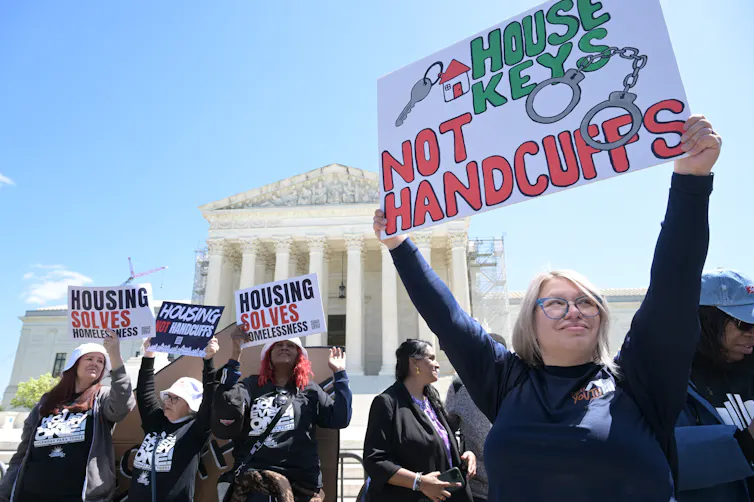
Housing activists demonstrate outside the Supreme Court on April 22, 2024. Matt McClain/The Washington Post via Getty Images

The Supreme Court has ruled that the Eighth Amendment to the U.S. Constitution does not prohibit cities from criminalizing sleeping outdoors.

City of Grants Pass v. Johnson began when a small city in Oregon with just one homeless shelter began enforcing a local anti-camping law against people sleeping in public using a blanket or any other rudimentary protection against the elements – even if they had nowhere else to go.

The court confronted this question: Is it unconstitutional to punish homeless people for doing in public things that are necessary to survive, such as sleeping, when there is no option to do these acts in private?

In a 6-3 decision written by Justice Neil Gorsuch, the court said no. It rejected the claim that criminalizing sleeping in public by those with nowhere to go violates the Constitution’s prohibition on cruel and unusual punishment. In my view, the decision – which I see as disappointing but not surprising – will not lead to any reduction in homelessness, and will certainly result in more litigation.

As a specialist in poverty law, civil rights and access to justice who has litigated many cases in this area, I know that homelessness in the U.S. is a function of poverty, not criminality, and that criminalizing people experiencing homelessness in no way helps solve the problem.

Cities like Portland, Oregon, have struggled to find viable ways of managing homeless encampments while they work to generate more housing.

The Grants Pass case

Grants Pass v. Johnson culminated years of struggle over how far cities can go to discourage homeless people from residing within their borders, and whether or when criminal sanctions for actions such as sleeping in public are permissible.

In a 2019 case, Martin v. City of Boise, the 9th U.S. Circuit Court of Appeals held that the Eighth Amendment’s cruel and unusual punishment clause forbids criminalizing sleeping in public when a person has no private place to sleep. The decision was based on a 1962 Supreme Court case, Robinson v. California, which held that it is unconstitutional to criminalize being a drug addict. Robinson and a subsequent case, Powell v. Texas, have come to stand for distinguishing between status, which cannot constitutionally be punished, and conduct, which can.

In the Grants Pass ruling, the 9th Circuit went one step further than it had in the Boise case and held that the Constitution also banned criminalizing the act of public sleeping with rudimentary protection from the elements. The decision was contentious: Judges disagreed over whether the anti-camping ban regulated conduct or the status of being homeless, which inevitably leads to sleeping outside when there is no alternative.

Grants Pass urged the Supreme Court to abandon the Robinson precedent and its progeny as “moribund and misguided.” It argued that the Eighth Amendment forbids only certain cruel methods of punishment, which do not include fines and jail terms.

The homeless plaintiffs did not challenge reasonable regulation of the time and place of outdoor sleeping, the city’s ability to limit the size or location of homeless groups or encampments, or the legitimacy of punishing those who insist on remaining in public when shelter is available.

But they argued that broad anti-camping laws inflicted overly harsh punishments for “wholly innocent, universally unavoidable behavior” and that punishing people for “simply existing outside without access to shelter” would not reduce this activity.

A woman in a suit jacket stands at an outdoor podium
Helen Cruz, who once lived on the streets in Grants Pass, Oregon, speaks at a rally outside the Supreme Court on April 22, 2024. AP Photo/J. Scott Applewhite

In today’s decision, the court rejected the city’s invitation to overrule the 1962 Robinson decision and eliminate the prohibition on criminalizing status, but denied that being homeless is a status. Instead, the court agreed with the city that camping or sleeping in public are activities, not statuses, despite the plaintiffs’ evidence that for homeless people, there is no difference between criminalizing “being homeless” and criminalizing “sleeping in public.”

The decision is surprisingly thin on Eighth Amendment analysis. It declines to engage with plaintiffs’ arguments that criminalizing sleeping imposes disproportionate punishment or imposes punishment without a legitimate deterrent or rehabilitative goal.

Instead, the court returned over and over to the idea that the 9th Circuit’s decision required judges to make impermissible policy decisions about how to respond to homelessness. The court also extensively cited friend-of-the-court briefs from cities and others discussing the difficulties of addressing homelessness. Significantly, however, neither these briefs nor the court’s decision cite evidence that criminalization reduces homelessness in any way.

In a strong dissent beginning “Sleep is a biological necessity, not a crime,” Justice Sonia Sotomayor, joined by Justices Elena Kagan and Ketanji Brown Jackson, quoted extensively from the record in the case. The dissent included some shocking statements from the Grants Pass City Council, such as “Maybe [the homeless people] aren’t hungry enough or cold enough … to make a change in their behavior.”

Sotomayor noted that time, place and manner restrictions on sleeping in public are perfectly permissible under the Ninth Circuit’s analysis, and that the inevitable line-drawing problems upon which the majority dwells are a normal part of constitutional interpretation. She also observed that the majority’s contention that the Ninth Circuit’s rule is unworkable was belied by Oregon’s own actions: in 2021, the state legislature codified the Martin v. Boise ruling into law.

A national crisis

Homelessness is a massive problem in the U.S. The number of people without homes held steady during the COVID-19 pandemic largely because of eviction moratoriums and the temporary availability of expanded public benefits, but it has risen sharply since 2022.

Scholars and policymakers have spent many years analyzing the causes of homelessness. They include wage stagnation, shrinking public benefits, inadequate treatment for mental illness and addiction, and the politics of siting affordable housing. There is little disagreement, however, that the simple mismatch between the vast need for affordable housing and the limited supply is a central cause.

Crackdowns on the homeless

Increasing homelessness, especially its visible manifestations such as tent encampments, has frustrated city residents, businesses and policymakers across the U.S. and led to an increase in crackdowns against homeless people. Reports from the National Homelessness Law Center in 2019 and 2021 have tallied hundreds of laws restricting camping, sleeping, sitting, lying down, panhandling and loitering in public.

Under presidents Barack Obama and Joe Biden, the federal government has asserted that criminal sanctions are rarely useful. Instead it has emphasized alternatives, such as supportive services, specialty courts and coordinated systems of care, along with increased housing supply.

Some cities have had striking success with these measures. But not all communities are on board.

Pushing people out of town

I expect that this ruling will prompt some jurisdictions to continue or increase crackdowns on the homeless, despite the complete lack of evidence that such measures reduce homelessness. What such laws may well accomplish is to push the issue into other towns, as Grants Pass officials candidly admitted they sought to do.

The decision will likely put even more pressure on jurisdictions that choose not to criminalize homelessness, such as Los Angeles, whose mayor, Karen Bass, has condemned the ruling. While this ruling resolves the Eighth Amendment claims against sleeping bans, litigation over homeless policy is doubtless far from over.

This is an updated version of an article originally published April 17, 2024.The Conversation

Clare Pastore, Professor of the Practice of Law, University of Southern California

This article is republished from The Conversation under a Creative Commons license. Read the original article.

  • 419
  • 420
  • 421
  • 422
  • 423
  • 424
  • 425
  • 426
  • 427
  • 428

Community

  • Lake County Wine Alliance offers sponsor update; beneficiary applications open 

  • Mendocino National Forest announces seasonal hiring for upcoming field season

Public Safety

  • Lakeport Police logs: Thursday, Jan. 15

  • Lakeport Police logs: Wednesday, Jan. 14

Education

  • Woodland Community College receives maximum eight-year reaffirmation of accreditation from ACCJC

  • SNHU announces Fall 2025 President's List

Health

  • California ranks 24th in America’s Health Rankings Annual Report from United Health Foundation

  • Healthy blood donors especially vital during active flu season

Business

  • Two Lake County Mediacom employees earn company’s top service awards

  • Redwood Credit Union launches holiday gift and porch-to-pantry food drives

Obituaries

  • Rufino ‘Ray’ Pato

  • Patty Lee Smith

Opinion & Letters

  • The benefits of music for students

  • How to ease the burden of high electric bills

Veterans

  • CalVet and CSU Long Beach team up to improve data collection related to veteran suicides

  • A ‘Big Step Forward’ for Gulf War Veterans

Recreation

  • Wet weather trail closure in effect on Upper Lake Ranger District

  • Mendocino National Forest seeking public input on OHV grant applications

  • State Parks announces 2026 Anderson Marsh nature walk schedule 

  • BLM lifts seasonal fire restrictions in central California

Religion

  • Kelseyville Presbyterian to host Ash Wednesday service and Lenten dinner Feb. 18

  • Kelseyville Presbyterian Church to hold ‘Longest Night’ service Dec. 21

Arts & Life

  • Auditions announced for original musical ‘Even In Shadow’ set for March 21 and 28

  • ‘The Rip’ action heist; ‘Steal’ grounded in a crime thriller

Government & Politics

  • Lake County Democrats issue endorsements in local races for the June California Primary

  • County negotiates money-saving power purchase agreement

Legals

  • March 3 hearing on ordinance amending code for commercial cannabis uses

  • Feb. 12 public hearing on resolution to establish standards for agricultural roads

How to resolve AdBlock issue?

Refresh this page