 How to resolve AdBlock issue?
News
A neutron star is the closest thing to a black hole that astronomers can observe directly, crushing half a million times more mass than Earth into a sphere no larger than a city.
In October 2010, a neutron star near the center of our galaxy erupted with hundreds of X-ray bursts that were powered by a barrage of thermonuclear explosions on the star's surface.
NASA's Rossi X-ray Timing Explorer (RXTE) captured the month-long fusillade in extreme detail.
Using this data, an international team of astronomers has been able to bridge a long-standing gap between theory and observation.
"In a single month from this unique system, we have identified behavior not seen in observations of nearly 100 bursting neutron stars during the past 30 years," said Manuel Linares, a postdoctoral researcher at the Kavli Institute for Astrophysics and Space Research at the Massachusetts Institute of Technology in Cambridge.
He led a study of the RXTE data that will be published in the March 20 issue of The Astrophysical Journal.
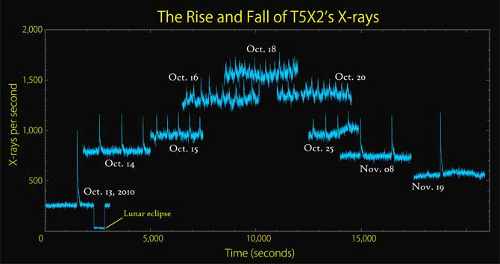
This graph based on RXTE data provides an overview of the changing character of T5X2's Xray emission during outbursts from Oct. 13 to Nov. 19, 2010.
On Oct. 10, 2010, the European Space Agency's INTEGRAL satellite detected a transient X-ray source in the direction of Terzan 5, a globular star cluster about 25,000 light-years away toward the constellation Sagittarius.
The object, dubbed IGR J17480–2446, is classed as a low-mass X-ray binary system, in which the neutron star orbits a star much like the sun and draws a stream of matter from it.
As only the second bright X-ray source to be found in the cluster, Linares and his colleagues shortened its moniker to T5X2.
Three days after the source's discovery, RXTE targeted T5X2 and detected regular pulses in its emission, indicating that the object was a pulsar – a type of neutron star that emits electromagnetic energy at periodic intervals.
The object's powerful magnetic field directs infalling gas onto the star's magnetic poles, producing hot spots that rotate with the neutron star and give rise to X-ray pulses.
At NASA's Goddard Space Flight Center in Greenbelt, Md., RXTE scientists Tod Strohmayer and Craig Markwardt showed that T5X2 spins at a sedate – for neutron stars – rate of 11 times a second.
And because the pulsar's orbital motion imparts small but regular changes in the pulse frequency, they showed that the pulsar and its sun-like companion revolve around each other every 21 hours.
That same day, RXTE observed its first burst from the system: an intense spike in X-rays lasting nearly three minutes and caused by a thermonuclear explosion on the neutron star's surface.
Ultimately, RXTE cataloged some 400 events like this between Oct. 13 and Nov. 19, with additional bursts observed by INTEGRAL and NASA's Swift and Chandra observatories. NASA decommissioned RXTE on Jan. 5, 2012.
In the T5X2 system, matter streams from the sun-like star to the neutron star, a process called accretion.

Because a neutron star packs more than the sun's mass into a sphere between 10 and 15 miles across – about the size of Manhattan or the District of Columbia – its surface gravity is extremely high.
The gas rains onto the pulsar's surface with incredible force and ultimately coats the neutron star in a layer of hydrogen and helium fuel.
When the layer builds to a certain depth, the fuel undergoes a runaway thermonuclear reaction and explodes, creating intense X-ray spikes detected by RXTE and other spacecraft. The bigger the blast, the more intense its X-ray emission.
Models designed to explain these processes made one prediction that had never been confirmed by observation.
At the highest rates of accretion, they said, the flow of fuel onto the neutron star can support continuous and stable thermonuclear reactions without building up and triggering episodic explosions.
At low rates of accretion, T5X2 displays the familiar X-ray pattern of fuel build-up and explosion: a strong spike of emission followed by a long lull as the fuel layer reforms.
At higher accretion rates, where a greater volume of gas is falling onto the star, the character of the pattern changes: the emission spikes are smaller and occur more often.
But at the highest rates, the strong spikes disappeared and the pattern transformed into gentle waves of emission.
Linares and his colleagues interpret this as a sign of marginally stable nuclear fusion, where the reactions take place evenly throughout the fuel layer, just as theory predicted.
"We see T5X2 as a 'model burster,' the one that's doing everything expected of it," said Diego Altamirano, an astrophysicist at the University of Amsterdam in The Netherlands and a co-author on the paper describing the findings.
The question now before the team is why this system is so different from all others studied in previous decades.
inares suspects that T5X2's slow rotation may hold the key. Faster rotation would introduce friction between the neutron star’s surface and its fuel layers, and this frictional heat may be sufficient to alter the rate of nuclear burning in all other bursting neutron stars previously studied.
MENDOCINO COUNTY, Calif. – Mendocino County officials seized more than two dozen firearms, some of them stolen, and arrested two men during a Friday investigation.
Vince Allan Ballew, 45, of Boonville and 40-year-old Patrick Dino Mariani of Philo were arrested in the case, according to Sgt. Greg Van Patten of the Mendocino County Sheriff's Office.
Van Patten reported that at 4 p.m. Friday Anderson Valley Resident Deputy Sheriff Craig Walker responded to a residence located on Hutsell Road in Boonville to serve a search warrant.
Deputy Walker was assisted by sheriff's office detectives and special agents with the Mendocino Major Crimes Task Force, Van Patten said.
In recent months Deputy Walker had received confidential information about the presence of several firearms at the residence, one of which being reported as stolen during a burglary to a Ukiah area residence in October 2011, according to Van Patten.
Upon arriving at the location Walker, the detectives and special agents contacted Ballew and Mariani, who were inside the living room area of the residence, Van Patten said. Based upon previous law enforcement contacts the residence was known to be Ballew's primary residence with Mariani apparently being a guest.
Upon contact the pair were in close proximity of several loaded and unloaded firearms. Van Patten said some of the firearms where determined to be assault weapons illegal for a private person to possess in California.
During a search of the residence approximately 26 firearms were seized to include different types of rifles, shotguns and handguns, Van Patten said.
Of the firearms seized five were assault rifles, one was an Uzi machine gun and two later were determined to be reported stolen during a burglary to a Ukiah area residence in October 2011, Van Patten reported. Various types and amounts of ammunition for the firearms were also located inside the residence.
Ballew was arrested for being in possession of assault weapons and for possessing a firearm with an altered serial number. Mariani was arrested for being a felon in possession of a firearm.
Both were transported to the Mendocino County Jail where Ballew was to be held in lieu of $15,000 bail and Mariani was to be held in lieu of $25,000 bail.
COBB, Calif. – A moderate-sized earthquake was reported on Cobb Mountain Saturday afternoon.
The 3.1-magnitude quake occurred at 4:21 p.m., according to an initial report from U.S. Geological Survey.
The estimate of the temblor's magnitude could change later when reviewed by a seismologist.
The quake was recorded at a depth of a tenth of a mile two miles west of Cobb, three miles northeast of The Geysers and six miles northwest of Anderson Springs.
A 4.3-magnitude quake hit the Cobb area on Feb. 12, as Lake County News has reported.
E-mail Elizabeth Larson at elarson@lakeconews.com .

Since many of us became “honorary Irish”yesterday, it’s an appropriate time to discuss the oat, a grain that’s a favorite in Ireland.
Oats are amazingly healthy, and the only grain to have a legume-like protein. Oat protein is nearly equivalent in quality to soy protein, which, according to research done by the World Health Organization, is equal to animal protein from meat, dairy products or eggs.
The protein content of the oat groat, meaning its hull-less kernel, ranges from 12 to 24 percent, the highest among cereals.
Today’s oats are descendants of the wild red oat,a plant originating in the Fertile Crescent of the Near East; however, they were first cultivated in Bronze Age Europe, far from the origins of their wild relatives.
Cold winter mornings, especially blustery ones,are perfect for a hearty bowl of oatmeal. In case you’ve ever wondered why there are so many varieties of this seemingly simple cereal, here’s the lowdown, from the least to the most processed:
Steel-cut oats are produced by running the grain through steel blades that thinly slice them. They’re also known as Irish oats or pin oats and have a dense, chewy texture. Because they’re relatively unprocessed, they take about 40 minutes to cook, but are considered the healthiest form of oatmeal.
Old-fashioned oats (also known as rolled oats) are flat as a result of their being steamed and then rolled into flakes, whichmreduces the cooking time to about five minutes. The process was invented by the Quaker Oat Co. in the 1870s, revolutionizing the oat industry.
Quick-cooking oats are processed like rolled oats,but are finely cut before being sent through the rolling mills, reducing the cooking time even further.
Instant oatmeal is created by partially cooking the grains and then rolling them very thin. Oftentimes sugar, salt and other ingredients, such as flavorings, are added. Instant oatmeal is prepared by adding boiling water.
Other oat products include oat bran, which is the outer layer of the grain that resides under the hull. Bran is found in steel-cut and rolled oats, but may be purchased separately for adding to recipes, such as muffins, or even cooked on its own to make a cereal. (One caveat: I’ve found cereal made solely from oat bran to be unpleasantly sticky.)
Oat flour is used in baking, often combined withwheat or other gluten-containing flours when making leavened bread.
Oats are a cool-season, moisture-loving crop, so are mostly grown in northerly climates, such as the upper tier of states in the U.S., in Canada, Scandinavia, Germany, Poland and Russia. They’re often plantedas a cover crop in the fall to benefit the soil during the winter months; they then produce a springtime crop before the heat of summer sets in.
The ancient Greeks enjoyed oats, especially in sweet cakes made with the flour; however, the Romans considered them barbaric, at least until they conquered Celtic Britain, where they found oats to be an easily grown and nutritious food.
Since this time, oats have been identified with the British Isles, being a favorite not only in Ireland, but in Scotland and Wales, as well, as evidenced by haggis, a Scottish favorite made by mixing oats with offal and, if made the traditional way, cooked in a sheep’s stomach.
In England, oatmeal stout is brewed by mixing oatmeal in with the grist, meaning the brewing grains. It’s a dark and viscous beer, with a creamy texture that’s imparted by the oats.
The Japanese also make an alcoholic drink with oats. Amazake is a sweeter version of sake made with oats instead of rice.
Oat milk, like soy, rice, or almond milk, can be found in many stores as an alternative to dairy, and oats are a major ingredient in a variety of cold breakfast cereals, like muesli and granola.
When my sons were young, I added peanut butter and maple syrup to their oatmeal one morning and it became a family favorite. Nuts and dried fruit, such as raisins, sultanas or currants, are delicious with oatmeal and eliminate the need for sweeteners. Diced fresh apples may be tossed in while oatmeal is cooking.
Preparing oatmeal with milk instead of water makes for an extra creamy version, and spices such as nutmeg, cardamom or cinnamon add interest.
I’d love to hear your favorite way of preparing it, so please feel free to share your traditions and ideas in the comments section!
The health benefits of oats have been studied extensively. The fiber specific to oatmeal has been shown to lower cholesterol levels,and its unique antioxidants reduce the risk of cardiovascular disease.
In addition, they enhance our immune response to infection, stabilize blood sugar, lower risk for type II diabetes, and its fiber protects against breast cancer.
They’re a very good source of manganese and selenium, and a good source of dietary fiber, magnesium, zinc and phosphorus.
Today’s recipe is a twist on traditional oatmeal cookies, with the addition of coconut allowing the use of less sugar. They have a chewy texture and a caramel-like flavor.
The recipe calls for freshly grated nutmeg, and if you don’t have whole nutmeg at home, it may be found in the spice aisle of most supermarkets. Nutmeg may be grated using a tool such as a Microplane zester (preferred) or the finest side of a standing cheese grater. Otherwise, ground nutmeg may be substituted.
And before I go, if you’ve ever wanted to make steel-cut oats for breakfast, but don’t have the time, here’s a trick. Soak them in water overnight and you’ll be able to cook them in 10 minutes the following morning.
Chewy oatmeal-coconut cookies
1 ¼ cups old-fashioned (five-minute) rolled oats
½ cup brown sugar, firmly packed
¼ cup shredded coconut
1 tablespoon all-purpose flour
½ teaspoon freshly grated nutmeg
¼ teaspoon salt
4 tablespoons unsalted butter, melted
1 large egg, beaten
¾ teaspoon vanilla extract
Preheat oven to 350 degrees Fahrenheit. Grease two baking sheets.
In a large bowl, combine the oats, brown sugar, coconut, flour, nutmeg and salt.
In a separate bowl, whisk together the butter, egg and vanilla, then mix with the dry ingredients.
Drop teaspoonfuls onto the baking sheets about 3 inches apart and flatten with the back of a fork.
Bake about eight minutes, until nicely browned. Let the cookies cool for a couple of minutes, then transfer them to a wire rack to allow them to completely cool before stacking.
Recipe courtesy of “The Organic Cook’s Bible” by Jeff Cox.
Esther Oertel, a freelance writer, cooking teacher, and speaker, is passionate about local produce and all foods in the vegetable kingdom. She welcomes your questions and comments and may be reached at veggiebelle@hotmail.com .
LAKE COUNTY, Calif. – It’s another full house of adoptable dogs at the Lake County Animal Care and Control shelter.
Dogs large and small, of various breeds, are available at the shelter, which now offers spaying and neutering services for adopted pets in order to reduce adoption costs.
Dogs that are adopted from Lake County Animal Care and Control are either neutered or spayed, microchipped and, if old enough, given a rabies shot and county license before being released to their new owner. License fees do not apply to residents of the cities of Lakeport or Clearlake.
If you're looking for a new companion, visit the shelter. There are many great pets hoping you'll choose them.
The following dogs at the Lake County Animal Care and Control shelter have been cleared for adoption (additional dogs on the animal control Web site not listed are still “on hold”).

Labrador Retriever mix
This Labrador Retriever mix is a female; shelter staff has not reported her age.
She has tan coloring; whether she has been altered is not known.
Find her in kennel No. 15, ID No. 31902.

Chihuahua-Dachshund mix
This male Chihuahua-Dachshund mix is 7 months old.
He weighs 15 pounds, has blue and fawn coloring, and is not yet altered.
He’s in kennel No. 19, ID No. 32032.

Male shepherd-pit bull mix
This male shepherd-pit bull terrier mix is 7 months old.
He has a brown and white coat and is not yet altered.
He is in kennel No. 20, ID No. 32027.

Female pit bull terrier mix
This female pit bull terrier mix is 5 months old.
She has a short coat with reddish coloring. She is not yet altered.
Find her in kennel No. 21b, ID No. 32038.
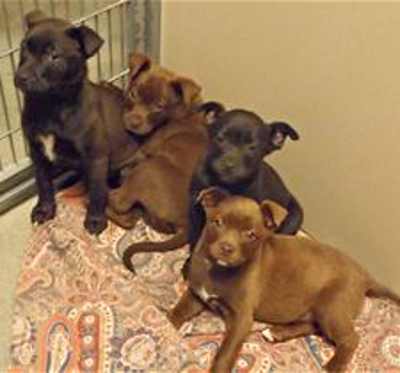
Border collie mix puppies
These border collie mix puppies are 13 weeks old.
Some of them have black coloring, and some chocolate coloring, with short coats.
They are in kennel No. 25, ID No. 32045.

Female border collie mix
This female border collie mix, called “Delilah,” is 3 years old.
She has black coloring and a short coat. She is not yet altered.
She is in kennel No. 26, ID No. 32044.

Male pit bull mix
This handsome male pit bull mix is 7 months old.
He is black and white – he looks like he’s wearing a tuxedo – and is not yet altered.
He’s in kennel No. 27, ID No. 32039.

‘Lucy’
“Lucy” is a female Labrador Retriever-Rottweiler mix.
She is 1 year old, has black brindle coloring, and is not yet altered.
Find her in kennel No. 29, ID No. 32057.

Heeler-border collie mix
This male blue heeler-border collie mix is 7 months old.
He is black and tan in color, and is not yet altered.
Find him in kennel No. 7, ID No. 32009.

Male poodle mix
This male poodle mix is 6 years old.
He has gold eyes and a white curly coat which recently was cut short but is normally long. He has been neutered.
Find him in kennel No. 14, ID No. 31968.

‘Delilah’
“Delilah” is a 2-year-old female Labrador Retriever-boxer mix.
She has black coloring and a short coat, and is spayed.
Shelter staff said she’s is super sweet, affectionate and housebroken.
She is in kennel No. 16, ID No. 31916.

Heeler-pit bull mix
This male heeler-pit bull mix is 1 year old.
He has tan and white coloring and a short coat, and is not yet neutered.
He is in kennel No. 5, ID No. 31954.

Rhodesian Ridgeback-boxer mix
This male Rhodesian Ridgeback-boxer mix is 10 months old.
He has a short, white and black spotted coat, and is neutered.
Find him in kennel No. 6, ID No. 31955.
Adoptable dogs also can be seen at http://www.co.lake.ca.us/Government/Directory/Animal_Care_And_Control/Adopt/Dogs_and_Puppies.htm or at www.petfinder.com .
Please note: Dogs listed at the shelter's Web page that are said to be “on hold” are not yet cleared for adoption.
To fill out an adoption application online visit http://www.co.lake.ca.us/Government/Directory/Animal_Care_And_Control/Adopt/Dog___Cat_Adoption_Application.htm .
Lake County Animal Care and Control is located at 4949 Helbush in Lakeport, next to the Hill Road Correctional Facility.
Office hours are Monday through Friday, 8 a.m. to 5 p.m., and 1 p.m. to 3 p.m., Saturday. The shelter is open from 10:30 a.m. to 4:30 p.m. Monday through Friday and on Saturday from 1 p.m. to 3 p.m.
Visit the shelter online at http://www.co.lake.ca.us/Government/Directory/Animal_Care_And_Control.htm .
For more information call Lake County Animal Care and Control at 707-263-0278.
As the one-year anniversary of the devastating Japanese tsunami arrived this month, engineers from the USC Viterbi School of Engineering Tsunami Research Center are working with the State of California to better understand the damaging currents caused by tsunamis.
Funded by the California Geological Survey, the California Emergency Management Agency, and the Federal Emergency Management Agency, USC researchers will use hydrodynamic computer modeling and historical tsunami data to evaluate the currents generated by tsunamis and their effect within California ports and harbors.
Results from the study will be used to determine safe depths for evacuation, to map zones that might be prone to higher or lower currents under tsunami conditions (to inform how ships and boats are moved and evacuated), and to create hazard maps for ports, harbors and marinas. Work will begin in the next few weeks and last through the end of 2012.
Currents caused by the Japanese tsunami of March 2011 caused millions of dollars of damage at 27 harbors along the California coast, particularly in Santa Cruz and Crescent City.
In Santa Barbara, swirling currents lasted for more than 24 hours, with the strongest surges taking place long after the original currents.
According to Associate Professor Patrick Lynett and Adjunct Research Professor Jose Borrero of the USC Sonny Astani Department of Civil and Environmental Engineering, who will conduct the study, these tsunami-induced “phantom currents” are not well understood.
Even in moderate-sized tsunamis, currents can rip large boats from their moorings. During the Indian Ocean tsunami in 2004, at locations very far from the earthquake itself, large ships were ripped from their moorings and pushed around the harbor by surges occurring many hours after the tsunami first arrived.
A similar effect occurred in Crescent City in November 2006, when a magnitude 8.3 earthquake off of Russia's Kuril Island caused a moderate tsunami.
The currents caused by the waves were strongest some three hours after tsunami arrival and caused $20 million in damage to Crescent City harbor. Repairs from that event had not yet been completed when the Japan tsunami struck.
“Imagine an oil tanker or cargo ship torn loose and out of control in the Port of LA or San Francisco Bay,” warned Dr. Lynett, USC's John and Dorothy Shea Early Career Chair in Civil Engineering. “The problem could escalate very quickly.”
“California is being proactive in its effort to re-evaluate certain elements of its tsunami preparedness based on lessons learned from the Japan event,” said Dr. Borrero. “During the Japan tsunami, even though we knew how big the waves were going to be, we severely underestimated the strength and duration of the currents.”
“Fortunately, this is a hazard that can be dealt with,” said Rick Wilson of the California Geological Survey.
Wilson's agency and the federal and state emergency management agencies are funding Lynett and Borrero to look at this issue as part of USC's ongoing initiative to provide tsunami expertise to the State.
Lynett and Borrero have been working together gathering data on this phenomenon and to applying advanced computer models to quantify the extent and duration of these late arriving and potentially damaging surges.
Said Lynett, “We have the tools available to understand this problem and make the right call in the future.”
In an article published earlier this month in the journal Earth and Planetary Science Letters, Lynett and Borrero described observations of these currents at several locations both within California and internationally and describe their efforts to understand them.
For more information about that paper, visit www.sciencedirect.com/science/article/pii/S0012821X12000696 .