 How to resolve AdBlock issue?
News
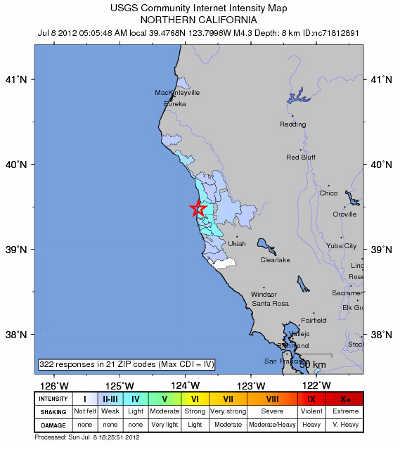
NORTHERN CALIFORNIA – A 4.3-magnitude quake was reported near the coastal town of Fort Bragg in Mendocino County early Sunday morning.
The US Geological Survey said the quake occurred at 5:05 a.m. two miles north northwest of Fort Bragg and 40 miles northwest of Ukiah. It was recorded at the earth’s surface.
A survey shake map showed the quake’s intensity at its center was rated as “strong.”
By 11:30 a.m. Sunday the US Geological Survey had received 322 shake reports from 21 zip codes from around Mendocino and Humboldt counties, and other parts of the Northern California.
Email Elizabeth Larson at
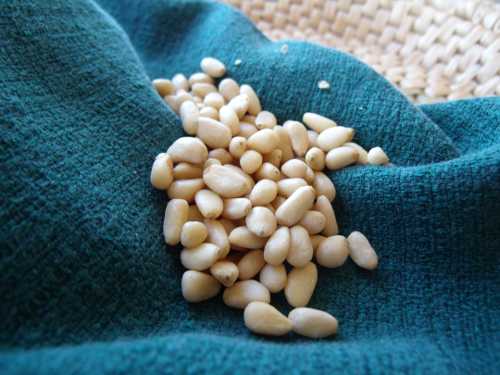
There is nothing like the experience of eating a pine nut. Do you recall your first encounter with them? I do mine.
It was in the mid-1980s when I lived in a rambling Victorian flat in the Inner Sunset district of San Francisco. A friend dropped in unexpectedly with handfuls of sweet, pungent basil, extra virgin olive oil, fresh Parmesan cheese, and something I’d never seen before: pine nuts.
She wanted to borrow my blender. You can guess why, I’m sure, but at the time I didn’t have a clue as to what she had up her sleeve.
I stood transfixed, watching her put ingredients one by one into the blender to conjure up the first pesto sauce I’d ever tasted.
While pesto is common today, at the time my experience with Italian food had only gone as far as spaghetti and meatballs or lasagna.
It was a magical experience.
Through the years I’ve learned to appreciate pine nuts for their own merits: an ever-so-delicate crunch, creamy smooth texture, and a flavor that I can only describe as luxuriously buttery, somewhat sweet, and slightly resinous.
Pine nuts are the seeds of several different pine trees, with most from the Italian stone pine, the pinyon pine, and the Chinese nut pine.
The seeds develop in the crevices between the scales of the cones on these trees, and are almost exclusively harvested in the wild.
The hard shell in which they’re encased must be removed before enjoying the delectable seed within.
In North America, most pine nuts are from pinyon pine varieties found in mountainous regions in the western U.S. and Mexico, including in the Sierra foothills on the east side of California’s Central Valley.
In Europe, they’re harvested from the Italian stone pine that grows throughout the Mediterranean region, and from the Chinese nut pine in Asia.
They lend their unique nuttiness to a variety of foods: sprinkled over salads, incorporated into rice or pasta dishes, roasted with meat, strewn over pizza, or added to frittatas once they’re almost set, to name a few.
Basically, if you can drizzle olive oil over it, you can also pepper it with pine nuts. Think, for example, of roasted vegetables, pasta salad, or little Italian toasts (crostini) spread with any manner of toppings.
Some use pine nuts in desserts: in a pie, as a component of a cobbler topping, or in other more exotic applications.
I love an unexpected touch of savory in a sweet dessert – thyme in a fruit tart or coarsely ground black pepper over strawberries and vanilla ice cream – but caution must be exercised with pine nuts. Use a light hand, as their distinctive taste can easily overtake a dish.
If you’d like to try your hand at including them in a dessert, they go especially well with apples, figs, and apricots.
Italians bake them in biscuits or cakes, which give the finished product a fine texture and flavor.
Pine nuts are a very old food source, having been gathered since prehistoric times in Europe and the Americas. American Indians in the Southwest relied on pine nuts for millennia as a protein source.
Pine nuts were used in cuisine in ancient Rome, especially prized for thickening sauces or in an herby relish for meat. In ancient Greece, they were often preserved in honey.
They’re an excellent protein source, one of the best in the nut family. They also have great stores of monounsaturated fats (healthful fats which lower LDL cholesterol and triglycerides in the blood), B vitamins, folate, and trace minerals.
In general, European species of pine nuts are richer in protein and lower in fat than American varieties, but American pine nuts offer more vitamins and minerals.
Pine contains a potent antioxidant called pycnogenol, one of the few that protect brain cells from the ravages of free radicals in the blood, and its benefits can be had from consuming pine nuts.
Because pine nuts contain high levels of fat which can quickly turn rancid, it’s important that they be stored well and consumed as fresh as possible.
Pine nuts still in the shell will remain fresh longest, but that means finding them in this state and cracking them before eating. The Internet is one option for procuring unshelled pine nuts, and, while I haven’t done it myself, I’m told a gentle tap with a hammer should easily release the tender seed.
If purchasing them loose in bulk bins, the least expensive way to go, be sure to check for freshness by smell (or taste, if allowed). If they smell a bit musty, it means the fats have become rancid.
Pine nuts are expensive, and the “per pound” price may cause sticker shock. Thankfully they’re small and light, and the amount for most recipes doesn’t weigh much. I find that I can get away with spending only two or three dollars for almost all applications.
Unless they’re still in the shell, store pine nuts in a tightly-sealed container in the fridge for optimum freshness.
Roasting pine nuts brings out their nutty flavor, and today’s recipe for classic basil pesto may be made with toasted or untoasted nuts, depending on your preference. I’ve listed two methods for toasting them below the pesto recipe.
In addition to being wonderful on pasta, basil pesto is fantastic as a spread for sandwiches or hors d’oeuvres. A dollop of pesto adds delicious flavor to soups or sauces.
Here’s to having plenty of opportunities to enjoy pine nuts frequently and creatively! Bon appétit!
Basic basil pesto with pine nuts
3 cups packed basil leaves
½ cup (approximately) extra virgin olive oil
3 cloves garlic (use more or less to taste), minced
½ cup pine nuts (toasted or not)
½ teaspoon salt (or more, to taste)
Freshly ground black pepper
If desired, toast the pine nuts (see methods below) and set aside.
Add basil, garlic, pine nuts, and approximately one-quarter cup of the olive oil to the bowl of a food processor fitted with a steel blade. (Or you may use a blender.) Pulse or blend until ingredients become a rough puree.
With the motor running, drizzle olive oil into the food processor or blender until a smooth, creamy consistency is achieved. You may end up using more or less than the remaining ¼ cup of oil.
Add the half teaspoon salt, blend, and taste. Add more salt if desired, and pepper to taste.
This makes about 1 ½ cups of pesto, which, although best used immediately, will keep for at least a day or two in the fridge if stored in a tightly-covered container.
Pesto may be frozen, either in ice cube trays (and then stored in zipper-sealed freezer bags) or in an airtight freezer container.
Recipe by Esther Oertel.
Variations: If a more rustic version is desired, ingredients should be processed less, until a rough puree is formed. For a rich pesto sauce, add a quarter pound or so of freshly-grated sharp, dry cheese, such as Parmigiano-reggiano. For less basil flavor, add 1 cup of Italian parsley in place of 1 cup of the basil.
Methods for toasting pine nuts
Toasted pine nuts should be a lovely golden color reminiscent of butterscotch. Keep a close eye on them, as it only takes a second to go from perfect to overdone, even burned. Once you begin to smell their aroma, chances are they’re done or close to it.
Below are two methods for toasting, oven and stovetop.
In the oven: Preheat the oven to 350 degrees Fahrenheit. Spread pine nuts on a baking sheet and place them in the oven. Bake for three to five minutes, checking after three minutes.
On the stovetop: Put pine nuts into a dry pan over medium heat. Toss them in the pan (or, if you prefer, stir them) as they toast. This is a much quicker method, so it’s important to watch them closely.
Esther Oertel, a freelance writer, cooking teacher, and speaker, is passionate about local produce and all foods in the vegetable kingdom. She welcomes your questions and comments and may be reached at
LAKEPORT, Calif. – Lake County’s animal shelter has a variety of dogs of all sizes and breeds available to join your family.
This week it’s mixes of breeds including shepherds, Chihuahuas, Shar Peis, terriers, dachshunds and boxers.
Thanks to Lake County Animal Care and Control’s new veterinary clinic, many of the animals offered for adoption already are spayed or neutered and ready to go home with their new families.
Dogs that are adopted from Lake County Animal Care and Control are either neutered or spayed, microchipped and, if old enough, given a rabies shot and county license before being released to their new owner. License fees do not apply to residents of the cities of Lakeport or Clearlake.
If you're looking for a new companion, visit the shelter. There are many great pets hoping you'll choose them.
The following dogs at the Lake County Animal Care and Control shelter have been cleared for adoption (additional dogs on the animal control Web site not listed are still “on hold”).
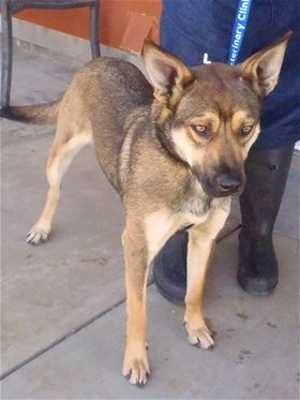
Female shepherd mix
This female shepherd mix is 1 year old.
She has a short brown and black coat, and weighs 46 pounds.
She’s in kennel No. 12, ID No. 33364.

‘Cali’
“Cali” is a female Chihuahua mix is 8 years old.
She has a short black and brown coat, and has been spayed.
She’s in kennel No. 13, ID No. 33343.

Hound-Shar Pei mix
This female hound-Shar Pei mix is 2 years old.
She has a short brown and black coat, brown eyes and floppy ears.
Find her in kennel No. 14, ID No. 33365.

‘Taco’
“Taco” is a 3-year-old male Chihuahua mix.
He has a short white coat, and is not yet neutered.
He’s in kennel No. 16, ID No. 33342.

Chihuahua-terrier mix
This female Chihuahua-terrier mix is 4 years old.
She weighs 9 pounds and has a short tan coat.
Find her in kennel No. 18, ID No. 33273.

Boxer mix
This female boxer mix is 4 years old.
She has red and white coloring, a docked tale and weighs 50 pounds.
She’s in kennel No. 20, ID No. 33284.

Female dachshund mix
This female dachshund mix is 1 year old.
She has a short black coat, weighs 32 pounds and has not yet been spayed.
She’s in kennel No. 24B, ID No. 33221.
Adoptable dogs also can be seen at http://www.co.lake.ca.us/Government/Directory/Animal_Care_And_Control/Adopt/Dogs_and_Puppies.htm or at www.petfinder.com .
Please note: Dogs listed at the shelter's Web page that are said to be “on hold” are not yet cleared for adoption.
To fill out an adoption application online visit http://www.co.lake.ca.us/Government/Directory/Animal_Care_And_Control/Adopt/Dog___Cat_Adoption_Application.htm .
Lake County Animal Care and Control is located at 4949 Helbush in Lakeport, next to the Hill Road Correctional Facility.
Office hours are Monday through Friday, 8 a.m. to 5 p.m., and 1 p.m. to 3 p.m., Saturday. The shelter is open from 10:30 a.m. to 4:30 p.m. Monday through Friday and on Saturday from 1 p.m. to 3 p.m.
Visit the shelter online at http://www.co.lake.ca.us/Government/Directory/Animal_Care_And_Control.htm .
For more information call Lake County Animal Care and Control at 707-263-0278.
Email Elizabeth Larson at
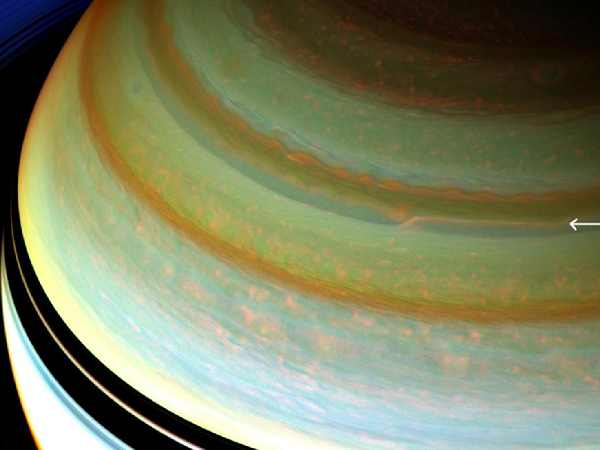
Turbulent jet streams, regions where winds blow faster than in other places, churn east and west across Saturn.
Scientists have been trying to understand for years the mechanism that drives these wavy structures in Saturn’s atmosphere and the source from which the jets derive their energy.
In a new study appearing in the June edition of the journal Icarus, scientists used images collected over several years by NASA’s Cassini spacecraft to discover that the heat from within the planet powers the jet streams.
Condensation of water from Saturn’s internal heating led to temperature differences in the atmosphere. The temperature differences created eddies, or disturbances that move air back and forth at the same latitude, and those eddies, in turn, accelerated the jet streams like rotating gears driving a conveyor belt.
A competing theory had assumed that the energy for the temperature differences came from the sun. That is how it works in the Earth’s atmosphere.
“We know the atmospheres of planets such as Saturn and Jupiter can get their energy from only two places: the sun or the internal heating. The challenge has been coming up with ways to use the data so that we can tell the difference,” said Tony Del Genio of NASA’s Goddard Institute for Space Studies, N.Y., the lead author of the paper and a member of the Cassini imaging team.
The new study was possible in part because Cassini has been in orbit around Saturn long enough to obtain the large number of observations required to see subtle patterns emerge from the day-to-day variations in weather.
“Understanding what drives the meteorology on Saturn, and in general on gaseous planets, has been one of our cardinal goals since the inception of the Cassini mission,” said Carolyn Porco, imaging team lead, based at the Space Science Institute, Boulder, Colo. “It is very gratifying to see that we’re finally coming to understand those atmospheric processes that make Earth similar to, and also different from, other planets.”
Rather than having a thin atmosphere and solid-and-liquid surface like Earth, Saturn is a gas giant whose deep atmosphere is layered with multiple cloud decks at high altitudes.
A series of jet streams slice across the face of Saturn visible to the human eye and also at altitudes detectable to the near-infrared filters of Cassini’s cameras.
While most blow eastward, some blow westward. Jet streams occur on Saturn in places where the temperature varies significantly from one latitude to another.
Thanks to the filters on Cassini’s cameras, which can see near-infrared light reflected to space, scientists now have observed the Saturn jet stream process for the first time at two different, low altitudes.
One filtered view shows the upper part of the troposphere, a high layer of the atmosphere where Cassini sees thick, high-altitude hazes and where heating by the sun is strong.
Views through another filter capture images deeper down, at the tops of ammonia ice clouds, where solar heating is weak but closer to where weather originates. This is where water condenses and makes clouds and rain.
In the new study, which is a follow-up to results published in 2007, the authors used automated cloud tracking software to analyze the movements and speeds of clouds seen in hundreds of Cassini images from 2005 through 2012.
“With our improved tracking algorithm, we’ve been able to extract nearly 120,000 wind vectors from 560 images, giving us an unprecedented picture of Saturn’s wind flow at two independent altitudes on a global scale,” said co-author and imaging team associate John Barbara, also at the Goddard Institute for Space Studies.
The team’s findings provide an observational test for existing models that scientists use to study the mechanisms that power the jet streams.
By seeing for the first time how these eddies accelerate the jet streams at two different altitudes, scientists found the eddies were weak at the higher altitudes where previous researchers had found that most of the sun’s heating occurs.
The eddies were stronger deeper in the atmosphere. Thus, the authors could discount heating from the sun and infer instead that the internal heat of the planet is ultimately driving the acceleration of the jet streams, not the sun.
The mechanism that best matched the observations would involve internal heat from the planet stirring up water vapor from Saturn’s interior.
That water vapor condenses in some places as air rises and releases heat as it makes clouds and rain. This heat provides the energy to create the eddies that drive the jet streams.
The condensation of water was not actually observed; most of that process occurs at lower altitudes not visible to Cassini. But the condensation in mid-latitude storms does happen on both Saturn and Earth.
Storms on Earth – the low- and high-pressure centers on weather maps – are driven mainly by the sun’s heating and do not mainly occur because of the condensation of water, Del Genio said.
On Saturn, the condensation heating is the main driver of the storms, and the sun’s heating is not important.
Images of one of the strongest jet streams and a figure from the paper can be found at http://www.nasa.gov/cassini , http://saturn.jpl.nasa.gov and http://ciclops.org .
The Cassini-Huygens mission is a cooperative project of NASA, the European Space Agency and the Italian Space Agency.
The Jet Propulsion Laboratory, a division of the California Institute of Technology in Pasadena, manages the Cassini-Huygens mission for NASA’s Science Mission Directorate, Washington.
The Cassini orbiter and its two onboard cameras were designed, developed and assembled at JPL. The imaging team is based at the Space Science Institute in Boulder, Colo.
NORTHERN CALIFORNIA – A fire in the Mendocino National Forest had reached an estimated 300 acres by Saturday night, according to forest officials.
The Mill Fire is burning near the Mill Valley Campground and Upper Letts Lake in Colusa County.
Mendocino National Forest officials reported that it was first spotted at about 3 p.m. Saturday and was estimated to have hit the 300-acre mark by 10 p.m.
Forest spokesperson Tamara Schmidt cautioned that the acreage is only an estimate until better maps are generated on the fire.
The U.S. Forest Service – with the assistance of Cal Fire – is working the fire, with Schmidt reporting that resources were continuing to make their way to the incident.
Reports from the scene indicated steep terrain that’s difficult for ground crews, with requests placed Saturday evening for additional air tankers and smokejumpers.
Twenty-five structures were threatened at the Board Camp summer home tract as well as the Mill Valley, Mill Creek and Letts Lake campgrounds, all of which Schmidt said were evacuated Saturday.
Visitors evacuating from the Letts Lake area on the west side of the fire are advised to take the Miner Ridge Road to Road M5 near Cedar Camp and follow M5 or County Road 42 out.
Schmidt said the road between Letts Lake and Fouts Springs, leading to Stonyford, is currently inaccessible, and forest visitors were asked to avoid the Fouts Springs and Davis Flat area due to increased fire traffic.
The cause of the fire remains under investigation, according to Schmidt.
In addition to assisting on the Mill Fire, Cal Fire personnel were engaged in fire suppression efforts around the state.
The Thunder fire, located off Highway 162 at Thunderhill Raceway near Willows in Glenn County, was fully contained on Saturday afternoon at 167 acres, Cal Fire reported.
Also on Saturday, the 140-acre Butte Fire – located off of Butte Mountain Road at Corning Road southwest of Corning in Tehama County – was 100-percent contained, as was the 1,200-acre Dale Fire southwest of Redding in Shasta County, according to Cal Fire.
Still not contained on Saturday were the Tin Can Canyon fire in San Diego County, at an initial size of 20 acres, and the Fish Fire in Inyo County, reported Saturday night to be 175 acres and 20 percent contained.
Email Elizabeth Larson at
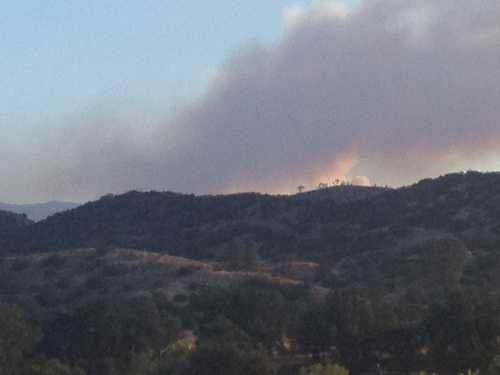
NORTHERN CALIFORNIA – A fire burning in the Mendocino National Forest has reached 150 acres, according to a Saturday evening report from forest officials.
The Mill Fire is burning near the Mill Valley Campground and Upper Letts Lake in Colusa County, as Lake County News reported earlier Saturday evening.
Tamara Schmidt, a Mendocino National Forest spokesperson, said the fire was spotted on the forest at about 3 p.m. Saturday.
Shortly before 8 p.m., Schmidt reported that the fire had grown to 150 acres, with firefighters still in initial attack.
She said a Type 3 Incident Team was working on the fire Saturday night with resources scheduled to be coming in overnight and on Sunday.
Mill Valley, Mill Creek and Letts Lake campgrounds were evacuated, as well as the Board Camp summer home tract, Schmidt said.
The Mill Fire was threatening approximately 25 structures, including the campgrounds, according to Schmidt.
Schmidt said the road between Letts Lake and Fouts Springs, leading to Stonyford, is currently inaccessible.
She said visitors evacuating from the Letts Lake area on the west side of the fire are advised to take the Miner Ridge Road to Road M5 near Cedar Camp and follow M5 or County Road 42 out.
Schmidt said visitors are being asked to avoid the Fouts Springs and Davis Flat area due to increased fire traffic.
Forest officials were not currently aware of any injuries associated with the Mill Fire, Schmidt said.
The cause of the fire is currently under investigation, Schmidt said.
Email Elizabeth Larson at