 How to resolve AdBlock issue?
News
As the California Legislature prepares to consider bills relating to implementing the Affordable Care Act (ACA) and expanding Medicaid, the state has the opportunity to significantly increase health insurance coverage at minimal cost to the state budget, according to a joint study by the University of California, Berkeley’s Center for Labor Research and Education and the UCLA Center for Health Policy Research.
According to the report, new state spending directly related to the expansion is likely to be largely offset by savings from reduced expenses in other state health programs, mental health services and state prisons.
“This is a historic juncture for California: the state has the chance to improve the health of its residents by greatly expanding health care coverage at a relatively minimal cost,” said Laurel Lucia, policy analyst at the UC Berkeley Center for Labor Research and Education and the study's lead author. “And this expansion also would translate into much-needed new jobs for many Californians.”
The report comes as the California Legislature is about to begin a special session to consider health care legislation related to implementing the ACA.
Medicaid eligibility expansion was effectively made optional for states by a U.S. Supreme Court decision last June, and California legislators have not formally approved such a change.
Under the expansion, more than 1.4 million California adults under age 65 will be newly eligible for Medi-Cal (the state's Medicaid program), of which between 750,000 and 910,000 are expected to enroll by 2019.
Researchers estimate new state spending on these enrollees at between $46 million and $75 million in 2014, growing to between $309 million and $381 million in 2019.
The federal government will pay all medical costs for the newly-eligible enrollees from 2014 to 2016 and no less than 90 percent in future years.
The minimal state spending from 2014 to 2016 reflects the state’s share of administrative expenses, which are equivalent to 2.5 percent of medical costs, according to the new report.
Another 240,000 to 510,000 Californians who are already eligible but not yet enrolled are expected to take-up Medi-Cal coverage by 2019.
This is because of greater awareness of coverage options and ACA provisions that require individuals to obtain insurance coverage and require states to simplify Medicaid enrollment and renewal processes, changes taking place regardless of any expansion.
Most of the new annual state Medi-Cal spending from 2014 to 2016 – projected at between $188 million and $471 million, depending on how many people sign up for health insurance – will be related to increased enrollment among Californians who are already eligible.
Billions of dollars in new federal Medi-Cal funds will pay for at least 85 percent of the total costs of the eligibility expansion and increased take-up among those already eligible through 2019.
California has been working towards implementing this Medicaid expansion since 2011 by enrolling 500,000 California adults in coverage prior to ACA implementation through county-based, low -income health programs, said the researchers, and these Californians will transition to Medi-Cal in 2014.
The report’s enrollment projections were made using the California Simulation of Insurance Markets (CalSIM) model, a micro-simulation developed by researchers at the two centers with support from The California Endowment.
CalSIM uses a range of official data sources, including the California Health Interview Survey, to estimate the impact of the ACA on employer decisions to offer insurance coverage and individual decisions to get coverage in California.
To estimate federal and state Medi-Cal spending, the authors calculated average per-member, per-month costs for new enrollees by analyzing data from the state Department of Health Care Services and by applying assumptions based in part on the CalSIM model.
The study was funded by The California Endowment.
The California Legislative Analyst’s Office (LAO) so far has released only very high-level estimates of the impact of state spending under the Medi-Cal expansion.
Lucia added that while the nonprofit Urban Institute think tank in Washington, D.C., has issued a report on the impacts of the health insurance expansion report that provides a state-by-state analysis using national data sources, the UC Berkeley/UCLA report used California-specific data sources and explores the particulars of the California budget.
Read the report: "Medi-Cal Expansion under the Affordable Care Act: Significant Increase in Coverage with Minimal Cost to the State" online at http://laborcenter.berkeley.edu/healthcare/medi-cal_expansion.shtml .
The UC Berkeley Center for Labor Research and Education, a public service and outreach program of the UC Berkeley Institute for Research on Labor and Employment, was founded in 1964 to conduct research and educate on issues related to labor and employment, such as job quality and workforce development.
The UCLA Center for Health Policy Research is one of the nation's leading health policy research centers and the premier source of health-related information on Californians.
Kathleen Maclay writes for UC Berkeley’s News Center.
NORTHERN CALIFORNIA – Cal Fire said this week that it is hiring seasonal firefighters for this year’s fire season.
Seasonal firefighters are entry level positions that eventually can lead to careers in the agency.
Cal Fire firefighters played a key role in helping to stop several large wildland fires burning in and around Lake County and the state during last year’s fire season.
The application filing period for the 2013 season ends Jan. 31.
“Fire Fighter I” is a seasonal, temporary classification used by Cal Fire.
Hiring usually occurs between April and June, depending upon the year's fire and weather conditions.
The minimum qualification to participate in the Fire Fighter I Classification is that a person must be 18 years of age at the time of appointment to the position.
Applications will be accepted by mail or in person for the units in the Northern Region. Applications will not be accepted at Sacramento headquarters, region offices, or conservation camps.
Cal Fire said applications must be filed at each unit where a candidate wishes to be considered for an appointment. For unit contacts see http://calfire.ca.gov/contacts/ .
Applications can be downloaded at http://calfire.ca.gov/about/downloads/careers/FFI_Application.pdf .
For more information visit http://calfire.ca.gov/about/about_careers_fireprotection_seasonal.php .
CLEARLAKE OAKS, Calif. – Two Ukiah teenagers were injured on Saturday when the vehicle in which they were traveling went off of Highway 20 east of Clearlake Oaks.
The crash occurred east of Walker Ridge Road just before 2:30 p.m., according to Officer Kory Reynolds of the California Highway Patrol’s Clear Lake Area office.
The two young women injured were Maria Vargas, 18, and Angelica Duarte, 19, Reynolds reported.
Reynolds said Vargas was driving eastbound on Highway 20 when, for unknown reasons, she allowed her 1999 Toyota Camry to go off the roadway, strike an embankment and overturn.
Northshore Fire Deputy Chief Pat Brown told Lake County News on Saturday that the Camry had gone off the road and about 150 feet down an embankment. Northshore Fire and Williams Fire had to use a rope rescue to bring Vargas and Duarte up from the demolished car.
Reynolds said both young women were transported to St. Helena Hospital Clear Lake. Vargas complained of pain to her back, head and legs, and Duarte had pain and small lacerations to her forehead.
He said the collision is still under investigation by CHP Officer Steve Patrick.
LAKE COUNTY, Calif. – A consortium of local organizations is planning to conduct the first comprehensive survey of the homeless in Lake County later this month.
The survey, which will take place on Friday, Jan. 25, is being carried out as as project of the Lake County Continuum of Care.
That group is composed of agencies including the Employment Development Department, Lake County Social Services, Lake County Office of Education, the Lake Family Resource Center and local churches, amongst others.
The goal is to canvass the groups’ entire service territory across Lake County and seek individuals and families who have challenges securing permanent housing.
Chris Taliaferro of the Employment Development Department, who works with veterans to find employment, said the organizations are combining their efforts for the same goal – helping the homeless.
The survey will give the organizations information they will need to apply for federal grants for such needs as housing vouchers and other services, Taliaferro said.
Gloria Flaherty, executive director of the Lake Family Resource Center, said communities are required to establish their own continuums of care to be eligible for state and federal grants. The consortium reflects countywide homeless issues and includes stakeholders.
She said Lake County is part of a larger continuum of care group composed of eight small rural counties, led by Glenn County.
Flaherty said a count was done in January 2012 of the homeless at shelters only – including the Freedom House domestic violence shelter.
Last September, another count was done in which 62 homeless individuals were identified, said Taliaferro.
The count scheduled for Jan. 25 will include the entire county, not just shelters, said Flaherty.
“This is a larger effort for us,” she said.
The homeless survey will determine what kind of funding and assistance Lake County is eligible to receive, Flaherty said.
It also will be valuable for planning purposes, helping organizations understand demographics – whether the homeless are single or in families, and if there are mental and physical health issues, Flaherty said.
Flaherty said Lake Family Resource Center staff will be involved in the process.
Taliaferro said they are continuing to seek volunteers to help with the count.
So far they have 35 volunteers, who will be divided up into groups to carry out various tasks – from going to homeless camps and recycling centers, to working at specific reporting locations which are still being determined, he said.
During the survey, which takes place from 8:30 a.m. to 4:30 p.m. Jan. 25, volunteers will work side by side with expert homeless service providers, walking and driving assigned routes, officials reported.
Taliaferro said it will be just a collection of data; no names or specific personal information will be taken.
Community members who want to volunteer for the count can contact Taliaferro at the Employment Development Department,
Email Elizabeth Larson at
Limiting climate change to target levels will become much more difficult to achieve, and more expensive, if action is not taken soon, according to a new analysis published in the journal Nature.
The new study examined the probability of keeping average global temperatures from rising more than 2°C above preindustrial levels under varying levels of climate policy stringency, and thus mitigation costs.
In addition, the study for the first time quantified and ranked the uncertainties associated with efforts to mitigate climate change, including questions about the climate itself, uncertainties related to future technologies and energy demand, and political uncertainties as to when action will be taken.
The climate system itself is full of uncertainty – an oft-used argument to postpone climate action until more has been learned.
“We wanted to frame the problem in a new way and try to understand which uncertainties matter in trying to limit global warming by specific climate action,” said Joeri Rogelj, ETH Zurich researcher and lead author on the paper, who carried out the research at the International Institute for Applied Systems Analysis, or IIASA, an international scientific institute that conducts research into the critical issues of global environmental, economic, technological, and social change that we face in the 21st century.
The most important uncertainty, according to the study, is political – that is, the question of when countries will begin to take serious action to reduce greenhouse gas emissions and implement other policies that could help mitigate climate change.
“With a 20-year delay, you can throw as much money as you have at the problem, and the best outcome you can get is a 50-50 chance of keeping temperature rise below two degrees,” said Keywan Riahi, IIASA energy program leader and study co-author.
Two degrees is the level that is currently supported by over 190 countries as a limit to avoid dangerous climate change.
Social uncertainties, which influence consumer energy demand, were second-most important, the study found. Social uncertainties refer to things like people’s awareness and choices with respect to energy and to the adoption of efficient technologies.
“How much energy the world consumes going forward turns out to be a much bigger swing factor for climate change than the availability of technologies like solar and wind power, biofuels, and so on,” said IIASA researcher David McCollum, another co-author. “Energy efficiency, improved urban planning, lifestyle changes – these things on the demand side of the energy equation are so important; yet they receive relatively little attention compared to the supply side.”
The researchers examined geophysical and technological uncertainties and found that while the climate system and energy supply technologies are generally seen as the major factors for climate, they ranked below political and social uncertainties in the new study.
Geophysical uncertainties refer to the unknown – and unknowable – factors about how the climate system will react to greenhouse gas emissions. Technological uncertainties refer to questions about which energy supply and carbon capture systems will be available in the future.
The authors used scenarios to define how these factors affect the probability of staying within a given temperature target, at a variety of carbon prices.
In addition to the 2°C target, the researchers also explored the distribution of costs and risks for limiting global warming to below 1.5°C and 3°C.
Even for a 3°C target, a 20-year delay in the most stringent greenhouse gas reductions in combination with a high demand future means that there would remain a one in three chance that temperatures exceed 3°C.
At the same time, limiting warming to 1.5°C with at least a 50-50 chance – a target supported by the least-developed countries and small island states – appears only to be possible if the world starts acting on climate change now and turns towards an energy-efficient future.
Surprisingly, while much research is focused on understanding the global climate, a highly complex system with many uncertainties, the new study finds that after a certain point, there is little chance of limiting temperature rise to below 2°C.
“Ultimately, the geophysical laws of the Earth system and its uncertainties dictate what global temperature rise to expect,” said Rogelj. “If we delay for 20 years, the likelihood of limiting temperature rise to two degrees becomes so small that the geophysical uncertainties don’t play a role anymore.”
LAKE COUNTY, Calif. – Three cats are awaiting adoption at Lake County Animal Care and Control this week.
All of the cats are adults that have been medically cleared and prepared for new homes.
In addition to spaying or neutering, cats that are adopted from Lake County Animal Care and Control are microchipped before being released to their new owner. License fees do not apply to residents of the cities of Lakeport or Clearlake.
If you're looking for a new companion, visit the shelter. There are many great pets there, hoping you'll choose them.
The following cats at the Lake County Animal Care and Control shelter have been cleared for adoption (other cats pictured on the animal control Web site that are not listed here are still “on hold”).

Male brown tabby
This brown tabby is of undetermined age and gender.
The cat has green eyes and a short coat. Shelter staff didn’t report if it had been altered.
You can find the cat in cat room kennel No. 42, ID No. 35146.
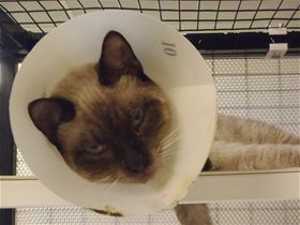
Domestic short hair mix
This male domestic short hair mix is of undetermined age.
He has seal point coloring and blue eyes. Staff did not report if he was altered or not.
He’s in cat room kennel No. 63, ID No. 35131.

Female domestic short hair mix
This female domestic short hair mix is 2 years old.
She has green eyes and a short gray tabby coat, and weighs 9 pounds. She has been spayed.
She’s in cat room kennel No. 88, ID No. 34940.
Adoptable cats also can be seen at http://www.co.lake.ca.us/Government/Directory/Animal_Care_And_Control/Adopt/Cats_and_Kittens.htm or at www.petfinder.com .
Please note: Cats listed at the shelter's Web page that are said to be “on hold” are not yet cleared for adoption.
To fill out an adoption application online visit http://www.co.lake.ca.us/Government/Directory/Animal_Care_And_Control/Adopt/Dog___Cat_Adoption_Application.htm .
Lake County Animal Care and Control is located at 4949 Helbush in Lakeport, next to the Hill Road Correctional Facility.
Office hours are Monday through Friday, 8 a.m. to 5 p.m., and 1 p.m. to 3 p.m., Saturday. The shelter is open from 10:30 a.m. to 4:30 p.m. Monday through Friday and on Saturday from 1 p.m. to 3 p.m.
Visit the shelter online at http://www.co.lake.ca.us/Government/Directory/Animal_Care_And_Control.htm .
For more information call Lake County Animal Care and Control at 707-263-0278.
Email Elizabeth Larson at