 How to resolve AdBlock issue?
News
Even if you live more than 1,000 miles from the nearest large city, it could be affecting your weather.
In a new study that shows the extent to which human activities are influencing the atmosphere, scientists have concluded that the heat generated by everyday activities in metropolitan areas alters the character of the jet stream and other major atmospheric systems.
This affects temperatures across thousands of miles, significantly warming some areas and cooling others, according to the study in Nature Climate Change.
The extra “waste heat” generated from buildings, cars, and other sources in major Northern Hemisphere urban areas causes winter warming across large areas of northern North American and northern Asia.
Temperatures in some remote areas increase by as much as 1 degree Celsius (1.8 degrees Fahrenheit), according to the research by scientists at the Scripps Institution of Oceanography, University of California, San Diego; Florida State University; and the National Center for Atmospheric Research.
At the same time, the changes to atmospheric circulation caused by the waste heat cool areas of Europe by as much as 1 degree C (1.8 degrees F), with much of the temperature decrease occurring in the fall.
The net effect on global mean temperatures is nearly negligible—an average increase worldwide of just 0.01 degrees C (about 0.02 degrees F). This is because the total human-produced waste heat is only about 0.3 percent of the heat transported across higher latitudes by atmospheric and oceanic circulations.
However, the noticeable impact on regional temperatures may explain why some regions are experiencing more winter warming than projected by climate computer models, the researchers conclude. They suggest that models be adjusted to take the influence of waste heat into account.
“The burning of fossil fuel not only emits greenhouse gases but also directly affects temperatures because of heat that escapes from sources like buildings and cars,” says NCAR scientist Aixue Hu, a co-author of the study. “Although much of this waste heat is concentrated in large cities, it can change atmospheric patterns in a way that raises or lowers temperatures across considerable distances.”
The researchers stressed that the effect of waste heat is distinct from the so-called urban heat island effect. Such islands are mainly a function of the heat collected and re-radiated by pavement, buildings, and other urban features, whereas the new study examines the heat produced directly through transportation, heating and cooling units, and other activities.
The study, “Energy consumption and the unexplained winter warming over northern Asia and North America” appears this Sunday. It was funded by the National Science Foundation, NCAR’s sponsor, as well as the Department of Energy and the National Oceanic and Atmospheric Administration.
Hu, along with lead author Guang Zhang of Scripps and Ming Cai of Florida State University, analyzed the energy consumption – from heating buildings to powering vehicles – that generates waste heat release. The world’s total energy consumption in 2006 was equivalent to a constant-use rate of 16 terawatts (one terawatt, or TW, equals 1 trillion watts). Of that, an average rate of 6.7 TW was consumed in 86 metropolitan areas in the Northern Hemisphere.
Using a computer model of the atmosphere, the authors found that the influence of this waste heat can widen the jet stream.
“What we found is that energy use from multiple urban areas collectively can warm the atmosphere remotely, thousands of miles away from the energy consumption regions,” Zhang says. “This is accomplished through atmospheric circulation change.”
The release of waste heat is different from energy that is naturally distributed in the atmosphere, the researchers noted.
The largest source of heat, solar energy, warms Earth’s surface and atmospheric circulations redistribute that energy from one region to another.
Human energy consumption distributes energy that had lain dormant and sequestered for millions of years, mostly in the form of oil or coal.
Though the amount of human-generated energy is a small portion of that transported by nature, it is highly concentrated in urban areas.
In the Northern Hemisphere, many of those urban areas lie directly under major atmospheric troughs and jet streams.
“The world’s most populated and energy-intensive metropolitan areas are along the east and west coasts of the North American and Eurasian continents, underneath the most prominent atmospheric circulation troughs and ridges,” Cai says. “The release of this concentrated waste energy causes the noticeable interruption to the normal atmospheric circulation systems above, leading to remote surface temperature changes far away from the regions where waste heat is generated.”

LAKE COUNTY, Calif. – Several Lake County women made the trip across the United States last week in order to witness President Barack Obama’s inauguration.
Deb Clarke, Judy Conard, Wanda Harris and Joy Swetnam took the trip together to Washington, DC for the Jan. 21 celebration.
The four braved huge crowds, long walks and cold weather to attend the event, joining about another one million people, according to estimates of crowd size.
They received tickets to the event from Congressman John Garamendi, who represents the newly redrawn Third Congressional District, which includes the northern portion of Lake County.
In addition to the inaugural ceremony at the U.S. Capitol, the group attended the Democratic California Bash held at the Washington Court Hotel, one of the celebration’s many inaugural balls.
There, they met up with Garamendi and his wife Patti, who graciously stayed and took time to speak with the group.
They also were able to meet House Minority Leader Nancy Pelosi, US Congresswoman Maxine Waters and Mayor Jean Quan of Oakland, who also attended the event.
The trip was full of sightseeing for the Lake County residents and meeting of many lovely citizens of the DC area, as well as nearby Maryland where they shared a condo. When eating out, they were surprised by the nice selection of Lake County wines.


LAKEPORT, Calif. – Three male dogs are waiting at the county’s animal shelter for adoption this week.
There are two young male pit bull mixes and a smaller Pomeranian mix cleared for takeoff to new homes.
Dogs that are adopted from Lake County Animal Care and Control are either neutered or spayed, microchipped and, if old enough, given a rabies shot and county license before being released to their new owner. License fees do not apply to residents of the cities of Lakeport or Clearlake.
If you're looking for a new companion, visit the shelter. There are many great pets hoping you'll choose them.
The following dogs at the Lake County Animal Care and Control shelter have been cleared for adoption (additional dogs on the animal control Web site not listed are still “on hold”).

Pomeranian mix
This male Pomeranian mix is 2 years old.
He has a long black and white coat, is small in size and has been neutered.
He’s in kennel No. 8, ID No. 35274.

Male pit bull terrier mix
This male pit bull terrier mix is 1 year old.
He weighs 42 pounds, and has a short brown brindle and white coat. Shelter staff did not report if he had been altered.
He’s in kennel No. 11, ID No. 35318.

Male pit bull terrier mix
This male pit bull terrier mix is 2 years old.
He has a short brown brindle coat and is of medium size. It was not noted if he had been altered.
Find him in kennel No. 24, ID No. 35338.
Please note: Dogs listed at the shelter's Web page that are said to be “on hold” are not yet cleared for adoption.
To fill out an adoption application online visit http://www.co.lake.ca.us/Government/Directory/Animal_Care_And_Control/Adopt/Dog___Cat_Adoption_Application.htm .
Lake County Animal Care and Control is located at 4949 Helbush in Lakeport, next to the Hill Road Correctional Facility.
Office hours are Monday through Friday, 8 a.m. to 5 p.m., and 1 p.m. to 3 p.m., Saturday. The shelter is open from 10:30 a.m. to 4:30 p.m. Monday through Friday and on Saturday from 1 p.m. to 3 p.m.
Visit the shelter online at http://www.co.lake.ca.us/Government/Directory/Animal_Care_And_Control.htm .
For more information call Lake County Animal Care and Control at 707-263-0278.
Email Elizabeth Larson at

Peering deep into the dim edges of a distorted pinwheel galaxy in the constellation Ursa Major (the Great Bear), astronomers at Case Western Reserve University and their colleagues have discovered a faint dwarf galaxy and another possible young dwarf caught before it had a chance to form any stars.
Within the faint trails of intergalactic traffic, the researchers also found more evidence pointing to two already known dwarf galaxies as probable forces that pulled the pinwheel-shaped disk galaxy known as M101 out of shape.
M101 is the dominant member in a group of 15 galaxies in Ursa Major. Most galaxies reside in such small-group environments, which means the factors shaping M101 are likely the same shaping most galaxies throughout the universe, the researchers say.
Their efforts, which required the researchers to discern starlight 100 times fainter than the black of the dark night sky and trace extremely low concentrations of interstellar gases among the celestial bodies, are reported in two papers published in the Astrophysical Journal.
“We created the deepest image ever taken of M101 and followed it up with the most sensitive survey of gas clouds surrounding the galaxy,” said Chris Mihos, an astronomy professor at Case Western Reserve and lead author of both papers. “Compared to what is seen in the Hubble Space Telescope image, the galaxy’s disk is much larger and we can see very large, faint plumes of stars and streamers of gas in its outskirts.”
Perhaps most surprisingly, the researchers discovered two new clouds of hydrogen gas in the M101 group, more distant and distinct from M101’s own supply of gas.
The gas clouds, formally named G1425+5235 and G1355+5439, were nicknamed Skipper and Gilligan by the team, and identified as new dwarf galaxies in the group, independent from M101 itself.
A followup analysis of images from the Sloan Digital Sky Survey showed a faint patch of starlight associated with Skipper, confirming its status as a true dwarf galaxy with a population of both gas and stars.
But the same analysis found no stars inside Gilligan. Gilligan could be a proto dwarf-galaxy, Mihos said, where the density of gas inside the cloud was too low for gravity to squeeze the gas down and form stars.
“We’ll follow up,” Mihos said. “There’s a gas cloud but no stars yet. People have seen a few starless clouds before, but they’ve always associated with gas from a larger galaxy. This is different—it has nothing to link it to the other galaxies in the group. It may be one of the first true protogalaxies ever discovered.”
As galaxies move within galaxy groups, they may sideswipe one another or even run into each other head-on.
These intergalactic traffic jams leave behind telltale signatures in the galaxies’ stars and gas. In the faint light around M101, the researchers discovered such evidence of a sideswipe in the galaxy’s past: a distorted plume of starlight reaching far to the northeast of the galaxy, and a second plume extending to the east.
The shapes and colors of the plumes suggest that they formed when a small galaxy passed by M101, and its gravity tugged stars and gas out from the bigger galaxy.
The northeast plume of the pinwheel is bluer than any other region of the galaxy, indicating it is made from younger stars.
“We think it was born about 250 million years ago. It has the right colors,” Mihos said. “If the material in the blue plume was pulled out of an interaction with another galaxy, the interaction was probably 250 million years ago.
“The eastern spur is redder, which is what you expect from an older set of stars. We think, unlike the blue plume of new stars, the eastern spur formed when stars from the older, inner part of the disk were pulled out during the encounter.”
The gas far from the center of M101 is less strongly attached to the galaxy and is therefore more likely to be drawn out by interactions with other galaxies. The trail of neutral hydrogen leaves clues that can be used to reconstruct past near misses and collisions with other galaxies.
Analysis of position and motion of gas around M101 suggests that the nearby galaxy NGC 5474 was the one that recently interacted with M101. The two galaxies appear to be linked by a stream of gas pulled out from one or both galaxies during the interaction.
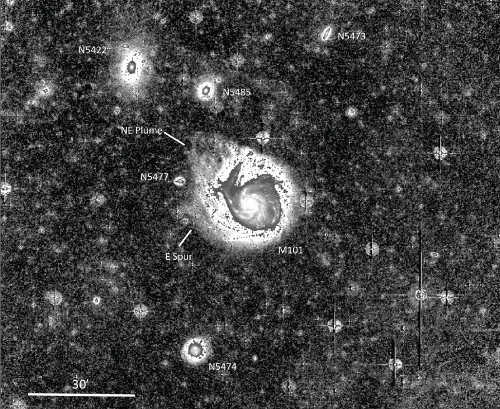
The plume of red stars also may have been formed during this interaction, from older stars pulled from M101’s inner disk, the researchers conclude. Or, another nearby dwarf galaxy, NGC 5477, may have acted alone or in concert with NGC 5474 to draw material from inner disk.
To do the optical survey, they relied on Case Western Reserve’s revamped 72-year-old Burrell Schmidt wide field telescope, located at Kitt Peak National Observatory near Tucson, Ariz.
The team then used the Robert C. Byrd Green Bank Telescope at the National Radio Astronomy Observatory in Green Bank, W.Va., to perform the most sensitive survey ever of neutral hydrogen gas – the fuel for forming new stars and galaxies – around M101.
To see the incredibly faint light from M101’s outer disk required a series of changes to the Burrell Schmidt telescope.
“We’re looking at signals buried in the noise; the noise here is scattered and stray light,” said Paul Harding, Case Western Reserve’s observatory manager.
Harding, associate astronomer Charlie Knox and the rest of the CWRU team reconfigured the telescope, replacing the secondary mirror with a larger version, but moving it farther from the primary mirror. The results: a wider field of view – nine moons can fit in the view – without significantly increasing the amount of light obstructed by the secondary mirror.
They then treated the optical surfaces of the telescope’s camera with an anti-reflective coating and lined the inside of the telescope with black velvet, further reducing scattered and stray light.
To test whether Gilligan is a protogalaxy, Mihos said they hope to use the Very Large Array telescope at the National Radio Astronomical Observatory in the desert southwest of Albuquerque, N.M., to map out the gas in more detail, compare it to known dwarf galaxies, and determine if it’s getting ready to form stars.
If, however, this gas cloud is a protogalaxy, it may not begin forming stars for millions or billions of years to come.

LAKE COUNTY, Calif. – The Lake County Office of Education and two local high schools, Middletown High School and Upper Lake High School, are quickly approaching their inaugural Mock Trial Competition.
In 1980, Constitutional Rights Foundation (CRF) introduced the Mock Trial Program to all the counties in California.
The program was created to help students acquire a working knowledge of our judicial system, develop analytical abilities and communication skills, and gain an understanding of their obligations and responsibilities as participating members of our society.
The program currently involves 36 California counties.
Schools are partnered with teacher coaches and local attorneys to coach them through the materials and the rules in a court room.
Students compete during local, county competitions and the winning team then travels to compete at the state level Mock Trial competition.
Thanks to local donations, including a donation from the District Attorney’s Alternative to Community Service program, the winning Lake County high school team, will be able to travel to the state competition which is held in Riverside this year.
“This is a great program that introduces students to the legal system. We are glad to be able to support our local youth,” said Lake County District Attorney Don Anderson.
Lake County Office of Education officials said they are very grateful to all of the local attorneys and deputy district attorneys who have partnered with local teams to support our youth.
Donations are still being sought to help support the winning team’s expenses. For more information or to send a donation to support the state level competition, please contact Lake County Office of Education, Attn: Mock Trial program, 1152 S. Main St., Lakeport CA 95453, or contact Stephanie Wayment at 707-262-4163,
“Health in Mind,” a new report from Healthy Schools Campaign (HSC) and Trust for America’s Health (TFAH), details immediate solutions that can help close the achievement gap and create a healthy future for all children.
American children are struggling academically and the nation faces a growing achievement gap that is increasingly tied to health disparities-today’s children could become the first generation to live shorter and less healthy lives than their parents, notes the report.
Health in Mind offers a strong framework for addressing the nation’s most urgent health and education challenges by outlining strategies within the current regulatory and budget framework of the Department of Education and Department of Health and Human Services that the administration can utilize to better the conditions for health and learning in schools.
The report also examines the research connecting health disparities with educational outcomes and presents case studies of innovative on-the-ground practices across the nation.
“We’ve never met a parent, teacher or school leader who didn’t recognize that healthy students are better prepared to learn,” said Rochelle Davis, president and chief executive officer of HSC, a national advocacy organization that focuses much of its work on improving the food and fitness environment in Chicago schools.
“But the truth is that vast health disparities exist in our nation and far too many children attend school in environments that do not support their health,” Davis said. “Unless we address these challenges, our efforts to close the achievement gap will be compromised. The consequences are enormous for children’s learning and for their lifetime health.”
Health in Mind presents research, policy analysis and immediate recommendations focused on:
- Preparing teachers and principals to promote student health and wellness;
- Engaging parents in school health;
- Incorporating health and wellness into school metrics, accountability and recognition programs; Building the Department of Education’s capacity to address student health and wellness; and Placing a school nurse in every school.
“We are beginning to see an important shift in the way the nation addresses health and wellness,” said Jeffrey Levi, PhD, executive director of TFAH. “With Health in Mind and the National Prevention Strategy, we’ve begun to move toward integrating and thinking about health in all of the contexts-education, transportation, housing and other areas-that impact health. Specifically focusing on the connection between health and school will ensure students can do as well as possible academically and are healthier.”
“We know that health and education are inextricably linked; with that knowledge, we must shift how we approach both wellness and the school day,” said Dr. Gail Christopher, vice president for program strategy at the W.K. Kellogg Foundation. “The Health in Mind report points us forward. Our communities truly can develop children who are healthy, smart and strong. Doing so will take creativity and commitment from leaders at all levels. I am confident we can rise to that challenge.”
The report follows a May 2012 event at which HSC and TFAH, with the support of the nation’s largest education unions, presented a set of recommendations to U.S. Secretary of Education Arne Duncan and U.S. Secretary of Health and Human Services Kathleen Sebelius.
At the event, both Secretary Duncan and Secretary Sebelius publicly expressed their support for the goals that would form the basis for Health in Mind.
In December 2012, 10 members of Congress signed on to a letter to Secretary Duncan and Secretary Sebelius expressing their support for the recommendations.
More than 70 organizations representing the nation’s health and education advocates have signed on to the Health in Mind vision statement.
For more information or to view the full report, please visit www.healthinmind.org .