How to resolve AdBlock issue?
News
LAKE COUNTY, Calif. – The Lake County Winery Association invites community members to be the judges at the People’s Choice Wine Awards at the Lake County Fair on Saturday, Aug. 31.
The event takes place from 4 p.m. to 7 p.m. at the Lake County Fairgrounds, 401 Martin St., Lakeport.
As follow up to the competitive and prestigious 2013 Lake County Wine Awards event, where an acclaimed panel of wine experts from across the country blind-tasted and awarded medals to the top Lake County wines, community members are invited to judge for themselves and select the “People’s Choice.”
“We were honored to have a distinguished panel of professional wine judges evaluate the wines of our distinct winegrowing region and we are excited to share those wines with our community and discover The People’s Choice,” said Jacquelyn Farrington of Six Sigma Ranch, the event’s chair.
Tickets cost $45, which includes entrance to the fair and People’s Choice.
For more information or to purchase tickets to the People’s Choice Wine Competition on Aug. 31, visit www.lakecountywineries.org .
LAKE COUNTY, Calif. – On Friday, the day that striking Lake Transit workers had intended to return to the job, curtailed bus services remained in place as the transit operator said it was taking its legally afforded time to process the return of workers.
At the same time, both Teamsters Local 665 and Paratransit Services have indicated their willingness to return to negotiations in order to arrive at a new contract.
Teamsters Local 665, which represents 28 striking Lake Transit workers, accused Paratransit Services, the operator of Lake Transit, of locking out employees after they were not allowed to return to work on Friday.
However, Paratransit Services officials said they were using the five days to process the workers’ return to work that is afforded to employers by the National Labor Relations Act,
“The reason for this is to insure that all administrative matters are handled in a legally appropriate manner and the rights of all parties are protected in the process,” Paratransit Services said in a Friday statement.
The Washington-based nonprofit said it has several “special cases” involving striking employees that they need to make sure are handled appropriately.
Paratransit Services said it is retaining the replacement workers it has hired since the strike started. The striking workers will be allowed to come back when they’re called from a preferential recall list to fill open positions, a process that Paratransit Services said is typically done based on seniority.
Despite the continuing tensions, the two sides appear ready to head back to the negotiating table.
Local 665 President Ralph Miranda said he sent a letter to the federal mediator overseeing negotiations to ask that Paratransit Services meet them for negotiations.
On Friday, Paratransit Services said it also had requested that negotiations resume next week and were awaiting a response.
Also on Friday, Assemblymember Yamada traveled to Lower Lake to visit with the striking workers and with Paratransit Services officials.
This week, Yamada and state Sen. Noreen Evans had sent the union and Lake Transit a letter encouraging the two sides to sit down for binding arbitration.
Paratransit Services representatives gave Yamada their own update on the status of negotiations and discussed the service restoration.
They reported that Yamada informed them that she didn't want to involve herself in local matters and realized they had a federally assigned mediator to assist in negotiations.
The strike began on Monday, July 29, less than a month after a two-day strike union members held to protest continuing disagreements over wages.
The union had agreed to give up step increases in 2010 during negotiations for the contract still in place, but argue that they had done so with the understanding that the step increases would be restored once the economy improved.
On Thursday Teamsters members voted to return to work immediately and unconditionally in an effort to restore full transit services to the community members that rely on them.
That followed a Wednesday Lake Transit Authority Board meeting in which the union called on the board to support binding arbitration and appoint a fact-finding group to help bring the strike to an end.
The board declined to take action, saying the contract between Lake Transit and Paratransit Services prohibits the authority from interfering with the employer-employee contractor.
The union, which has consistently asserted that Paratransit Services can’t restore services through the beginning of September as it says it is on track to do, said its members chose to return to work “for the benefit of those who have been left stranded by the ineptness of Paratransit.”
During the strike, Local 665 called on Lake Transit to enforce performance of its contract, but at the Wednesday transit board meeting, Lake Transit General Manager Mark Wall said the contract’s language allowed for the contractor to be fined only $200 per month if it failed to meet performance standards.
Paratransit Services said Friday that it intends to move forward with restoring the majority of services by next Thursday, Aug. 22. Revised scheduled will be issued this next Monday.
Meanwhile, Teamsters Local 665 Secretary-Treasurer Mark Gleason said Friday that union leadership and members plan to head to Sacramento to seek a review and hearing concerning the conduct of Lake Transit and Paratransit Services.
Email Elizabeth Larson at
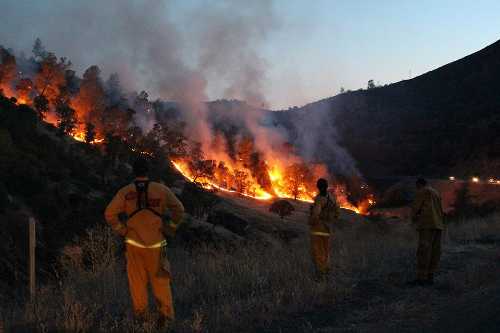
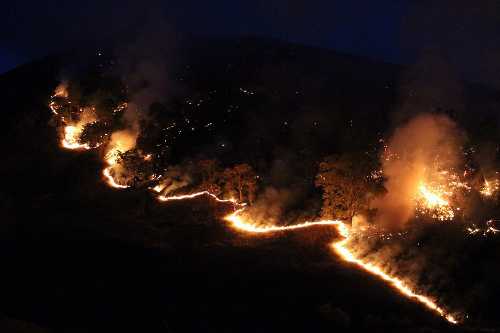
CLEARLAKE OAKS, Calif. – State and local firefighters remained on scene overnight at a fire burning east of Clearlake Oaks.
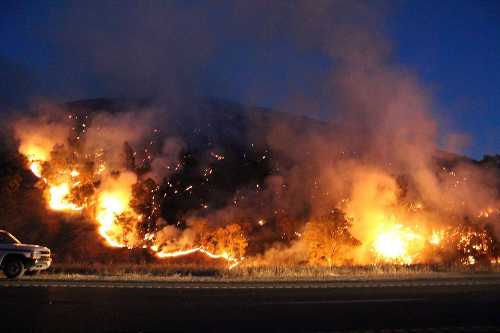
The Double Fire was sparked shortly before 6 p.m. Friday on the south side of Highway 20 at Mule Skinner Road near the Double Eagle Ranch, Cal Fire reported.
By late Friday night the fire had burned 70 acres and was 20 percent contained, according to Cal Fire Battalion Chief Greg Bertelli.
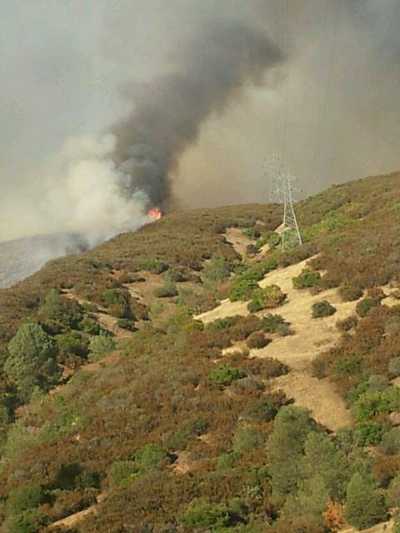
The fire is burning in steep, rugged country, consuming mainly brush and some grass and oak woodland, Bertelli said.
“We’re getting some spotting right now,” he said shortly after 10 p.m. Friday, explaining that a spot fire was burning on the opposite side of the highway but firefighters were picking it up.
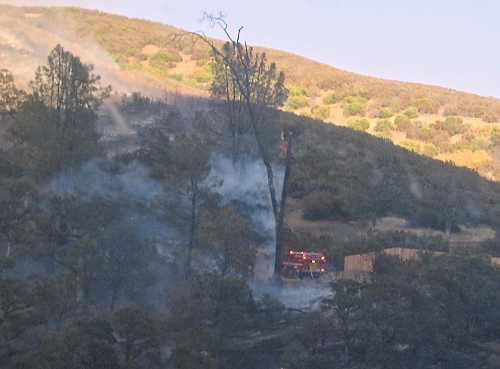
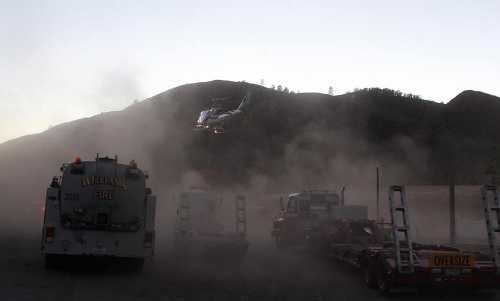
On scene overnight were four hand crews, 10 engines, four bulldozers, four water tenders and numerous overhead officers, with resources coming from Cal Fire, Lake County Fire, Northshore Fire and Kelseyville Fire, Bertelli said. Williams Fire also had resources at the scene.
“Everyone’s going to be working all night,” said Bertelli.
Fire resources will be stepped up in the morning, when Bertelli said they will bring in four additional hand crews, which are necessary due to the terrain’s inaccessibility to equipment like bulldozers.
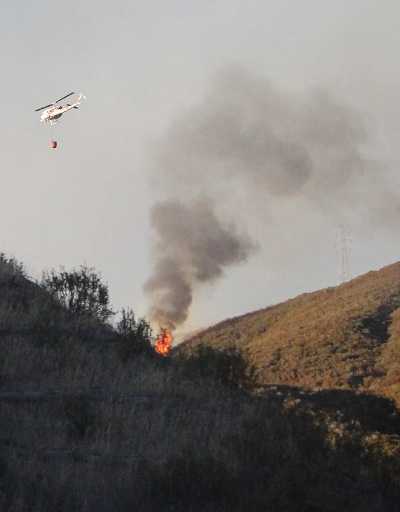
Cal Fire had sent air attack, tankers and a helicopter to the scene on Friday evening, with those air resources hitting the fire aggressively during its first hours, when there had been concerns that the fire had the potential to burn hundreds of acres.
A concern overnight was the wind. Bertelli said the winds usually kick up at night and can shift, but they were cautiously optimistic. “We’re not letting our guard down.”
The California Highway Patrol remained on scene helping with traffic control through the fire area.
Bertelli said the CHP was slowing traffic down as it passed along Highway 20 near the fire, and he urged people to be cautious in that area.
He expected traffic control to be in effect until the fire is contained.
As to an expected containment time, Bertelli said, “We’ll be out here at least for a couple few days.”
Email Elizabeth Larson at
Atmospheric physicist Nick Gorkavyi missed witnessing an event of the century last winter when a meteor exploded over his hometown of Chelyabinsk, Russia.
From Greenbelt, Md., however, NASA’s Gorkavyi and colleagues witnessed the atmospheric aftermath. The explosion created a never-before-seen belt of “meteor dust” that circulated through the stratosphere for at least three months.
Shortly after dawn on Feb. 15, 2013, the meteor, or bolide, measuring 18 meters across and weighing 11,000 metric tons, screamed into Earth’s atmosphere at 41,600 miles per hour.
Burning from the friction with Earth’s thin air, the space rock exploded 23 km above Chelyabinsk, releasing more than 30 times the energy from the atom bomb that destroyed Hiroshima.
Some of the surviving pieces of the Chelyabinsk bolide fell to the ground. But the explosion also deposited hundreds of tons of dust up in the stratosphere, allowing the NASA-NOAA Suomi National Polar-orbiting Partnership satellite to make unprecedented measurements of how the material formed a thin but cohesive and persistent stratospheric dust belt.
“We wanted to know if our satellite could detect the meteor dust,” said Gorkavyi, of NASA’s Goddard Space Flight Center in Greenbelt, Md., who led the study, which has been accepted for publication in the journal Geophysical Research Letters. “Indeed, we saw the formation of a new dust belt in Earth’s stratosphere, and achieved the first space-based observation of the long-term evolution of a bolide plume.”
Gorkavyi and colleagues combined a series of satellite measurements with atmospheric models to simulate how the plume from the bolide explosion evolved as the stratospheric jet stream carried it around the Northern Hemisphere.
About three and a half hours after the initial explosion, the Ozone Mapping Profiling Suite instrument’s Limb Profiler on Suomi detected the plume high in the atmosphere at an altitude of about 40 km, quickly moving east at about 190 miles per hour.
The day after the explosion, the satellite detected the plume continuing its eastward flow in the jet and reaching the Aleutian Islands.
Larger, heavier particles began to lose altitude and speed, while their smaller, lighter counterparts stayed aloft and retained speed – consistent with wind speed variations at the different altitudes.
By Feb. 19, four days after the explosion, the faster, higher portion of the plume had snaked its way entirely around the Northern Hemisphere and back to Chelyabinsk. But the plume’s evolution continued: At least three months later, a detectable belt of bolide dust persisted around the planet.
The scientists’ model simulations, based on the initial Suomi NPP observations and knowledge about stratospheric circulation, confirmed the observed evolution of the plume, showing agreement in location and vertical structure.
“Thirty years ago, we could only state that the plume was embedded in the stratospheric jet stream,” said Paul Newman, chief scientist for Goddard’s Atmospheric Science Lab. “Today, our models allow us to precisely trace [the dust from] the bolide and understand its evolution as it moves around the globe.”
The full implications of the study remain to be seen.
Every day, tens of metric tons of small material from space encounters Earth and is suspended high in the atmosphere.
Even with the addition of the Chelyabinsk debris, the environment there remains relatively clean. Particles are small and sparse, in contrast to a stratospheric layer just below where abundant natural aerosols from volcanoes and other sources collect.
Still, with satellite technology now capable of more precisely measuring tiny atmospheric particles, scientists can embark on new studies in high-altitude atmospheric physics.
How common are previously unobservable bolide events? How might this debris influence stratospheric and mesospheric clouds?
Scientists previously knew that debris from an exploded bolide could make it high into the atmosphere. In 2004, scientists on the ground in Antarctica made a single lidar observation of the plume from a 1,000-ton bolide.
“But now in the space age, with all of this technology, we can achieve a very different level of understanding of injection and evolution of meteor dust in atmosphere,” Gorkavyi said. “Of course, the Chelyabinsk bolide is much smaller than the ‘dinosaurs killer,’ and this is good: We have the unique opportunity to safely study a potentially very dangerous type of event.”
Dr. Tony Phillips works for the National Aeronautics and Space Administration.
People who relocate into or out of California may confront the issue of whether the living trust that they established in the state of their former residence should be revoked and a new trust established under the laws of their new state of residence.
Let us discuss the issues.
Trusts are contracts. Like all contracts trusts must declare which state’s laws govern the administration, interpretation and validity of the trust instrument.
Typically, the laws of the state where the trust is established are initially chosen. Accordingly, when a California resident establishes a living trust for his California assets, California law governs. A California court is then much better able to understand how the terms of the trust and California law interplay.
It is more difficult when a court must interpret a trust established out of state and apply a different state’s law relating to the interpretation and validity of the trust.
California statutory trustee powers, trustee authorities and trust administration rules that apply to all California trusts, except insofar as the trust specifically provides otherwise, automatically apply.
In certain areas, however, California law requires that the trust follow the statutory rules without exception.
What if the California resident later leaves California? A trust is administered wherever the trustee resides. The laws of the second state where the trustee now resides would apply should the trustee ever use the state’s courts with respect to administration matters, such as the duties of the trustee to the beneficiaries and the rights of the beneficiaries under state law.
The laws of the first state would usually continue to apply to issues of interpretation and validity. That said, different states take different views on what issues are matters of administration, on the one hand, versus matters of interpretation or validity, on the other.
Does that mean that a new trust must always be established in the second state? It depends.
If the resident moves between community property states then perhaps a new trust is not necessarily needed. Some trusts provide that its governing law may be changed.
If so, is changing which state law governs sufficient? Not usually. Amending the state specific legal references concerning the trustee powers, trustee authority, and definition of legal terms will need to be amended.
Next, is it always desirable to change the jurisdiction of a trust when relocating? Not always. It might not be suitable if there were significant real property holdings or legal issues continuing in the first state.
For example, consider a settlor moves from California to Arizona, also a community property state, but who keeps a home in California and has death beneficiaries in California, he or she might decide to keep the California trust as such.
Also there may be asset protection and tax differences between the laws of the states that require consideration.
Depending on circumstance, the settlor might decide to add the new assets acquired in Arizona to the California trust or perhaps establish a separate trust under Arizona law.
What if the original trust is generally speaking out of date? Obviously, in that case it is much more likely that the old trust will be revoked (scrapped) and assets transferred to a new trust established under the laws of the second state.
Lastly, when people change residences they will want to create new powers of attorneys under the new state’s laws to designate agents to make decisions during periods of incapacity affecting their finances, property, legal affairs, and health care.
Dennis A. Fordham, attorney (LL.M. tax studies), is a State Bar Certified Specialist in Estate Planning, Probate and Trust Law. His office is at 55 First St., Lakeport, California. Dennis can be reached by e-mail at

NORTHERN CALIFORNIA – Two children abducted from Elko, Nev., earlier this week are the subjects of a newly issued Amber Alert.
The California Highway Patrol issued the alert Friday evening on behalf of the Elko Police Department in the effort to locate 9-year-old Lillyanna Ramires and her younger brother Martin Angel Rosales, 3.
The Amber Alert was activated from Sacramento south to Mexico, the CHP said.
Authorities said the children were the victim of a parental abduction that occurred at around 4 p.m. Wednesday.
The suspects believed to have abducted the children are Martin Cisneras Rosales, 33, the father of the little boy, and Amber Schenck, 29, who is the mother of both children, authorities said.
Nevada media are reporting that the children were taken from the Department of Child and Family Services, whose care they were in due to concerns for their safety.
The couple may be driving a 1980s or 1990s model blue Ford Mustang, with a Nebraska or paper license plate, the CHP said.
The CHP said both children and Martin Rosales are Hispanic, but could not offer other physical descriptions.
Schenck is a Caucasian female with sandy-colored hair and blue eyes. She is 5 feet, 9 inches tall and weighs 150 pounds.
If they’re seen, the public is asked to immediately call 911.