 How to resolve AdBlock issue?
News
The next time you step onto an airplane, consider the following: In any given year, the pilot of your aircraft probably absorbs as much radiation as a worker in a nuclear power plant.
And you are about to follow him wherever he goes.
The FAA classifies pilots as “occupational radiation workers.” Flying high above Earth with little atmosphere to protect them, they can absorb significant doses of cosmic rays and solar radiation.
During a typical polar flight from Chicago to Beijing, for instance, a pilot is exposed to the equivalent of two chest x-rays. Multiplied over the course of a career, this can cause problems such as increased risk of cancer and possibly cataracts.
Passengers have reason to be concerned, too.
“A 100,000 mile frequent flyer gets about 20 chest x-rays,” points out Chris Mertens, a senior research scientist at NASA Langley Research Center. “This is true regardless of the latitude of the flights.”
It’s worth noting that even people on the ground absorb some radiation.
Cosmic rays and their by-products are so powerful, they can reach all the way down to Earth’s surface, giving a person at sea level the equivalent of one chest x-ray every 10 days or so.
On a plane, however, dose rates increase 10-fold or more. The exposure depends on factors ranging from the altitude and latitude of the flight path (polar routes are irradiated most) to sunspot counts and solar activity (a powerful solar storm can boost radiation levels a hundredfold).
To help airline companies safeguard passengers and personnel, NASA is developing an experimental tool to predict exposures in real time.
Mertens is the PI of the system, called NAIRAS – short for “Nowcast of Atmosphere Ionizing Radiation for Aviation Safety.”
Mertens notes that the number of flights over the poles has skyrocketed in recent years. Airlines prefer polar routes for international travel because they are shorter and have reduced head winds, creating fuel savings of tens of thousands of dollars per flight.
However, Earth's poles are where the radiation problem can be most severe. Our planet's magnetic field funnels cosmic rays and solar energetic particles over the very same latitudes where airlines want to fly.
On a typical day when the sun is quiet, dose rates for international flights over the poles are 3 to 5 times higher than domestic flights closer to the equator.
If a flight controller wants to know the situation around the poles right now, NAIRAS can help. It is, essentially, an online global map of radiation dose rates for different flight paths and altitudes.
Maps are produced in near real-time by a computer at Langley, which combines cutting-edge physics codes with realtime measurements of solar activity and cosmic rays.
“We are still in an experimental phase,” he said. “The ultimate goal of the NAIRAS effort is to adopt a paradigm similar to terrestrial weather forecasting.”
The value to the airlines is clear. The ability to fly over the poles can save $35,000 to $40,000 per flight in fuel costs alone. On the other hand, altering course to avoid a polar radiation storm can cost as much as $100,000. A forecasting tool like NAIRAS can help the airlines make the right decision.
Of even greater importance to Mertens is the human factor.
“Back in 2004, I went to a workshop on space weather and aviation. A pilot from American Airlines stood up to address the audience: ‘Look,’ he said, ‘we are classified as radiation workers, we are the most exposed than any other group, yet we know the least of all the groups.’ That was a turning point for me. I wanted to do something to help pilots better understand what they are flying into.”
And so NAIRAS was born.
Mertens and colleagues are about to publish a paper in the journal Space Weather comparing NAIRAS predictions to actual radiation measurements onboard airplanes.
“The results are encouraging,” he said, “but we still have work to do.”
Dr. Tony Phillips works for the National Aeronautics and Space Administration.

LAKEPORT, Calif. – Last Saturday, Oct. 19, 15 contestants in the Miss Lake County and Miss Lake County's Outstanding Teen Scholarship Pageant at the Soper-Reese Community Theatre in Lakeport reemphasized that beauty is more than skin deep.
Rather, it is mind-, heart- and soul-deep.
The pageant has been imparting this message for more than 70 years.
Beauty is the time and volunteerism girls and young women have put into a variety of social concerns before they even step into the pageant spotlight.
It is the winner of this year's pageant, Alice Crockett's, platform which was the growing concern over obesity with 81 million obese people in the United States.
A freshman at Folsom Lake College who is studying for her registered nurse degree, Crockett's excellence in academics, performing arts and social issues cover a wide spectrum for so young a person.
The crowning as 2014 Miss Lake County for the Clear Lake High School graduate this year follows her being awarded the Miss Lake County's Outstanding Teen title in 2012.
Beauty is the campaign against bullying in the schools waged by Teylor Tobin, a Terrace Middle School student.
Teylor was not only the youngest contestant ever in the teenage (13-17) segment, but, as the new Miss Lake County's Outstanding Teen, its youngest winner. Teylor, according to Pageant Executive Director Diana Dahl, only this month turned 13.
And beauty is the volunteer work of young Middletown real estate agent Sarah Zepeda, a second runner-up for this year's Miss Lake County title. Zepeda goes to Bangladesh every summer to aid human trafficking victims.
… Or it is the visits that Julie Ann Mather, last year's Miss Lake County's Outstanding Teen, has made to 10 different schools to promote healthy diets, exercise, stress relief and self-love?
“The pageant is not based on beauty,” said Dahl, who moved into her executive directorship this year with the retirement of Sandra Orchid, but has been with the organization since 2006. “It's based on the way (contestants) walk on to the stage. Do they grab your attention?
“Some girls come out and just light up the room,” Dahl added. “These are the girls who move on to become ambassadors for the county.”
In the Miss Lake County competition, in addition to Crockett, scholarship support winners were Courtny Conkle of Lakeport, first runner-up, a freshman at Santa Rosa Junior College; Zepeda of Hidden Valley Lake, a sophomore at Simpson University, second runner-up; and Miranda Richardson of Lakeport, a junior at Cabrillo College, third runner-up.
Zepeda won Miss Congeniality and the Bob Borghesani Community Service Award, and Crockett won the Michael and Linnea Humble Interview Award.
In the Miss Lake County's Outstanding Teen event, in addition to winner Teyler Tobin, Audrey Showen of Middletown, a freshman at Middletown High School, was first runner-up; Kennedi Syphax of Lakeport, a junior at Clear Lake High School, was second runner-up; and Teda Cheng of Clearlake, a sophomore at Lower Lake High School, was third runner-up.
Kimberly English of Lakeport, a freshman at Clear Lake High School, won the Miss Congeniality title; Kennedi Syphax won the Brian L. Grey Interview Award and tied with Jamie Canada of Lakeport, a Clear Lake High School student, for the Bob Borghesani Community Service Award; and Mariah Rudnick, a sophomore at Clear Lake High, won the Peoples Choice Award.
Miss Lake County and Miss Lake County's Outstanding Teen also will move on to the competition for Miss California and Miss California's Outstanding Teen – along with young women from 57 other counties – in Fresno next June.
It is a tough battle. Only one Miss Lake County – Elizabeth Davis – in the 1970s made it into the top 10.
“All of the girls have backgrounds in volunteering,” said Dahl, “and they all have different social platforms. They have taken on race relations, bullying, obesity and other concerns. In the Miss California competition they also honor the girls who have the best platforms.”
In Lake County, girls 13-17 (who are not high school seniors) are eligible to compete in the Miss Lake County's Outstanding Teen division. Young women 18-24 can compete for Miss Lake County honors.
How do the girls and young women in Miss Lake County Pageants prosper from the experience?
To begin with, scholarship support, which the top three contestants in both divisions of the competition receive. Eight Miss Lake County contestants and seven teens vied for more than $8,300 in scholarships this year.
But, moreover, said Dahl, “They all learn different things.
“The girls learn confidence on stage,” she explained. “They learn speaking skills and they learn volunteerism, which is needed. Part of their platform is volunteering. They actually have to turn a resume into the (six) judges that show volunteerism in the community.
Dahl added: “The girls who want to win next year are going to volunteer in the community all this year. So we have 15 girls out there who are already planning on the volunteer work they're going to be doing. It just teaches them to be better leaders, volunteering, physical fitness and taking care of themselves.”
Email John Lindblom at

LAKE COUNTY, Calif. – The Lake County Office of Education’s AmeriCorps Program is partnering with Lake County CAN! in holding its annual Make A Difference Day nonperishable food drive on Saturday.
Make A Difference Day is a national day of service during which volunteers across the county will take part in service projects to make a difference here in Lake County.
Volunteers will be at locations around Lake County collecting food and at several locations assisting on community improvements projects.
Some of the AmeriCorps food collection sites include Sentry Market in Nice, Foods Etc. IGA in Clearlake, Grocery Outlet in Lakeport and Clearlake, and Bruno’s Foods and Safeway in Lakeport.
Lake Transit Authority will furnish two buses to be parked at Clearlake Grocery Outlet and Lakeport Grocery Outlet stores for the day, where volunteers will be on hand to collect food and stuff the buses with donations.
This marks the 13th year of the event. Since its inception, more than 48,000 pounds of food have been collected and distributed to Lake County families.
All proceeds stay in Lake County and will go to Lake County CAN! for distribution to food cupboards/pantries and food baskets for Lake County residents.

LAKEPORT, Calif. – A fundraiser next month will help a family whose son is fighting brain cancer.
The tri tip barbecue dinner and silent auction to benefit Ronnie Dekeyser III and his family will take place on Saturday, Nov. 9, at the Lakeport Elks Lodge, 3775 Lakeshore Blvd.
Ronnie, 11, was diagnosed with diffuse pontine glioma, a cancerous brain tumor, in 2007 when he was 5 years old.
For the past three years the tumor has been inactive, but four months ago the tumor became active again, and it's inoperable.
This fundraiser is to raise money to help this courageous boy fulfill his wish list.
Ronnie likes dirt bike riding, camping and fishing, NASCAR racing and monster trucks. He wants to go on a hot air balloon ride, ride the Skunk Train and go to Chuck E. Cheese.
Recently he became an honorary police officer with the Lakeport Police Department, as Lake County News has reported.
The auction will start at 3 p.m., with food service to begin at 4 p.m. and continue until it runs out.
There also will be raffles as well as a silent auction.
Organizers are looking for local businesses to donate for the silent auction. Any and all donations would be much appreciated.
For more information please call Carla Gallagher at 707-245-0283, Jo Ann Gettman at 707-263-3956 or Lakeport Elks Lodge at 707-263-8422.
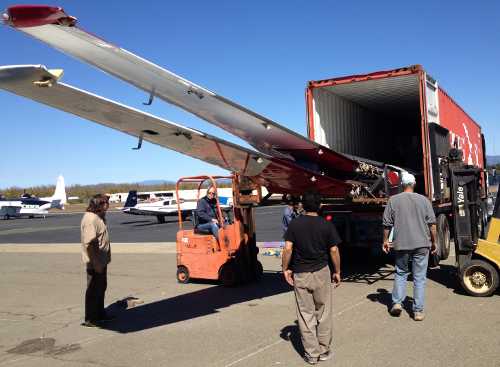
LAKEPORT, Calif. – How challenging is it to package up not one, but two airplanes for a long ocean voyage from Lakeport to Australia?
The staff at local business Lake Aero Styling and Repair (LASAR) recently found out.
After many hours of specialized work by the skilled staff at LASAR, the single engine airplanes were ready to be shipped to their new owners in Australia.
Paul Loewen, owner of LASAR, oversaw the entire project.
“One of the airplanes was here for a month-long retrofit and upgrade of its radios equipment and navigation screens,” said Loewen.
It was flown to Lake County from Portland, Ore., by local pilot Damon Trimble.
The second aircraft, a unique Porsche powered turbo-charged Mooney, began its journey in Wisconsin.
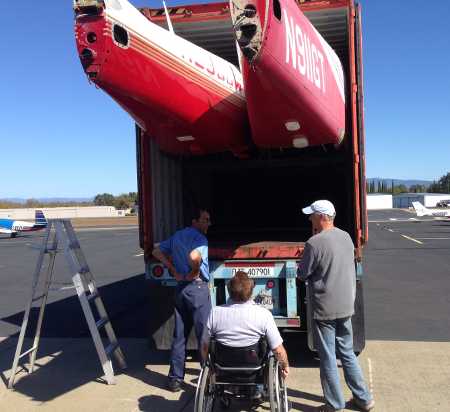
Both Mooney airplanes were partially disassembled and carefully loaded onto racks that were specially designed to support the two aircraft bodies, wings, and tails and to fit into the cargo container.
Hamish Ramsey, owner of a Mooney service center in Wangaratta, Victoria, Australia, spent three months in Lakeport managing the retrofit project and designing the special shipping racks.
“We continue to appreciate the excellent service by the creative, talented, and friendly folks at Lampson Field for our overseas aviation requirements,” Ramsey said.

Ramsey and the two Mooney aircraft are now on their way to Australia.
Aircraft businesses at Lampson Field support our local economy by attracting a wide variety of aviation customers from both U.S. and international locations, including Europe, Asia, Africa, Canada, and South America.
“Virtually all of our business is from outside of Lake County,” reports Steve Culbertson, owner of a Lampson aircraft repair company.
Tom Wasson, owner of a general maintenance shop, agrees and points out that seven of the eight airplanes currently in his shop are from out of the county.
“Our local aircraft businesses have earned a reputation for excellence,” Loewen noted. “In addition to a large number of highly qualified technicians and employees at the Lampson businesses, there is enough business brought into Lake County to keep several local pilots busy providing delivery services from all corners of the world.”
Yankee Composites owner Rick Anderson added that his shop that specializes in the repair and maintenance of composite aircraft has almost all of its customers come from outside of Lake County.


The ozone hole that forms each year in the stratosphere over Antarctica was slightly smaller in 2013 than average in recent decades, according to NASA satellite data.
The ozone hole is a seasonal phenomenon that starts to form during the Antarctic spring (August and September). The September-October 2013 average size of the hole was 8.1 million square miles.
For comparison, the average size measured since the mid-1990s when the annual maximum size stopped growing is 8.7 million square miles.
However, the size of the hole in any particular year is not enough information for scientists to determine whether a healing of the hole has begun.
“There was a lot of Antarctic ozone depletion in 2013, but because of above average temperatures in the Antarctic lower stratosphere, the ozone hole was a bit below average compared to ozone holes observed since 1990,” said Paul Newman, an atmospheric scientist and ozone expert at NASA's Goddard Space Flight Center in Greenbelt, Md.
The ozone hole forms when the sun begins rising again after several months of winter darkness.
Polar-circling winds keep cold air trapped above the continent, and sunlight-sparked reactions involving ice clouds and chlorine from manmade chemicals begin eating away at the ozone.
Most years, the conditions for ozone depletion ease before early December when the seasonal hole closes.
Levels of most ozone-depleting chemicals in the atmosphere have gradually declined as the result of the 1987 Montreal Protocol, an international treaty to protect the ozone layer by phasing out production of ozone-depleting chemicals.
As a result, the size of the hole has stabilized, with variation from year to year driven by changing meteorological conditions.
The single-day maximum area this year was reached on Sept. 16 when the maximum area reached 9.3 million square miles, about equal to the size of North America.
The largest single-day ozone hole since the mid-1990s was 11.5 million square miles on Sept. 9, 2000.
Science teams from NASA and the National Oceanic and Atmospheric Administration (NOAA) have been monitoring the ozone layer from the ground and with a variety of instruments on satellites and balloons since the 1970s.
These ozone instruments capture different aspects of ozone depletion. The independent analyses ensure that the international community understands the trends in this critical part of Earth's atmosphere.
The resulting views of the ozone hole have differences in the computation of the size of the ozone hole, its depth, and record dates.
NASA observations of the ozone hole during 2013 were produced from data supplied by the Ozone Monitoring Instrument on NASA's Aura satellite and the Ozone Monitoring and Profiler Suite instrument on the NASA-NOAA Suomi National Polar-orbiting Partnership satellite.
Long-term satellite ozone-monitoring instruments have included the Total Ozone Mapping Spectrometer, the second generation Solar Backscatter Ultraviolet Instrument, the Stratospheric Aerosol and Gas Experiment series of instruments, and the Microwave Limb Sounder.