How to resolve AdBlock issue?
News
State health officials said Friday that the deaths related to seasonal influenza are continuing to increase.
Dr. Ron Chapman, director of the California Department of Public Health and state health officer, said the number of confirmed influenza-related deaths in the state has increased to 45 for the season so far, including two pediatric deaths.
This is an increase of 38 deaths from last week’s announcement, Chapman said.
“Flu activity continues to increase statewide, including reports of hospitalizations, severe disease and the number of deaths,” said Dr. Chapman. “We are clearly in the midst of what appears to be an earlier peaking, severe flu season, and I encourage everyone who has not yet gotten a flu vaccination to do so. The influenza vaccine remains the most effective way to protect yourself from the flu.”
For the most recent reporting period, ending Jan. 11, there were an additional 38 confirmed deaths in 20 counties throughout California, Chapman said. That brings the total of influenza related deaths for the season to 45.
Chapman said an additional 50 deaths are under investigation by CDPH.
The 45 influenza-associated deaths this season have been reported by the following counties: Alameda (3), Contra Costa (2), Kern (1), Kings (2), Lassen (1), Los Angeles (4), Marin (2), Mendocino (1), Merced (2), Orange (3), Riverside (1), Sacramento (5), San Bernardino (4), San Diego (3), San Francisco (1), San Mateo (2), Santa Barbara (1), Santa Clara (3), Sonoma (1) and Stanislaus (3). The pediatric deaths occurred in Los Angeles and San Mateo counties, according to Chapman's report.
There is no shortage of influenza vaccine. At the state level, CDPH still has about 50,000 state-purchased doses that are available to local health departments, Chapman said.
He said there also are more than 290,000 federally purchased Vaccines for Children (VFC) program doses available to order by local health departments or private providers.
Lake County Public Health continues to offer the vaccine. Walk-in clinic hours at the Public Health offices, located at 922 Bevins Court in Lakeport, are 9 a.m. to 11 a.m. Tuesdays, 11 a.m. to 1 p.m. Wednesdays and 2 p.m. to 4 p.m. Thursdays.
In addition, the agency will hold a Clearlake flu clinic from 10:30 a.m. to 12:30 p.m. Tuesday, Jan. 21, at the Highlands Senior Center, 3245 Bowers Road.
Lake County Public Health charges $2 per person for the shots. Call 800-794-9291 or 263-1090 for more information.
There are many more doses available on the private market for private providers, Chapman said.
The state said it is possible that private health care providers in California may temporarily run out of stock from time-to-time, but ample supplies of vaccine are still available for order. There also are no known widespread shortages of anti-viral medication to treat influenza.
CDPH continues to monitor flu activity statewide and the availability of vaccine and anti-virals, as well as hospital capacity.
Dr. Chapman also notes that in addition to getting vaccinated, it's important to practice good hand washing and other good health habits.
He said people who are ill should take actions to stop the spread of germs such as:
- While sick, limit contact with others;
- Cover your nose and mouth when coughing or sneezing;
- Wash hands thoroughly with soap and water, or use an alcohol-based rub;
- Avoid touching your eyes, nose and mouth.
Those at highest risk – the elderly, pregnant women, infants, or those with other health conditions – who show flu symptoms should contact their physician immediately in order to get the most effective treatment, Chapman said.
Symptoms include fever, cough, sore throat, runny or stuffy nose, muscle or body aches, headaches and fatigue, according to Chapman.
For more information on influenza and other respiratory disease surveillance reports visit http://www.cdph.ca.gov/data/statistics/Pages/CISPDataArchive.aspx .
With California facing water shortfalls in the driest year in recorded state history, Gov. Edmund G. Brown Jr. today proclaimed a state of emergency and directed state officials to take all necessary actions to prepare for these drought conditions.
“We can’t make it rain, but we can be much better prepared for the terrible consequences that California’s drought now threatens, including dramatically less water for our farms and communities and increased fires in both urban and rural areas,” said Gov. Brown. “I’ve declared this emergency and I’m calling all Californians to conserve water in every way possible.”
In the state of emergency declaration, Gov. Brown directed state officials to assist farmers and communities that are economically impacted by dry conditions and to ensure the state can respond if Californians face drinking water shortages.
The Governor also directed state agencies to use less water and hire more firefighters and initiated a greatly expanded water conservation public awareness campaign (details at www.saveourh2o.org ).
In addition, the proclamation gives state water officials more flexibility to manage supply throughout California under drought conditions.
State water officials say that California’s river and reservoirs are below their record lows. Manual and electronic readings record the snowpack’s statewide water content at about 20 percent of normal average for this time of year.
The governor’s drought state of emergency follows a series of actions the administration has taken to ensure that California is prepared for record dry conditions.
In May 2013, Gov. Brown issued an executive order to direct state water officials to expedite the review and processing of voluntary transfers of water and water rights.
In December, the governor formed a drought task force to review expected water allocations, California’s preparedness for water scarcity and whether conditions merit a drought declaration.
Earlier this week, the governor toured the Central Valley and spoke with growers and others impacted by California’s record dry conditions.
The full text of the emergency proclamation is below.
A PROCLAMATION OF A STATE OF EMERGENCY
WHEREAS the State of California is experiencing record dry conditions, with 2014 projected to become the driest year on record; and
WHEREAS the state’s water supplies have dipped to alarming levels, indicated by: snowpack in California’s mountains is approximately 20 percent of the normal average for this date; California’s largest water reservoirs have very low water levels for this time of year; California’s major river systems, including the Sacramento and San Joaquin rivers, have significantly reduced surface water flows; and groundwater levels throughout the state have dropped significantly; and
WHEREAS dry conditions and lack of precipitation present urgent problems: drinking water supplies are at risk in many California communities; fewer crops can be cultivated and farmers’ long-term investments are put at risk; low-income communities heavily dependent on agricultural employment will suffer heightened unemployment and economic hardship; animals and plants that rely on California’s rivers, including many species in danger of extinction, will be threatened; and the risk of wildfires across the state is greatly increased; and
WHEREAS extremely dry conditions have persisted since 2012 and may continue beyond this year and more regularly into the future, based on scientific projections regarding the impact of climate change on California’s snowpack; and
WHEREAS the magnitude of the severe drought conditions presents threats beyond the control of the services, personnel, equipment and facilities of any single local government and require the combined forces of a mutual aid region or regions to combat; and
WHEREAS under the provisions of section 8558(b) of the California Government Code, I find that conditions of extreme peril to the safety of persons and property exist in California due to water shortage and drought conditions with which local authority is unable to cope.
NOW, THEREFORE, I, EDMUND G. BROWN JR., Governor of the State of California, in accordance with the authority vested in me by the state Constitution and statutes, including the California Emergency Services Act, and in particular, section 8625 of the California Government Code HEREBY PROCLAIM A STATE OF EMERGENCY to exist in the State of California due to current drought conditions.
IT IS HEREBY ORDERED THAT:
1.State agencies, led by the Department of Water Resources, will execute a statewide water conservation campaign to make all Californians aware of the drought and encourage personal actions to reduce water usage. This campaign will be built on the existing Save Our Water campaign (www.saveourh20.org) and will coordinate with local water agencies. This campaign will call on Californians to reduce their water usage by 20 percent.
2.Local urban water suppliers and municipalities are called upon to implement their local water shortage contingency plans immediately in order to avoid or forestall outright restrictions that could become necessary later in the drought season. Local water agencies should also update their legally required urban and agricultural water management plans, which help plan for extended drought conditions. The Department of Water Resources will make the status of these updates publicly available.
3.State agencies, led by the Department of General Services, will immediately implement water use reduction plans for all state facilities. These plans will include immediate water conservation actions, and a moratorium will be placed on new, non-essential landscaping projects at state facilities and on state highways and roads.
4.The Department of Water Resources and the State Water Resources Control Board (Water Board) will expedite the processing of water transfers, as called for in Executive Order B-21-13. Voluntary water transfers from one water right holder to another enables water to flow where it is needed most.
5.The Water Board will immediately consider petitions requesting consolidation of the places of use of the State Water Project and Federal Central Valley Project, which would streamline water transfers and exchanges between water users within the areas of these two major water projects.
6.The Department of Water Resources and the Water Board will accelerate funding for water supply enhancement projects that can break ground this year and will explore if any existing unspent funds can be repurposed to enable near-term water conservation projects.
7.The Water Board will put water right holders throughout the state on notice that they may be directed to cease or reduce water diversions based on water shortages.
8.The Water Board will consider modifying requirements for reservoir releases or diversion limitations, where existing requirements were established to implement a water quality control plan. These changes would enable water to be conserved upstream later in the year to protect cold water pools for salmon and steelhead, maintain water supply, and improve water quality.
9.The Department of Water Resources and the Water Board will take actions necessary to make water immediately available, and, for purposes of carrying out directives 5 and 8, Water Code section 13247 and Division 13 (commencing with section 21000) of the Public Resources Code and regulations adopted pursuant to that Division are suspended on the basis that strict compliance with them will prevent, hinder, or delay the mitigation of the effects of the emergency. Department of Water Resources and the Water Board shall maintain on their websites a list of the activities or approvals for which these provisions are suspended.
10. The state’s Drinking Water Program will work with local agencies to identify communities that may run out of drinking water, and will provide technical and financial assistance to help these communities address drinking water shortages. It will also identify emergency interconnections that exist among the state’s public water systems that can help these threatened communities.
11.The Department of Water Resources will evaluate changing groundwater levels, land subsidence, and agricultural land fallowing as the drought persists and will provide a public update by April 30 that identifies groundwater basins with water shortages and details gaps in groundwater monitoring.
12.The Department of Water Resources will work with counties to help ensure that well drillers submit required groundwater well logs for newly constructed and deepened wells in a timely manner and the Office of Emergency Services will work with local authorities to enable early notice of areas experiencing problems with residential groundwater sources.
13.The California Department of Food and Agriculture will launch a one-stop website (www.cdfa.ca.gov/drought) that provides timely updates on the drought and connects farmers to state and federal programs that they can access during the drought.
14.The Department of Fish and Wildlife will evaluate and manage the changing impacts of drought on threatened and endangered species and species of special concern, and develop contingency plans for state Wildlife Areas and Ecological Reserves to manage reduced water resources in the public interest.
15. The Department of Fish and Wildlife will work with the Fish and Game Commission, using the best available science, to determine whether restricting fishing in certain areas will become necessary and prudent as drought conditions persist.
16.The Department of Water Resources will take necessary actions to protect water quality and water supply in the Delta, including installation of temporary barriers or temporary water supply connections as needed, and will coordinate with the Department of Fish and Wildlife to minimize impacts to affected aquatic species.
17.The Department of Water Resources will refine its seasonal climate forecasting and drought prediction by advancing new methodologies piloted in 2013.
18.The California Department of Forestry and Fire Protection will hire additional seasonal firefighters to suppress wildfires and take other needed actions to protect public safety during this time of elevated fire risk.
19.The state’s Drought Task Force will immediately develop a plan that can be executed as needed to provide emergency food supplies, financial assistance, and unemployment services in communities that suffer high levels of unemployment from the drought.
20.The Drought Task Force will monitor drought impacts on a daily basis and will advise me of subsequent actions that should be taken if drought conditions worsen.
I FURTHER DIRECT that as soon as hereafter possible, this Proclamation be filed in the Office of the Secretary of State and that widespread publicity and notice be given of this Proclamation.
IN WITNESS WHEREOF I have hereunto set my hand and caused the Great Seal of the State of California to be affixed this 17th day of January, 2014.
______________________________
EDMUND G. BROWN JR.,
Governor of California
ATTEST:
______________________________
DEBRA BOWEN,
Secretary of State
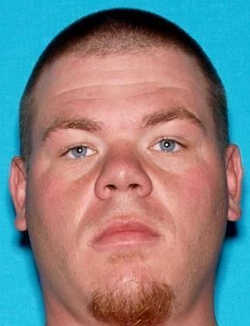
LAKEPORT, Calif. – The Lakeport Police Department is continuing to seek a suspect who is believed to have been involved in a series of burglaries in the city last week.
Burglary suspect Jeffery William Stokes, 25, whose last known address is in Upper Lake, was identified as being responsible for the downtown burglaries, as Lake County News has reported.
Lakeport Police Department Chief Brad Rasmussen said the agency has a warrant to arrest Stokes, who has been formally charged with numerous felony and misdemeanor crimes.
Rasmussen said that on Monday the Lake County District Attorney's Office filed a complaint accusing Stokes of eight counts of felony burglary, five counts of felony possession of stolen property, four counts of misdemeanor theft, and one count each of misdemeanor possession of burglary tools and vandalism.
The arrest warrant issued for Stokes covers all of those charges, Rasmussen said.
Stokes is 6 feet, 2 inches tall and weighs 220 pounds, has blue eyes, and is bald or has very short hair, according to police.
Due to prior media coverage Rasmussen said police have received numerous calls from the public about where Stokes may be located but so far they have not been able to track him down.
Anyone with information on Stokes' location is asked to contact the Lakeport Police Department at 707-263-5491.
UPPER LAKE, Calif. – Following two previous meetings that had involved lengthy debates on the topic, the Upper Lake High School District Board voted Wednesday night to separate the graduations of Upper Lake High School and the district's continuation high school, Clover Valley.
The board was split on the topic, with trustees Claudine Pedroncelli and Wanda Quitiquit against the action.
The decision won't affect this year's graduation, when at least two Clover Valley grads are expected to walk the stage with Upper Lake High's graduating seniors.
Superintendent/Principal Patrick Iaccino said the board wasn't comfortable making the change midyear, with students now having the expectation of the shared commencement. Instead, the transition will occur in the 2014-15 school year.
The two schools' graduations have been combined for about a decade, and the matter has come up regularly over the years, according to school officials.
The shared graduation was a discussion item at the board's December meeting as well as a special workshop this past Saturday, when Iaccino said they spent three hours on the topic.
Between those previous meetings and Wednesday night, Pedroncelli and Quitiquit hadn't changed their opposition to the move. Trustee Richard Swaney remained supportive of the separation, and Board President Keith Austin and Trustee Valerie Duncan both indicated the Saturday discussion had brought their support for two ceremonies into focus.
It was Duncan who made the motion at the meeting to separate the ceremonies, with Swaney seconding. Pedroncelli then moved to table the matter, a motion that failed 2-3.
Pedroncelli said she felt there was a “disconnect” between what is happening at Clover Valley and Upper Lake High. “What I see happening is very disheartening to me,” she said, adding that to her the quality of education mattered most.
Iaccino explained that, historically, continuation schools are separate, although Upper Lake and Clover Valley share a variety of facilities and resources, including computer access and online classes.
“I think we provide students many opportunities out there,” Iaccino said.
However, he pointed to Clover Valley High's low attendance rates. “Why aren't they taking advantage of what they're given?”
There are 13 seniors at Clover Valley High right now. “Very few of them come to school,” Iaccino said.
Rather than having them attend Clover Valley, where the standards are less rigid, “I can keep them here,” he said, referring to Upper Lake High, “and guess what they're not going to do in June? They're not going to walk any stage.”
The students won't take the opportunities offered to get a diploma, Iaccino said. “I wish I had the answer.”
Austin told his board colleagues that he would be angry if a vote to separate the ceremonies was construed as anti-student.
Each school has different requirements for attendance and graduation, and they don't have the same curriculum. “Everything that is different about it says to me that we need to have a separate graduation,' Austin said.
“If we're doing anything, we're robbing them of the chance or the opportunity to better themselves” by not requiring them to come to school and get decent grades to graduate, he said.
Austin said he believed the separation was necessary and that it would be effective for children who are “on the bubble.”
“We have to eliminate the possibility that those students are going to abuse the system and not see or recognize the value of what they're getting from their diploma,” Austin said.
The board then took the 3-2 vote to separate the graduations.
Later in the meeting, Pedroncelli said she believed the graduation issue has “far reaching end results,” and that she planned to tour Clover Valley High to get a better sense of what goes on there.
While recognizing that they can't force someone to do something, she said the district had an “obligation to inspire” its students, adding she believed Clover Valley's students are being forgotten. Quitiquit agreed, saying she wanted to find ways to motivate the students.
Swaney said if they sent a motivation speaker to the school there would be no one there for them to talk to because of the poor attendance. He hoped that the plans for a school resource officer would help with that problem.
He called the Wednesday night vote “a call to arms” on how they get truant students back in school.
Christian McMilin, the student board member, supported separating the graduations. She said she's not seen any of Clover Valley High's students or their parents come forward to say they want the dual ceremony. Had she, McMilin said it might have changed her mind.
She added that she's friends with a student at Clover Valley High who doesn't care about the issue.
“How do we make them care?” Austin asked.
Pedroncelli said they could agree that was a key question.
“Motivation is needed on this campus as well,” she added.
Email Elizabeth Larson at
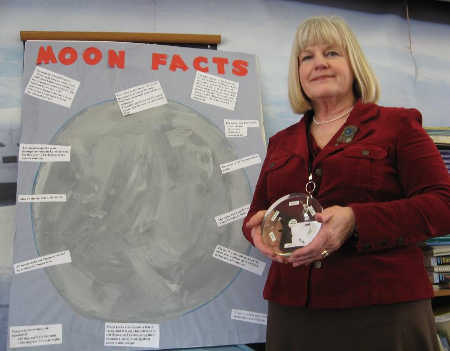
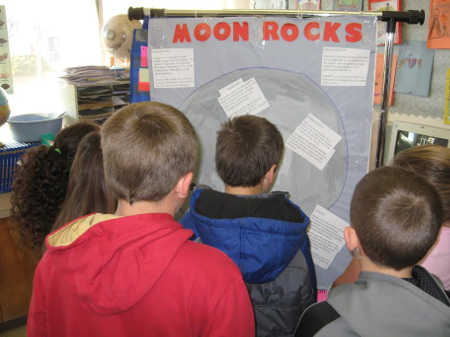
HIDDEN VALLEY LAKE, Calif. – Students in Kathy Scavone's fourth grade class became docents of the moon when they gave “moon tours” to hundreds of students at Coyote Valley Elementary School last week.
Scavone took a class at NASA Ames Research Center to allow her to borrow and interpret our country's national treasures, the lunar samples, or moon rocks, to students.
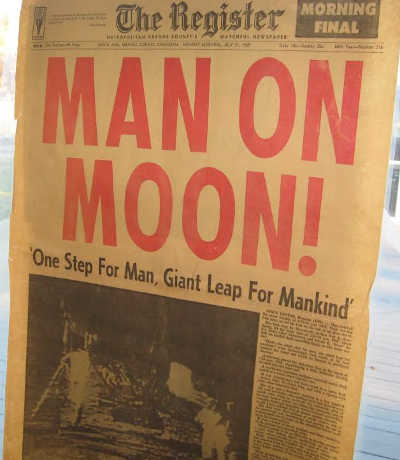
The “moon stations” included a newspaper dated July 20, 1969 with the bold headlines, “Men on the Moon!”
Students learned what daring events unfolded back then, with thousands of people working together in the space program to make this extraordinary feat occur, and that millions of people around the world watched in wonder as the moon landing story unfolded, and astronaut Neil Armstrong said, “That's one small step for man, and one giant leap for mankind.”
Students' tours included posters with information on the Apollo missions, moon facts, moon phases, moon rocks facts, then viewed the actual lunar samples.
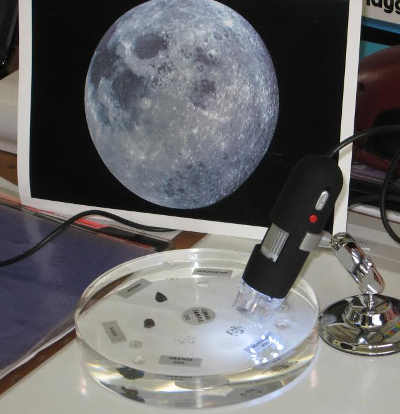
The lunar samples, small rocks and soils obtained from the over 800 pounds of rocks brought back to Earth from some of the six manned moon missions which spanned the years 1969 to 1973 were encased in a clear, plastic disc so that they would not change, or oxidize.
The rocks and soils were viewed on the large Smart Board via a new computer-microscope. The six samples included mare soil, the fragments of which were produced by meteorites hitting basalts.
The mare soil held grains of the minerals feldspar and pyroxene and were collected by the Apollo 17 mission, the last mission by humans to the moon. Breccia was viewed, which was collected by the Apollo 15 astronauts near Hadley Rille, a canyon-like depression on the moon.
Breccias are made of fragments of other rocks that were smashed by meteorite bombardment on the moon.
They viewed orange soil, which is a mixture of dark red-orange and black spheres returned by Apollo 17 astronauts when they used shovels to collect this unique soil at the moon's Mare Serenitatis.
Orange soil originated over 3.5 billion years ago from volcanic lava sprays. When the debris was in flight, it cooled to form the tiny glass spheres.
Anorthosite is a breathtakingly beautiful white rock comprised mainly of feldspar crystals. This sample was retrieved from the moon's Descartes region in the light-colored highlands of the center of the moon by Apollo 16 astronauts.
Anorthosite's crystals were once pale gray, but when meteorites bombarded the moon and broke the crust into fragments, the feldspar was 'shocked' and shattered, turning the crystals white.
They viewed Highland Soil which was collected by the Apollo 16 astronauts near the moon's center, on highlands between dark “mare” areas.
This soil is comprised of particles of rocks, mineral grains and glass melted during the meteorite impacts on the moon's surface long ago. The glasses included in Highland Soil are many colors, such as brown, pale green, gray and black.
The other lunar sample in the disc they viewed was basalt. Basalt formed when lava spilled onto the moon's surface and cooled, then crystallized. The grains in the basalt were pyroxene, feldspar, olivine and iron titanium oxide. The sample was collected in August 1971 by the Apollo 15 astronauts at the east edge of Mare Imbrium, the large circular area on the moon's upper left surface.
Some of the other things student's shared through their studies of moon rocks: Students learned that 12 men walked on the moon from 1969 to 1973, and there were six manned landings.
All moon rocks are igneous. Moon rocks are similar to Earth rocks, but Moon rocks contain no water and Earth rocks do. It is easy for scientists to tell them apart under a microscope and by analyzing their chemistry.
The moon, like Earth, has a crust, mantle, outer core, inner core and moonquakes. The poles of the moon contain metric tons of water ice.
The “man in the moon” we see on the moon's surface is the large Imbrium, formed by meteorites. The dark areas we see are called maria, and are layered with basalt lava.
The astronauts left a sign on the moon that says, “Here men from the planet Earth first set foot upon the moon July 1969, A.D. We came in peace for all mankind.”
Kathleen Scavone, M.A., is an educator, potter, writer and author of “Anderson Marsh State Historic Park: A Walking History, Prehistory, Flora, and Fauna Tour of a California State Park” and “Native Americans of Lake County.” She also writes for NASA and JPL as one of their “Solar System Ambassadors.” She was selected “Lake County Teacher of the Year, 1998-99” by the Lake County Office of Education, and chosen as one of 10 state finalists the same year by the California Department of Education.
KELSEYVILLE, Calif. – On Tuesday the Sheriff’s Narcotics Task Force served a search warrant on a Kelseyville residence and subsequently seized 216 marijuana plants and the residence was red-tagged.
Lt. Steve Brooks of the Lake County Sheriff's Office said narcotics detectives on Tuesday secured a search warrant for a residence located in the 10000 block of Boren Bega Drive, serving the warrant at 2 p.m. that day.
Brooks said detectives entered the residence and were unable to locate anyone. The house was sparsely furnished and it was obvious to the detectives that no one was living at the residence full-time.
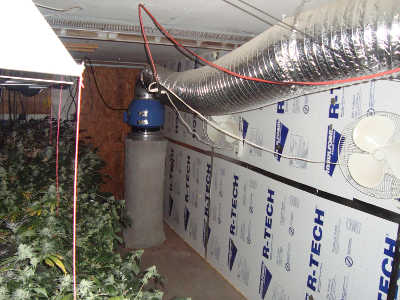
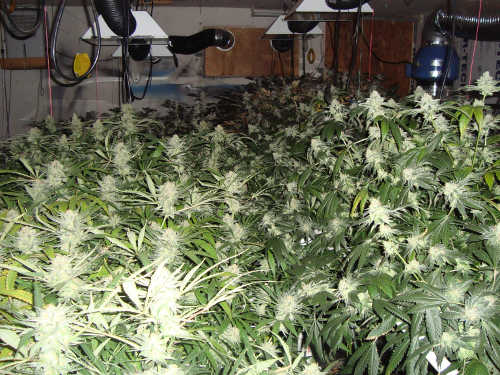
It appeared the residence was only being used to cultivate marijuana. Brooks said one of the bedrooms was converted into a drying room and another bedroom was being utilized to clone the marijuana plants.
He said the garage was sectioned off with a vegetation room, containing nonflowering plants and a flowering room which contained mature plants.
The remainder of the garage was being used as a processing area for the marijuana and chemical storage, Brooks said.
Brooks said narcotics detectives located and eradicated 216 marijuana plants, which were in different stages of growth.
Lake County Code Enforcement assisted the detectives by red-tagging the residence for unsafe and unpermitted electrical wiring, Brooks said.
The investigation is ongoing and Brooks said detectives are pursuing all leads to identify the suspects responsible for the illegal cultivation of marijuana.
The Sheriff’s Narcotics Task Force can be reached through its anonymous tip line at 707-263-3663.