 How to resolve AdBlock issue?
News
LAKE COUNTY, Calif. – Lake County Animal Care and Control is offering five male dogs for adoption as the week begins.
The dogs are mixes of border collie, Labrador Retriever, pit bull and terrier, and range in age from 15 weeks to 2 years.
Dogs that are adopted from Lake County Animal Care and Control are either neutered or spayed, microchipped and, if old enough, given a rabies shot and county license before being released to their new owner. License fees do not apply to residents of the cities of Lakeport or Clearlake.
If you're looking for a new companion, visit the shelter. There are many great pets hoping you'll choose them.
In addition to the animals featured here, all adoptable animals in Lake County can be seen here: http://bit.ly/Z6xHMb .
The following dogs at the Lake County Animal Care and Control shelter have been cleared for adoption (additional dogs on the animal control Web site not listed are still “on hold”).

'Dugan'
“Dugan” is a 2-year-old pit bull terrier-Labrador Retriever mix.
He has a short brown coat, weighs 66 pounds and has been neutered.
Find him in kennel No. 14, ID No. 40080.

Male terrier mix
This male terrier mix is 2 years old.
He weighs 11 pounds, has a short tan and white coat, and has not been neutered.
Find him in kennel No. 25, ID No. 39953.

'Kody'
“Kody” is an 8-month-old male border collie mix.
He weighs 57 pounds, has a short tan and white coat, and has been neutered.
He's in kennel No. 27, ID No. 40041.
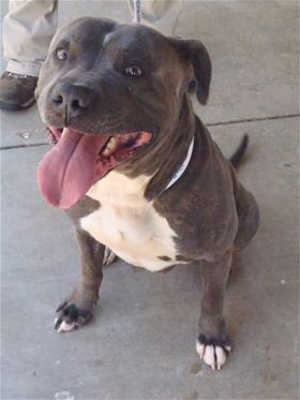
'Blue'
“Blue” is a 2-year-old male pit bull terrier mix.
He has a medium-length blue coat, weighs 73 pounds and has not been neutered.
Find him in kennel No. 28, ID No. 39852.

Pit bull terrier mix puppy
This male pit bull terrier mix puppy is 15 weeks old.
He has a short brown brindle and white coat, weighs 12 pounds and has not been neutered.
He's in kennel No. 32a, ID No. 39792.
To fill out an adoption application online visit http://www.co.lake.ca.us/Government/Directory/Animal_Care_And_Control/Adopt/Dog___Cat_Adoption_Application.htm .
Lake County Animal Care and Control is located at 4949 Helbush in Lakeport, next to the Hill Road Correctional Facility.
Office hours are Monday through Friday, 8 a.m. to 5 p.m., and 1 p.m. to 3 p.m., Saturday. The shelter is open from 10:30 a.m. to 4:30 p.m. Monday through Friday and on Saturday from 1 p.m. to 3 p.m.
Visit the shelter online at http://www.co.lake.ca.us/Government/Directory/Animal_Care_And_Control.htm .
For more information call Lake County Animal Care and Control at 707-263-0278.
Email Elizabeth Larson at
LAKE COUNTY, Calif. – The cities of Clearlake and Lakeport reported that the candidate filing periods are about to open for the municipal elections on Nov. 4.
The clerks for the two cities said their candidate filing periods – for posts including city council seats – open at 8 a.m. Monday, July 14.
The filing periods close at 5 p.m. Friday, Aug. 8, unless one or more of the incumbents doesn't file to run for reelection, in which case the filing period will be extended until 5 p.m. Wednesday, Aug. 13, for non-incumbents, city officials said.
In Clearlake, City Clerk Melissa Swanson said two city council seats, as well as the city treasurer and city clerk seats, are up for election. All have four-year terms.
The council seats are those currently held by Joey Luiz and Jeri Spittler. Spittler is headed to a fall runoff for the District 2 supervisorial seat against incumbent Jeff Smith, so it's unlikely she will run for reelection to the council.
In Lakeport, two four-year council seats are up for election in November, according to Lakeport City Clerk Janel Chapman.
The Lakeport seats to go on the ballot currently are held by Tom Engstrom and Stacey Mattina. Engstrom announced in February that he will not seek a second term.
Candidates must be registered to vote and reside within the limits of the city where they want to run, the clerks reported.
If no one or only one person is nominated for each elective office, appointment to the elective office may be made as prescribed by Section 10229 of the State Elections Code, Swanson said.
Each candidate must be nominated by not less than 20 nor more than 30 registered voters, Chapman said.
Chapman recommended that prospective candidates pick up nomination papers well in advance of the deadline for filing to allow time to gather signatures.
For Clearlake, candidate packets will be available in the City Clerk’s Office at City Hall, 14050 Olympic Drive.
Swanson encouraged candidates to call her office at 707-994-8201, Extension 106, or email her at
For Lakeport candidates, Chapman asked that they contact her at 707-263-5615, Extension 12, for further information and to set up an appointment to pick up and go over the nomination packet.
Email Elizabeth Larson at
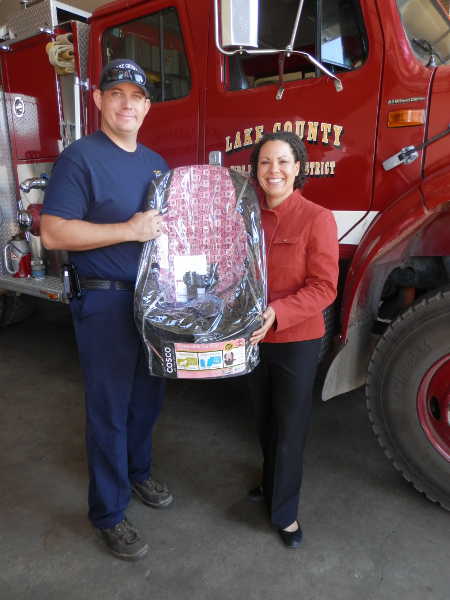
CLEARLAKE, Calif. – Lake County Fire Protection District recently received a donation of 36 car seats from the Rotary Club of Clearlake.
The donation supports the department's child safety program, which provides an ongoing safety service to the public.
The program lacks in grant funding and community assistance is being sought to overcome a $2,500 shortfall in the budget.
“Car seats are one of the most important things you can do to protect your child,” Clearlake Rotarian Karen Karnatz said. “This program was struggling. We budgeted $1,500 and most all of that was spent on car seats.”
Karnatz said the donation supports the child safety program she installed during her club presidency three years ago.
She said she was pregnant at the time and wanted to bring pregnancy, birth and child resources to the community.
Karnatz said she appreciates the club's continued support, exemplifying its motto of “Service above Self.”
EMT/Paramedic Marc Hill coordinates the child safety program for the Lake County Fire Protection District.
He said trained and certified technicians inspect child safety restraints and replace them, if needed.
Free inspection events happen once a month at the district station on Olympic Drive in Clearlake.
The next one is scheduled for 9 a.m. to noon Friday, July 11.
For those who miss the free events, call the district office at 707-994-2170 for an appointment.
Hill said the program has raised $6,800 for technician training to be provided in October.
He said additional funds are needed assist in funding training instructors, certifications and other program costs.
Donation inquiries can also be directed through the district office.
Email Denise Rockenstein at
NASA has successfully launched its first spacecraft dedicated to studying atmospheric carbon dioxide.
On Wednesday, July 2, at 2:56 a.m. PDT, the Orbiting Carbon Observatory-2 (OCO-2) raced skyward from Vandenberg Air Force Base in California on a United Launch Alliance Delta II rocket.
Approximately 56 minutes after the launch, the observatory separated from the rocket's second stage into an initial 429-mile (690-kilometer) orbit. Initial telemetry shows the spacecraft is in excellent condition.
See the launch here: http://youtu.be/njf67aov4XA .
OCO-2 soon will begin a minimum two-year mission to locate Earth’s sources of and storage places for atmospheric carbon dioxide, the leading human-produced greenhouse gas responsible for warming our world and a critical component of the planet’s carbon cycle.
“Climate change is the challenge of our generation,” said NASA Administrator Charles Bolden. “With OCO-2 and our existing fleet of satellites, NASA is uniquely qualified to take on the challenge of documenting and understanding these changes, predicting the ramifications, and sharing information about these changes for the benefit of society.”
OCO-2 will take NASA's studies of carbon dioxide and the global carbon cycle to new heights.
The mission will produce the most detailed picture to date of natural sources of carbon dioxide, as well as their “sinks” – places on Earth’s surface where carbon dioxide is removed from the atmosphere.
The observatory will study how these sources and sinks are distributed around the globe and how they change over time.
“This challenging mission is both timely and important,” said Michael Freilich, director of the Earth Science Division of NASA’s Science Mission Directorate in Washington. “OCO-2 will produce exquisitely precise measurements of atmospheric carbon dioxide concentrations near Earth's surface, laying the foundation for informed policy decisions on how to adapt to and reduce future climate change.”
Carbon dioxide sinks are at the heart of a longstanding scientific puzzle that has made it difficult for scientists to accurately predict how carbon dioxide levels will change in the future and how those changing concentrations will affect Earth's climate.
“Scientists currently don't know exactly where and how Earth's oceans and plants have absorbed more than half the carbon dioxide that human activities have emitted into our atmosphere since the beginning of the industrial era,” said David Crisp, OCO-2 science team leader at NASA's Jet Propulsion Laboratory (JPL) in Pasadena.
“Because of this we cannot predict precisely how these processes will operate in the future as climate changes. For society to better manage carbon dioxide levels in our atmosphere, we need to be able to measure the natural source and sink processes,” Crisp said.
Precise measurements of the concentration of atmospheric carbon dioxide are needed because background levels vary by less than two percent on regional to continental scales. Typical changes can be as small as one-third of one percent. OCO-2 measurements are designed to measure these small changes clearly.
During the next 10 days, the spacecraft will go through a checkout process and then begin three weeks of maneuvers that will place it in its final 438-mile (705-kilometer), near-polar operational orbit at the head of the international Afternoon Constellation, or “A-Train,” of Earth-observing satellites.
The A-Train, the first multi-satellite, formation flying “super observatory” to record the health of Earth's atmosphere and surface environment, collects an unprecedented quantity of nearly simultaneous climate and weather measurements.
OCO-2 science operations will begin about 45 days after launch. Scientists expect to begin archiving calibrated mission data in about six months and plan to release their first initial estimates of atmospheric carbon dioxide concentrations in early 2015.
The observatory will uniformly sample the atmosphere above Earth's land and waters, collecting more than 100,000 precise individual measurements of carbon dioxide over Earth's entire sunlit hemisphere every day.
Scientists will use these data in computer models to generate maps of carbon dioxide emission and uptake at Earth’s surface on scales comparable in size to the state of Colorado.
These regional-scale maps will provide new tools for locating and identifying carbon dioxide sources and sinks.
OCO-2 also will measure a phenomenon called solar-induced fluorescence, an indicator of plant growth and health.
As plants photosynthesize and take up carbon dioxide, they fluoresce and give off a tiny amount of light that is invisible to the naked eye.
Because more photosynthesis translates into more fluorescence, fluorescence data from OCO-2 will help shed new light on the uptake of carbon dioxide by plants.
Dr. Tony Phillips works for the National Aeronautics and Space Administration.
The California Department of Public Health reported this week that the number of reportable sexually transmitted diseases in the state increased in 2013.
“Sexually transmitted diseases can cause major health problems for people over time,” said Dr. Chapman, director of the California Department of Public Health and state health officer.
“This increase is concerning, particularly because STDs are preventable,” Chapman added.
The data show that almost 168,000 cases of chlamydia, over 38,000 cases of gonorrhea, over 3,500 cases of primary and secondary syphilis, almost 2,900 cases of early latent syphilis, and over 3,600 cases of late latent syphilis were reported in 2013, for a total of 216,000 reportable cases of STDs.
In 2013, the rates of gonorrhea and primary and secondary syphilis (the most infectious stages) increased substantially compared to 2012.
In 2013, the gonorrhea rate increased 13 percent to 100.4 per 100,000 population, and the P&S syphilis rate increased 18 percent to 9.3 per 100,000 population.
In contrast, in 2013 the rate of chlamydia cases decreased slightly for the first time in almost two decades, to 439.5 per 100,000 population, Chlamydia is the most commonly reported disease in California.
For Lake County, the statistics show that Lake County had 157 chlamydia cases in 2013, down from the 172 reported in 2012 but up from the 140 reported in 2009.
Gonorrhea cases in Lake County numbered 25 in 2013, down from 53 the previous year and the 38 reported in 2009, based on the state data.
Lake County had a jump in primary and secondary cases of syphilis, with five reported in 2013 and none in 2012. There were three reported in 2010.
There was one case of early latent syphilis in the county in 2013, and no other cases going back to 2009. As for latent and late syphilis cases, there were three in 2013, with one case reported in 2012, the state reported.
Lake County also had two congenital syphilis cases reported in 2013, but none in the previous several years, based on the figures.
STD rates continue to be highest in young people 15-24 years of age, especially for females, with over 66 percent of female chlamydia cases and over 54 percent of female gonorrhea cases being in this narrow age group. Young women are the most vulnerable to infertility and other long-term reproductive health problems caused by STDs.
“Any sexually active person can get an STD through unprotected sex,” said Chapman. “They should talk with their health care provider and ask if testing for STDs is appropriate.” An online directory of test sites is available at www.findstdtest.org . Many clinics offer free tests.
Chapman pointed out that in addition to getting tested regularly, individuals can reduce their risk by using condoms, reducing their number of partners, being in a monogamous relationship or practicing abstinence.
Profound racial disparities persist. In 2013, the African-American gonorrhea rate of 351.1 per 100,000 was 6.2 times the non-Hispanic white rate of 56.9 per 100,000.
CDPH has been working to address health disparities in STDs.
The STD Control Branch has identified census tracts with high numbers of gonorrhea cases and significant racial disparities and has focused interventions in these areas.
In addition, the branch is collaborating with the Centers for Disease Control and California’s Department of Education to reduce the high rates of STDs among youth through supporting comprehensive sex education, improving access to sexual health services, and helping schools build supportive environments for all youth, including lesbian, gay, bisexual and transgender students.
CDPH trains medical providers to assure that they are assessing their patients’ risk for STDs, screening appropriately, and using the most effective treatments.
CDPH also works closely with local health jurisdictions to coordinate disease prevention and control efforts statewide, including helping identify infected individuals and assuring that they and their partners get treated.
SOUTH LAKE COUNTY, Calif. – The effort to fully contain the Butts Fire continued Friday, with firefighters gaining more ground and preventing the incident from growing.
Cal Fire said the fire's acreage remained at 4,300 acres on Friday, with containment rising to 65 percent.
The fire – the cause of which is still under investigation – began on Tuesday afternoon in Pope Valley north of Lake Berryessa, just inside Napa County, and burned into south Lake County.
The steep, rugged terrain has been a challenge to firefighters. Cal Fire said there have been a total of three injuries during the firefighting effort so far.
Overnight weather conditions allowed firefighters to continue making progress constructing handlines, Cal Fire reported.
On Friday, a total of 1,755 personnel remained assigned to the fire, along with 116 fire engines, 62 fire crews, four air tankers, nine helicopters, 10 dozers and 15 water tenders from agencies around the North Coast, Cal Fire said.
Cooperating agencies on the fire include the Napa County Sheriff's, California Highway Patrol, United States Forest Service, California Office of Emergency Services, Napa County Office of Emergency Services, Lake County Office of Emergency Services, Pacific Gas and Electric, Bureau of Land Management, California Department of Corrections and Rehabilitation and Napa County Fire.
Nine structures – two homes and seven outbuildings – were destroyed in the first days of the fire, Cal fire reported.
However, there are no longer any threats to homes in the area, Cal Fire said.
Evacuation orders for areas of Napa County and a voluntary evacuation order for the Butts Canyon corridor inside Lake County was lifted on Thursday, and all roads in the area have been reopened, fire officials said.
Cal Fire urged area residents to be especially careful during the holiday weekend due to weather conditions and elevated fire danger.
Email Elizabeth Larson at