How to resolve AdBlock issue?
Refresh this page
How to resolve AdBlock issue?
Refresh this page
Lake County News,California
  • Home
    • Registration Form
  • News
    • Education
    • Veterans
    • Community
      • Obituaries
      • Letters
      • Commentary
    • Police Logs
    • Business
    • Recreation
    • Health
    • Religion
    • Legals
    • Arts & Life
    • Regional
  • Calendar
  • Contact us
    • FAQs
    • Phones, E-Mail
    • Subscribe
  • Advertise Here
  • Login

News

Microplastics promote cloud formation, with likely effects on weather and climate


Giant cumulonimbus clouds in Australia. Steve Christo - Corbis/Corbis via Getty Images

Clouds form when water vapor – an invisible gas in the atmosphere – sticks to tiny floating particles, such as dust, and turns into liquid water droplets or ice crystals. In a newly published study, we show that microplastic particles can have the same effects, producing ice crystals at temperatures 5 to 10 degrees Celsius (9 to 18 degrees Fahrenheit) warmer than droplets without microplastics.

This suggests that microplastics in the air may affect weather and climate by producing clouds in conditions where they would not form otherwise.

We are atmospheric chemists who study how different types of particles form ice when they come into contact with liquid water. This process, which occurs constantly in the atmosphere, is called nucleation.

Clouds in the atmosphere can be made up of liquid water droplets, ice particles or a mixture of the two. In clouds in the mid- to upper atmosphere where temperatures are between 32 and minus 36 F (0 to minus 38 C), ice crystals normally form around mineral dust particles from dry soils or biological particles, such as pollen or bacteria.

Microplastics are less than 5 millimeters wide – about the size of a pencil eraser. Some are microscopic. Scientists have found them in Antarctic deep seas, the summit of Mount Everest and fresh Antarctic snow. Because these fragments are so small, they can be easily transported in the air.

Clouds are important parts of Earth’s complex weather system, with effects on precipitation, temperature and climate.

Why it matters

Ice in clouds has important effects on weather and climate because most precipitation typically starts as ice particles.

Many cloud tops in nontropical zones around the world extend high enough into the atmosphere that cold air causes some of their moisture to freeze. Then, once ice forms, it draws water vapor from the liquid droplets around it, and the crystals grow heavy enough to fall. If ice doesn’t develop, clouds tend to evaporate rather than causing rain or snowfall.

While children learn in grade school that water freezes at 32 F (0 C), that’s not always true. Without something to nucleate onto, such as dust particles, water can be supercooled to temperatures as low as minus 36 F (minus 38 C) before it freezes.

For freezing to occur at warmer temperatures, some kind of material that won’t dissolve in water needs to be present in the droplet. This particle provides a surface where the first ice crystal can form. If microplastics are present, they could cause ice crystals to form, potentially increasing rain or snowfall.

Clouds also affect weather and climate in several ways. They reflect incoming sunlight away from Earth’s surface, which has a cooling effect, and absorb some radiation that is emitted from Earth’s surface, which has a warming effect.

The amount of sunlight reflected depends on how much liquid water vs. ice a cloud contains. If microplastics increase the presence of ice particles in clouds compared with liquid water droplets, this shifting ratio could change clouds’ effect on Earth’s energy balance.

Diagram showing incoming energy to Earth from the Sun and how much is absorbed or reflected by various parts of the climate system.
The Earth constantly receives energy from the Sun and reflects it back into space. Clouds have both warming and cooling effects in this process. NOAA

How we did our work

To see whether microplastic fragments could serve as nuclei for water droplets, we used four of the most prevalent types of plastics in the atmosphere: low density polyethylene, polypropylene, polyvinyl chloride and polyethylene terephthalate. Each was tested both in a pristine state and after exposure to ultraviolet light, ozone and acids. All of these are present in the atmosphere and could affect the composition of the microplastics.

We suspended the microplastics in small water droplets and slowly cooled the droplets to observe when they froze. We also analyzed the plastic fragments’ surfaces to determine their molecular structure, since ice nucleation could depend on the microplastics’ surface chemistry.

For most of the plastics we studied, 50% of the droplets were frozen by the time they cooled to minus 8 F (minus 22 C). These results parallel those from another recent study by Canadian scientists, who also found that some types of microplastics nucleate ice at warmer temperatures than droplets without microplastics.

Exposure to ultraviolet radiation, ozone and acids tended to decrease ice nucleation activity on the particles. This suggests that ice nucleation is sensitive to small chemical changes on the surface of microplastic particles. However, these plastics still nucleated ice, so they could still affect the amount of ice in clouds.

What still isn’t known

To understand how microplastics affect weather and climate, we need to know their concentrations at the altitudes where clouds form. We also need to understand the concentration of microplastics compared with other particles that could nucleate ice, such as mineral dust and biological particles, to see whether microplastics are present at comparable levels. These measurements would allow us to model the impact of microplastics on cloud formation.

Plastic fragments come in many sizes and compositions. In future research, we plan to work with plastics that contain additives, such as plasticizers and colorants, as well as with smaller plastic particles.

The Research Brief is a short take about interesting academic work.The Conversation

Miriam Freedman, Professor of Chemistry, Penn State and Heidi Busse, PhD Student in Chemistry, Penn State

This article is republished from The Conversation under a Creative Commons license. Read the original article.

Space News: How can Jupiter have no surface? A dive into a planet so big, it could swallow 1,000 Earths


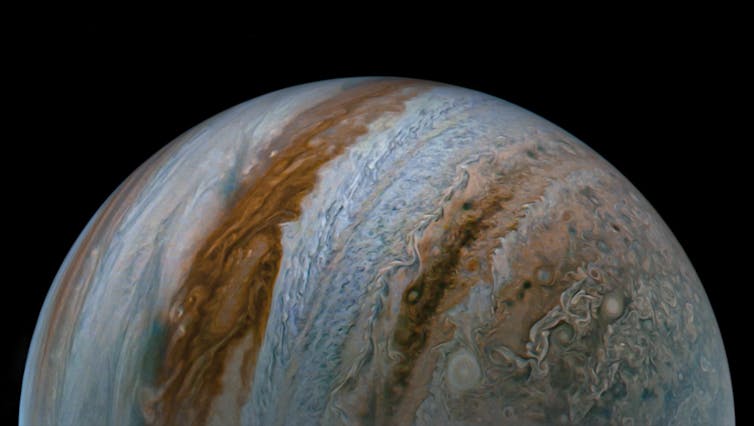
A photo of Jupiter taken by NASA’s Juno spacecraft in September 2023. NASA/JPL-Caltech/SwRI/MSSS, image processing by Tanya Oleksuik

Curious Kids is a series for children of all ages. If you have a question you’d like an expert to answer, send it to This email address is being protected from spambots. You need JavaScript enabled to view it..


Why does Jupiter look like it has a surface – even though it doesn’t have one? – Sejal, age 7, Bangalore, India


The planet Jupiter has no solid ground – no surface, like the grass or dirt you tread here on Earth. There’s nothing to walk on, and no place to land a spaceship.

But how can that be? If Jupiter doesn’t have a surface, what does it have? How can it hold together?

Even as a professor of physics who studies all kinds of unusual phenomena, I realize the concept of a world without a surface is difficult to fathom. Yet much about Jupiter remains a mystery, even as NASA’s robotic probe Juno begins its ninth year orbiting this strange planet.

Jupiter’s mass is two-and-a-half times that of all the other planets in the solar system combined.

First, some facts

Jupiter, the fifth planet from the Sun, is between Mars and Saturn. It’s the largest planet in the solar system, big enough for more than 1,000 Earths to fit inside, with room to spare.

While the four inner planets of the solar system – Mercury, Venus, Earth and Mars – are all made of solid, rocky material, Jupiter is a gas giant with a composition similar to the Sun; it’s a roiling, stormy, wildly turbulent ball of gas. Some places on Jupiter have winds of more than 400 mph (about 640 kilometers per hour), about three times faster than a Category 5 hurricane on Earth.

A photograph of the planet Jupiter swathed in blue, brown and gold bands.
A photo of the southern hemisphere of Jupiter, taken by NASA’s Juno spacecraft in 2017. NASA/JPL-Caltech/SwRI/MSSS/Gerald Eichstadt/Sean Doran

Searching for solid ground

Start from the top of Earth’s atmosphere, go down about 60 miles (roughly 100 kilometers), and the air pressure continuously increases. Ultimately you hit Earth’s surface, either land or water.

Compare that with Jupiter: Start near the top of its mostly hydrogen and helium atmosphere, and like on Earth, the pressure increases the deeper you go. But on Jupiter, the pressure is immense.

As the layers of gas above you push down more and more, it’s like being at the bottom of the ocean – but instead of water, you’re surrounded by gas. The pressure becomes so intense that the human body would implode; you would be squashed.

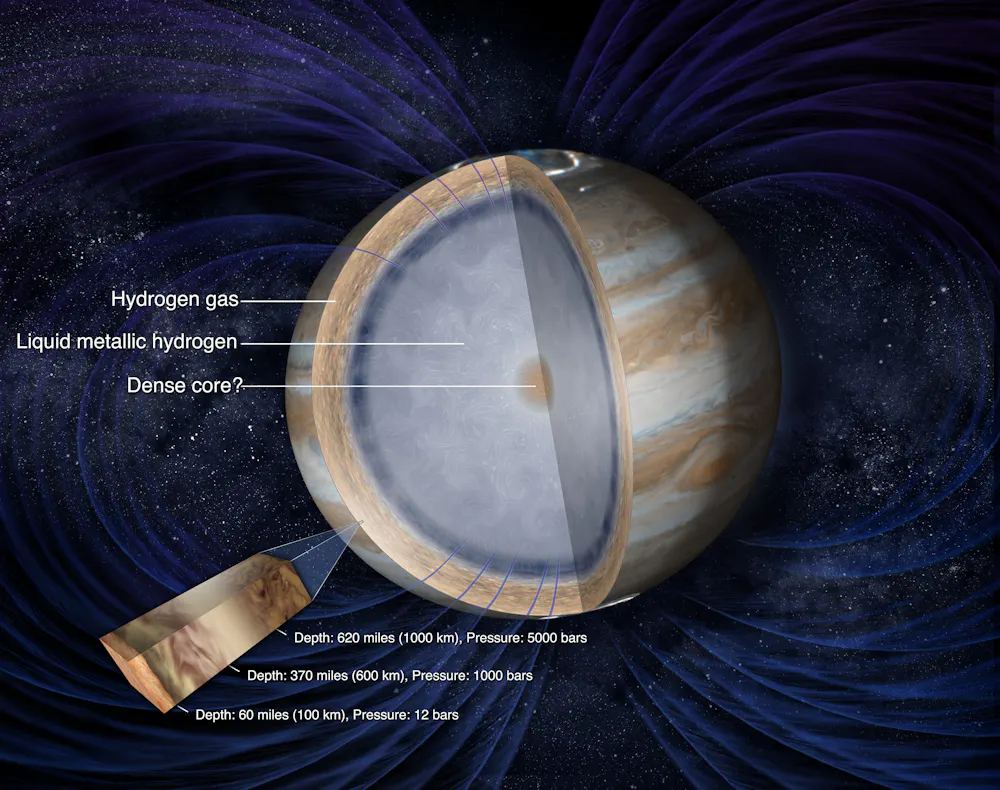
Go down 1,000 miles (1,600 kilometers), and the hot, dense gas begins to behave strangely. Eventually, the gas turns into a form of liquid hydrogen, creating what can be thought of as the largest ocean in the solar system, albeit an ocean without water.

Go down another 20,000 miles (about 32,000 kilometers), and the hydrogen becomes more like flowing liquid metal, a material so exotic that only recently, and with great difficulty, have scientists reproduced it in the laboratory. The atoms in this liquid metallic hydrogen are squeezed so tightly that its electrons are free to roam.

Keep in mind that these layer transitions are gradual, not abrupt; the transition from normal hydrogen gas to liquid hydrogen and then to metallic hydrogen happens slowly and smoothly. At no point is there a sharp boundary, solid material or surface.

An illustration that shows the interior layers of Jupiter, including its core.
An illustration of Jupiter’s interior layers. One bar is approximately equal to the air pressure at sea level on Earth. NASA/JPL-Caltech

Scary to the core

Ultimately, you’d reach the core of Jupiter. This is the central region of Jupiter’s interior, and not to be confused with a surface.

Scientists are still debating the exact nature of the core’s material. The most favored model: It’s not solid, like rock, but more like a hot, dense and possibly metallic mixture of liquid and solid.

The pressure at Jupiter’s core is so immense that it would be like 100 million Earth atmospheres pressing down on you – or two Empire State buildings on top of each square inch of your body.

But pressure wouldn’t be your only problem. A spacecraft trying to reach Jupiter’s core would be melted by the extreme heat – 35,000 degrees Fahrenheit (20,000 degrees Celsius). That’s three times hotter than the surface of the Sun.

An image of Jupiter featuring brown, beige and orange belts along with the Great Red Spot.
An image taken of Jupiter by Voyager 1. Note the Great Red Spot, a storm large enough to hold three Earths. NASA/JPL

Jupiter helps Earth

Jupiter is a weird and forbidding place. But if Jupiter weren’t around, it’s possible human beings might not exist.

That’s because Jupiter acts as a shield for the inner planets of the solar system, including Earth. With its massive gravitational pull, Jupiter has altered the orbit of asteroids and comets for billions of years.

Without Jupiter’s intervention, some of that space debris could have crashed into Earth; if one had been a cataclysmic collision, it could have caused an extinction-level event. Just look at what happened to the dinosaurs.

Maybe Jupiter gave an assist to our existence, but the planet itself is extraordinarily inhospitable to life – at least, life as we know it.

The same is not the case with a Jupiter moon, Europa, perhaps our best chance to find life elsewhere in the solar system.

NASA’s Europa Clipper, a robotic probe launching in October 2024, is scheduled to do about 50 fly-bys over that moon to study its enormous underground ocean.

Could something be living in Europa’s water? Scientists won’t know for a while. Because of Jupiter’s distance from Earth, the probe won’t arrive until April 2030.


Hello, curious kids! Do you have a question you’d like an expert to answer? Ask an adult to send your question to This email address is being protected from spambots. You need JavaScript enabled to view it.. Please tell us your name, age and the city where you live.

And since curiosity has no age limit – adults, let us know what you’re wondering, too. We won’t be able to answer every question, but we will do our best.The Conversation

Benjamin Roulston, Assistant Professor of Physics, Clarkson University

This article is republished from The Conversation under a Creative Commons license. Read the original article.

Registrar of Voters Office reports on official canvass progress for Nov. 5 election

LAKE COUNTY, Calif. — As the process of completing the count for the Nov. 5 election continues, elections officials on Thursday issued a report on the number of unprocessed ballots, which surpasses the number at this time four years ago.

The Lake County Registrar of Voters said that during the 28-day official canvass period, there are 19,021 ballots still to count.

That total includes the following breakdown:

• Vote-by-mail ballots: 17,445.
• Provisional/conditional ballots: 1,453.
• Vote-by-Mail ballots that require further review for various reasons: 123.

The registrar’s office reported that the unprocessed ballot number could change, as there are still ballots being returned by mail.

The deadline for elections officials to receive vote-by-mail ballots returned by mail for the Nov. 5 General Election is Nov. 12.

Those ballots must be postmarked on or before Election Day and delivered to the elections office by the U.S. Postal Service or a private mail delivery company no later than seven days after Election Day.

The number of unprocessed ballots reported on Thursday is up slightly from the number reported at this point after the 2020 election, when there were 18,270 ballots remaining to be tallied.

The final voter turnout for the 2020 presidential election was 78.42%. Based on the current count of both unprocessed and processed ballots, this year’s final turnout could be around 71%.

The California Secretary of State’s Office reported on Thursday that 10,728,985 ballots have been counted so far. The estimated number of ballots left to count is 5,472,423.

The official canvass period

While the preliminary election counts were issued on Tuesday night and Wednesday morning, the elections office cautioned that those are not final results.

“There are many checks and balances when certifying the election results. The process of certifying election results, also known as the official canvass, is mandated by state law to make sure the public can have confidence in the integrity of the final results. Staff members are working very diligently on completing all tasks required to certify the election,” the Registrar of Voters Office reported.

The process includes the requirement that vote-by-mail ballots must be examined by staff to see if the signature compares with the voter’s signature on file.

After the vote-by-mail voter’s information has been entered and proofed, the vote-by-mail envelopes have to be sorted by voting precinct. Election staff must verify the number of vote-by-mail ballots processed by the voting precinct before the envelopes can be opened. Once staff balances, the envelopes can be opened.

There also are “polls provisional ballots” which are cast at polling places on Election Day.

Poll workers Lake County News spoke to on Election Day reported receiving a large volume of provisional ballots.

Some of the reasons a voter is issued a provisional ballot include:

• The voter’s name is listed on the active voter roster list as a vote-by-mail voter and the voter is unable to surrender his/her vote-by-mail ballot in order to be issued a polls ballot.
• The voter’s name is not printed in the roster-index, has moved and did not re-register to vote at his/her new residence address.
• A voter is voting in the wrong voting precinct and not his/her assigned voting precinct.
• A first time voter who is required to provide ID, but is unable to do so.
• The voter’s eligibility to vote cannot be determined by the poll worker.

“Conditional voter ballots” are issued to a person who missed the regular voter registration deadline of Oct. 21, but they still have the option to vote in an election by conditionally registering to vote and casting a conditional ballot. This is also same day voter registration.

Voters who were allowed to sign the roster-index and issued a ballot at their assigned polling place will have their ballot counted at the Registrar of Voters Office on Election Night.

In addition, all of the roster-indexes must also be examined for errors or omissions. The elections office said its staff checks the ballot statement including the number of returned voted ballots against the number of voters who signed the roster-index.

Provisional and conditional voter signatures also need to match the number of voter provisional and conditional ballots. Once this is done, staff must enter voter history from each of the roster-indexes and record it into the voting system as voter history, the elections office reported.

As part of the official canvass, at 9 a.m. Wednesday, Nov. 13, the Registrar of Voter’s Office will conduct a public manual tally of a minimum of 1% of randomly selected precincts which will include each contest voted on at the Nov. 5 General Election. The selection of the precincts to be included in the manual tally will be randomly chosen on the same date prior to the manual tally.

Community members can view the public manual tally at the elections office, located at 325 N. Forbes St. in Lakeport.

Email Elizabeth Larson at This email address is being protected from spambots. You need JavaScript enabled to view it.. Follow her on Twitter, @ERLarson, or Lake County News, @LakeCoNews.

Public works and utilities projects progressing in Lakeport

LAKEPORT, Calif. — In response to the visible uptick in construction along the Lakeport Boulevard corridor, the city of Lakeport’s Public Works and Utilities Department is providing updates on the infrastructure projects currently underway.

The city said these coordinated efforts focus on enhancing the community's infrastructure while minimizing disruption to residents and businesses.

Water and sewer main replacement project

This large-scale project is essential for Lakeport’s water and sewage infrastructure, targeting the replacement of aging water and sewer mains across key locations, including Lakeshore Boulevard, Sayre Street, Jones Street, Tunis Street, Tenth Street, Armstrong Street, Martin Street, Lakeport Boulevard, K Street and Forbes Street.

The updates will enhance water flow and sewage management, setting the groundwork for subsequent paving projects.

After overcoming unforeseen underground conditions, the project is progressing smoothly, with an expected completion by summer 2025.

South Main Street Paving Project

As part of Lakeport’s commitment to maintaining road safety and infrastructure, the South Main Street Paving Project will follow the completion of necessary underground repairs in the South Main Street and Lakeport Blvd area.

Originally scheduled for this year, paving will now begin in spring 2025, aligning with optimal weather conditions for road durability.

This project will provide new asphalt paving, striping, crosswalks, and rectangular rapid flashing beacons for enhanced pedestrian safety.

Lakeport Courthouse project

Since breaking ground in July, the construction of the new Lakeport Courthouse is moving forward.

The 46,000-square-foot facility will feature four courtrooms, secured parking for judicial officers, and 100 surface parking spaces for public use.

Additionally, the courthouse design includes solar power generation capability, underscoring our commitment to sustainability.

This project is managed and funded by the Judicial Council of the State of California, with no city or county funds used, and is expected to be completed by May 2026.

Lakeport Boulevard Improvement Project

In anticipation of future improvements to the Lakeport Blvd corridor, the City is preparing the Lakeport Boulevard Improvement Project.

This initiative will enhance pedestrian and traffic safety with road repaving, continuous sidewalks, and new crosswalks equipped with RRFBs.

Design and planning are underway, with construction slated to begin in fiscal year 2026-2027.

For more information, please contact the Lakeport Public Works and Utilities Department at 707-263-3578.

City of Lakeport seeks Planning Commission applicants

LAKEPORT, Calif. — The city of Lakeport is seeking enthusiastic community members to fill two upcoming vacancies on the Lakeport Planning Commission beginning Jan. 1.

If you’re passionate about local government and community planning, this is your chance to make an impact.

One seat may be filled by an applicant residing outside of Lakeport city limits but within the Lakeport zip code. The other seat must be filled by an applicant living within the city limits of Lakeport.

The Planning Commission comprises five members who serve four-year terms and meet monthly to advise the City Council on planning, zoning and land use matters.

Topics include the general plan, rezoning, subdivisions and architectural reviews.

Applications can be accessed on the city’s website under “Now Recruiting: Commission/Committee Openings” at www.cityoflakeport.com (or see Government > Committees & Commissions section).

Submit your application by 5 p.m. Tuesday, Nov. 12.

For more information, please contact Deputy City Clerk Hilary Britton at 707-263-5615, Extension 102 or This email address is being protected from spambots. You need JavaScript enabled to view it..

Gov. Newsom convenes a special session of the Legislature to protect California values

Gov. Gavin Newsom on Thursday issued a proclamation convening a special session of the California Legislature to safeguard California values and fundamental rights in the face of an incoming Trump administration.

The special session will focus on bolstering California legal resources to protect civil rights, reproductive freedom, climate action and immigrant families.

This is the first of several actions by the Newsom Administration, in partnership with the Legislature, as the governor begins shoring up California's defenses against an incoming federal administration that has threatened the state on multiple fronts.

“The freedoms we hold dear in California are under attack — and we won’t sit idle. California has faced this challenge before, and we know how to respond,” Newsom said. “We are prepared to fight in the courts, and we will do everything necessary to ensure Californians have the support and resources they need to thrive.”

“No matter what the incoming Administration has in store, California will keep moving forward,” said Attorney General Rob Bonta. “We’ve been through this before, and we stand ready to defend your rights and protect California values. We’re working closely with the Governor and the Legislature to shore up our defenses and ensure we have the resources we need to take on each fight as it comes.”

“Voters sent a clear message this election, and we need to lean-in and listen," said Speaker Robert Rivas (D-Hollister). "But we also must be prepared to defend California values, no matter the challenges ahead, so it makes sense to consider the Governor’s proposal. I’m ready to fight harder than ever for opportunity, equality and a Golden State that works for each and every resident.”

“We learned a lot about former President Trump in his first term — he’s petty, vindictive, and will do what it takes to get his way no matter how dangerous the policy may be," said Senate President pro Tempore Mike McGuire (D-North Coast). "California has come too far and accomplished too much to simply surrender and accept his dystopian vision for America. This is why we’re moving with speed and investing in our legal defense. This is an important first step in protecting our progress and the values that make this state great. We’ll be working with the Assembly and the Governor in the months ahead to ensure the rights of all Californians are safeguarded.”

Special session goals

The special session responds to the public statements and proposals put forward by President-elect Trump and his advisors, and actions taken during his first term in office — an agenda that could erode essential freedoms and individual rights, including women's rights and LGBTQ+ rights.

A special session allows for expedited action that will best protect California and its values from attacks.

The special session will begin Dec. 2, when the Legislature convenes.

The governor has outlined several urgent priorities to be defended in this special session by bolstering legal defenses against federal actions.

The governor's proclamation calls for legislation to provide additional resources to the California Department of Justice and other state entities to pursue robust affirmative litigation against any unlawful actions by the incoming Trump Administration, as well as defend against federal lawsuits aimed at undermining California’s laws and policies.

The funding will support the ability to immediately file litigation and seek injunctive relief against unlawful federal actions.
  • 324
  • 325
  • 326
  • 327
  • 328
  • 329
  • 330
  • 331
  • 332
  • 333

Community

  • Lake County Wine Alliance offers sponsor update; beneficiary applications open 

  • Mendocino National Forest announces seasonal hiring for upcoming field season

Public Safety

  • Lakeport Police logs: Thursday, Jan. 15

  • Lakeport Police logs: Wednesday, Jan. 14

Education

  • Woodland Community College receives maximum eight-year reaffirmation of accreditation from ACCJC

  • SNHU announces Fall 2025 President's List

Health

  • California ranks 24th in America’s Health Rankings Annual Report from United Health Foundation

  • Healthy blood donors especially vital during active flu season

Business

  • Two Lake County Mediacom employees earn company’s top service awards

  • Redwood Credit Union launches holiday gift and porch-to-pantry food drives

Obituaries

  • Rufino ‘Ray’ Pato

  • Patty Lee Smith

Opinion & Letters

  • The benefits of music for students

  • How to ease the burden of high electric bills

Veterans

  • CalVet and CSU Long Beach team up to improve data collection related to veteran suicides

  • A ‘Big Step Forward’ for Gulf War Veterans

Recreation

  • Wet weather trail closure in effect on Upper Lake Ranger District

  • Mendocino National Forest seeking public input on OHV grant applications

  • State Parks announces 2026 Anderson Marsh nature walk schedule 

  • BLM lifts seasonal fire restrictions in central California

Religion

  • Kelseyville Presbyterian to host Ash Wednesday service and Lenten dinner Feb. 18

  • Kelseyville Presbyterian Church to hold ‘Longest Night’ service Dec. 21

Arts & Life

  • Auditions announced for original musical ‘Even In Shadow’ set for March 21 and 28

  • ‘The Rip’ action heist; ‘Steal’ grounded in a crime thriller

Government & Politics

  • Lake County Democrats issue endorsements in local races for the June California Primary

  • County negotiates money-saving power purchase agreement

Legals

  • March 3 hearing on ordinance amending code for commercial cannabis uses

  • Feb. 12 public hearing on resolution to establish standards for agricultural roads

How to resolve AdBlock issue?
Refresh this page