 How to resolve AdBlock issue?
News
From possible ice volcanoes to twirling moons, NASA’s New Horizons science team is discussing more than 50 exciting discoveries about Pluto at this week’s 47th Annual Meeting of the American Astronomical Society’s Division for Planetary Sciences in National Harbor, Maryland.
“The New Horizons mission has taken what we thought we knew about Pluto and turned it upside down,” said Jim Green, director of planetary science at NASA Headquarters in Washington. “It's why we explore – to satisfy our innate curiosity and answer deeper questions about how we got here and what lies beyond the next horizon."
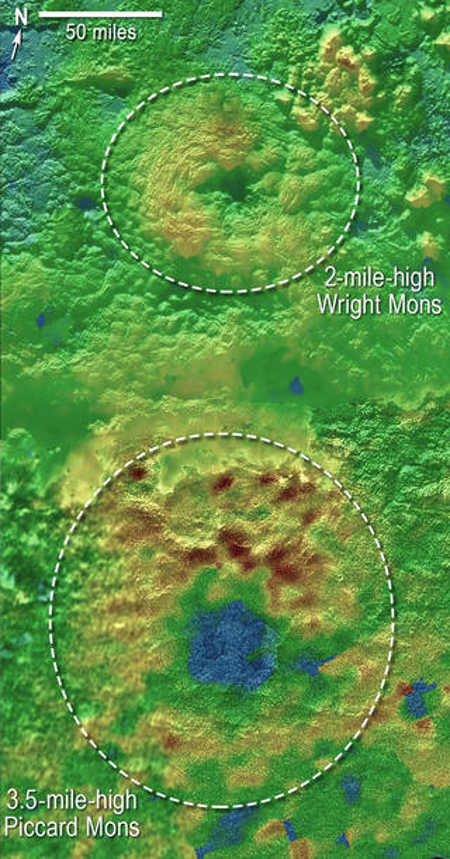
For one such discovery, New Horizons geologists combined images of Pluto’s surface to make 3-D maps that indicate two of Pluto’s most distinctive mountains could be cryovolcanoes – ice volcanoes that may have been active in the recent geological past.
“It’s hard to imagine how rapidly our view of Pluto and its moons are evolving as new data stream in each week. As the discoveries pour in from those data, Pluto is becoming a star of the solar system,” said mission Principal Investigator Alan Stern of the Southwest Research Institute in Boulder, Colorado. “Moreover, I’d wager that for most planetary scientists, any one or two of our latest major findings on one world would be considered astounding. To have them all is simply incredible.”
The two cryovolcano candidates are large features measuring tens of miles or kilometers across and several miles or kilometers high.
“These are big mountains with a large hole in their summit, and on Earth that generally means one thing – a volcano,” said Oliver White, New Horizons postdoctoral researcher at NASA’s Ames Research Center in Moffett Field, California. “If they are volcanic, then the summit depression would likely have formed via collapse as material is erupted from underneath. The strange hummocky texture of the mountain flanks may represent volcanic flows of some sort that have traveled down from the summit region and onto the plains beyond, but why they are hummocky, and what they are made of, we don't yet know.”
While their appearance is similar to volcanoes on Earth that spew molten rock, ice volcanoes on Pluto are expected to emit a somewhat melted slurry of substances such as water ice, nitrogen, ammonia, or methane. If Pluto proves to have volcanoes, it will provide an important new clue to its geologic and atmospheric evolution.
“After all, nothing like this has been seen in the deep outer solar system,” said Jeffrey Moore, New Horizons Geology, Geophysics and Imaging team leader, at Ames.
Pluto’s long history of geologic activity
Pluto’s surface varies in age – from ancient, to intermediate, to relatively young – according to another new finding from New Horizons.
To determine the age of a surface area of the planet, scientists count crater impacts. The more crater impacts, the older the region likely is. Crater counts of surface areas on Pluto indicate that it has surface regions dating to just after the formation of the planets of our solar system, about four billion years ago.
But there also is a vast area that was, in geological terms, born yesterday – meaning it may have formed within the past 10 million years.
This area, informally named Sputnik Planum, appears on the left side of Pluto’s “heart” and is completely crater-free in all images received, so far.
New data from crater counts reveal the presence of intermediate, or “middle-aged,” terrains on Pluto, as well. This suggests Sputnik Planum is not an anomaly – that Pluto has been geologically active throughout much of its more than 4-billion-year history.
“We’ve mapped more than a thousand craters on Pluto, which vary greatly in size and appearance,” said postdoctoral researcher Kelsi Singer, of the Southwest Research Institute (SwRI) in Boulder, Colorado. “Among other things, I expect cratering studies like these to give us important new insights into how this part of the solar system formed.”
Building blocks of the Solar System
Crater counts are giving the New Horizons team insight into the structure of the Kuiper Belt itself. The dearth of smaller craters across Pluto and its large moon Charon indicate the Kuiper Belt, which is an unexplored outer region of our solar system, likely had fewer smaller objects than some models had predicted.
This leads New Horizons scientists to doubt a longstanding model that all Kuiper Belt objects formed by accumulating much smaller objects --less than a mile wide.
The absence of small craters on Pluto and Charon support other models theorizing that Kuiper Belt objects tens of miles across may have formed directly, at their current – or close to current – size.
In fact, the evidence that many Kuiper Belt objects could have been “born large” has scientists excited that New Horizons’ next potential target – the 30-mile-wide KBO named 2014 MU69 – which may offer the first detailed look at just such a pristine, ancient building block of the solar system.
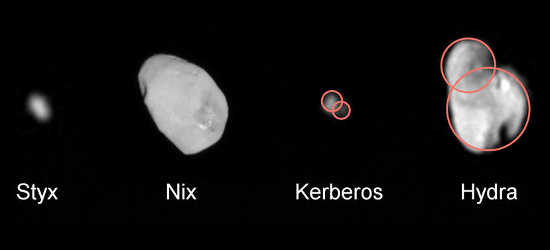
Pluto’s spinning, merged moons
The New Horizons mission also is shedding new light on Pluto’s fascinating system of moons, and their unusual properties. For example, nearly every other moon in the solar system – including Earth’s moon – is in synchronous rotation, keeping one face toward the planet. This is not the case for Pluto’s small moons.
Pluto’s small lunar satellites are spinning much faster, with Hydra – its most distant moon – rotating an unprecedented 89 times during a single lap around the planet. Scientists believe these spin rates may be variable because Charon exerts a strong torque that prevents each small moon from settling down into synchronous rotation.
Another oddity of Pluto’s moons: scientists expected the satellites would wobble, but not to such a degree.
“Pluto’s moons behave like spinning tops,” said co-investigator Mark Showalter of the SETI Institute in Mountain View, California.
Images of Pluto’s four smallest satellites also indicate several of them could be the results of mergers of two or more moons.
“We suspect from this that Pluto had more moons in the past, in the aftermath of the big impact that also created Charon,” said Showalter.
To view more images and graphics being presented by New Horizons scientists at the 47th Annual Meeting of the American Astronomical Society’s Division for Planetary Sciences, visit http://pluto.jhuapl.edu/News-Center/Press-Conferences/November-9-2015.php .
For more information on NASA’s New Horizons mission, including fact sheets, videos and images, visit http://www.nasa.gov/newhorizons .
MIDDLETOWN, Calif. – Lake County's representative in the California Senate spoke to the Middletown Area Town Hall on Thursday night, offering updates on the state role in the Valley fire recovery and other important issues to the community.
Sen. Mike McGuire spoke to the group for close to an hour during its gathering at the Middletown Senior Center.
MATH Board member Mike Tabacchi introduced McGuire, who took office in December, noting it was the first time in the group's nine-year history that a state senator had addressed it. (Tabacchi's introduction begins just after the 35 minute mark in the video above.)
A topic that would arise throughout the evening – both in public comment and in McGuire's talk – was the Valley fire and its aftermath. “It's changed the landscape here,” said Tabacchi. “For many of us in this room, it has changed our lives forever.”
McGuire began his talk with a discussion of the response to the fire and the recovery, explaining that the state is committed now and in the years to come to helping the community rebuild.
“There are times where the state has not been nearly as active or engaged as they should have been here in Lake County,” he said. “And I also promise you that those days are over.”
He said a top priority has been making sure Lake County has the resources it needs to thrive.
“It has been an extremely challenging year to say the least,” McGuire said.
McGuire said 52 percent of all of California's fire activity this year was in Lake County.
“I have never seen anything like the Valley fire,” he said, recounting arriving in Lake after midnight on Sept. 13, meeting with Sheriff Brian Martin and traveling down to the fire area. Recounting it, he said, is an emotional experience.
McGuire said that a crisis like that of the fire can bring out the best in people. He said Lake County has the hardest working people in California, and he's proud to talk about that to his colleagues in the Legislature as well as people across the state.
“I know we've got a lot in front of us,” he said.
Discussing the state response, he said within hours of the fire beginning the California Office of Emergency Services activated and had staff embedded in the county. Within 72 hours, the state had advanced $5 million to help the county.
“We won't quit until we are looking at full recovery,” McGuire said.
McGuire said there also is the need to go out and raise private dollars. He reported on an effort that he is part of that includes Redwood Credit Union that has so far raised $2.3 million for the Valley Fire Fund. Just under $1 million has been distributed, with another $800,000 to be advanced over the next 45 days.
The fund has so far focused on helping students impacted by the fire, the firefighters who themselves lost homes, and has offered assistance through North Coast Opportunities and the Lake County Farm Bureau. McGuire said they will be doing a significant push around the holidays to help everyone who lost their home.
McGuire said long-term solutions for the south county's financial and economic stability need to be considered, and a Nov. 23 call with state and county officials is planned to discuss that subject.
There also is a need to focus on the potential mud flow and erosion in the months ahead, McGuire said, explaining that the Valley fire burned so hot that it has sealed the ground.
That means that a 10-year rain event could produce nearly as much runoff as a 100-year event, he explained, raising concerns about flooding.
In order to prepare, McGuire said Cal Fire's helitack base on Boggs Mountain is remaining staffed full-time through the winter months. Cal Fire also will have additional crews and engines staffing its facilities through the winter in case of emergency.
McGuire said $2.4 million in payments that the South Lake County Fire Protection District would normally pay under its contract with the state have been frozen for a 12-month period.
As for the cleanup, progress is being made, said McGuire, with 218 properties having been cleared by 42 debris removal teams. Another 12 to 13 teams are expected to be activated in upcoming weeks, with McGuire adding that there is an emphasis on hiring local.
He said the Federal Emergency Management Agency has disbursed just under $6 million in housing assistance to fire survivors, with about $2 million disbursed for other property needs. He said Nov. 23 is the deadline to register for FEMA assistance.
Updates on state economy and drought
From the topic of the fire, McGuire moved into updates on a variety of other issues.
He said the state has a fiscal reserve for the first since 2006, and despite its regulations and environmental laws, California was named by Bloomberg as the best state in the country to do business.
“We need to continue to invest, especially in rural California,” he said.
One of the best investments is in public schools, said McGuire, pointing out that California has slipped to dead last among all states for K-12 per-student spending. Efforts this year to invest more money in students is expected to raise California to No. 35.
California also has more children in poverty than any other state in the nation, and some of the poverty-busting programs were cut during the recession, McGuire said.
McGuire discussed a $400 million infusion into career and technical training in high schools, which came about as a result of one of his bills this year. That training is key, since he said the data shows that 72 percent of high school graduates won't go on to college.
McGuire also succeeded in getting $5 million restored for replacing older school buses in rural school districts.
In other education news, he said there are 7,000 new preschool slots, 6,500 new spaces in after school programs and 32,000 new community college openings thanks to increased education investment.
He said next year California also is poised to make its last $3.5 billion payment on $35 billion in bonds it took out during the recession.
Regarding the drought, McGuire said the National Aeronautics and Space Administration has reported that California is the driest it has been in 500 years. “We've seen that, quite frankly, in fire activity.”
During the peak of the Valley fire, 34 acres per minute burned, which McGuire called “unprecedented.”
He said the state has moved $2.2 billion out of its Proposition 1 bond funds for ground recharge and other measures to deal with the drought.
As for expectations of an El Niño-driven winter, McGuire said 11 to 12 trillion gallons of rain is necessary to get the state to where it was before the drought began.
McGuire then moved talked about his district's products, noting that, compared with anywhere else in California, it has more wineries, craft breweries and oyster production, and that it produces 60 percent of the nation's marijuana.
Earlier this year, an effort led by McGuire succeeded in establishing new statewide medical marijuana regulations. He said he plans next year to bring forward a 15-percent state excise tax on medical marijuana sales to fund law enforcement and efforts to address environmental damage resulting from illegal marijuana grows.
He reported on California's recently passed law establishing equal pay for women, the strictest law of its kind in the nation. It goes into effect in January.
McGuire said white women make 78 cents for every dollar a man makes, compared to 54 cents for every dollar for Latinas and 64 cents per dollar for black women. He said two-thirds of minimum wage earners in California are women.
“What we know is when we pay women well, families thrive and our communities are stronger,” he said.
He also said he will be hosting a meeting on Dec. 16 in Sacramento with the state officials to find ways to help Lake County get first shot at the new career and technical education training.
Other topics McGuire touched on included the need to increase the reliability of the region's 911 system, which was taken offline by a fiber cut in the Hopland area earlier this year; plans to work with the governor next year to find funding to promote Clear Lake's health; the backlog on the state's public and road infrastructure; the need to increase the tobacco tax; and his goal of having community college education made free in California.
In other news at the Thursday meeting, MATH Chair Fletcher Thornton announced that Margaret Greenley has been named to the MATH Board. She will succeed Charlotte Kubiak, who left the county as a result of the Valley fire.
Email Elizabeth Larson at
While recent rains and cooler temperatures have lowered the threat of wildfires in some areas of California, Cal Fire continues to have extra firefighter staffing statewide and remains at peak fire season in Central and Southern California.
Last week alone Cal Fire crews responded to nearly 50 new wildfires.
Even as Cal Fire transitions out of peak fire season in Northern California and into its winter preparedness mode, fire officials are still asking residents statewide to be cautious outdoors as “one less spark means one less wildfire.”
“As drought conditions continued throughout the year, we experienced a significant increase in the number and size of fires," said Chief Ken Pimlott, Cal Fire director. “Even with the increased likelihood of precipitation due to El Niño, it will still take several years of steady rainfall for some of the larger vegetation to return to normal levels and no amount of rain will bring back millions of bark beetle infested dead and dying trees across the state. We can’t let our guard down, especially with changing climate conditions leading to longer fire seasons and larger wildfires.”
While Cal Fire has begun to close some of its seasonal fire stations and facilities in Northern California, Cal Fire is maintaining firefighter staffing that meets the current threat, as well as strategically moving resources to areas that remain at a higher threat level.
As California prepares to enter the fifth year of drought, Cal Fire will continue to monitor weather conditions closely to determine when it can move into winter preparedness in Central and Southern California.
The department also will increase staffing in Northern California should the weather conditions change or if there is a need to support wildfires or any other emergencies in Southern California.
The 2015 fire season to date has been an extremely active year, even more than in 2014.
Statewide, Cal Fire and firefighters from many local agencies battled over 6,100 wildfires within the State Responsibility Area that burned nearly 308,000 acres. This is nearly 1,800 more wildfires this year than in an average year.
Across all jurisdictions in California there were over 8,100 wildfires that burned nearly 825,000 acres in 2015.
A leading cause of wildfires this time of year is from escaped outdoor landscape debris burning. Residents are urged to still take precautions outdoors in order to prevent sparking a wildfire.
In Northern and Central California residents should ensure it’s a permissive burn day in their area by contacting the local air quality district and make sure they have any and all required burn permits.
During burning make sure that piles of landscape debris are no larger than 4 feet in diameter, provide a 10-foot clearance down to bare mineral soil around the burn pile and that a responsible adult is in attendance at all times with a water source and a shovel.
Firefighters also will be utilizing this same window of opportunity to conduct prescribed burns aimed at improving forest health on private and public lands.
For more ways to prevent sparking a wildfire visit www.ReadyForWildfire.org .
NORTHERN CALIFORNIA – In response to the devastating Valley fire in Lake County, Larkmead Vineyards has now raised more than $59,000 for those affected by the fire by matching up to $25,000 in donations to the Valley Fire Relief Fund.
More than $34,000 in personal donations has been received, of which Larkmead has matched $25,000 for a total of $59,000.
Proprietor Cam Baker expressed his gratitude for the outpouring of support. “It will be years for the community to recover. In addition to the devastation of the fires and the crippling of businesses, winter rains could make conditions even worse with mudslides and flooding.”
For those who have not yet donated, checks made payable to the Valley Fire Relief Fund can be sent to Larkmead Vineyards at 1100 Larkmead Lane, Calistoga, CA 94515, care of Erinn Maloney or to the Calistoga Chamber of Commerce at 133 Washington Street, Calistoga, CA 94515.
The Valley Fire Relief Fund is a registered 501(c)3 nonprofit and is channeling funds to the following two primary organizations.
The Up Valley Family Center in Lake County provides immediate aid to families who are struggling with large bills such as mortgages, utilities and car payments as well as providing funds for urgent daily needs such as food, diapers and essentials.
The Rotary of Middletown also will receive money to help aid families with severe losses.
In addition to the Valley fire donation, Larkmead recently raised more than $13,000 for the victims, families and congregation of Mother Emanuel AME Church in Charleston, South Carolina, in the Charleston Mayor’s Auction.
Cam Baker and his wife, Kate, hosted the winning couples at the Larkmead ranch home surrounded by the Larkmead vineyards. The trip was described as “a once in a lifetime experience” by the auction winners.
Larkmead thanks the all donors for their generous support.
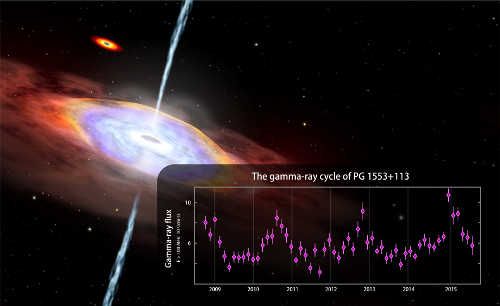
Astronomers using data from NASA's Fermi Gamma-ray Space Telescope have detected hints of periodic changes in the brightness of a so-called “active” galaxy, whose emissions are powered by a supersized black hole.
If confirmed, the discovery would mark the first years-long cyclic gamma-ray emission ever detected from any galaxy, which could provide new insights into physical processes near the black hole.
“Looking at many years of data from Fermi's Large Area Telescope (LAT), we picked up indications of a roughly two-year-long variation of gamma rays from a galaxy known as PG 1553+113,” said Stefano Ciprini, who coordinates the Fermi team at the Italian Space Agency's Science Data Center (ASDC) in Rome. “This signal is subtle and has been seen over less than four cycles, so while this is tantalizing we need more observations.”
Supermassive black holes weighing millions of times the sun's mass lie at the hearts of most large galaxies, including our own Milky Way.
In about 1 percent of these galaxies, the monster black hole radiates billions of times as much energy as the sun, emission that can vary unpredictably on timescales ranging from minutes to years. Astronomers refer to these as active galaxies.
More than half of the gamma-ray sources seen by Fermi's LAT are active galaxies called blazars, like PG 1553+113. As matter falls toward its supermassive black hole, some subatomic particles escape at nearly the speed of light along a pair of jets pointed in opposite directions.
What makes a blazar so bright is that one of these particle jets happens to be aimed almost directly toward us.
“In essence, we are looking down the throat of the jet, so how it varies in brightness becomes our primary tool for understanding the structure of the jet and the environment near the black hole,” said Sara Cutini, an astrophysicist at ASDC.
Motivated by the possibility of regular gamma-ray changes, the researchers examined a decade of multiwavelength data.
These included long-term optical observations from Tuorla Observatory in Finland, Lick Observatory in California, and the Catalina Sky Survey near Tucson, Arizona, as well as optical and X-ray data from NASA's Swift spacecraft.
The team also studied observations from the Owens Valley Radio Observatory near Bishop, Calif., which has observed PG 1553+113 every few weeks since 2008 as part of an ongoing blazar monitoring program in support of the Fermi mission.
“The cyclic variations in visible light and radio waves are similar to what we see in high-energy gamma-rays from Fermi,” said Stefan Larsson, a researcher at the Royal Institute of Technology in Stockholm and a long-time collaborator with the ASDC team. “The fact that the pattern is so consistent across such a wide range of wavelengths is an indication that the periodicity is real and not just a fluctuation seen in the gamma-ray data.”
Ciprini, Cutini, Larsson and their colleagues published the findings in the Nov. 10 edition of The Astrophysical Journal Letters. If the gamma-ray cycle of PG 1553+113 is in fact real, they predict it will peak again in 2017 and 2019, well within Fermi's expected operational lifetime.
The scientists identified several scenarios that could drive periodic emission, including different mechanisms that could produce a years-long wobble in the jet of high-energy particles emanating from the black hole.
The most exciting scenario involves the presence of a second supermassive black hole closely orbiting the one producing the jet we observe.
The gravitational pull of the neighboring black hole would periodically tilt the inner part of its companion's accretion disk, where gas falling toward the black hole accumulates and heats up.
The result would be a slow oscillation of the jet much like that of a lawn sprinkler, which could produce the cyclic gamma-ray changes we observe.
PG 1553+113 lies in the direction of the constellation Serpens, and its light takes about 5 billion years to reach Earth.
NASA's Fermi Gamma-ray Space Telescope was launched in June 2008. The mission is an astrophysics and particle physics partnership, developed in collaboration with the U.S. Department of Energy and with important contributions from academic institutions and partners in France, Germany, Italy, Japan, Sweden and the United States.
CLEARLAKE OAKS, Calif. – A Clearlake man died on Thursday morning after his car collided with a semi on Highway 20 in Clearlake Oaks.
The 20-year-old man's name was not released by the California Highway Patrol pending notification of family.
The crash occurred on Highway 20 west of Island Drive at 6:50 a.m., according to the CHP's report.
The Clearlake man was driving a 2003 Hyundai Accent westbound on Highway 20 at approximately 35 miles per hour, with 58-year-old Ralph Lucero of Redwood Valley traveling eastbound in a 2001 Kenworth T-800 semi at the same speed, the CHP said.
For reasons that the CHP said are yet to be determined, the two vehicles collided head-on, with the Hyundai coming to rest on the highway's north shoulder. The Kenworth came to rest on its wheels, facing in an easterly direction, fully blocking the eastbound lane of Highway 20.
The CHP said the Hyundai driver died at the scene. Lucero had minor injuries, with a complaint of pain.
The cause of the collision remains under investigation, and any witnesses are encouraged to call the CHP's Clear Lake Area office at 707-279-0103.
Email Elizabeth Larson at