 How to resolve AdBlock issue?
News
CLEARLAKE, Calif. – The Clear Lake/Callayomi Masonic Lodge No. 183, Free and Accepted Masons, hosts the “best breakfast in Lake County” on the third Sunday of each month at the Masonic Center, located at 7100 South Center Drive in Clearlake.
The next breakfast will be served April 17.
The lodge serves a full, sit-down breakfast from 8 to 11 a.m.
Choose your breakfast from a large menu including eggs (any style), omelets, hash browns, biscuits and gravy, hot cakes, breakfast meat, toast, juice and coffee.
The cost is $8 for adults, $4 for children ages 6 to 12. Children under age 6 may eat for free and are served a special “kids” breakfast.
LAKEPORT, Calif – The Lake County First 5 Lake Commission will meet on Wednesday, April 20.
The meeting will begin at 9 a.m. at Legacy Court, 1950 Parallel Drive in Lakeport.
Agenda items include an update on succession planning for Executive Director Tom Jordan, public hearings on the review of the strategic plan and approval of the 2015-16 First 5 Lake Long-Range Financial Plan, and a program presentation on AmeriCorps.
There also will be reports from the executive director and commissioners, and public comment and announcements.
Commissioners include Jim Brown, Laurie Daly, Brock Falkenberg, Carol Huchingson, Susan Jen, Pam Klier, Ana Santana and Jeff Smith.
For more information call the Lake County First 5 Lake Commission at 707-263-6169 or visit www.firstfivelake.org .
LAKEPORT, Calif. – The Construction Fundamentals class at Mendocino College’s Lake Center has collaborated with the Orphan Dog rescue organization to build a beautiful new kennel to house rescue dogs.
Orphan Dog and Mendocino College thanked sponsors First Pick Construction, Lucerne Roofing and Trex Building Materials.
Orphan Dog and Glenn Mueller, the course instructor, donated additional materials and plans to the construction class, and students and instructor provided the labor.
The students will present the kennel to Orphan Dog on Thursday, April 21, at 6 p.m. at the Lake Center in Lakeport.
This is the first Construction Fundamentals class offered at the Lake Center by Mendocino College’s Sustainable Technology Program, which is planning to offer additional courses in the building field this summer and in the coming semesters. Check the www.mendocino.edu online schedule for details.
Orphan Dogs is a 501(3)C organization that rescues dogs from Lake, Mendocino and Humboldt Counties. All of the animals are housed in foster homes or on the 80-acre Orphan Dog Ranch.
This year will mark the 3,000th dog homed by Orphan Dog, which is an all-volunteer rescue group. One hundred percent of every donation goes to the rescue, care, and rehoming of the dogs.
If you are interested in donating to help build the next kennel, contact Glenn Mueller at
Interested in being a foster dog caregiver? Contact Karen Shaver at
Persons marrying for a second time in California often want to protect themselves, in the event they divorce, and to protect both their surviving children and their new spouse if they become incapacitated and when they die.
Balancing these competing goals requires good planning.
Consider a hypothetical illustration: Jane owns a service business, which she incorporated as an LLC; she is employed by the LLC. She also owns various real estate, she has an investment account; and has a 401 (k) retirement account and an Individual Retirement Account (IRA). She has an 8-year-old daughter, Evelyn.
Jane is engaged to John, who is employed, has an IRA, and does not own any real estate. They plan to purchase a new home together once married. How may Jane likely proceed? [Note: Consult an attorney regarding any real-life situation.]
Jane decides to keep her substantial separate assets in her own revocable living trust to maintain their separate property character.
When she marries John, Jane amends her trust and her will to state her marriage and to provide for John in the event of her incapacity and death; otherwise, failing such amendment, John as a surviving omitted spouse could claim a share of Jane’s estate, if he survive her.
As his spouse, Jane owes John a right of support while they are married, and her estate plan will honor her obligation.
In the event of death, Jane wants John to have a place to live. Perhaps Jane will buy life insurance naming John as the primary beneficiary or, better yet, naming their joint trust together as beneficiary (so that the mortgage on their house together is paid off).
Also, Jane's separate trust might provide that certain assets are held in further trust for John's benefit until he dies or remarries at which time Evelyn inherits what remains, either outright or in further trust if she is then still a minor.
The same or different assets will be held in further trust for Evelyn until she reaches adulthood. The Trust will say how the trustee will use the assets to assist her daughter during her minority and afterwards.
Jane and John will probably want to own the home they buy together in a joint revocable living trust as co-trustees, as the residence is their community property.
Once married, because their employment earnings become community property, they will deposit their marital earnings into a joint account or into an account owned by their joint trust. Jane will keep her investment account in her separate trust.
Likewise, any retirement contributions that either spouse makes from marital earnings should go into new (IRA) accounts established during marriage.
Each spouse’s retirement contributions before marriage remain their separate property. Jane’s 401(k) is controlled by the federal Employee Retirement Income Security Act (“ERISA”) and thus outside California’s Community Property laws.
Over the course of their marriage, the community property estate will gain an increasing interest in Jane's business through her work.
Such interest which would have to be compensated if Jane and John divorce. Jane’s real property will remain her separate property, but the community property estate would be entitled to reimbursement for any marital earnings used to pay off any mortgage or improvements to Jane's separate real property. Jane will want to keep records of such payments.
If Jane and John have children together, Jane will again update her estate planning to include such children as beneficiaries of her trusts and her retirement accounts.
Jane may ask John to sign a premarital agreement to establish what is each spouse's separate property, the couple’s community property, their rights of reimbursement, and rights to spousal support; child custody and child support, however, cannot be included.
Such premarital agreements require full and open disclosure of assets, liabilities and income by each party.
To be enforceable, such agreements must be entered into voluntarily and without undue influence or fraud. Each must be apprised of his/her legal rights and be encouraged to obtain independent counsel.
Dennis A. Fordham, Attorney, is a State Bar-Certified Specialist in estate planning, probate and trust law. His office is at 870 S. Main St., Lakeport, Calif. He can be reached at
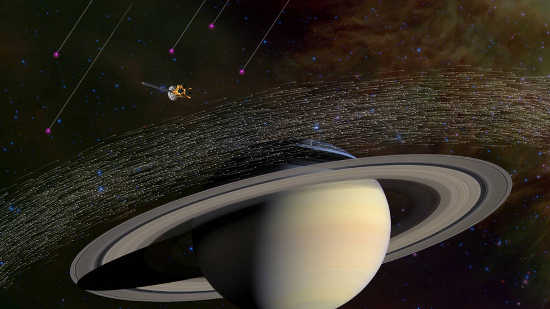
NASA's Cassini spacecraft has detected the faint but distinct signature of dust coming from beyond our solar system.
The research, led by a team of Cassini scientists primarily from Europe, is published this week in the journal Science.
Cassini has been in orbit around Saturn since 2004, studying the giant planet, its rings and its moons.
The spacecraft has also sampled millions of ice-rich dust grains with its cosmic dust analyzer instrument.
The vast majority of the sampled grains originate from active jets that spray from the surface of Saturn's geologically active moon Enceladus.
But among the myriad microscopic grains collected by Cassini, a special few – just 36 grains – stand out from the crowd.
Scientists conclude these specks of material came from interstellar space – the space between the stars.
Alien dust in the solar system is not unanticipated.
In the 1990s, the ESA/NASA Ulysses mission made the first in-situ observations of this material, which were later confirmed by NASA's Galileo spacecraft.
The dust was traced back to the local interstellar cloud: a nearly empty bubble of gas and dust that our solar system is traveling through with a distinct direction and speed.
“From that discovery, we always hoped we would be able to detect these interstellar interlopers at Saturn with Cassini. We knew that if we looked in the right direction, we should find them,” said Nicolas Altobelli, Cassini project scientist at ESA (European Space Agency) and lead author of the study. “Indeed, on average, we have captured a few of these dust grains per year, travelling at high speed and on a specific path quite different from that of the usual icy grains we collect around Saturn.”
The tiny dust grains were speeding through the Saturn system at over 45,000 mph (72,000 kilometers per hour), fast enough to avoid being trapped inside the solar system by the gravity of the sun and its planets.
“We're thrilled Cassini could make this detection, given that our instrument was designed primarily to measure dust from within the Saturn system, as well as all the other demands on the spacecraft,” said Marcia Burton, a Cassini fields and particles scientist at NASA's Jet Propulsion Laboratory in Pasadena, California, and a co-author of the paper.
Importantly, unlike Ulysses and Galileo, Cassini was able to analyze the composition of the dust for the first time, showing it to be made of a very specific mixture of minerals, not ice.
The grains all had a surprisingly similar chemical make-up, containing major rock-forming elements like magnesium, silicon, iron and calcium in average cosmic proportions.
Conversely, more reactive elements like sulfur and carbon were found to be less abundant compared to their average cosmic abundance.
“Cosmic dust is produced when stars die, but with the vast range of types of stars in the universe, we naturally expected to encounter a huge range of dust types over the long period of our study,” said Frank Postberg of the University of Heidelberg, a co-author of the paper and co-investigator of Cassini's dust analyzer.
Stardust grains are found in some types of meteorites, which have preserved them since the birth of our solar system. They are generally old, pristine and diverse in their composition. But surprisingly, the grains detected by Cassini aren't like that. They have apparently been made rather uniform through some repetitive processing in the interstellar medium, the researchers said.
The authors speculate on how this processing of dust might take place: Dust in a star-forming region could be destroyed and recondense multiple times as shock waves from dying stars passed through, resulting in grains like the ones Cassini observed streaming into our solar system.
“The long duration of the Cassini mission has enabled us to use it like a micrometeorite observatory, providing us privileged access to the contribution of dust from outside our solar system that could not have been obtained in any other way,” said Altobelli.
The Cassini-Huygens mission is a cooperative project of NASA, ESA and the Italian Space Agency. JPL, a division of the California Institute of Technology in Pasadena, manages the mission for NASA's Science Mission Directorate in Washington. The Cosmic Dust Analyzer is supported by the German Aerospace Center (DLR); the instrument is managed by the University of Stuttgart, Germany.
Emily Baldwin works for the European Space Agency.
NOTICE OF PROPOSED MINOR USE PERMIT
NOTICE IS HEREBY GIVEN that the Lake County Zoning Administrator will consider approving Minor Use Permit (MUP 16-02) of GREG CLOUSE in accordance with Lake County Code to allow a collector’s permit for construction of two accessory structures that will exceed the square footage of a primary residence and a front yard setback reduction to allow a twenty-two and a half foot setback.
The project is located at 15495 Hwy 175, Cobb, and further described as APN 013-050-15.
The Planner processing this application is Tricia Shortridge, (707) 263-2221 or
The Zoning Administrator will approve this Minor Use Permit with no public hearing if no written request for a public hearing is submitted by 5:00 P.M., April 13, 2016 to the Community Development Department, Courthouse, 255 N. Forbes St., Lakeport, California.
Should a timely request for hearing be filed, a public hearing will be held on April 20, 2016 at 2:00 p.m. in Conference Room C, 3rd Floor of the Courthouse.
COMMUNITY DEVELOPMENT DEPARTMENT
Scott DeLeon, Interim Director
By: ______________________________________
Danae Bowen, Office Assistant III