 How to resolve AdBlock issue?
News
THE HUNTSMAND: WINTER’S WAR (Rated PG-13)
The legend of Snow White, a nineteenth century German fairy tale popularized by the storytellers of folk tales known collectively as the Brothers Grimm, arguably gained the most public attention, at least on this side of the Atlantic, because of a 1937 Disney animated film.
“Snow White and the Seven Dwarfs” told the compelling story of the beautiful, lonely princess living with her stepmother, a vain and wicked Queen, whose jealousy resulted in the order for her Huntsman to take Snow White into the forest and kill her.
No need to rehash the story in exquisite detail, as we know she survives and finds allies with lovable adult dwarfs named Doc, Grumpy, Happy, Sleepy, Bashful, Sneezy and Dopey. We know the happy ending with the Prince.
“The Huntsman: Winter’s War” reveals no good outcome with a charming Prince kissing the sleeping Snow White. In fact, unlike “Snow White and the Huntsman,” for which the new film is apparently a prequel of sorts, “The Huntsman: Winter’s War” finds that Snow White is referenced without tangible, visible appearance.
The one constant factor for “The Huntsman” and the film that preceded it four years ago is that Chris Hemsworth comfortably fills the role of Eric the Huntsman again and Charlize Theron, dripping with ice in her veins, is still fittingly the evil Queen Ravenna.
New to the scene is Emily Blunt’s Freya, the good (well, relatively speaking) sister of Queen Ravenna who runs afoul of her coldhearted sibling by finding love and happiness with a newborn.
A nasty buzzkill, the Queen turns on her own blood relation for finding the kind of joy and ecstasy that eludes a narcissistic monarch who accepts only one answer to the question of “Who’s the fairest of them all?” posed to the Magic Mirror.
And so it happens that Freya’s baby is murdered in its crib, an unforgivable act that serves to freeze Freya’s heart to love and unleashing in her an icy power she never knew she possessed.
Retreating to a kingdom far to the north, Freya’s newfound callous mission is to abduct the young children of her subjects so as to create an army of unforgiving, pitiless killers impervious to compassion and love.
Queen Freya’s cardinal rule is that no one can fall in love in her ice kingdom, where even indoors the room temperature is never about the freezing level (sounds like “Frozen” but without any musical numbers). Freya can turn anyone into an icicle with the flip of her hand.
Two of the abducted children stand out as daunting warriors, growing up to be Eric the Huntsman and Sara (Jessica Chastain). Though love is forbidden in Freya’s kingdom, the Huntsman and Sara fall in love, and they are both banished, with Sara supposedly killed.
Seven years later, the Huntsman is wandering through forest lands for reasons not readily apparent. At least for the benefit of the audience, he teams up with two dwarves, Nion (Nick Frost) and Gryff (Rob Brydon), who bring much-needed comic relief.
Things improve even more on the road when the Huntsman and his two sidekicks meet up with two female dwarves, Mrs. Bromwyn (Sheridan Smith) and Doreena (Alexandra Roach), whose acerbic banter belies the fact the dwarves have now met their soul-mates.
It’s not really much of a spoiler to tell you that Sara turns up very much alive after all these years, and the question is whether she and the Huntsman can rekindle their romantic chemistry, which quite frankly wasn’t all that obvious in the first place.
As implied so far, there are confusing elements to this fantasy story that make it rather challenging to string the various sub-plots into a coherent whole. Is this story mainly about the rivalry of Ravenna and Freya, or is it focused on the Huntsman and Sara?
One gets the feeling that the absence of Kristen Stewart’s Snow White has scrambled the narrative equation. Still, the pursuit of the Magic Mirror, hidden in the forest and guarded by gorillas, is an essential element.
“The Huntsman” is a confounding exercise in storytelling. Confusion is so rampant that when the malevolent Queen Ravenna returns, slithering around as liquid gold oozes from her apparel, interest in the royal sibling rivalry is a ho-hum affair.
Things could have been far more interesting if Snow White had been in the picture, and the four dwarves that provide the greatness amount of fun and levity in an otherwise gloomy story could have been joined by three more of their kind.
For all its breathtaking visual effects, “The Huntsman: Winter’s War,” which drifts aimlessly, poses a question that can’t be answered by the Magic Mirror: “What’s the target audience for a film that’s a mish-mash of action, revenge, romance and fantasy?”
Tim Riley writes film and television reviews for Lake County News.
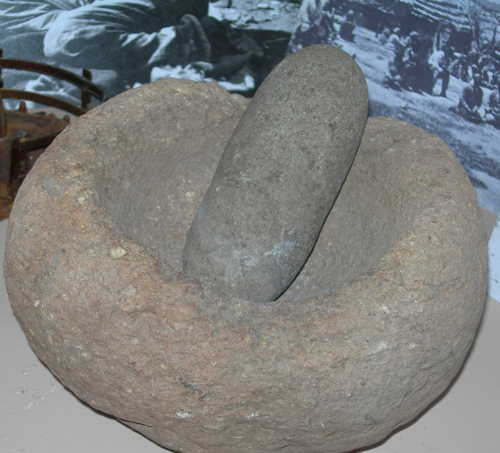
LAKE COUNTY, Calif. – A lecture by U.S. Department of Forestry Service archaeologist Barbara White at the Feb. 26, 2012, Lake County Historical Society’s meeting revealed some interesting facts about the Yuki Indian tribe of Lake County.
The Yuki language is thought to be the oldest in California. Archaeologists working in northern Lake County on the CA LAK 104 site north of Lake Pillsbury have documented house pits, chert flakes and a midden site.
They have unearthed many other historically relevant tools and discoveries such as a hearthstone, handstones, petroglyphs and various obsidian arrowheads.
The Yuki name is derived from “yuke,” meaning “enemy” or “stranger” in the Wintu language.
According to the Handbook of North American Indians, in 1850 the Yuki territory comprised areas of the Coast Range Mountains in Northwest California, and the upper Eel River, but there were more than six subdivisions throughout Round Valley, extending to the coast (Coast Yuki).
It was traditional for both men and women to participate in social dances. During those times they wore feather capes, dance skirts of deerskin, and feather headdresses.
These artful adornments were sometimes comprised of flicker quill headbands and an eagle down-filled head net. A belt was worn which was made of woven hemp and clamshell beads. They danced to the sounds of split-stick rattles, songs and log drums.
One special ceremony was the girl's adolescence ceremony. After a girl reached puberty she was kept in seclusion for a month, then, after the seclusion a village feast was held.
Other ceremonies included one for both boys and girls called the “obsidian school,” which was a type of puberty rite.
Throughout day-to-day life Yuki men wore deerskin wraps around their hips, or went naked. In winter, deerskin capes were worn. Women’s attire included a leather apron. Tattooing was common, as were bone adornments for earlobes and the nasal septum.
Tools and equipment used by the Yukis included stone mauls, mortar and pestle, various basketry, scrapers, fishing spears and fire drills. Also used were spoons of mussel shells, elkhorn wedges, hemp nets, bow and arrows with flint points.
The Yuki diet was varied and abundant, with staples such as salmon, acorns and deer. Like the other Lake County American Indian tribes, theirs was a hunter-gatherer society and included nuts, tubers, berries, seeds, mushrooms, bird eggs and honey. Sometimes grasshoppers and other insect larvae were consumed.
Part of their belief system included the principle that when an animal was hunted and taken, then another animal would replace that one. At the time of a young hunter's first kill it was taboo for him to partake of the hunt.
It was common for male hunters to hunt alone, and to use a snare or bow and arrow. Then, a deer-head was worn to aid in the hunt.
Prior to a hunt it was common practice to spend time in the sweat house and fast. A ceremony was held each year to their creator, Taikomol, or, “he who walks alone,” to appease Taikomol so they may be blessed with an abundance of acorns and other foodstuffs during that particular year.
The Yuki’s home-sites were constructed in villages of up to 150 members, led by a local chief, or leader. This leader was elected primarily to keep order in the community, however, there was a distinctive, individual war chief.
Their homes were cone-shaped, constructed of bark and poles, and were circular and cone in shape. They were approximately 10 feet in diameter and slightly submerged. It was traditional to contain a fire-pit in the center of the abode.
The Yukis usually constructed a summer dwelling out of brush, and also a dance or sweat-house. In Yuki communities, as most Native American communities, trees, creeks and lands were communally owned.
Individuals could own tools or equipment, however, and men traditionally owned tools and items related to hunting and fishing. Women possessed items related to the household.
Other homes of note were the summer brush-huts and the dance-house. The dance house had a dual purpose, and was used as a sweat-lodge as well. These structures were built in the manner of the bark homes, but larger.
Kathleen Scavone, M.A., is an educator, potter, writer and author of “Anderson Marsh State Historic Park: A Walking History, Prehistory, Flora, and Fauna Tour of a California State Park” and “Native Americans of Lake County.” She also writes for NASA and JPL as one of their “Solar System Ambassadors.” She was selected “Lake County Teacher of the Year, 1998-99” by the Lake County Office of Education, and chosen as one of 10 state finalists the same year by the California Department of Education.
LAKEPORT, Calif. – The Lake County Symphony will once again present its annual Mother’s Day concert – featuring popular music from the golden age of Broadway and film, along with a few timeless classics from Gilbert & Sullivan – on Sunday, May 8.
The concert's home is the Soper Reese Theatre, 275 S. Main St. in Lakeport.
Doors open at 3 p.m.
Music Director and Conductor John Parkinson has put together a program guaranteed to warm the hearts and keep the toes tapping of Lake County mothers and their mothers too.
As is traditional, the Lake County Youth Orchestra will open the concert, playing two popular pieces.
The first, “Blue Tango,” is by Leroy Anderson and is the most popular in his collection. Next is “Star Wars Heroes” with music by John Williams and arranged by Jerry Brubaker, with a medley from many of the “Star Wars” films.
The symphony’s opening number is “Showboat” by Jerome Kern, followed by Gilbert and Sullivan’s “Pirates of Penzance” Overture. Next is a salute to Lerner and Loewe with music from their Broadway hit “Brigadoon.”
Another Gilbert & Sullivan, the overture from “The Mikado” follows, with another Lerner and Loewe smash hit “My Fair Lady” with such classic numbers as “I Could Have Danced all Night,” “On the Street where you live,” “I’ve Grown Accustomed to her Face” and “Get me to the Church on Time.”
Following intermission the full orchestra returns with a brace of film songs including “I’ve Got You Under my Skin,” “The Shadow of your Smile,” “Night and Day” and “More,” the theme from the movie “Mondo Cane.”
The show concludes with some of the orchestra’s leading lights showing their talent via a trio of instrumental classics by Leroy Anderson.
They are “Fiddle Faddle,” highlighting the orchestra’s string section, followed by his “Clarinet Candy” featuring the clarinet duo of Nick Biondo and Peter Stanley, and ending with “Bugler’s Holiday” with the trumpet trio of Gary Miller, Dave Lindgren and John Smiraglia blowing the walls out.
The Mother's Day concert is a sellout nearly every year, and Lake County Symphony Association members are urged to get their reservations soon on-line at www.soperreesetheatre.com or by phone at 707-263-0577.
Tickets are $25 general admission or $30 premium reserved.
In order to encourage greater youth interest, a full dress rehearsal is held at 11 a.m. with young people under 18 admitted free of charge. Adults may also attend for a fee of just $5.
Connel Murray is a member of the Lake County Symphony Association.
LAKE COUNTY, Calif. – Lake County Animal Care and Control this week has a number of dogs of various breeds including Chihuahuas, boxers, pit bulls and a litter of adorable Rottweiler mix puppies needing homes.
The available dogs this week include mixes of boxer, Chihuahua, corgi, Labrador Retriever, pit bull, retriever, Rottweiler and shepherd.
Dogs that are adopted from Lake County Animal Care and Control are either neutered or spayed, microchipped and, if old enough, given a rabies shot and county license before being released to their new owner. License fees do not apply to residents of the cities of Lakeport or Clearlake.
If you're looking for a new companion, visit the shelter. There are many great pets hoping you'll choose them.
In addition to the animals featured here, all adoptable animals in Lake County can be seen here: http://bit.ly/Z6xHMb .
The following dogs at the Lake County Animal Care and Control shelter have been cleared for adoption (additional dogs on the animal control Web site not listed are still “on hold”).
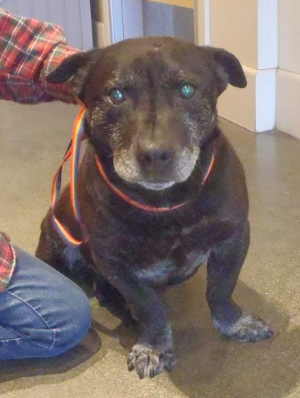
'Chato'
“Chato” is a sweet older male corgi and pit bull terrier mix.
He's in quarantine kennel No. 2, ID No. 4759.
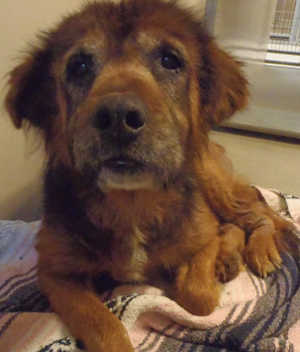
Male retriever mix
This male retriever mix has as a short brown coat.
He's in quarantine kennel No. 3, ID No. 4769.
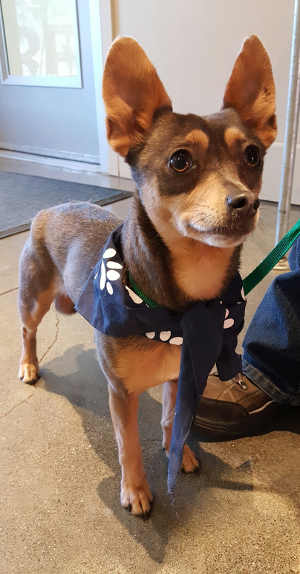
Female Chihuahua
This female Chihuahua has a short brown and tan coat.
She's in kennel No. 3, ID No. 4637.
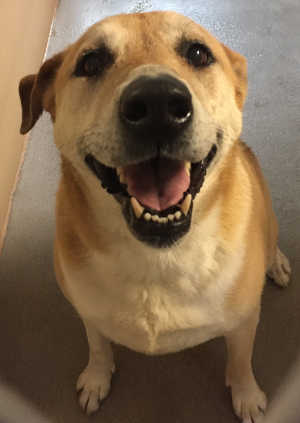
'Cali'
“Cali” is a female Labrador Retriever that shelter staff said is very sweet.
She has a short yellow coat.
Cali already is spayed so her adoption fee will be $71 instead of $161.
She's in kennel No. 6, ID No. 4683.
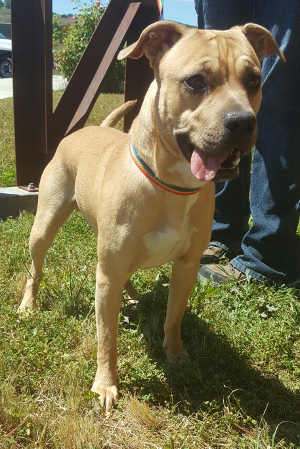
Pit bull mix
This male pit bull mix has a short tan coat.
He's in kennel No. 10, ID No. 4788.
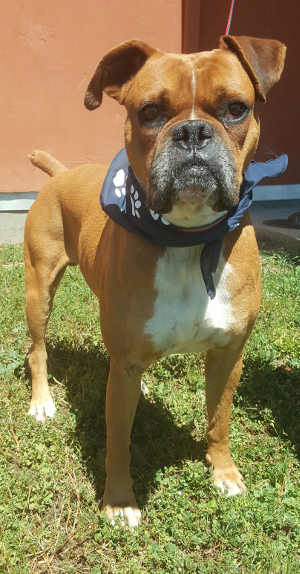
Male boxer
This handsome male boxer has a short brown coat with white markings.
He's in kennel No. 11, ID No. 4802.
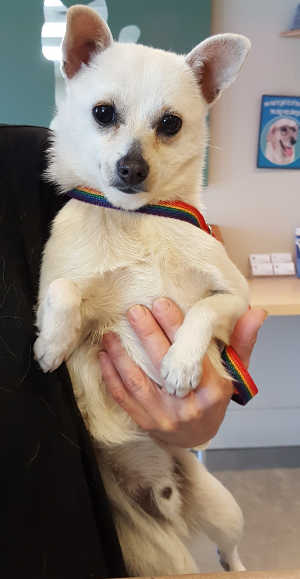
Male Chihuahua mix
This male Chihuahua mix has an all-white coat.
He's in kennel No. 17, ID No. 4591.
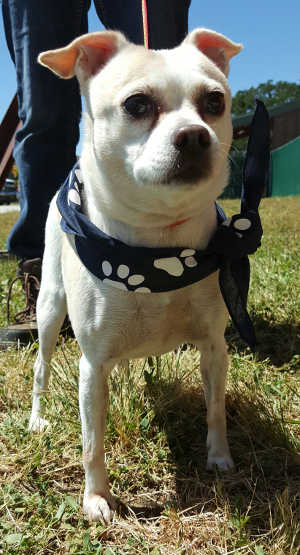
'Smokey'
“Smokey” is a Chihuahua in need of a new home.
He is in kennel No. 19b, ID No. 4706.
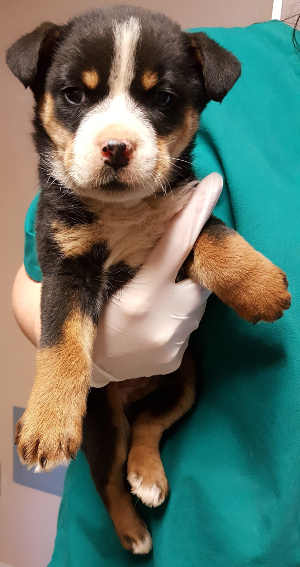
Rottweiler mix puppy
This male Rottweiler mix puppy has a short coat with brown, black and white markings.
He's in kennel No. 20a, ID No. 4805.

Rottweiler mix puppy
This female Rottweiler mix puppy has a short coat tricolor coat.
She's in kennel No. 20b, ID No. 4806.
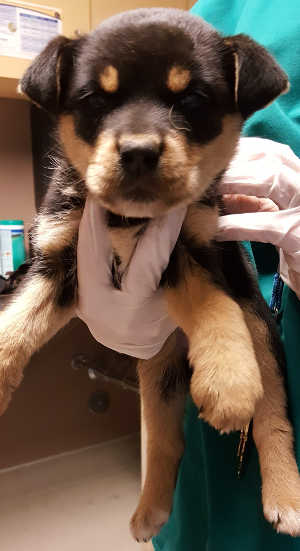
Rottweiler mix puppy
This female Rottweiler mix puppy has a short tan and black coat.
She's in kennel No. 20c, ID No. 4807.
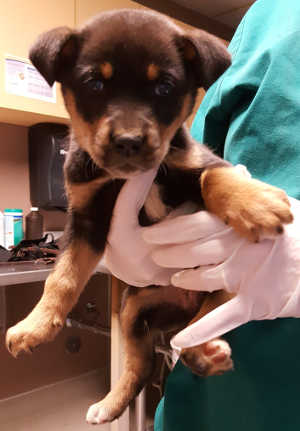
Rottweiler mix puppy
This female Rottweiler mix puppy has a short tan and black coat.
She's in kennel No. 20d, ID No. 4808.
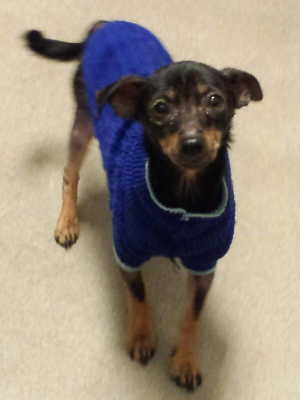
Male Chihuahua
This male Chihuahua has a short black and tan coat.
He's in kennel No. 21, ID No. 4781.

Female Chihuahua
This female Chihuahua has a short brown and white coat.
She's in kennel No. 22, ID No. 4636.

Female Chihuahua
This female Chihuahua mix has an all-white coat.
She's in kennel No. 23, ID No. 4733.
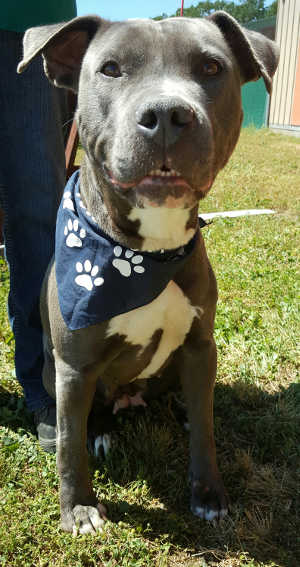
Female pit bull mix
This female pit bull mix has a short gray and white coat.
She's in kennel No. 25, ID No. 4588.
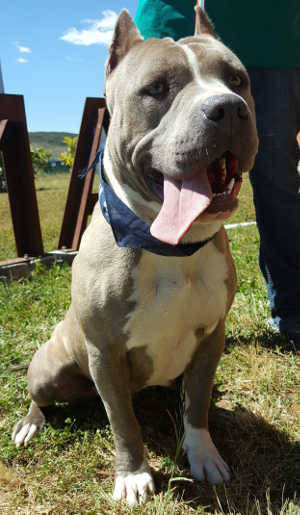
Female pit bull terrier mix
This female pit bull terrier mix has a short gray and white coat.
She's in kennel No. 29, ID No. 4749.

'Rosie'
“Rosie” is a female boxer-pit bull mix.
She has a short brown brindle coat with white markings.
Her adoption fee will be less expensive due to already being spayed.
She's in kennel No. 32, ID No. 4670.
To fill out an adoption application online visit http://www.co.lake.ca.us/Government/Directory/Animal_Care_And_Control/Adopt/Dog___Cat_Adoption_Application.htm .
Lake County Animal Care and Control is located at 4949 Helbush in Lakeport, next to the Hill Road Correctional Facility.
Office hours are Monday through Friday, 11 a.m. to 5 p.m., and 11 a.m. to 3 p.m., Saturday. The shelter is open from 11 a.m. to 4 p.m. Monday through Friday and on Saturday from 11 a.m. to 3 p.m.
Visit the shelter online at http://www.co.lake.ca.us/Government/Directory/Animal_Care_And_Control.htm .
For more information call Lake County Animal Care and Control at 707-263-0278.
Email Elizabeth Larson at
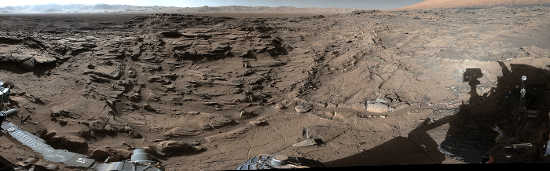 NASA's Curiosity Mars rover has nearly finished crossing a stretch of the most rugged and difficult-to-navigate terrain encountered during the mission's 44 months on Mars.
The rover climbed onto the “Naukluft Plateau” of lower Mount Sharp in early March after spending several weeks investigating sand dunes.
The plateau's sandstone bedrock has been carved by eons of wind erosion into ridges and knobs. The path of about a quarter mile westward across it is taking Curiosity toward smoother surfaces leading to geological layers of scientific interest farther uphill.
The roughness of the terrain on the plateau raised concern that driving on it could be especially damaging to Curiosity's wheels, as was terrain Curiosity crossed before reaching the base of Mount Sharp.
Holes and tears in the rover's aluminum wheels became noticeable in 2013. The rover team responded by adjusting the long-term traverse route, revising how local terrain is assessed and refining how drives are planned. Extensive Earth-based testing provided insight into wheel longevity.
The rover team closely monitors wear and tear on Curiosity's six wheels.
“We carefully inspect and trend the condition of the wheels,” said Steve Lee, Curiosity's deputy project manager at NASA's Jet Propulsion Laboratory, Pasadena, Calif. “Cracks and punctures have been gradually accumulating at the pace we anticipated, based on testing we performed at JPL. Given our longevity projections, I am confident these wheels will get us to the destinations on Mount Sharp that have been in our plans since before landing.”
Inspection of the wheels after crossing most of the Naukluft Plateau has indicated that, while the terrain presented challenges for navigation, driving across it did not accelerate damage to the wheels.
On Naukluft Plateau, the rover's Mast Camera has recorded some panoramic scenes from the highest viewpoints Curiosity has reached since its August 2012 landing on the floor of Gale Crater on Mars.
The scenes show wind-sculpted textures in the sandstone bedrock close to the rover, and Gale Crater's rim rising above the crater floor in the distance. Mount Sharp stands in the middle of the crater, which is about 96 miles (154 kilometers) in diameter.
The next part of the rover's route will return to a type of lake-deposited mudstone surface examined previously.
Farther ahead on lower Mount Sharp are three geological units that have been key destinations for the mission since its landing site was selected.
One of the units contains an iron-oxide mineral called hematite, which was detected from orbit. Just above it lies a band rich in clay minerals, then a series of layers that contain sulfur-bearing minerals called sulfates.
By examining them with Curiosity, researchers hope to gain a better understanding of how long ancient environmental conditions remained favorable for microbial life, if it was ever present on Mars, before conditions became drier and less favorable.
Each of Curiosity's six wheels is about 20 inches in diameter and 16 inches wide, milled out of solid aluminum. Most of the wheel's circumference is a metallic skin that is about half the thickness of a U.S. dime.
Nineteen zigzag-shaped treads, called grousers, extend about a quarter inch (three-fourths of a centimeter) outward from the skin of each wheel. The grousers bear much of the rover's weight and provide most of the traction and ability to traverse over uneven terrain.

The holes seen in the wheels so far perforate only the skin. Wheel-monitoring images obtained every 547 yards have not yet shown any grouser breaks on Curiosity.
Earth-based testing examined long-term wear characteristics and the amount of damage a rover wheel can sustain before losing its usefulness for driving.
The tests indicate that when three grousers on a wheel have broken, that wheel has reached about 60 percent of its useful mileage.
At a current odometry of 7.9 miles since its August 2012 landing, Curiosity's wheels are projected to have more than enough life remaining to investigate the hematite, clay and sulfate units ahead, even in the unlikely case that up to three grousers break soon.
The driving distance to the start of the sulfate-rich layers is roughly 4.7 miles from the rover's current location.
Curiosity reached the base of Mount Sharp in 2014 after fruitfully investigating outcrops closer to its landing site and then trekking to the layered mountain.
For more information about Curiosity, visit http://mars.jpl.nasa.gov/msl .
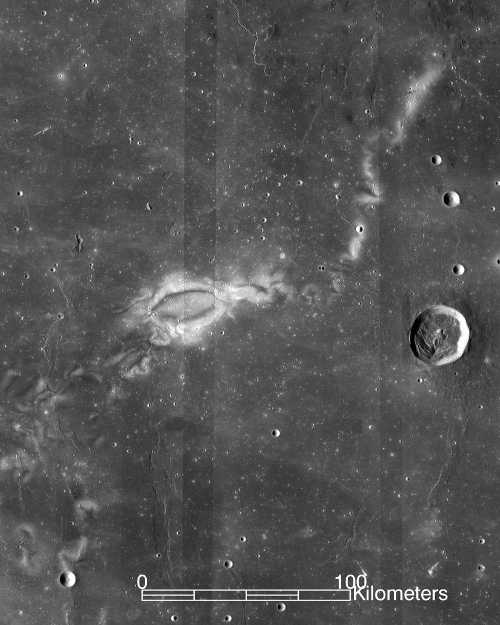
A powerful combination of observations and computer simulations is giving new clues to how the moon got its mysterious “tattoos” – swirling patterns of light and dark found at over a hundred locations across the lunar surface.
“These patterns, called 'lunar swirls,' appear almost painted on the surface of the moon,” said John Keller of NASA's Goddard Space Flight Center in Greenbelt, Maryland. “They are unique; we've only seen these features on the moon, and their origin has remained a mystery since their discovery.”
Keller is project scientist for NASA's Lunar Reconnaissance Orbiter (LRO) mission, which made the observations.
Lunar swirls can be tens of miles across and appear in groups or just as an isolated feature.
Previous observations yielded two significant clues about their formation: First, they appear where ancient bits of magnetic field are embedded in the lunar crust (although not every “fossil” magnetic field on the moon has a lunar swirl).
Second, the bright areas in the swirls appear to be less weathered than their surroundings. The space environment is harsh; many things can cause material exposed to space to change chemically and darken over time, including impacts from microscopic meteorites and the effects of the solar wind – a million-mile-per-hour stream of electrically conducting gas blown from the surface of the sun.
Those clues led to three prominent theories about how the swirls formed. The swirls and the magnetic fields could both have formed from plumes of material ejected by comet impacts.
Alternatively, perhaps when fine dust particles get lofted by micrometeorite impacts, an existing magnetic field over the swirls sorts them according to their susceptibility to magnetism, forming light and dark patterns with different compositions.
Finally, since particles in the solar wind (electrons and ions) are electrically charged, they respond to magnetic forces. Perhaps the magnetic field shields the surface from weathering by the solar wind.
In the new research, teams of scientists created computer models that provide new insights into how the magnetic shield hypothesis could work.
“The problem with the magnetic shield idea is that the embedded magnetic fields on the moon are very weak – about 300 times weaker than Earth's magnetic field,” said Bill Farrell of NASA Goddard. “It's hard to see how they would have the strength to deflect the solar wind ions.”
Farrell leads Goddard's DREAM-2 Center for Space Environments (Dynamic Response of the Environment at Asteroids, the Moon, and moons of Mars) which is funded by NASA's Solar System Exploration Research Virtual Institute (SSERVI) to conduct the model research.
The new models reveal that the magnetic field can create a strong electric field when the solar wind attempts to flow through.
It is this brawny electric potential of many hundreds of Volts that could deflect and slow particles in the solar wind. This would reduce the weathering from the solar wind, leaving brighter regions over protected areas.
The new models are published separately as a series of three papers, one in Icarus on March 1, 2016 by lead author Andrew Poppe of the University of California at Berkeley; one in the Journal of Geophysical Research: Space Physics on June 18, 2015 by lead author Shahab Fatemi of University of California, Berkeley; and one in the Journal of Geophysical Research: Planets on November 25, 2015 by lead author Michael Zimmerman of The Johns Hopkins University Applied Physics Laboratory, Laurel, Maryland.
New observations from LRO appear to provide support for the magnetic shield hypothesis, but don't rule out the other ideas.
“Until you have somebody making measurements on the lunar surface we may not get a definitive answer, but the new observations that analyze the swirls in ultraviolet and far-ultraviolet light are consistent with earlier observations that indicate the swirls are less weathered than their surroundings,” said Keller.
The new observations are the subject of two papers published in Icarus by lead author Brett Denevi of The Johns Hopkins University Applied Physics Laboratory, Laurel, Maryland on Jan. 21 and lead author Amanda Hendrix of the Planetary Science Institute, Tucson, Arizona on Feb. 4.
The DREAM-2 teams want to continue to develop their models to see how the magnetic shield responds to different strengths of the solar wind and various times of the lunar day, when the solar wind blows from different directions.
They also want to model the physical and chemical processes of space weathering to better understand how it can change the lunar surface.
The LRO team plans to modify the LAMP instrument (Lyman Alpha Mapping Project) on LRO to improve its signal-to-noise ratio for dayside observations, which will dramatically improve its ability to study this problem.
The research was funded by the LRO mission and the DREAM-2 center. DREAM-2 is part of SSERVI at NASA's Ames Research Center in California’s Silicon Valley. LRO is managed by NASA Goddard for the Science Mission Directorate at NASA Headquarters in Washington.