How to resolve AdBlock issue?
News
CLEARLAKE, Calif. – The next free household hazardous waste dropoff event will be held Friday, May 20, and Saturday, May 21, at Quackenbush Mountain Recovery & Compost Facility, 16520 Davis St., adjacent to the landfill in Clearlake.
From Highway 53 turn on to 40th Avenue, take a left on Moss Avenue, follow the signs to the landfill on Davis Avenue.
Hours will be from 9 a.m. until 1 p.m.
Households can bring up to 15 gallons of toxic items free of charge. Fees will be charged for amounts over 15 gallons.
Items that are accepted include paint, solvents, fuels, five-gallon propane tanks (empty), pool chemicals, pesticides, herbicides, batteries, fluorescent light tubes (up to 60 linear feet) and other toxic materials that cannot be put in the trash.
Items that cannot be accepted include televisions, computer monitors, ammunition, explosives, radioactive materials or infectious wastes.
To learn how and where to properly dispose these items, please visit www.recycling.co.lake.ca.us or contact the recycling hotline at 707-263-1980.
Household hazardous waste dropoff services are provided to Lake County residential households by the Integrated Waste Management Division of the Lake County Public Services Department and the Department of Resources Recycling and Recovery (CalRecycle).
Businesses also are welcome to use this convenient service to properly dispose of hazardous waste and protect our environment, however, businesses must pay for this county-funded service and first make an appointment. Business appointments can be made by calling Lake County Waste Solutions at 707-234-6400.
Beginning in June, ask about receiving a free puncture-proof sharps container at one of these events to use for free sharps disposal.
Free recycling options for residents and businesses:
· Recycled paint is available to both residents and businesses at Lake County Waste Solutions and South Lake Refuse and Recycling Center first-come, first-served basis in five gallon containers. Colors include tan, brown, gray and pink.
· Used motor oil and cooking oil can be dropped off by businesses and residents, at Lake County Waste Solutions, South Lake Refuse & Recycling Center, and the North Shore Fire Protection District station at 6257 Seventh Ave. in Lucerne. Visit www.recycling.co.lake.ca.us for more locations.
· Electronics (e-waste) can be dropped off at Lake County Waste Solutions and at South Lake Refuse & Recycling Center.
Lake County Waste Solutions
230 Soda Bay Road, Lakeport
888-718-4888 or 707-234-6400
Monday-Saturday, 7:30 a.m. - 4 p.m.
www.candswaste.com
South Lake Refuse & Recycling Center
16015 Davis St., Clearlake
Open daily, 7:30 a.m.-3 p.m.
707-994-8614
www.southlakerefuse.com
The free Household Hazardous Waste drop off program is subsidized by the Lake County Public Services Department, Integrated Waste Management Division and CalRecycle as a public service to Lake County households.
For more information about recycling, reusing and reducing, visit www.recycling.co.lake.ca.us , call the recycling hotline at 707-263-1980 or like Lake County Public Services on Facebook at https://www.facebook.com/LCPublicServices?fref=ts .
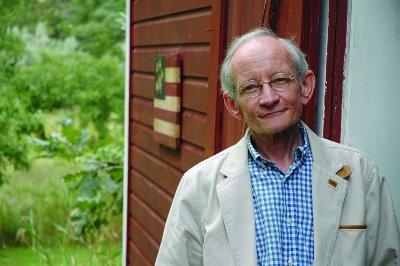
Pat Emile is Assistant Editor and Jill-Of-All-Trades for this column. Were it not for her help I couldn't keep these weekly selections coming. Here she is in another role, as a poet, stopping in a little food market and noticing things the way a poet should notice them.
They Dance Through Granelli's
He finds her near the stack
of green plastic baskets waiting to be filled
and circles her waist with his left arm,
entwines her fingers in his, pulls her toward him,
Muzak from the ceiling shedding a flashy Salsa,
and as they begin to move, she lets
her head fall back, fine hair swinging
a beat behind as they follow
their own music—a waltz—past the peaches
bursting with ripeness in their wicker baskets,
the prawns curled into each other
behind cold glass, a woman in a turquoise sari,
her dark eyes averted. They twirl twice
before the imported cheeses, fresh mozzarella
in its milky liquid, goat cheese sent down
from some green mountain, then glide past
ranks of breads, seeds spread across brown crusts,
bottles of red wine nested together on their sides.
He reaches behind her, slides a bouquet
of cut flowers from a galvanized bucket, tosses
a twenty to the teenaged boy leaning
on the wooden counter, and they whirl
out the door, the blue sky a sudden surprise.
American Life in Poetry is made possible by The Poetry Foundation ( www.poetryfoundation.org ), publisher of Poetry magazine. It is also supported by the Department of English at the University of Nebraska-Lincoln. They do not accept unsolicited submissions. Poem copyright ©2016 by Pat Hemphill Emile, “They Dance Through Granelli's.” Poem reprinted by permission of Pat Hemphill Emile. Introduction copyright © 2016 by The Poetry Foundation. The introduction's author, Ted Kooser, served as United States Poet Laureate Consultant in Poetry to the Library of Congress from 2004-2006.
UPPER LAKE, Calif. – The stage is being set for the annual celebration of Upper Lake's western heritage.
“Wild West Day” will ride into downtown Upper Lake once more on Saturday, June 4. Hours will be 8 a.m. to 4 p.m.
As in the past this celebration will feature the costume and beard contests, parades, The Blue Canyon Gang, good eats, live music and vendors. New to this year's festivities will be the juggling troupe "Physics at Play.”
This year's event also will feature a celebration of Upper Lake's beautiful 100-year-old Harriet Lee Hammond Library.
The Upper Lake Library, now a branch of the Lake County Library, opened in the fall of 1916, and will be open “true-to-form” during Wild West Day.
To the delight of readers young and old, from all walks of life, the library will be open for information, getting library cards, a book sale and just visiting.
The Women's Protective Club, which meets at the library the first Wednesday of each month, will be in the equestrian parade dressed in historical fashion and Linda Bushta, librarian of the Upper Lake Library, will be the grand marshal of the floats and autos parade.
This Wild West Day event is popular with the community and visitors alike thanks to an annual pancake breakfast served by Northshore Fire Support, the tri-tip barbecue prepared by ULHS Boosters and a strawberry ice cream social provided by the Oddfellows Hall IOOF No. 241.
So don your favorite old west attire, your dancing boots or walking shoes and join the fun on Main Street, June 4, for a day of western family fun, good food, a little toe-tapping music and shopping the great variety of "something for everyone" vendors. Don't forget to stop by and lasso a little history at the beautiful 100-year-old library.
Wild West Day is sponsored by Northshore Fire Protection District, Upper Lake Community Council, North Shore Business Association and Oddfellows Hall IOOF No. 241.
For more information call 707-275-2000 or 707-275-9515, or download parade and vendor forms at www.northshorebusinessassociation.com .
LAKE COUNTY, Calif. – Lake County Animal Care and Control has four cats needing homes this week.
The cats include three females and four males.
In addition to spaying or neutering, cats that are adopted from Lake County Animal Care and Control are microchipped before being released to their new owner. License fees do not apply to residents of the cities of Lakeport or Clearlake.
If you're looking for a new companion, visit the shelter. There are many great pets there, hoping you'll choose them.
In addition to the animals featured here, all adoptable animals in Lake County can be seen here: http://bit.ly/Z6xHMb .
The following cats at the Lake County Animal Care and Control shelter have been cleared for adoption (other cats pictured on the animal control Web site that are not listed here are still “on hold”).
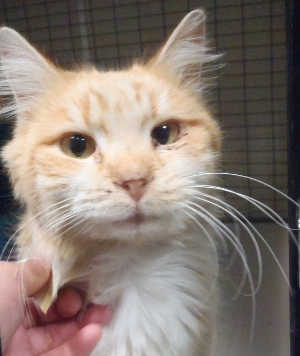
Domestic medium hair mix
This male domestic medium hair mix cat has an orange tabby coat with white markings.
He's in cat room kennel No. 20, ID No. 4773.
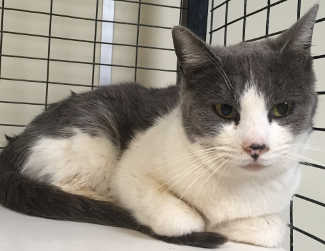
'Misty'
“Misty” is an adult female domestic short hair mix with a gray and white coat.
She's in cat room kennel No. 32, ID No. 4727.
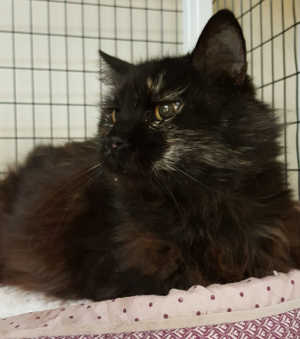
Domestic long hair mix
This female domestic long hair mix cat has an all-black coat.
Shelter staff describes her as a “love bug.”
They said she came in injured and they cannot yet determine when she will be available, but they invite applications.
She already is spayed so her adoption fee will be less expensive.
She's in cat room kennel No. 58, ID No. 4809.
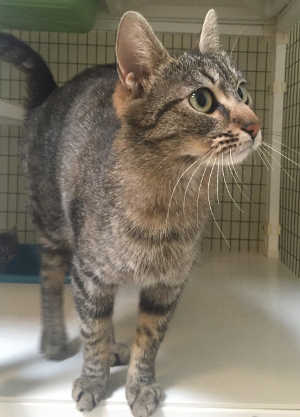
'Mom'
“Mom” is a female domestic short hair mix with a gray tabby coat.
She's in cat room kennel No. 114, ID No. 4823.
Adoptable cats also can be seen at http://www.co.lake.ca.us/Government/Directory/Animal_Care_And_Control/Adopt/Cats_and_Kittens.htm or at www.petfinder.com .
To fill out an adoption application online visit http://www.co.lake.ca.us/Government/Directory/Animal_Care_And_Control/Adopt/Dog___Cat_Adoption_Application.htm .
Lake County Animal Care and Control is located at 4949 Helbush in Lakeport, next to the Hill Road Correctional Facility.
Office hours are Monday through Friday, 11 a.m. to 5 p.m., and 11 a.m. to 3 p.m., Saturday. The shelter is open from 11 a.m. to 4 p.m. Monday through Friday and on Saturday from 11 a.m. to 3 p.m.
Visit the shelter online at http://www.co.lake.ca.us/Government/Directory/Animal_Care_And_Control.htm .
For more information call Lake County Animal Care and Control at 707-263-0278.
Email Elizabeth Larson at
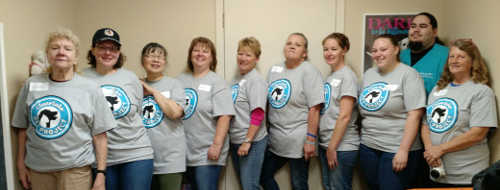 KELSEYVILLE, Calif. – An effort to provide free spaying and neutering for hundreds of Lake County pets got under way on Saturday.
The Clearlake Pet Project will provide a total of 500 free spay and neuter surgeries over the coming months in a large scale effort to help reverse the trend of dog and cat overpopulation in the county.
Organizers report that it's the largest free spay/neuter program in the county's history, and estimate that the 500 surgeries will prevent the birth of 7,500 unwanted puppies and kittens.
On Saturday, 31 pets were operated on at the SPCA of Lake County's Kelseyville clinic, according to SPCA Board President Brenda Crandall.
In addition to providing free spay and neuter surgeries, the Clearlake Pet Project – run by the nonprofit group Animal Refugee Response of Contra Costa County through a generous grant from PetSmart Charities – will offer free vaccinations and parasite control for pets of very low income pet owners.
The Clearlake Pet Project aims to decrease the incidence of unwanted litters, reduce incidence of preventable disease, and ultimately to reduce Lake County's pet euthanasia rate, which is one of the highest in California. Many of the prequalified pets have never before been seen by a veterinarian.
The first phase of the program focuses on the pets of Clearlake and Lower Lake residents. Applicants have been pre-approved and surgeries have been scheduled through the summer months.
Medical oversight is being provided by Animal Care Clinic of Contra Costa County. Transportation for pets without a way to and from their appointment is being provided by Animal Coalition of Lake County. Jameson Rescue Ranch of Napa County also is contributing additional support.
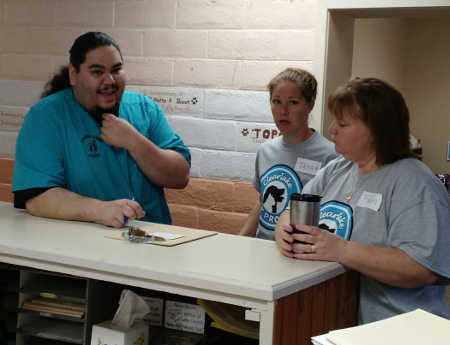
Although excellent low-cost spay/neuter options do exist in Lake County, including a voucher program from Animal Coalition of Lake County, and the FIX Lake County program from Orphan Dog, some pet owners cannot even afford these options.
The second phase of Clearlake Pet Project, planned to begin in the fall of 2016, will open up to other Lake County communities.
For more information contact Blythe Lucero at 510-230-3758 or
For pet owners who do not qualify for the Clearlake Pet Project but still need assistance with spay/neuter services, contact the local nonprofit animal rescue group Orphan Dog to fill out an application for its FIX Lake County initiative at http://www.orphandog.org/info/display?PageID=16604 or email
Lake County Animal Control and Care offers spay and neuter services for qualified individuals, and they will fix any pit bull for reduced rates ($50 for males, $70 for females). Call 707-263-0278 for more information.
For low cost spay and neuter vouchers in the city of Clearlake contact the Animal Coalition of Lake County at 707-995-0552.
On May 4, 1976, NASA launched a cannonball-shaped satellite that transformed studies of Earth’s shape, rotation and gravity field.
LAGEOS – short for Laser Geodynamic Satellite – was the first NASA orbiter dedicated to the precision measurement technique called laser ranging. With it, scientists have measured the movement of Earth’s tectonic plates, detected irregularities in the rotation of the planet, weighed it, and tracked small shifts in its center of mass.
Small deviations in the satellite’s orbit were used to develop early models of Earth’s gravitational field. Further perturbations in the orbit helped explain how sunlight heating small objects can affect their orbits, including near-Earth asteroids.
Built to last, the 900-pound (about 400 kilograms) satellite is passive, with no on-board sensors or electronics and no moving parts. Its brass core is covered by an aluminum shell that is dotted with 426 retroreflectors, making the satellite look like a giant golf ball.
“LAGEOS is elegantly simple – a ball covered with reflecting prisms,” said Stephen Merkowitz, manager of NASA’s Space Geodesy Project at the agency’s Goddard Space Flight Center in Greenbelt, Maryland. “But it set a new standard for laser ranging and has provided 40 years of continuity for these measurements.”
The satellite was launched from the Vandenberg Air Force Base in California. The design, development and construction of the orbiter was managed by NASA’s Marshall Space Flight Center in Huntsville, Alabama.
LAGEOS travels in a stable circular, pole-to-pole orbit more than 3,600 miles (5,900 kilometers) above Earth’s surface. At this altitude – medium Earth orbit – the satellite feels very little atmospheric drag and can be observed by ground stations on different continents simultaneously.
Over the years, 183 stations worldwide have ranged to LAGEOS, and dozens still do. A laser pulse is transmitted from a ground station and bounces off one of the satellite’s retroreflectors, directing part of the signal back to the station. The time it takes the pulse to make this round trip is measured precisely and used to calculate the distance between the satellite and the station.
This technique is called satellite laser ranging. By making these measurements over time, the absolute positions of the stations – relative to Earth’s center of mass – can be determined. From that, subtle changes in the positions of the stations relative to one another can be calculated.
One of the original goals of LAGEOS was to enable accurate measurements of the movements of the major plates that make up Earth’s crust. By the time the satellite was launched, the theory of plate tectonics was established, already supported by evidence of seafloor spreading and magnetic patterns in the crust. However, questions remained about how much the plates were moving in modern times and how that information could be applied to help understand earthquakes.
“What had been missing was a way to measure the speed and direction of plate movement over time,” said Frank Lemoine, a geophysical scientist at Goddard.
Satellite laser ranging had begun before LAGEOS, but early measurements had accuracies on the order of about 3 feet (1 meter). LAGEOS would make it possible to achieve accuracies of less than half an inch (1 centimeter) – the level needed to detect tectonic plate motion. Modern measurements have improved by another factor of 10.
“At the time, people couldn’t believe that we could actually range to a satellite orbiting at that altitude with such high accuracy,” said Erricos Pavlis, a researcher with the University of Maryland, Baltimore County.
These precise measurements also made it possible to detect small irregularities in Earth’s rotation, caused by the movement of mass in the atmosphere and oceans, and polar motion – the migration of the planet’s axis of rotation.
Ranging to LAGEOS was good enough to reveal small perturbations in the satellite’s orbit, which provided the basis for early gravity models of Earth. The satellite also was used to detect a rebounding of Earth’s crust in regions where it had flattened slightly when ancient ice sheets covered the Hudson Bay area, Finland and Scandinavia.
“Today, we see Earth as one system, with the planet’s shape, rotation, atmosphere, gravitational field and the motions of the continents all connected. We take it for granted now, but LAGEOS helped us arrive at that view,” said David E. Smith, who was the LAGEOS project scientist at Goddard and is now at the Massachusetts Institute of Technology in Cambridge.
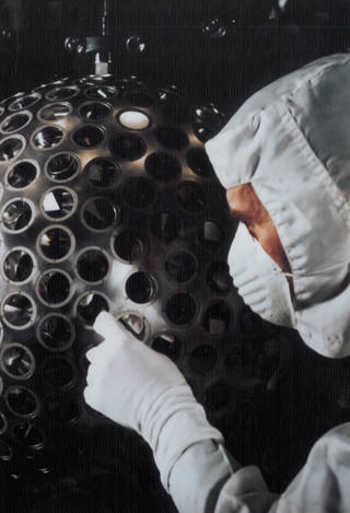
A nearly identical sister satellite, LAGEOS-2, was launched in 1992 as a joint venture of the Italian Space Agency and NASA. This satellite travels in a complementary orbit, and together, the two enabled a wider range of studies.
The data from this pair were used to confirm one prediction of Einstein’s general theory of relativity: frame dragging. This is a tiny perturbation of an object’s orbit around a massive rotating central body, called the gravitomagnetic or Lense-Thirring effect.
LAGEOS also led to the discovery of other subtle effects. One was the seasonal Yarkovsky effect, a tiny braking force that occurs when sunlight heats one side of the spacecraft and the spacecraft later emits that heat.
This drag is a variation of the original Yarkovsky effect, which takes place because of the rotation of the satellite about its axis. The seasonal version takes place over the course of its orbit around Earth.
The seasonal Yarkovsky effect – along with other miniscule forces – lowers LAGEOS’ orbit by a fraction of an inch each day.
“These and related effects are of particular interest lately because they can redirect the orbits of small objects, such as near-Earth asteroids,” said David Rubincam, a Goddard scientist involved in these studies.
NASA’s OSIRIS-REx spacecraft will investigate the Yarkovsky effect as part of its mission to study asteroid Bennu and return a sample to Earth for analysis.
These days, LAGEOS is part of a constellation of satellites that help establish and maintain the terrestrial reference frame, which links together navigation systems across the globe and serves as a fundamental reference for interplanetary navigation of spacecraft. The two LAGEOS satellites have the unique role of defining the origin, or center point, of the terrestrial reference frame; this is based on Earth’s center of mass.
Still going strong on its 40th anniversary, LAGEOS is expected to revolve around Earth for millions of years.
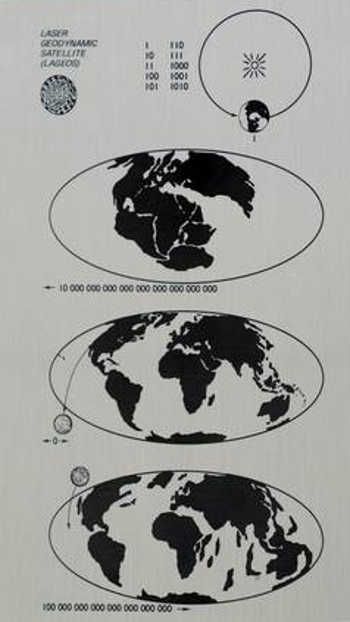
With that in mind, the orbiter carries a plaque designed by Carl Sagan. Most of the plaque is devoted to three panels, each with a map of Earth at a different epoch. The top panel represents Earth 268 million years ago, when the continents were joined as a single land mass. The middle panel shows the modern-day configuration of the continents. The last panel projects the configuration 8.4 million years in the future, when the satellite was originally predicted to finally fall to Earth.
“There is a lot of optimism embodied in this message to the future,” said Merkowitz. “It represents the vision that went into launching a satellite designed to operate for ages to come.”
Elizabeth Zubritsky works for NASA’s Goddard Space Flight Center in Greenbelt, Md.