 How to resolve AdBlock issue?
News
KELSEYVILLE, Calif. – In the three-way race for the District 5 supervisorial race, the incumbent is leading with the most money raised, according to the latest financial filings.
This past week Lake County News obtained the latest required pre-election financial documents for the candidates in the supervisorial races for Districts 1, 4 and 5, with the District 1 and District 4 race financials published Friday and Saturday, respectively.
These latest pre-election financial reports – covering the period from April 24 through May 21 – had to be submitted by May 26 to the Registrar of Voters Office.
A Lake County News analysis of the financials estimates a total of about $114,000 has been raised in all three supervisorial races to date.
In the District 1 race, $64,636.45 has been raised so far. The District 4 race has two candidates estimating they have each raised less than $2,000, leading to a rough estimate of $30,000 overall for that race.
For District 5, Lake County News estimates a total of up to $19,856 has been raised.
On the ballot for the June 7 presidential primary are District 5 candidates including longtime incumbent Rob Brown of Kelseyville, and challengers Phil Reimers of Cobb and John Stoddard of Kelseyville.
Brown is the money leader, having raised $16,256 to date, with approximately $10,369.93 spent, based on the reports.
Both Reimers and Stoddard have filed paperwork with the Registrar of Voters Office declaring that they do not expect to raise more than $2,000 each.
Contacted by Lake County News and asked for more specific details, Reimers explained that he's self-funding his campaign.
“After the fire I decided to fund it myself,” he said.
He estimated that he's spent $1,600 so far – not counting filing fees with the county – on signage and advertising.
Stoddard did not respond to messages seeking more specific information on his campaign fundraising and expenditures.
He also has not responded to other messages, and did not participate in a forum for candidates hosted by Lake County News and the Lake County Economic Development Corp. last month, the video of which can be seen above.
The Registrar of Voters Office said the next financial statement is due in August.
A summary of the candidates' finances to date is below.
ROB BROWN
Contributions received
Total contributions received, year to date/overall: $16,256
Total contributions received for reporting period: $3,050
Monetary contributions, year to date: $11,314
Monetary contributions for reporting period: $3,050
Loans received, year to date: $0
Loans received for reporting period: $0
Nonmonetary contributions, year to date: $0
Nonmonetary contributions for reporting period: $4,942
Expenditures made
Total expenditures made, year to date: $10,369.93
Total expenditures made for reporting period: $8,025
Payments made, year to date: $10,369.93
Payments made for reporting period: $8,025
Loans made, year to date: $0
Loans made for reporting period: $0
Current cash statement
Beginning cash balance: $5,917.07
Cash receipts: $3,050
Cash payments: $0
Ending cash balance: $8,967.07
Outstanding debts: $0
Top five monetary contributors, campaign to date
1. Dan Fossa, Kelseyville, contractor, $1,850
2. Bill Brunetti, Lakeport, land developer, $1,500
3. Chris Pivniska, Kelseyville, business owner, $900
4. Ronald Bartolucci, Kelseyville, rancher, $750
5. Margaret Lewis, Cobb, Calpine, $510
Top three expenses
1. Chris Jones Consulting, Newcastle, $7,500
2. Econoline Signs, Santa Rosa, $1,209.84
3. Lake County Registrar of Voters, Lakeport, $1,115.08
PHIL REIMERS
Filed Form 470 stating less than $2,000 received.
JOHN STODDARD
Filed Form 470 stating less than $2,000 received.
Email Elizabeth Larson at

“The force is an energy field created by all living things. It surrounds us, it penetrates us, it binds the galaxy together … May the Force be with you.” – Ben Kenobi, in the movie, Star Wars
LAKE COUNTY, Calif. – Here in beautiful Lake County we can find innumerable insects, many of which are known to be beneficial, such as bees, ladybugs, dragonfly nymphs and lacewings.
According to the Encyclopedia Smithsonian, “Insects also probably have the largest biomass of the terrestrial animals. At any time, it is estimated that there are some 10 quintillion (10,000,000,000,000,000,000) individual insects alive. In the United States, the number of described species is approximately 91,000.”
Most of these little critters are harmless, but some, like the scorpion, pack a wallop if you are unlucky enough to encounter one up close and personal, as I once did. (I stepped on a baby scorpion in my den decades ago, and I still recall the intense pain it caused!)
According to National Geographic's Web site, the scorpion can live from three to eight years, and – hold onto your hat – there are nearly 2,000 species of the creepy crawlers on Earth!
The scorpion has an amazing ability to survive in a variety of harsh conditions and, since they burrow, all that they need is soil to thrive.
There are stories of scorpions' capability to endure freezing circumstances, and they can “revive” themselves once they thaw out!
The robust scorpion lives on insects, and employs his front pincers, or chelae, to capture prey, then stings it with the venomous stinger located on its “tail.”
When conditions are poor, the scorpion has the ability to downshift its metabolism to around one-third its typical rate to survive.
Scorpions court beginning by finding their true love through a potent mix of pheromones, and through unique vibrations and dance. After mating, the male literally hightails it out of the female's sight so that he won't be eaten!
Dozens of baby scorpions, or scorplings, are born, after around a year. Then, the scorplings are carted around on the mother's back until molting has occurred, usually several times.
Another surprising factoid about scorpions is that, if viewed under ultraviolet light, they glow eerily.
Kathleen Scavone, M.A., is a retired educator, potter, writer and author of “Anderson Marsh State Historic Park: A Walking History, Prehistory, Flora, and Fauna Tour of a California State Park” and “Native Americans of Lake County.” She also writes for NASA and JPL as one of their “Solar System Ambassadors.” She was selected “Lake County Teacher of the Year, 1998-99” by the Lake County Office of Education, and chosen as one of 10 state finalists the same year by the California Department of Education.
LAKE COUNTY, Calif. – Lake County Animal Care and Control is offering to new homes this week a number of working breed dogs and some little ones, too.
Canines offered for adoption this week include mixes of boxer, Chihuahua, Doberman Pinscher, German Shepherd, Labrador Retriever, pit bull and Shih Tzu.
Dogs that are adopted from Lake County Animal Care and Control are either neutered or spayed, microchipped and, if old enough, given a rabies shot and county license before being released to their new owner. License fees do not apply to residents of the cities of Lakeport or Clearlake.
If you're looking for a new companion, visit the shelter. There are many great pets hoping you'll choose them.
In addition to the animals featured here, all adoptable animals in Lake County can be seen here: http://bit.ly/Z6xHMb .
The following dogs at the Lake County Animal Care and Control shelter have been cleared for adoption (additional dogs on the animal control Web site not listed are still “on hold”).

Labrador Retriever mix
This female Labrador Retriever mix has a short black coat with white markings.
She's in kennel No. 2, ID No. 4969.

Pit bull terrier mix
This male pit bull terrier mix has a short brown coat.
Shelter staff said he does not jump and is very friendly, walking well on a leash, showing no food aggression, and allowing handling of his mouth, ears, paws and tail with no problems. He also enjoys a good tummy rub.
He would do great in a home with no cats.
He's in kennel No. 4, ID No. 4850.

'Razor'
“Razor” is a female Chihuahua mix.
She has a short tan coat with white markings.
She's in kennel No. 8, ID No. 5017.

'Nitress'
“Nitress” is a female Doberman Pinscher-Labrador Retriever mix.
She' has a short black coat with tan markings.
She's in kennel No. 11, ID No. 5009.

Pit bull mix
This female pit bull terrier mix has a short white coat with dark markings, including an eye patch like “Petey” from the Little Rascals.
She's in kennel No. 13, ID No. 4926.

Yellow Labrador Retriever
This male Labrador Retriever mix has a short yellow coat.
He's in kennel No. 14a, ID No. 4925.

'Baby'
“Baby” is a female Labrador Retriever-pit bull mix.
She has a short, all-black coat.
Shelter staff said she is a sweet dog.
She's in kennel No. 15, ID No. 5005.

'Osito'
“Osito” is a male Shih Tzu.
He has a silver, gray and tan coat.
He's in kennel No. 16, ID No. 5013.

'Goliath'
“Goliath” is a male pit bull terrier mix.
He has a short white coat with a nifty brown eye patch.
He's in kennel No. 17, ID No. 5012.

German Shepherd mix
This handsome male German Shepherd mix has a short black coat with white markings.
Shelter staff said he is very people friendly, high energy, and good with female dogs or submissive males. He allows handling of his paws, ears, tail and body with no problems.
He wants to jump and play, and shelter staff suggested he would do great with children after some training for his jumping.
He's in kennel No. 20, ID No. 4862.

'Mom'
“Mom” is a female Labrador Retriever-Doberman Pinscher mix.
She has a pretty black and tan coat, and a sweet personality.
She's in kennel No. 22, ID No. 4917.
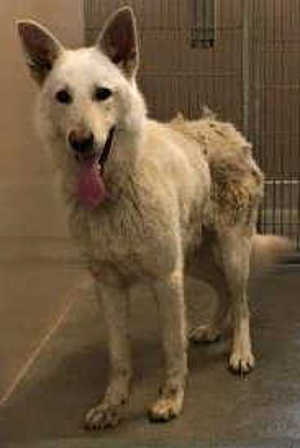
'Snowball'
“Snowball” is a handsome male German Shepherd mix with a short white coat.
He appears to have been abused in his previous home, and he will need a calm, patient and caring home where he can be made to feel safe and loved.
He's in kennel No. 24, ID No. 4947.

Male pit bull mix
This male pit bull mix has a short black coat with white markings on his chest and toes.
He's in kennel No. 29, ID No. 5004.

'Rosie'
“Rosie” is a female boxer-pit bull mix listed as “urgent,” and needing a new home immediately.
She has a short brown brindle coat with white markings, a friendly personality, lots of energy and a playful attitude. She's good with other large dogs and loves children.
Her adoption fee will be less expensive due to already being spayed.
She's in kennel No. 32, ID No. 4670.
To fill out an adoption application online visit http://www.co.lake.ca.us/Government/Directory/Animal_Care_And_Control/Adopt/Dog___Cat_Adoption_Application.htm .
Lake County Animal Care and Control is located at 4949 Helbush in Lakeport, next to the Hill Road Correctional Facility.
Office hours are Monday through Friday, 11 a.m. to 5 p.m., and 11 a.m. to 3 p.m., Saturday. The shelter is open from 11 a.m. to 4 p.m. Monday through Friday and on Saturday from 11 a.m. to 3 p.m.
Visit the shelter online at http://www.co.lake.ca.us/Government/Directory/Animal_Care_And_Control.htm .
For more information call Lake County Animal Care and Control at 707-263-0278.
Email Elizabeth Larson at
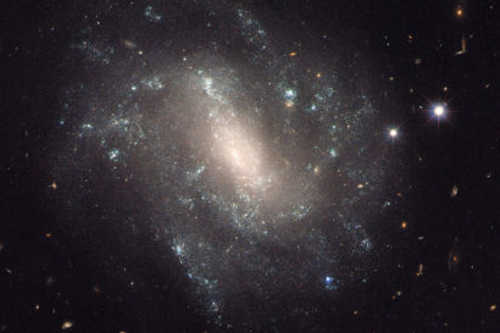
Astronomers have obtained the most precise measurement yet of how fast the universe is expanding, and it doesn’t agree with predictions based on other data and our current understanding of the physics of the cosmos.
The discrepancy – the universe is now expanding 9 percent faster than expected – means either that measurements of the cosmic microwave background radiation are wrong, or that some unknown physical phenomenon is speeding up the expansion of space, the astronomers say.
“If you really believe our number – and we have shed blood, sweat and tears to get our measurement right and to accurately understand the uncertainties – then it leads to the conclusion that there is a problem with predictions based on measurements of the cosmic microwave background radiation, the leftover glow from the Big Bang,” said Alex Filippenko, a UC Berkeley professor of astronomy and co-author of a paper announcing the discovery.
“Maybe the universe is tricking us, or our understanding of the universe isn't complete,” he added.
The cause could be the existence of another, unknown particle – perhaps an often-hypothesized fourth flavor of neutrino – or that the influence of dark energy (which accelerates the expansion of the universe) has increased over the 13.8 billion-year history of the universe. Or perhaps Einstein’s general theory of relativity, the basis for the Standard Model, is slightly wrong.
“This surprising finding may be an important clue to understanding those mysterious parts of the universe that make up 95 percent of everything and don’t emit light, such as dark energy, dark matter and dark radiation,” said the leader of the study, Nobel laureate Adam Riess, of the Space Telescope Science Institute and Johns Hopkins University, both in Baltimore,. Riess is a former UC Berkeley postdoctoral fellow who worked with Filippenko.
The results, using data from the Hubble Space Telescope and the Keck I telescope in Hawaii, will appear in an upcoming issue of the Astrophysical Journal.
Afterglow of Big Bang
A few years ago, the European Space Agency’s Planck observatory – now out of commission – measured fluctuations in the cosmic background radiation to document the universe’s early history.
Planck’s measurements, combined with the current Standard Model of physics, predicted an expansion rate today of 66.53 (plus or minus 0.62) kilometers per second per megaparsec. A megaparsec equals 3.26 million light-years.
Previous direct measurements of galaxies pegged the current expansion rate, or Hubble constant, between 70 and 75 km/sec/Mpc, give or take about 5-10 percent – a result that is not definitely in conflict with the Planck predictions.
But the new direct measurements yield a rate of 73.24 (plus or minus 1.74) km/sec/Mpc, an uncertainty of only 2.4 percent, clearly incompatible with the Planck predictions, Filippenko said.
The team, several of whom were part of the High-z Supernova Search Team that co-discovered the accelerating expansion of the universe in 1998, refined the universe’s current expansion rate by developing innovative techniques that improved the precision of distance measurements to faraway galaxies.
The team looked for galaxies containing both a type of variable star called a Cepheid and Type Ia supernovae.
Cepheid stars pulsate at rates that correspond to their true brightness (power), which can be compared with their apparent brightness as seen from Earth to accurately determine their distance and thus the distance of the galaxy.
Type Ia supernovae, another commonly used cosmic yardstick, are exploding stars that flare with the same intrinsic brightness and are brilliant enough to be seen from much longer distances.
By measuring about 2,400 Cepheid stars in 19 nearby galaxies and comparing the apparent brightness of both types of stars, the researchers accurately determined the true brightness of the Type Ia supernovae. They then used this calibration to calculate distances to roughly 300 Type Ia supernovae in far-flung galaxies.
“We needed both the nearby Cepheid distances for galaxies hosting Type Ia supernovae and the distances to the 300 more-distant Type Ia supernovae to determine the Hubble constant,” Filippenko said. “The paper focuses on the 19 galaxies and getting their distances really, really well, with small uncertainties, and thoroughly understanding those uncertainties.”
Calibrating Cepheid variable stars
Using the Keck I 10-meter telescope in Hawaii, Filippenko's group measured the chemical abundances of gases near the locations of Cepheid variable stars in the nearby galaxies hosting Type Ia supernovae. This allowed them to improve the accuracy of the derived distances of these galaxies, and thus to more accurately calibrate the peak luminosities of their Type Ia supernovae.
“We've done the world's best job of decreasing the uncertainty in the measured rate of universal expansion and of accurately assessing the size of this uncertainty,” said Filippenko, “yet we find that our measured rate of expansion is probably incompatible with the rate expected from observations of the young universe, suggesting that there's something important missing in our physical understanding of the universe."
“If we know the initial amounts of stuff in the universe, such as dark energy and dark matter, and we have the physics correct, then you can go from a measurement at the time shortly after the Big Bang and use that understanding to predict how fast the universe should be expanding today,” said Riess. “However, if this discrepancy holds up, it appears we may not have the right understanding, and it changes how big the Hubble constant should be today.”
Aside from an increase in the strength with which dark energy is pushing the universe apart, and the existence of a new fundamental subatomic particle – a nearly speed-of-light particle called “dark radiation” – another possible explanation is that dark matter possesses some weird, unexpected characteristics.
Dark matter is the backbone of the universe upon which galaxies built themselves into the large-scale structures seen today.
The Hubble observations were made with Hubble’s sharp-eyed Wide Field Camera 3 (WFC3), and were conducted by the Supernova H0 for the Equation of State (SHOES) team, which works to refine the accuracy of the Hubble constant to a precision that allows for a better understanding of the universe’s behavior.
The SHOES Team is still using Hubble to reduce the uncertainty in the Hubble constant even more, with a goal to reach an accuracy of 1 percent.
Telescopes such as the European Space Agency’s Gaia satellite, and future telescopes, such as the James Webb Space Telescope (JWST), an infrared observatory, and the Wide Field Infrared Space Telescope (WFIRST), also could help astronomers make better measurements of the expansion rate.
The Hubble Space Telescope is a project of international cooperation between NASA and the European Space Agency. NASA’s Goddard Space Flight Center in Greenbelt, Maryland, manages the telescope. The Space Telescope Science Institute (STScI) in Baltimore conducts Hubble science operations.
STScI is operated for NASA by the Association of Universities for Research in Astronomy in Washington, D.C. The W. M. Keck Observatory in Hawaii is operated as a scientific partnership among the California Institute of Technology, the University of California and NASA.
Filippenko's research was supported by NASA, the National Science Foundation, the TABASGO Foundation, Gary and Cynthia Bengier and the Christopher R. Redlich Fund.
Robert Sanders writes for the UC Berkeley News Center.
UPPER LAKE, Calif. – The 100th anniversary of one of the world's greatest tragedies will happen this summer, and it will be the topic of the next Lake County History Roundtable on Monday, June 6.
The roundtable will meet beginning at 6:15 p.m. at the Tallman Hotel, 9550 Main St. in Upper Lake.
The Battle of the Somme took place between July 1 and Nov. 18, 1916, on both sides of upper reaches of the River Somme in France.
It was the largest battle of World War I on the Western Front; more than one million men were wounded or killed, making it one of the bloodiest battles in human history.
Local historian Zane Jensen will explore what led to the battle, the battle itself and the aftermath of the Battle of the Somme.
Jensen, a history teacher with Terrace Middle School in Lakeport, will give a multimedia presentation that will describe the technology that drove the carnage.
In addition, Phil Smoley will present some casualty statistics on World War I, and how they compare to other wars.
The History Roundtable meets the first Monday of most months. Admission is free.
For more information, contact Phil Smoley at
LAKE COUNTY, Calif. – Habitat for Humanity Lake County is accepting enrollment in its Homeownership Program.
If you have lost your residence to the 2015 fires and have limited rehousing resources, or are an otherwise qualified low-income family who has resided in the county for at least one year and possess a sustainable income, you are encouraged to apply.
Contact the Habitat for Humanity office at 707-994-1100, visit online at www.lakehabitat.org or stop by the office at 16285 A Main St. in Lower Lake for an intake application and appointment with the family selection volunteers.
The volunteers will be able to answer all applicants' questions regarding Habitat for Humanity and how the Homeownership Program works.