 How to resolve AdBlock issue?
News
The Department of Veterans Affairs (VA) announced the launch of the Veterans Legacy Program to memorialize veterans’ service and sacrifice through public educational programming.
The program uses the rich resources found throughout VA national cemeteries, soldiers’ lots and monument sites. Secretary of Veterans Affairs Robert A. McDonald announced the program yesterday during a Memorial Day ceremony at Riverside National Cemetery in Riverside, California.
“The Veterans Legacy Program is meant to bring to life the stories of veterans buried in VA national cemeteries through lesson plans, interactive maps and video vignettes,” said Secretary McDonald. “Behind every marker is a story – a story of what it meant to be a Soldier, Sailor, Airman, Marine and Coast Guardsman at a particular moment in time. Our goal is to ensure that our nation does not forget their stories and their sacrifice.”
Using online educational products such as lesson plans, interactive maps and short video vignettes, VA, through the Veterans Legacy Program, will engage the general public, students and educators.
VA launched this initiative earlier this year at two pilot sites: Beaufort National Cemetery in South Carolina and Riverside National Cemetery in California.
Over the next several years, online educational products and programs will be developed for all VA national cemeteries.
VA has also formed a partnership with the American Battle Monuments Commission (ABMC) to co-sponsor a “Teachers Institute,” a workshop for educators who will conduct research at VA and ABMC cemeteries. Information about the program may be found at www.cem.va.gov/cem/legacy/.
More than four million Americans, including veterans of every war and conflict, are buried in VA’s 133 national cemeteries.
VA also provides funding to establish, expand, improve, and maintain 100 veterans cemeteries in 47 states and territories including tribal trust lands, Guam and Saipan.
For veterans not buried in a VA national cemetery, VA provides headstones, markers or medallions to commemorate their service.
In 2015, VA honored more than 353,000 veterans and their loved ones with memorial benefits in national, state, tribal and private cemeteries.
Information on VA burial benefits is available from local VA national cemetery offices at www.cem.va.gov or by calling VA regional offices toll-free at 800-827-1000.
For more information about the history of VA national cemeteries, visit www.cem.va.gov/history .
LOWER LAKE, Calif. – The Lake County Democratic Club will hold its monthly meeting on Tuesday, June 14.
There will be a short business meeting at 6:30 p.m. in the social hall of the Lower Lake Community United Methodist Church, 16255 Second St.
The meeting will be followed by a potluck dinner. Feel free to bring a dish to share and enjoy an evening of socializing with Lake County friends and neighbors as they discuss the outcome of the June primary.
Meetings are open to the public. Membership is open to all registered Democrats.
The Lake County Democratic Club is an officially chartered club of the Democratic Party of Lake County.
For more information visit www.lakecountydemocraticclub.org or contact the club at
LAKE COUNTY, Calif. – Lake County Animal Care and Control has a mix of young dogs – including several Labrador Retriever mixes – plus some adults waiting for new homes this week.
This week's dogs include mixes of Chihuahua, Doberman Pinscher, German Shepherd, Labrador Retriever and pit bull.
Dogs that are adopted from Lake County Animal Care and Control are either neutered or spayed, microchipped and, if old enough, given a rabies shot and county license before being released to their new owner. License fees do not apply to residents of the cities of Lakeport or Clearlake.
If you're looking for a new companion, visit the shelter. There are many great pets hoping you'll choose them.
In addition to the animals featured here, all adoptable animals in Lake County can be seen here: http://bit.ly/Z6xHMb .
The following dogs at the Lake County Animal Care and Control shelter have been cleared for adoption (additional dogs on the animal control Web site not listed are still “on hold”).
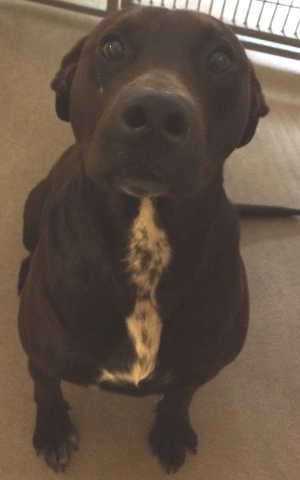
Labrador Retriever mix
This female Labrador Retriever mix has a short black coat with white markings.
She's in kennel No. 2, ID No. 4969.
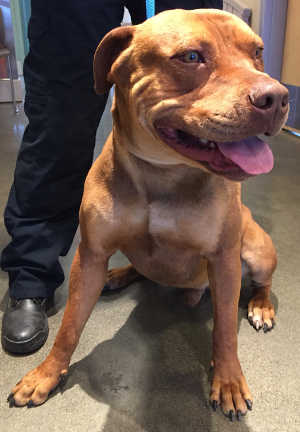
Pit bull terrier mix
This male pit bull terrier mix has a short brown coat.
Shelter staff said he does not jump and is very friendly, walking well on a leash, showing no food aggression, and allowing handling of his mouth, ears, paws and tail with no problems. He also enjoys a good tummy rub.
He would do great in a home with no cats.
He's in kennel No. 4, ID No. 4850.
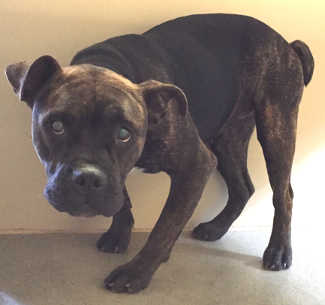
Pit bull terrier
This female pit bull terrier has a short dark coat.
She's in kennel No. 5, ID No. 5029.
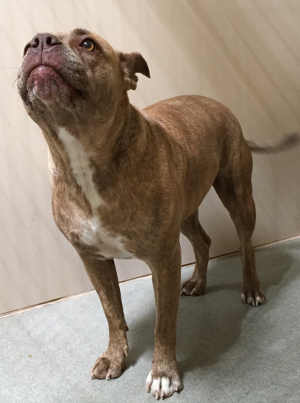
Pit bull terrier
This female pit bull terrier has a short tan brindle coat.
She's in kennel No. 6, ID No. 5028.
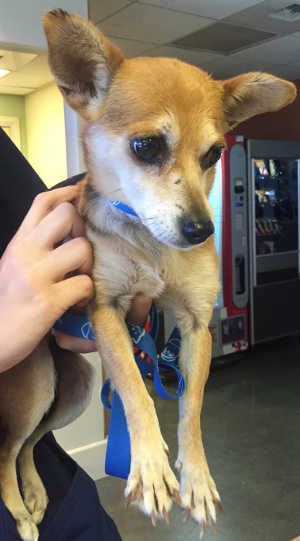
'Razor'
“Razor” is a female Chihuahua mix.
She has a short tan coat with white markings.
She's in kennel No. 8, ID No. 5017.
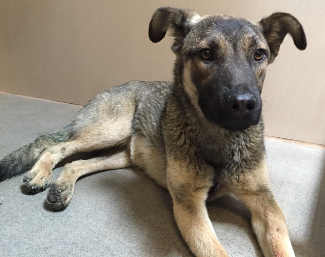
German Shepherd mix
This female German Shepherd mix has a short black and tan coat.
She's in kennel No. 10, ID No. 5065.
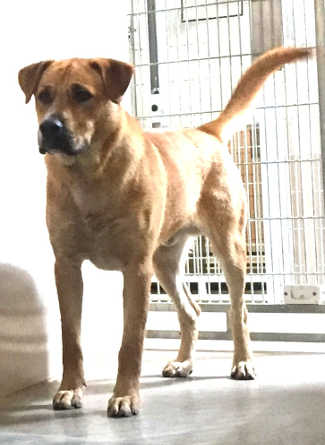
Yellow Labrador Retriever
This male Labrador Retriever mix has a short yellow coat.
He's in kennel No. 14a, ID No. 4925.
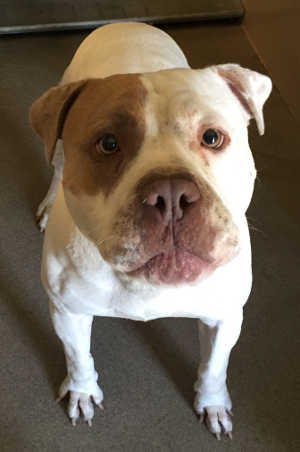
'Goliath'
“Goliath” is a male pit bull terrier mix.
He has a short white coat with a nifty brown eye patch.
He's in kennel No. 17, ID No. 5012.
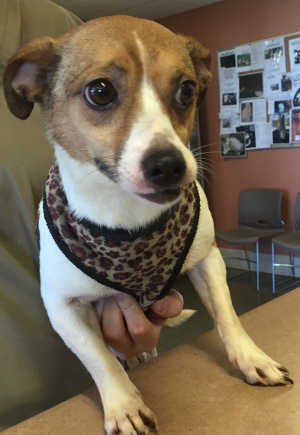
Chihuahua mix
This female Chihuahua mix has a short tan and white coat.
She's in kennel No. 20, ID No. 5068.
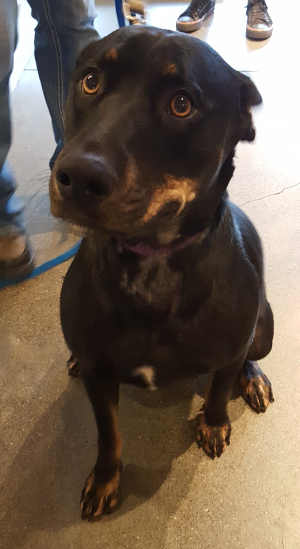
'Mom'
“Mom” is a female Labrador Retriever-Doberman Pinscher mix.
She has a pretty black and tan coat, and a sweet personality.
She's in kennel No. 22, ID No. 4917.
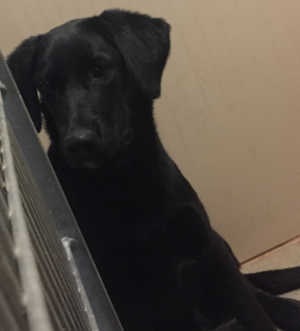
Labrador Retriever mix
This young male Labrador Retriever mix has a short black coat.
He's in kennel No. 25a, ID No. 5061.
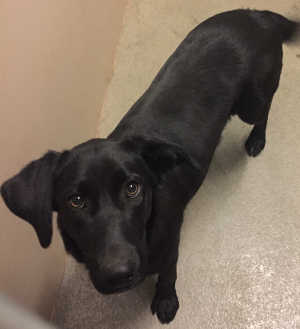
Labrador Retriever mix
This young male Labrador Retriever mix has a short black coat.
He's in kennel No. 25b, ID No. 5062.
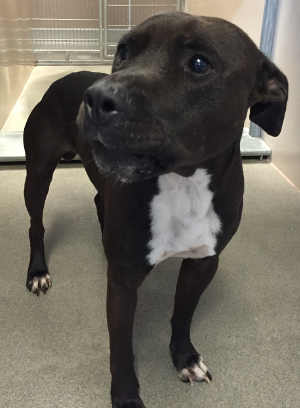
Male pit bull mix
This male pit bull mix has a short black coat with white markings on his chest and toes.
He's in kennel No. 29, ID No. 5004.
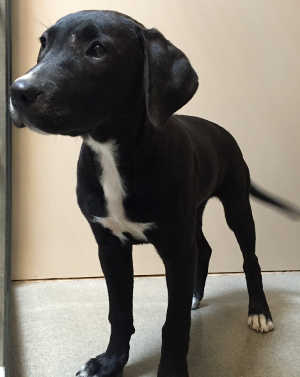
Labrador Retriever mix puppy
This female Labrador Retriever mix puppy has a short black coat with white markings.
She's in kennel No. 32, ID No. 5066.
To fill out an adoption application online visit http://www.co.lake.ca.us/Government/Directory/Animal_Care_And_Control/Adopt/Dog___Cat_Adoption_Application.htm .
Lake County Animal Care and Control is located at 4949 Helbush in Lakeport, next to the Hill Road Correctional Facility.
Office hours are Monday through Friday, 11 a.m. to 5 p.m., and 11 a.m. to 3 p.m., Saturday. The shelter is open from 11 a.m. to 4 p.m. Monday through Friday and on Saturday from 11 a.m. to 3 p.m.
Visit the shelter online at http://www.co.lake.ca.us/Government/Directory/Animal_Care_And_Control.htm .
For more information call Lake County Animal Care and Control at 707-263-0278.
Email Elizabeth Larson at
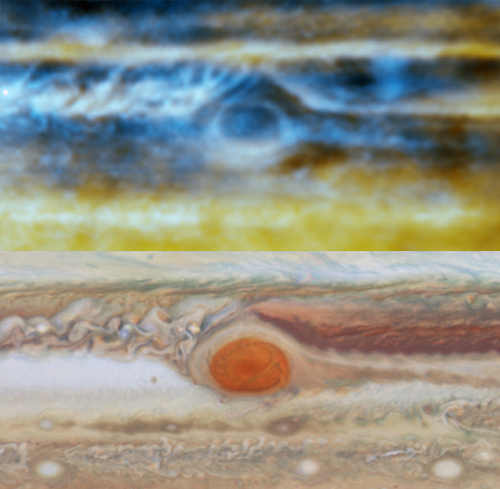
Astronomers using the upgraded Karl G. Jansky Very Large Array in New Mexico have produced the most detailed radio map yet of the atmosphere of Jupiter, revealing the massive movement of ammonia gas that underlies the colorful bands, spots and whirling clouds visible to the naked eye.
The University of California, Berkeley researchers measured radio emissions from Jupiter’s atmosphere in wavelength bands where clouds are transparent. The observers were able to see as deep as 100 kilometers (60 miles) below the cloud tops, a largely unexplored region where clouds form.
The planet’s thermal radio emissions are partially absorbed by ammonia gas. Based on the amount of absorption, the researchers could determine how much ammonia is present and at what depth.
By studying these regions of the planet's atmosphere, astronomers hope to learn how global circulation and cloud formation are driven by Jupiter's powerful internal heat source. These studies also will shed light on similar processes occurring on other giant planets in our solar system and on newly discovered giant exoplanets around distant stars.
“We in essence created a three-dimensional picture of ammonia gas in Jupiter’s atmosphere, which reveals upward and downward motions within the turbulent atmosphere,” said principal author Imke de Pater, a UC Berkeley professor of astronomy.
The map bears a striking resemblance to visible-light images taken by amateur astronomers and the Hubble Space Telescope, she said.
The radio map shows ammonia-rich gases rising into and forming the upper cloud layers: an ammonium hydrosulfide cloud at a temperature near 200 Kelvin (minus 100 degrees Fahrenheit) and an ammonia-ice cloud in the approximately 160 Kelvin cold air (minus 170degrees Fahrenheit). These clouds are easily seen from Earth by optical telescopes.
Conversely, the radio maps show ammonia-poor air sinking into the planet, similar to how dry air descends from above the cloud layers on Earth.
The map also shows that hotspots – so-called because they appear bright in radio and thermal infrared images – are ammonia-poor regions that encircle the planet like a belt just north of the equator. Between these hotspots are ammonia-rich upwellings that bring ammonia from deeper in the planet.
“With radio, we can peer through the clouds and see that those hotspots are interleaved with plumes of ammonia rising from deep in the planet, tracing the vertical undulations of an equatorial wave system,” said UC Berkeley research astronomer Michael Wong.
The final maps have the best spatial resolution ever achieved in a radio map: 1,300 kilometers.
“We now see high ammonia levels like those detected by Galileo from over 100 kilometers deep, where the pressure is about eight times Earth’s atmospheric pressure, all the way up to the cloud condensation levels,” de Pater said.
De Pater, Wong and their colleagues will report their findings and highly detailed maps in the June 3 issue of the journal Science.
Prelude to Juno’s arrival
The observations are being reported just one month before the July 4 arrival at Jupiter of NASA’s Juno spacecraft, which plans, in part, to measure the amount of water in the deep atmosphere where the Very Large Array looked for ammonia.
“Maps like ours can help put their data into the bigger picture of what’s happening in Jupiter’s atmosphere,” de Pater said, noting that her team will observe Jupiter with the VLA at the same time as Juno’s microwave instruments are probing for water.
Key to the new observations was an upgrade to the VLA that improved sensitivity by a factor of 10, said Bryan Butler, a co-author and staff astronomer at the National Radio Astronomy Observatory in Socorro, New Mexico, which operates the VLA. “These Jupiter maps really show the power of the upgrades to the VLA.”
The team observed over the entire frequency range between 4 and 18 gigahertz (1.7 – 7 centimeter wavelength), which enabled them to carefully model the atmosphere, said David DeBoer, a research astronomer with UC Berkeley’s Radio Astronomy Laboratory.
“We now see fine structure in the 12 to 18 gigahertz band, much like we see in the visible, especially near the Great Red Spot, where we see a lot of little curly features,” Wong said. “Those trace really complex upwelling and downwelling motions there.”
The observations also resolve a puzzling discrepancy between the ammonia concentration detected by the Galileo probe when it plunged through the atmosphere in 1995 – 4.5 times the abundance observed in the sun – and VLA measurements from before 2004, which showed much less ammonia gas than measured by the probe.
“Jupiter’s rotation once every 10 hours usually blurs radio maps, because these maps take many hours to observe,” said co-author Robert Sault, of the University of Melbourne in Australia. “But we have developed a technique to prevent this and so avoid confusing together the upwelling and downwelling ammonia flows, which had led to the earlier underestimate.”
This research was supported by Planetary Astronomy and Outer Planets Research Program awards from the National Aeronautics and Space Administration. NRAO is a National Science Foundation facility operated under cooperative agreement by Associated Universities Inc.
Robert Sanders writes for the UC Berkeley News Center.
LAKE COUNTY, Calif. – A portion of Northern California that includes Lake County remains under a red flag warning through Sunday evening due to fire weather conditions.
The National Weather Service issued the warning, which ends at 5 p.m. Sunday.
A red flag warning means that critical fire weather conditions are either occurring now or will shortly, the agency said.
While the county has seen slightly cooler temperatures over the last few days following a short hot spell, forecasters are concerned due to a combination of strong winds, low relative humidity and warm temperatures across the region that can contribute to extreme fire behavior.
Lake County's specific forecast calls for daytime temperatures into the high 80s on Sunday, dropping into the high 50s at night.
Winds of up to 10 miles per hour are forecast around the county on Sunday, with gustier winds anticipated on Monday.
Cooler daytime temperatures – into the high 70s – are anticipated for the rest of the week, according to the forecast.
Email Elizabeth Larson at
LAKE COUNTY, Calif. – All branches of the Lake County Library system will be closed Saturday, July 2, to observe Independence Day.
Normal hours at all branches will resume on Tuesday, July 5.
Even though the library will be closed you can still go online to the library Web site at http://library.lakecountyca.gov to download ebooks, audiobooks and magazines.
You can also check on your account, renew any items you have checked out or requests books from libraries in Lake, Sonoma and Mendocino to pick up at your local branch when the library does reopen.
Call your local branch if you have any questions.
Lakeport Library, located at 1425 N. High St., is open Tuesday, Thursday, Friday and Saturday, 10 a.m. to 5 p.m., and Wednesday, 10 a.m. to 7 p.m. The phone number is 707-263-8817.
Redbud Library, 14785 Burns Valley Road, Clearlake, is open Tuesday, Thursday, Friday and Saturday, 10 a.m. to 5 p.m., and Wednesday, noon to 7 p.m. The phone number is 707-994-5115.
Middletown Library, 21256 Washington St., is open Tuesday through Friday, noon to 5 p.m., and Saturday, 10 a.m. to 3 p.m. The phone number is 707-987-3674.
Upper Lake Library, 310 Second St., is open Tuesday through Friday, noon to 5 p.m., and Saturday, 10 a.m. to 3 p.m. The phone number is 707-275-2049.