 How to resolve AdBlock issue?
News

LAKEPORT, Calif. – Considered by many film critics to be the most perfect film noir ever made, “Chinatown,” starring Jack Nicholson and Faye Dunaway, screens at the Soper Reese Theatre in Lakeport on Tuesday, July 12, at 1 and 6 p.m.
Made in 1974, this was the last film that director Roman Polanski made in America, and features a Robert Towne script set in 1930s Los Angeles.
It stars Nicholson as the cynical cop turned private eye, and Dunaway as the mysterious lady in distress.
The film won six Academy Awards including best picture, actor, actress and director.
The movie is sponsored by Westside Park Grillin’ On The Green. Rated R with run time of 2 hours 10 minutes.
Entry to the film is by donation.
The Soper Reese Theatre is located at 275 S. Main St., Lakeport, 707-263-0577, www.soperreesetheatre.com .
LAKEPORT, Calif. – The University of California Master Gardeners group will host Dr. Harry Lyons at its monthly meeting in July.
The meeting, which is open to the public, will take place beginning at 1 p.m. Wednesday, July 13, at the Hartley Masonic Lodge, 375 N. Main St. in Lakeport. The entrance is on Fourth Street.
Lyons' topic will be “Lessons from Green Water.”
Lyons, a retired biology professor, weaves the stories of two nutrient-rich aquatic ecosystems, the Hudson River and Clear Lake, in addressing the problems and promises of such rich biological communities.
Although differing in their geological and hydrologic histories, the two systems face similar problems with over-enrichment and point-source contamination.
Most feel the biological condition of the Hudson has improved; some feel the biological condition of Clear Lake has not.
Can the political action taken on behalf of the Hudson River serve as a model for pushing improvement of water quality in Clear Lake? How is the chance of success through political action dependent on the type of pollution and its causes?
Dr. Lyons grew up swimming and fishing in the Hudson. His lifelong interest in water led him to pursue his PhD in oceanography from the Scripps Institution of the University of California after academic work at Rutgers and Stanford.
He has lived by, sampled from, and swum in Clear Lake for more than 35 years. His talks are always peppered with the spirit of relevant songs.
To RSVP call 707-263-6838 or email
LAKE COUNTY, Calif. – The two air medical providers who serve Lake County announced Thursday that they are joining forces.
REACH Air Medical Services LLC and California Shock Trauma Air Rescue, known more commonly as CALSTAR – two of the preeminent air medical ambulance providers in Northern and Central California for three decades – are entering into an agreement that will place CALSTAR within the same corporate holding company as REACH, the REACH Medical Holdings LLC.
“This is an opportunity for both CALSTAR and REACH to not be working against each other in Northern California but combine forces to serve the communities,” Anna Blair, REACH vice president of Business Relations & Development, told Lake County News in a Thursday interview.
REACH and CALSTAR are frequently called upon to transport patients to out-of-county hospitals either directly from local hospitals or from the scenes of incidents such as vehicle crashes, and have even helped with searches for missing people.
As part of the terms of the agreement, the air medical operation of CALSTAR will become a limited liability company and will operate under the current CALSTAR brand as CALSTAR Air Medical Services LLC, according to a joint announcement from both providers.
The new company will be one of the three firms under REACH Medical Holdings LLC, a holding corporation which is part of Air Medical Group Holdings Inc., one of the largest air medical firms in the United States. Cal-Ore Life Flight, which merged with REACH in 2011, also is a part of the holding company, officials said.
Blair said both CALSTAR and REACH will continue to operate under their separate, well-known names.
In addition, she said CALSTAR will continue to operate with its own unique brand and flight nurse staffing model, which she called the “dual nurse” configuration. REACH also can offer the dual nurse configuration as well as using paramedic-nurse partners on flights.
REACH and CALSTAR officials foresee no base closures, with the goal being to focus on integration, support and maintaining the services that have made both organizations successful.
That means REACH's Lake County base, REACH 6 at Lampson Airport near Lakeport, will continue. Blair said the base has been in operation since 2004.
Initially, REACH served Lake County from its REACH 1 flagship base in Santa Rosa beginning in 1987, Blair said.
As for other impacts for Lake County, Blair said she anticipated an increase in the availability and efficiency of services because the two providers can now talk to each other.
There also is the matter of the change in coverage for people who hold memberships with the two providers.
“This is the best part,” said Blair, explaining that CALSTAR will now come under the AirMedCare Network structure, which means that the balance remaining after insurance pays for flights will be covered by CALSTAR just as it is by REACH.
“The goal is no out-of-pocket costs for the patient for the air transport portion,” Blair said.
Those benefits will apply across a network that covers 32 states and more than 251 aircraft locations that are part of AirMedCare Network, according to the Thursday announcement.
Blair said that it will take a few months before that update to the membership benefits is finalized. In the meantime, she encourages subscribers to keep their memberships with the providers current and, when the benefits are changed, subscribers will be notified.
“I'm so excited that we've finally been able to get here,” she said.
REACH – which includes Cal-Ore Life Flight – has more than 40 rotor and fixed-wing aircraft at more than 30 bases in California, Oregon, Nevada, Wyoming, Montana and Colorado; has bases affiliated with hospitals in Texas; and also assists customers in ground transport programs. Combined with Cal-Ore, the company has approximately 600 employees.
CALSTAR was founded in 1984 with headquarters in Hayward and today is based in McClellan. It has 225 employees, and 14 rotor and fixed-wing aircraft at nine bases of operation.
“At this time both entities are operating and functioning really well and our goal is to support that right now,” Blair said.
The providers said no other decisions have been made related to services.
While financial terms are not being disclosed at this time, REACH and CALSTAR did report that proceeds of the merger transaction will go to fund a new not-for-profit foundation to benefit the public.
The mission and activities of this new foundation are still to be determined and will be shared at a later date as they become available, officials said.
“Our companies have been competitors for 30 years, built upon similar foundations of high quality services, patient care and loyalty to our communities, to our patients and to our members who rely upon us for safe, reliable air medical transport,” said REACH President Sean Russell.
As part of Thursday's announcement, Lynn Malmstrom, CALSTAR's chief executive officer, said a team that includes staff from each company will be appointed to help guide the integration process.
“We want to ensure that the resources of both programs are reviewed and utilized in a manner that is reflective of the best practices from our 30-year commitments to community and patient care, to industry-leading employee training and to the safe operations of one of the most modern rotor and fixed-wing fleets in air medical care,” Malmstrom said.
Malmstrom and two others on his senior executive team – Tad Henderson, chief operating officer, and Mark Vincenzini, chief financial officer – will assist with the integration, but their respective roles will cease within the next 12 months as part of the agreement.
Both Russell and Malmstrom told employees Thursday that the goal is to maintain current operations and that no other decisions affecting base locations, staffing and fleet have been made.
For more information about REACH visit www.reachair.com ; visit CALSTAR online at www.calstar.org ; and follow the AirMedCare Network on Facebook.
Email Elizabeth Larson at
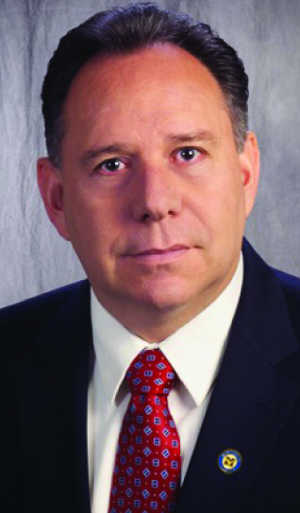
NORTH COAST, Calif. – The Mendocino College Board of Trustees has approved an adjustment to the contract with Superintendent/President Arturo Reyes.
The action extends his current contract through June 30, 2020.
An amendment to the current contract will include a salary increase to bring Reyes' salary in line with the mean California Community College single district average of $228,000.
The new contract also includes an annual 5-percent salary increase beginning with the 2017-18 fiscal year.
“President Reyes has done a great job of providing the leadership Mendocino College needed during challenging fiscal times,” Trustee Dave Geck said. “His focus on supporting staff ensures success for all students, which has been key to making Mendocino College a shining star in the community college system. I look forward to his future guidance as we expand the programs and the territory served by our wonderful college.”
Reyes has been the superintendent/president at Mendocino College since January 2013 and was recently a finalist in the search for a new superintendent/president at Palomar College in Southern California.
Mendocino College officials said much has been accomplished in the last few years and they're looking ahead to an even brighter future.
Recent college accomplishments under Reyes’ leadership include full reaffirmation of accreditation; increased budget reserves to more than 18 percent; increased enrollments; the hiring of 34 staff, faculty and managers over the past year; and the establishment of strong partnerships with all regional high schools.
The college also has provided instruction to the coast community, attained Hispanic Serving Institution status, provided additional professional development funds for faculty and staff, and increased community presence at the college.
In addition, the transfer of territory and acquisition of the Educational Center in Fort Bragg from College of the Redwoods to Mendocino College is in the final stages with official transfer date set for July 1, 2017.
U.S. Rep. Mike Thompson (CA-5) on Thursday introduced legislation (H.R. 5504) to require that the Federal Bureau of Investigation be notified when individuals formerly under a terrorism investigation purchase firearms or explosives.
“We need to make sure that those responsible for our country’s security have all the information they need to help keep Americans safe,” said Thompson. “By alerting the FBI when individuals formerly under a terrorism investigation purchase guns or explosives, the FBI can determine if there is new cause for concern, and hopefully, intervene before tragedy strikes.”
“Congress must take immediate action to better protect the American people from gun violence and terrorism, and that starts with preventing radicalized, hate-filled individuals from having access to dangerous weapons,” said Rep. Patrick Murphy (D-FL). “It’s unacceptable that suspected terrorists can walk into a gun shop and buy a gun. We need to put the partisanship aside and pass this common-sense bill. The families and communities suffering in the wake of this horrific violence against the LGBT community deserve nothing less.”
“In the wake of the horrific terrorist attack against the LGBT community in Orlando, Floridians from across our state are demanding change. There is no one answer to solve the problem of gun violence in America – but that doesn’t mean Congress shouldn’t try to make our streets safer, to save lives, to prevent another tragedy like the Pulse shooting,” said Rep. Gwen Graham (D-FL). “This is commonsense legislation that will help prevent suspected terrorists from attacking Americans, without infringing on the rights of law abiding citizens. I applaud Senator Nelson and Representative Thompson for their leadership on this issue, and I’m proud to join them in this effort.”
“Congress’s continuing silence in the face of modern terror threats is completely unacceptable,” said Rep. Elizabeth Esty (D-CT). “Passing H.R. 5504 is a commonsense step forward we should immediately take to help our law enforcement agencies identify and thwart potential terrorists before they can carry out their plans.”
“The presence of an assault weapon enables a gunman to kill many people, in a short amount of time, easily. One cannot kill 49 people, and injure 53 others with a box cutter or a rock,” said Rep. Alan Grayson (D-FL).
Currently, not only can individuals on the FBI’s Terrorists Watchlist pass a background check and legally purchase guns, but the FBI is not notified when individuals formerly under investigation for ties to terrorism purchase firearms or explosives.
Rep. Thompson has sponsored bipartisan legislation (H.R. 1076) to prohibit those on the FBI’s Terrorists Watchlist from purchasing firearms and has introduced H.R. 5504 to ensure that after a terrorism investigation is closed, the FBI is alerted should that individual purchase firearms or explosives.
Specifically, H.R. 5504 requires that any individual who is, or who has been, under a terrorism investigation be entered into the National Instant Criminal Background Check System (NICS).
NICS is the national database used to determine whether a prospective buyer is eligible to purchase a firearm.
The bill would further require that the NICS system automatically notify the FBI should a background check be conducted for such an individual.
Omar Mateen, the gunman responsible for the mass shooting in Orlando, had been removed from the FBI’s Terrorists Watchlist before he legally purchased the two firearms he used in the attack.
H.R. 5504 is the House companion to identical legislation introduced in the Senate by Sen. Bill Nelson (D-FL). H.R. 5504 has four original cosponsors, including Reps. Patrick Murphy (D-FL), Gwen Graham (D-FL), Elizabeth Esty (D-CT) and Alan Grayson (D-FL).
H.R. 5504 been referred to the House Committee on the Judiciary for further consideration.
Thompson represents California’s Fifth Congressional District, which includes all or part of Contra Costa, Lake, Napa, Solano and Sonoma counties.
Return on investment in county public health departments in California exceeds return on investment in many other areas of medical care, according to a new study by a University of California, Berkeley economist.
In the study, highlighted by the American Journal of Public Health and published online on June 16 ahead of print publication, Timothy Brown, a health economist with UC Berkeley’s School of Public Health, estimated from his analysis of data for the years 2001 through 2009 that each dollar that counties spent on public health programs in California returned $67 to $88 dollars of value in terms of improved health outcomes.
“The very large estimated return on investment for California county departments of public health, relative to the return on investment for selected aspects of medical care, suggests that public health is a wise investment,” Brown concluded. The study is the first to place a value on the overall health outcomes from such programs and to compare them to costs, Brown said.
Unlike medical care, which primarily focuses on treating disease, county public health departments focus on the prevention of disease. Brown also concluded that the return from Medicare’s national investment in four major health conditions was far less than the return from county public health spending. For heart disease, Type 2 diabetes, stroke and breast cancer, Brown’s review of the research literature revealed that returns on Medicare expenses ranged from $1.10 to $4.80 per dollar spent.
Many innovations in medical care also have had a lesser impact than county public health expenditures, according to Brown. In a review of reported outcomes for innovations in medical practice, Brown found that researchers reported returns ranging from $1.12 for bone marrow transplant for women with metastatic breast cancer, to $38 for heart attack survivors taking beta-blockers.
“Information only recently became available that made it possible to calculate the average return on investment for public health programs in California,” Brown said.
The new study is part of a larger project Brown has been leading to develop a health economics framework for determining return on investment in public health.
Public health departments regulate food service establishments, provide disease screening and treatment for communicable disease, offer prenatal care, regulate various aspects of the water supply, provide immunizations, and provide other services that can immediately improve population health, as well as improve population health over the longer term. Health departments also engage in activities that attempt to influence county populations to adopt healthier habits, which primarily affect population health over the longer term.
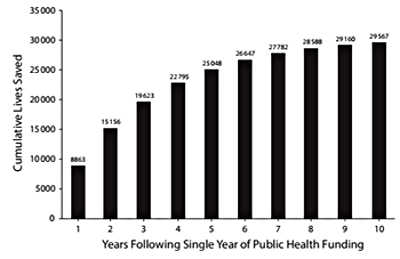
To understand the potential long-term health impacts of investment in public health, Brown and colleagues published two earlier studies that provided key information used in the return-on-investment calculations in this study. One study found that, on average, a single year of county public health spending continued to improve general health status in the population for over four years, ultimately improving the general health status of over 216,000 people.
A second study found that beyond its effects on general health status, the same single year of public health spending also saved the lives of over 29,000 people who otherwise would have died, with this effect playing out over a ten-year period.
To determine the monetary value of these changes in general health status, Brown used information from another study published as part of this project, in which the “subjective well-being valuation method” was used to determine the monetary value of improved general health status.
This method has previously been applied broadly to value things not normally bought and sold in a market, such as climate, air and noise pollution, risks for natural disaster, and proximity to waste facilities, coastlines, and transportation. It has also been applied to medical conditions, such as cardiovascular disease, migraine headaches, various chronic illnesses, mental health and chronic pain.
Conceptually, the method is not unlike the way a victim in an accident may be compensated for pain and suffering, Brown said.
“A decrease in general health status that reduces happiness is statistically valued by the amount of family income it would take to completely reverse this reduction in happiness, so that happiness is the same as it was before the decrease in general health status occurred,” Brown stated in the study, which concluded that a year spent in good or excellent health instead of poor or fair health could be valued at $41,654
To estimate the value of avoided deaths, Brown used standard valuations of $8.9 to $9.6 million per life saved, taken from estimates used by the federal government.
Brown cautions that this study does not address the question of how to optimize public health expenditures among various programs, but notes that other researchers have begun investigating the costs of foundational public health services at a county-wide level.
From Brown’s perspective, “Investments in research must go hand-in-hand with investment in public health activities to obtain the long-term improvements in population health that we all work toward.”
The study was funded by the Robert Wood Johnson Foundation.
Robert Sanders writes for the UC Berkeley News Center.