How to resolve AdBlock issue?
News
LAKEPORT, Calif. – Hospice Services of Lake County is preparing for the second annual Hike for Hospice, a family friendly fundraising event, on Saturday, July 23.
People who want to participate in the hike are encouraged to preregister at www.lakecountyhospice.org or Hospice thrift stores located in Middletown, Clearlake and Lakeport prior to the event.
Once registered, a hiker’s packet that includes sponsorship forms and “sponsor me” buttons will be mailed to the hiker along with details of the event.
Hikers, or teams of hikers, are asked to have family and friends sponsor their hike by making a donation to Hospice Services of Lake County. The hiker collects the donations in an envelope provided in the hiker’s packet, and delivers the donations on the event date as they check in to hike.
Hikers will start their trek after checking in no later than 9 a.m. at Highland Springs Park with an anticipated end time of 11 a.m. Check-in begins at 8 a.m. at the picnic area near the reservoir.
Hikers may choose one of four predefined hiking trails through the park that are one, two or three and five miles long. Hikes range from very gentle to somewhat challenging.
When all the hikers have returned the fun continues with a light brunch, live music and awards given for most money raised by an individual, most money raised by a team, most creatively dressed individual and most creatively dressed team. Creative apparel is highly encouraged.
Highland Springs Park is located at 3600 E. Highland Springs Road in Lakeport, off of Highway 29 past the Lampson Field Airport.
Donations from this event help provide care to residents of Lake County in their last months of life and bereavement services to those who have lost loved ones. All donations are fully tax-deductible.
For more information, to register to hike or sponsor a hiker, go to www.lakecountyhospice.org or call 707-263-6270, Extension 111.
LAKE COUNTY, Calif. – Pacific Gas and Electric Co. will be conducting low-level helicopter patrols July 12 to inspect electric distribution lines for maintenance in rural and remote areas in parts of Lake, Mendocino and Sonoma counties.
The flights will also help locate dead hazard trees in those areas.
In Lake County, flights will cover Highway 53, the city of Clearlake and the communities of Lower Lake and Hidden Valley Lake.
In Mendocino County, flights will cover Highways 20 and 29, the towns of Potter Valley and Redwood Valley, and the community of Pomo.
In Sonoma County flights will cover Highway 12 and Calistoga Road, the towns of Sonoma, Santa Rosa and Kenwood, and the communities of Oakmont, Spring Lake Village, El Verano, Temelec, Eldridge, Sonoma Mountain as well as the Petrified Forest area.
The flights will take off from the Sonoma County and Ukiah airports. Flights will start at 8 a.m. and finish by 4 p.m.
A helicopter will fly at approximately 500 feet, depending on the area and if livestock are present. PG&E patrols remote power lines, which are often located in rural areas, by helicopter as part of its continuing effort to ensure safety and reliability of its electric system.
If issues are identified, it’s possible that they may need to inspect at a lower altitude.
PG&E patrols and inspects all of its lines annually – nearly 134,000 miles of them – to ensure safety and reliability, and to identify equipment in need of repair.
This allows PG&E to proactively schedule repairs that might otherwise result in power outages. In rough country, remote areas or areas where there are fewer trees, the most efficient and sometimes only way to accomplish this is by helicopter.
PG&E uses a helicopter company to fly the PG&E inspectors.

As children, just about everyone has experienced the very real fear of an imaginary monster.
But what if our mothers could have spoken to our childhood fears?
Carrie Shipers of Wisconsin, the author of Family Resemblances: Poems (University of New Mexico Press), depicts just that when a protective mother talks back to her son's Bogeyman in this fine poem.
Mother Talks Back to the Monster
Tonight, I dressed my son in astronaut pajamas,
kissed his forehead and tucked him in.
I turned on his night-light and looked for you
in the closet and under the bed. I told him
you were nowhere to be found, but I could smell
your breath, your musty fur. I remember
all your tricks: the jagged shadows on the wall,
click of your claws, the hand that hovered
just above my ankles if I left them exposed.
Since I became a parent I see danger everywhere—
unleashed dogs, sudden fevers, cereal
two days out of date. And even worse
than feeling so much fear is keeping it inside,
trying not to let my love become so tangled
with anxiety my son thinks they're the same.
When he says he's seen your tail or heard
your heavy step, I insist that you aren't real.
Soon he'll feel too old to tell me his bad dreams.
If you get lonely after he's asleep, you can
always come downstairs. I'll be sitting
at the kitchen table with the dishes
I should wash, crumbs I should wipe up.
We can drink hot tea and talk about
the future, how hard it is to be outgrown.
American Life in Poetry is made possible by The Poetry Foundation ( www.poetryfoundation.org ), publisher of Poetry magazine. It is also supported by the Department of English at the University of Nebraska-Lincoln. They do not accept unsolicited submissions. Poem copyright ©2015 by Carrie Shipers, “Mother Talks Back to the Monster” (North American Review, Vol. 300, no. 4, 2015). Poem reprinted by permission of Carrie Shipers and the publisher. Introduction copyright © 2016 by The Poetry Foundation. The introduction's author, Ted Kooser, served as United States Poet Laureate Consultant in Poetry to the Library of Congress from 2004-2006.
LAKE COUNTY, Calif. – The Sons In Retirement group has a number of upcoming golf events around Lake County.
The following is the list of events with dates, times, location and cost:
– Wednesday, July 13, 9 a.m., Adams Springs, two-man BB, cost is $50 with lunch.
– Wednesday, July 27, at 9 a.m., Colusa, medal play, cost is $45 with lunch.
– Wednesday, Aug. 10, 9 a.m., Adams Springs, two-man BB, cost is $45 with lunch.
– Wednesday, Aug. 24, 9 a.m., Fox Tail, scramble, cost is $45 with lunch.
– Wednesday, Sept. 7, 9 a.m., Colusa, four-man two BB, cost is $45 with lunch.
– Wednesday, Sept. 21, 9 a.m., Black Rock, medal play, cost is $45 with lunch.
– Saturday, Sept. 24, to Thursday, Sept. 29, Monterey, various locations.
– Wednesday, Oct. 12, 9 a.m, Teal Bend, scramble, cost is $45, does not include lunch.
– Wednesday, Oct. 26, 9 a.m, Hidden Valley Lake, four-man two BB, cost is $45 with lunch.
– Wednesday, Nov. 9, 9 a.m., Black Rock, nine and nine, cost is $50 with lunch.
Sons In Retirement is a social organization for men of retirement age who are pursuing the goal of enjoying their later years.
Branch 168 holds a luncheon on the second Friday of each month at the TNT Restaurant in Lakeport.
If you would be interested in learning more about Sons In Retirement please feel free to contact Larry Powers, chair of the membership committee, at 707-263-3403 or visit the state Web site at http://sirinc.org/sirhappenings .
LAKEPORT, Calif. –The Lake County Library’s free lecture series Know Lake County is set to feature Antone “Tony” Pierucci, curator of the Lake County Museums, speaking about “Creation, Consolidation, Segregation: A History of Schools in Lake County.”
The free program takes place on Saturday, July 16, at 2 p.m. at the Lakeport branch of the Lake County Library, 1425 N. High St.
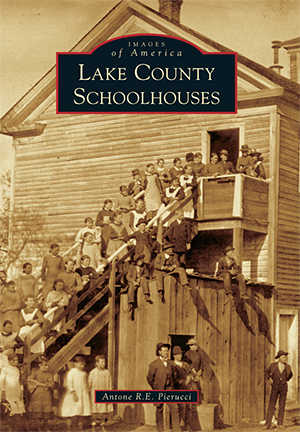
Pierucci also will present his new book “Lake County Schoolhouses,” the fourth Images of America book about Lake County from Arcadia.
Schools in Lake County often began as one-room buildings serving a handful of students and only went to the eighth grade.
Before 1915 students who wanted a high school education attended Lakeport Academy or moved out of Lake County.
Segregation entered the picture with the creation of separate facilities for Native American children, a practice that lasted until about 1930 in some districts.
Pierucci was hired as assistant curator for the Lake County Museums in 2014, and upon Linda Lake’s retirement in 2015, became curator of the museum system.
A native of Stockton, Pierucci grew up with an early appreciation for history that he brings to his profession.
Pierucci was educated at Gonzaga University and earned his master’s degree in art history and archaeology at the University of Missouri.
He has a passion for finding unexplored areas of Lake County history and bringing them to the public through museum exhibits and publications.
Lake County PEG TV records the Know Lake County presentations for re-broadcast on PEG TV Channel 8 and on www.lakecountypegtv.org . The presentations are also available on DVD to check out from the Lake County Library.
The Lake County Library is on the Internet at http://library.lakecountyca.gov and Facebook at www.facebook.com/LakeCountyLibrary .
For more information about Know Lake County and other library programs call 707-263-8817.
Jan Cook is a library technician at the Lakeport Library.
“Things ain't what they used to be and probably never was.” – Will Rogers
“Say goodbye to the oldies, but goodies, because the good old days weren't always good and tomorrow ain't as bad as it seems.” – Billy Joel
LAKE COUNTY, Calif. – Ever wonder why they call it “the good old days”?
Of course, when you ponder days of yore, you may think of a time when everything was simple and much less complicated.
Possibly, images of a tire-swing hanging over a bucolic creek come to mind, or the aroma of a fresh-baked blackberry pie dances in your head.
You might not ever consider the myriad of inconveniences and discomforts of past times.
Take the noble outhouse for instance, or the layers of pantaloons and petticoats that were once the fashion norm.
Have you ever thought about needing to visit the local blacksmith for all of your iron needs, such as horse shoes, repairing pots and pans or fixing your plowshare?
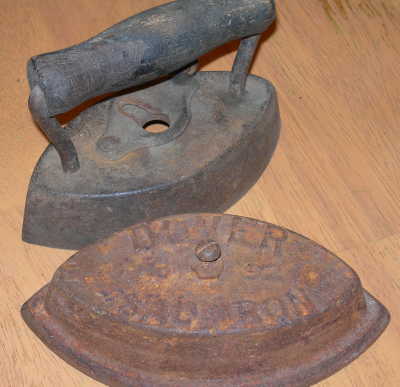
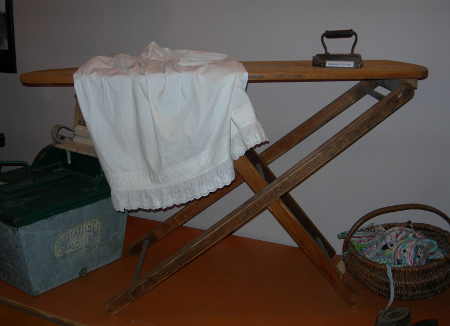
In the “good old days” you might have toiled over a cumbersome, forged iron to press your clothes.
Irons for ironing clothes were called flat irons or sad irons. Actually, these particular irons were commonly used from times as far back as the late Middle Ages.
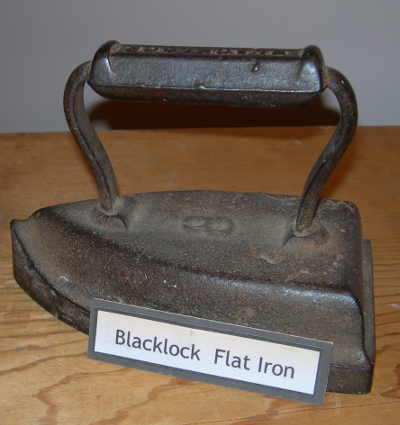
The early model iron had no temperature control, and it had to be heated on a stove, or in some cases, a fire. Some European irons were fashioned from clay or soapstone.
To keep the iron from sullying or scorching your clothes, it was necessary to sand-paper or polish the iron.
The meaning for the iron called a “sad iron” is said to have been derived from the word “solid.” Sad irons were comprised of thick iron, with the addition of a handle, while flat irons, also known as smoothing irons were thinner in appearance, with a flat base.
Believe it or not, some irons, used up until World War II, used liquid fuel such as was used for lights to heat their irons.
Kathleen Scavone, M.A., is a retired educator, potter, writer and author of “Anderson Marsh State Historic Park: A Walking History, Prehistory, Flora, and Fauna Tour of a California State Park” and “Native Americans of Lake County.” She also writes for NASA and JPL as one of their “Solar System Ambassadors.” She was selected “Lake County Teacher of the Year, 1998-99” by the Lake County Office of Education, and chosen as one of 10 state finalists the same year by the California Department of Education.