 How to resolve AdBlock issue?
News
LAKE COUNTY, Calif. – The nomination period for Congressman John Garamendi’s 2016 Women of the Year Awards is now open.
Each year, Congressman Garamendi recognizes outstanding women of the Third Congressional District, who through their work or volunteerism, have improved the quality of life in their communities.
Organizations and individuals from each of the eight counties he represents – Colusa, Glenn, Lake, Sacramento, Solano, Sutter, Yolo and Yuba – are encouraged to submit nominations for a panel review.
Congressman Garamendi will recognize honorees at a special event on Oct. 13 at Woodland Community College.
Last year’s event honored 35 incredible Third District Women for their contributions to their communities.
The deadline for nominations is Aug. 19.
Nominations can be filed electronically or downloaded at www.garamendi.house.gov/womenoftheyear .
Questions can be directed to the Davis District Office at 530-753-5301.
SACRAMENTO – The State Water Resources Control Board has approved the use of $10 million to help protect the state’s coastline and the public by improving aging sewer infrastructure at three California State Parks beaches.
Upgrading these sewer systems, through funds from the Clean Beaches Initiative Grant Program, will improve water quality and help protect beaches that are enjoyed by more than one million people annually.
The three parks designated for these funds include Doheny State Beach in Dana Point; El Capitán State Beach in Goleta; and Carpinteria State Beach, located 12 miles south of Santa Barbara.
The Clean Beaches Initiative has funded projects that have restored and protected water quality and the environment at coastal waters, estuaries, bays, and nearshore waters.
This program was created due to poor water quality and high levels of bacteria found at state beaches.
Studies have shown high bacteria levels to be associated with pathogens that can cause gastroenteritis, infections and respiratory illnesses.
The grant program has provided approximately $100 million to projects throughout California.
A total of four projects have been proposed at the three beaches. At Doheny the tasks include replacing an aging sewer main and line, rehabilitating a sewer lift station and relining 10,000 linear feet of sewer pipe.
At El Capitán the proposed project is to design and construct an on-site wastewater treatment facility to increase system capacity.
Carpinteria’s project will consist of replacing 60 recreational vehicle (RV) hookups and upgrading 5,000 linear feet of sewer pipe.
While the final costs for the four projects are not finalized, the State Water Board and California State Parks are committed to ensuring the $10 million in grants will address the highest priority water quality threats at the three state beaches.
WASHINGTON, DC – The Department of Veterans Affairs’ (VA) Veterans Choice Program (VCP) has reached a key milestone in improving access to health care for veterans.
More than two million appointments have been scheduled through the program.
“While two million appointments have been scheduled using the Choice Program and we are making progress, we will not rest until all veterans who choose VA to be their healthcare provider are receiving the care they need, when they need it,” said VA Secretary Robert McDonald. “We will continue to make strides towards an integrated care network, and I urge Congress to enact our Plan to Consolidate Community Care so we can continue to build upon our progress.”
The Choice Act, which included the VCP, was passed in August 2014 to help veterans access timely health care both within VA and the community.
VA was required to implement a new, national program in just 90 days, with new requirements that complicated the way VA provides community care.
VA recognized many of these challenges very early in the implementation of the program and VA and all our stakeholders have been working together to make needed changes while implementing this new nationwide program.
VA has outlined a path to improve community care and create a program that is easy to understand, simple to administer, and meets the needs of veterans, community providers, and VA staff. VA submitted this plan to Congress in October 2015.
Within the plan are several legislative proposals that VA and Congress need to work on together to improve the experiences for Veterans and community providers.
The first proposal would increase veterans’ access to community care providers by allowing VA to enter into agreements with local community providers.
The second would streamline when and how much VA pays for health care services by having VA be the primary payer.
The third fix would allow VA to more accurately account for healthcare purchased in the community.
Finally, the last request is for funding and funding flexibility to improve access to care, reimburse the cost of emergency treatment, and create value-based payment models to best serve veterans that need community care.
“VA is developing innovative ideas and solutions to enhance the veterans experience and strengthen partnerships with community providers” said Dr. Baligh Yehia, assistant deputy undersecretary for Health, Community Care. “The Choice Program of today is a very different program than the one rolled out in November 2014. Many improvements have been made and we continue to work to deliver care to veterans where and when they need it.”
VCP progress to date
More than two million appointments scheduled using the VCP significantly increases veterans access to care.
Since the start of VCP we have seen a dramatic increase in utilization. From October 2015 to March 2016 VCP authorizations for care have increased 103 percent.
Over the course of the last 12 months, the Choice Provider Network has grown by 85 percent. The network now has over 350,000 providers and facilities.
Improved timeliness of payments to community providers by removing the requirement that VA receive the veteran’s entire medical record prior to payment.
Reduced administrative burden for medical record submission for community providers by streamlining the documentation required.
To enhance care coordination for veterans, we have embedded contractor staff with VA staff at select locations.
Created dedicated teams from across the county to deliver community care improvements.
VA has also partnered with Congress to change laws to improve the community care experience by:
– Removing the enrollment date requirement for Choice, allowing more veterans to receive community care.
– Implementing criteria of 40-mile driving distance from medical facility with primary care physician to increase number of veterans accessing the program
– Implementing the unusual or excessive burden criteria to increase access for veterans that do not meet other eligibility criteria.
– Expanding the episode of care authorization from 60 days to up to one year to reduce the administrative burdens of veterans, community providers and VA staff.
“VA needs Congress’s continued support to keep driving progress forward,” added VA Secretary Robert McDonald. “Several legislative barriers remain which inhibit improvements outlined in our Plan to Consolidate Community Care Programs.”
SACRAMENTO – The California Community Colleges Chancellor's Office has announced the promotion of Mario Rodriguez to the role of vice chancellor of the College Finance and Facilities Planning Division.
Rodriguez had filled the position on an acting basis since April.
“I am thrilled Mario is officially filling the role of vice chancellor,” said California Community Colleges Interim Chancellor Erik E. Skinner. “He hit the ground running when he stepped into the job several months ago, and has proved time and time again he has the knowledge and expertise to successfully lead the division and oversee the system’s budget and facilities programs. We are incredibly lucky to have him as a member of our team.”
Before stepping into the role of acting vice chancellor, Rodriguez had served as assistant vice chancellor of finance for the Chancellor's Office since August 2014.
Prior to that, he was a finance budget analyst with the Department of Finance and a project manager with the Office of the Governor. Rodriguez began his career in state government in 2007 as a budget analyst with the Department of General Services.
Rodriguez is a member of the San Juan Unified School District Citizens Oversight Committee and a board member on the Fiscal Crisis and Management Assistance Team. He received his bachelor’s degree in business administration from California State University, Sacramento.
The College Finance and Facilities Planning Division oversees the formulation of policies that determine the distribution of local assistance and capital outlay funds for the 72 community college districts.
The division staff oversees the construction and remodeling of new buildings and centers and uses web-based tools to assess facilities, coordinate planning and manage projects efficiently.
The California Community Colleges is the largest system of higher education in the nation composed of 72 districts and 113 colleges serving 2.1 million students per year.
Community colleges supply workforce training, basic skills education in English and math, and prepare students for transfer to four-year institutions.
The Chancellor’s Office provides leadership, advocacy and support under the direction of the Board of Governors of the California Community Colleges.
For more information about the community colleges, please visit http://californiacommunitycolleges.cccco.edu/ , https://www.facebook.com/CACommColleges or https://twitter.com/CalCommColleges .
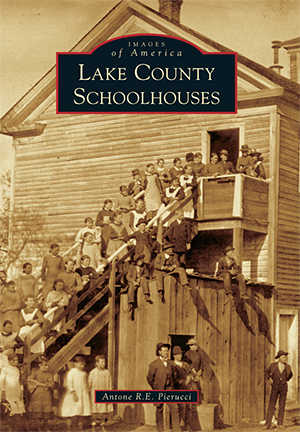
MIDDLETOWN, Calif. – Antone “Tony” Pierucci, curator of Lake County Museums, and David Leonard, principal of Cobb Mountain Elementary School, will offer a broad scope of the challenges faced in bringing the best possible education to the children of Lake County at the Gibson Museum on Sunday, July 17.
The presentation will take place from 3 to 5 p.m.
Pierucci has compiled photos from the collections of the Courthouse Museum in Lakeport and the Schoolhouse Museum in Lower Lake, together with prized pictures procured from other resources and informative captions, to present Lake County Schoolhouses.
Leonard will update neighbors on the challenges faced by Cobb School after 30 percent of its students and staff were burned out in the Valley fire.
He, like Superintendent Catherine Stone, had been in office only since the first of September when the fire occurred. The Leonard family home was among those destroyed.
Pierucci’s book is too rich to appropriately describe. It is hard to imagine the lives of those barefoot children posed in front of teeny one-room wood-frame schoolhouses. It astonishes with a reminder that public high schools were introduced as late as 1907.
The book, released only June 27, is among recent additions to Arcadia Publishing’s popular Images of America series, which now numbers more than 7,500 books of hyper-local history.
Three other Lake County histories are in the series: Lake County, The Pomo of Lake County, The Resorts of Lake County. Those, and Lake County Schoolhouses, may be purchased at Gibson Museum, Ely Stage Stop, Courthouse Museum and Schoolhouse Museum. The usual price is $22.
Gibson Museum & Cultural Center is located at 21267 Calistoga St. (Highway 29), directly opposite Middletown’s Community Center. For further information, call Nina Bouska at 707-987-2349.
LAKEPORT, Calif. – The Lake County Vector Control District confirmed Friday that four mosquito samples and a dead bird tested positive for West Nile virus this week in Lake County.
The positive mosquitoes were collected from Kelseyville, Upper Lake and Anderson Marsh, according to Jamesina Scott, Ph.D., Lake County Vector Control District manager and research director.
Scott said the dead bird, a great blue heron, was collected from Upper Lake. Two weeks ago, a domestic turkey from north Lakeport tested positive for West Nile virus.
No human cases of West Nile virus have been reported in Lake County this year, Scott said.
“West Nile virus is established throughout California and we expect to find it in dead birds and mosquitoes at this time of the year,” said Scott. “We all need to take precautions to avoid mosquito bites and the diseases they transmit. Take a walk around your yard today and dump out containers of water like buckets, wading pools, fountains, and toys.”
She said residents can help protect themselves and their community by reporting dead birds to help the district identify where West Nile virus activity is taking place. All dead bird reports from the public are critical in helping the district direct mosquito operations.
Members of the public can report dead birds to the state’s toll-free hotline at 1-877-968-2473 (1-877-WNV-BIRD) or by visiting the California Department of Public Health's Web West Nile virus Web site, http://westnile.ca.gov/ .
Residents are urged to help reduce their risk of contracting mosquito-borne diseases by following these guidelines:
• Dump or drain standing water. Mosquitoes grow in standing water.
• Defend yourself with mosquito repellents containing Picaridin, DEET, IR3535, Oil of Lemon Eucalyptus, or PMD. Need help finding a repellent to meet your needs? The Environmental Protection Agency has a search tool to help you choose the repellent that is right for you at https://www.epa.gov/insect-repellents/find-insect-repellent-right-you#search tool.
• Avoid being outdoors when mosquitoes are biting, typically dawn and dusk.
• Maintain swimming pools. Just one neglected swimming pool can produce more than one million mosquitoes and affect people up to five miles away.
• Report dead birds to the state hotline: 1-877-968-2473 or online at http://www.westnile.ca.gov/report_wnv.php . All reports are crucial.
Residents with questions about West Nile virus or who would like help with a mosquito problem can contact the Lake County Vector Control District at 707-263-4770, Monday through Friday from 7:30 a.m. to 4 p.m., or visit the district Web site at www.lcvcd.org .