 How to resolve AdBlock issue?
News
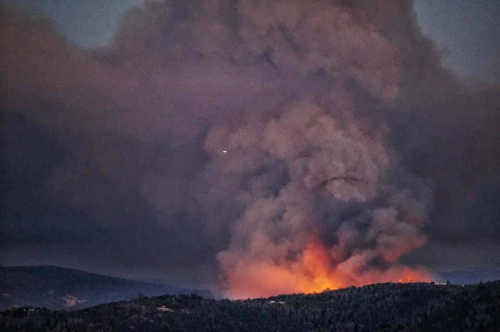
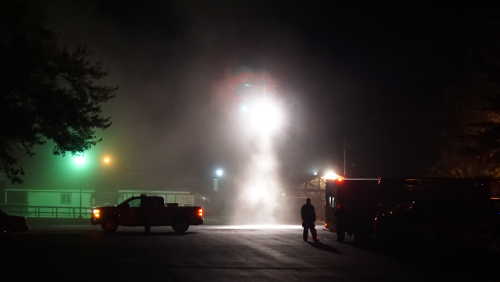
LOWER LAKE, Calif. – The work to control a wildland fire near Lower Lake continued on Saturday night, as fire resources came into Lake County from around the region.
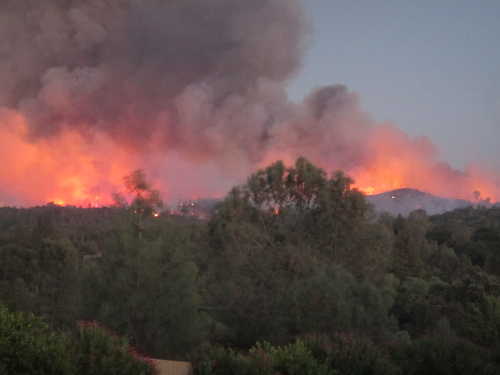
The Clayton fire, reported shortly before 5 p.m. Saturday on Clayton Creek Road at Highway 29 south of Lower Lake, had scorched several hundred acres within hours of dispatch, as Lake County News has reported.
Shortly after 11 p.m., the fire had grown to 900 acres, with containment at 10 percent, according to Suzie Blankenship of Cal Fire.
Blankenship told Lake County News that, by that point, one structure had been destroyed. She said Cal Fire couldn't yet confirm the type of building or its location.
Cal Fire and fire districts from around Lake County were engaged in the fire fight, with ground resources also coming from neighboring counties and air resources responding from further away.
As the fire grew, there were reports of spot fires, including one that was reported to have hit a travel trailer and another in the Oak Haven Road area, according to radio reports.
Earlier in the evening, fire officials had estimated 200 structures were threatened.
Radio reports late Saturday night indicated firefighters were working to protect structures in the area of Cantwell Ranch Road and Lake Ridge Road, where there were immediate threats to homes.
Early Saturday evening evacuations had been ordered for Clayton Creek Road, Cantwell Ranch Road, Morgan Valley Road, Riata Road, Teklas Road Hale, Daly Hill, Teklas, Spruce Grove Road to Noble Ranch Road and Ellen Springs, Staehle Lane and Morgan Valley Road to mile marker 7.1, and Spruce Grove Road North to Old Spruce Grove Road in Middletown.
“We're almost out to the county line on evacuations on Morgan Valley Road,” Sheriff Brian Martin told Lake County News Saturday night.
Additionally, he said the area of Black Bass Pass Road near Lower Lake also had been issued an evacuation order.
Martin said the mandatory evacuations were remaining in place overnight.
Blankenship also reported that advisory evacuations had been issued for Bonham Road and Jerusalem Grade Road.
The areas impacted by the fire had been among the places under evacuation orders because of last summer's wildland fires.
Martin said the Red Cross opened a shelter at the Highlands Senior Center at 3245 Bowers Ave. in Clearlake, which also had acted as an evacuation center last year.
The Red Cross confirmed the shelter was opened and that, as of 9 p.m., 12 residents had registered.
Lake Evacuation and Animal Protection, or LEAP, was activated Saturday evening, with volunteers on their way into the fire area, according to Orphan Dog, one of the local rescue organization involved with LEAP.
Early in the incident authorities had ordered Clayton Creek Road at Highway 29 shut down to all but fire vehicles, and Lake County Public Works road crews were reported to be closing down Morgan Valley Road near the Napa County line due to the fire later in the night.
As of Saturday evening, the California Highway Patrol and Caltrans reported that all state highways in the fire area remained open.
Blankenship said Cal Fire had a large amount of equipment on the fire; a resource list was expected to be issued early Sunday.
Due to the fire, as of 11 p.m. power was out for about 1,000 Pacific Gas and Electric customers, the company said.
Email Elizabeth Larson at
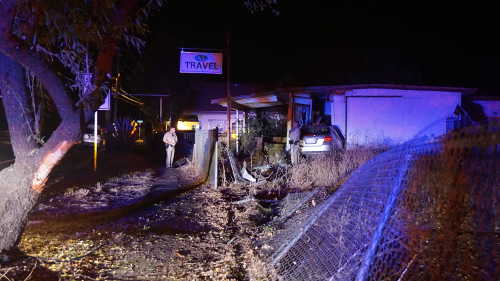 LUCERNE, Calif. – One person was injured and a building was damaged as the result of an early Saturday morning vehicle crash.
The crash occurred at around 12:45 a.m. Saturday on Highway 20 at 11th Avenue in Lucerne.
A silver sedan, which appeared to have been heading westbound on Highway 20, crashed into the east side of a building that formerly housed a travel business at 6264 E. Highway 20.
Before the car hit the side of the structure, it took out about 20 feet of chain link fence and scraped a chunk of bark off of a large tree.
About a third of the side of the building was punched through by the car's front end.
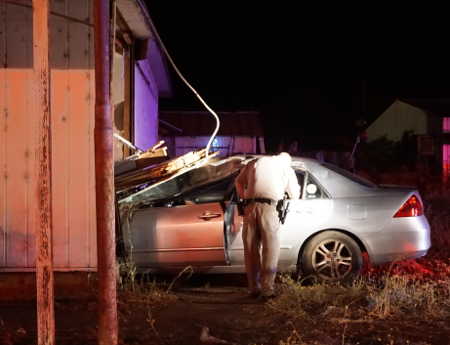
Radio reports indicated that an elderly male driver, the vehicle's only occupant, was injured and had to be extricated.
The driver was then transported by Northshore Fire ambulance to Lucerne Harbor Park a block away, where a REACH air ambulance landed to transport the patient to an out-of-county trauma center.
The California Highway Patrol was on the scene, with officers investigating what led to the crash.
Email Elizabeth Larson at
 NORTHERN CALIFORNIA – In the summer months you get to see a lot of really lovely butterflies and interesting-looking moths in the Berryessa Snow Mountain National Monument region, but keep an eye out for their babies, too.
Although some of them have faces only their mothers could love, caterpillars are really quite fascinating.
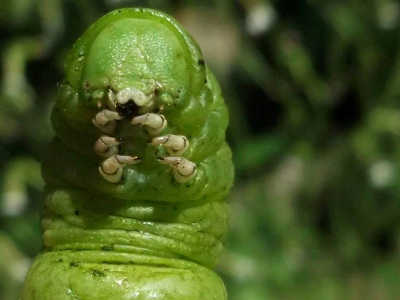
Looking very much like a tomato hornworm, the flat-faced tobacco hornworm (Manduca sexta) caterpillar is bulky and bright green. It’s the larval stage of a kind of very large sphinx moth.
You’ll usually find it munching through the leaves, stems and flowers of wild native flowering tobacco (like Nicotiana attenuate) and non-native tree tobacco plants (like Nicotiana glauca), leaving behind untidy piles of dark “frass” (droppings) on the foliage below them.
Like all hornworms, these guys have a thick pointed protuberance located on the last segment of their body that sticks straight up. It’s not a stinger, it’s more like an adornment, and its color can change as the larvae ages.
When this caterpillar is mature enough, it will drop from the plant and burrow about 4 inches into the ground. There it will form a pupal cell (chrysalis) around it.
The elliptical-shaped cell has an obvious loop at one end which will eventually hold the developing moth’s mouth parts. The pupa will over-winter in the ground and emerge as a moth in the following summer.
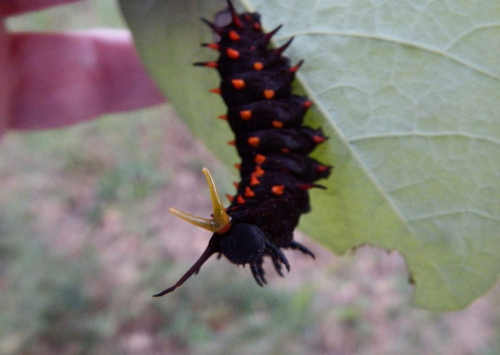
And then there’s the caterpillar of pipevine swallowtail butterfly (Battus philenor). Hatching from tiny rust-colored eggs that can be laid anywhere on the pipevine plant, the larvae start out reddish-brown in color with orange spikes.
As the caterpillars mature, the spikes remain but the rest of the body turns dark black. They can be found wandering around pipevine plants – the only plants they are built to eat – feeling their way with the fleshy “antennae” that protrude from either side of the head.
Since the host plants they eat contain a toxic alkaloid, the caterpillars are toxic, too, and they’re equipped with a pair of foul-tasting “horns” that they can brandish at any bird or lizard foolish enough to try to eat them.
When mature, these caterpillars don’t go underground. Instead, they will climb into a nearby tree (or fencepost) and attach themselves to it with a suspension line of silk.
Once settled, the caterpillar then encases itself in a chrysalis (which can be green or brown) and wait to emerge later in the season as a butterfly. Pipevine swallowtails can have two broods a year.
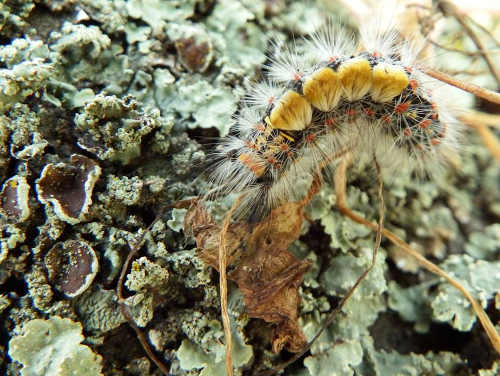
Third up is the tussock moth caterpillar (Orgyia sp). Its face and body are covered in hairs and piles of prickly tufts (that can produce an allergic reaction in people who are sensitive to it).
The hairs not only help to identify this particular caterpillar, they are also used to build its cocoon after it matures. Inside the cocoon, the caterpillar will form a hard casing around itself as it pupates, and the following season a moth will emerge.
What’s most interesting about this species is the fact that although papa moth is a rather nondescript guy with brownish-gray wings, mama tussock moth is very special.
Fluffy and fat when she emerges from her cocoon, she is completely wingless. That’s right; she’s a moth with no wings. Because she can’t fly to her love like the females of other moth species, mama tussock moth will wander out onto the end of a branch and exude a pheromone that lures the males to her.
After mating, she then lays hundreds of eggs inside a silk sac that is made in part of the same hairs that made up her cocoon when she was younger. She’s an awesome recycler!
So, although they may look creepy to everyone but their mothers, caterpillars can make for some interesting studies. And they are an essential part of the ecosystem. They are, after all, baby butter-flies and moths, the early forms of the world’s best pollinators. We couldn’t do without them.
So, don’t errantly squish “icky looking” caterpillars when you come across them. In fact, plant flowers and shrubs in your garden that help to feed them. The more caterpillar-friendly your garden is, the more butterflies and moths it will attract.
Tuleyome is a501(c)(3) nonprofit conservation organization based in Woodland, Calif. For more information visit www.tuleyome.org . Mary K. Hanson is a Certified California Naturalist and author of the “Cool Stuff Along the American River” series of nature guides available at www.lulu.com .

NASA’s Hubble Space Telescope has uncovered two tiny dwarf galaxies that have wandered from a vast cosmic wilderness into a nearby “big city” packed with galaxies.
After being quiescent for billions of years, they are ready to party by starting a firestorm of star birth.
“These Hubble images may be snapshots of what present-day dwarf galaxies may have been like at earlier epochs,” said lead researcher Erik Tollerud of the Space Telescope Science Institute in Baltimore, Maryland. “Studying these and other similar galaxies can provide further clues to dwarf galaxy formation and evolution.”
The Hubble observations suggest that the galaxies, called Pisces A and B, are late bloomers because they have spent most of their existence in the Local Void, a region of the universe sparsely populated with galaxies. The Local Void is roughly 150 million light-years across.
Under the steady pull of gravity from the galactic big city, the loner dwarf galaxies have at last entered a crowded region that is denser in intergalactic gas.
In this gas-rich environment, star birth may have been triggered by gas raining down on the galaxies as they plow through the denser region.
Another idea is that the duo may have encountered a gaseous filament, which compresses gas in the galaxies and stokes star birth.
Tollerud’s team determined that the objects are at the edge of a nearby filament of dense gas. Each galaxy contains only about 10 million stars.
Dwarf galaxies are the building blocks from which larger galaxies were formed billions of years ago in the early universe.
Inhabiting a sparse desert of largely empty space for most of the universe’s history, these two galaxies avoided that busy construction period.
“These galaxies may have spent most of their history in the void. If this is true, the void environment would have slowed their evolution. Evidence for the galaxies’ void address is that their hydrogen content is somewhat high relative to similar galaxies,” Tollerud explained.
“In the past, galaxies contained higher concentrations of hydrogen, the fuel needed to make stars,” Tollerud continued. “But these galaxies seem to retain that more primitive composition, rather than the enriched composition of contemporary galaxies, due to a less vigorous history of star formation. The galaxies also are quite compact relative to the typical star-forming galaxies in our galactic neighborhood.”
The dwarf galaxies are small and faint, so finding them is extremely difficult. Astronomers spotted them by using radio telescopes in a unique survey to measure the hydrogen content in our Milky Way.
The observations captured thousands of small blobs of dense hydrogen gas. Most of them are gas clouds within our galaxy, but astronomers identified 30 to 50 of those blobs as possible galaxies.
The researchers used the WIYN telescope in Arizona to study 15 of the most promising candidates in visible light.
Based on those observations, Tollerud’s team selected the two that are the most likely candidates to be nearby galaxies and analyzed them with Hubble’s Advanced Camera for Surveys.
Hubble’s sharp vision helped the astronomers confirm that both of them, Pisces A and B, are dwarf galaxies.
The Hubble telescope is aptly suited to study nearby, dim dwarf galaxies because its sharp vision can resolve individual stars and help astronomers estimate the galaxies’ distances.
Distance is important for determining a galaxy’s brightness, and, in these Hubble observations, for calculating how far away the galaxies are from nearby voids.
Pisces A is about 19 million light-years from Earth and Pisces B roughly 30 million light-years away. Based on the galaxies’ locations, an analysis of the stars’ colors allowed the astronomers to trace the star formation history of both galaxies.
Each galaxy contains about 20 to 30 bright blue stars, a sign that they are very young, less than 100 million years old.
Tollerud’s team estimates that less than 100 million years ago, the galaxies doubled their star-formation rate. Eventually, the star formation may slow down again if the galaxies become satellites of a much larger galaxy.
“The galaxies could even probably stop forming stars altogether, because they will stop getting new gas to make stars,” Tollerud said. “So they will use up their existing gas. But it’s hard to tell right now exactly when that would happen, so it’s a reasonable guess that the star formation will ramp up at least for a while.”
Tollerud’s team hopes to observe other similar galaxies with Hubble. He also plans to scour the Panoramic Survey Telescope and Rapid Response System survey for potential dwarf galaxies.
Future wide-survey telescopes, such as the Large Synoptic Survey Telescope in Chile and the large radio telescope in China, should be able to find many of these puny galactic neighbors.
The team’s results will appear in the Aug. 11 issue of The Astrophysical Journal.
The Hubble Space Telescope is a project of international cooperation between NASA and the European Space Agency. NASA's Goddard Space Flight Center in Greenbelt, Maryland, manages the telescope.
The Space Telescope Science Institute (STScI) in Baltimore, Maryland, conducts Hubble science operations. STScI is operated for NASA by the Association of Universities for Research in Astronomy in Washington, D.C.
Executing and recording a deed is the standard way to transfer title to real property. Doing so puts the world on notice as to the change in ownership.
Nonetheless, in the absence of a deed, courts may still, under the right circumstances, grant petitions to confirm title to real property as a trust asset based on the trust documents alone.
A so-called “declaration of trust” is established when the settlor(s) declares that they as trustee(s) hold certain assets that they transferred into their trust. These assets are specifically listed on an attached schedule of initial trust assets.
A trust agreement, unlike a trust declaration, involves someone other than the settlor(s) acting as trustee(s) from the commencement. Thus, no declaration by the settlor that they are holding their assets as trustee(s) is made. A trust agreement may also include a schedule of initial trust assets.
Since the 1993 landmark Estate of Heggstad, (1993) 16 CA4th 943, court decision, now anytime a settlor of a declaration of trust dies without having formally deeded title to assets that are specifically listed in a trust’s schedule of assets, the successor trustee petitions to confirm that title belongs to the trust; provided these assets were not transferred before the settlor died.
Under Heggstad, it is often sufficient for a settlor of a declaration of trust to have listed an item of real property on an initial asset schedule attached to the trust document in order for the court upon petition to transfer title to such asset.
More recently, in 2015, the court in Ukkestad v. RBS Asset Finance, Inc., (2015) 235 CA4th 156, allowed title to real property to be transferred into a deceased owner’s declaration of trust under a petition even though the properties were not specifically identified in the trust document or its attachments.
In Ukkestad the settlor had declared in the trust that all of his “right, title and interest” to “all of his real property” were included in the trust's assets.
Establishing what “real property” belonged to the settlor, and thus subject to the declaration of trust, was determined by what real property was still titled in the decedent’s name.
Now, the court in Carne v Worthington, (2016) 246 CA4th 548, has allowed the schedule of assets to a trust agreement to act as an instrument of conveyance.
In Carne the decedent had a revocable declaration of trust (“revocable trust”) and a subsequently created irrevocable trust agreement (“irrevocable trust”). title to the decedent’s real property was held in the revocable trust but was also later listed as an asset in the irrevocable trust’s schedule of assets.
The court held that title to the real property was transferred to the newer irrevocable trust when the decedent (while still alive) signed the irrevocable trust because it specifically included, on an attached schedule of trust assets, even though the same real property was still titled in the decedent’s name as trustee of his revocable trust.
That the decedent, while alive, had not deeded the real property from himself, as trustee of his revocable trust, to the trustees of the irrevocable trust did not matter, as far as whether title was transferred.
The Carne court acknowledged, however, that the absence of a recorded deed could well have mattered had the decedent’s creditors protested that they were not aware of the transfer.
The point in Carne is that the decedent, while alive, as the settlor of his revocable trust, both had the authority to transfer title to the real property from that revocable trust to his irrevocable trust and had specifically listed the property as an asset of the irrevocable trust, itself a trust agreement.
Court petitions are avoided and money, time and aggravation spared when deeds are used. However, if necessary, such court petitions can prevent an unintended probate and/or ensure the decedent’s intended distribution of assets.
Dennis A. Fordham, Attorney, is a State Bar-Certified Specialist in estate planning, probate and trust law. His office is at 870 S. Main St., Lakeport, Calif. He can be reached at
KELSEYVILLE, Calif. – After years of planning and months of construction, the Kelseyville Community Skatepark is ready for its debut.
The Lake County Public Services Department said construction is complete for the new skatepark, located at 5270 State St.
To celebrate, the county is inviting community members to a grand opening at 9 a.m. Wednesday, Aug. 17.
District 5 Supervisor Rob Brown, who has advocated for the park over the last several years, will be presenting the park to the community and making some special announcements.
The 9,000-square-foot facility offers features such as a quarter pipe return, four stair and skate rail combo, hipped bank, sushi dish ledge, bank to pole jam, taco transition, flat slate rail, radial transition, six stair slate rail and hubba combo.
The Kelseyville Community Skatepark is open to the public during regular park hours.
It is an unsupervised open recreation space, and participants are reminded that they skate at your own risk and are asked to take care of the facility so the county can continue to build spaces such as this for the community's enjoyment.
County officials said they are delighted to bring the community this professionally-designed skatepark that will provide a safe and welcoming place for physical activity and community building.
“Kelseyville Community Skatepark is an excellent example of the results when people work together for the betterment of our communities,” the department said in its announcement.
For more information call the Lake County Public Services Department at 707-262-1618 Monday through Friday from 8 a.m. to 5 p.m.