 How to resolve AdBlock issue?
News
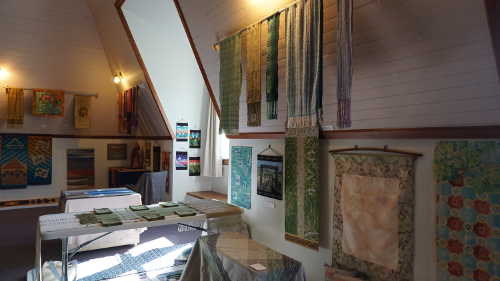
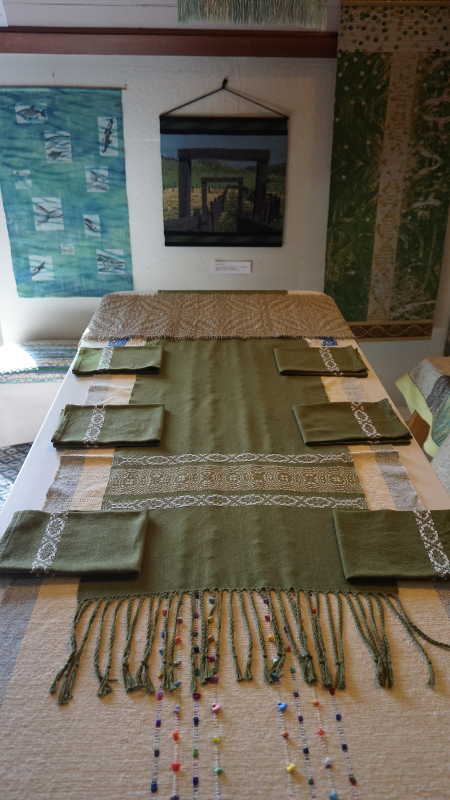
LOWER LAKE, Calif. – On Saturday, the Lower Lake Historic Schoolhouse Museum will open its popular annual Quilt and Fiber Arts Show, a celebration of weaving, quilting, spinning and other forms of textile artwork.
The 24th annual show opens Saturday, with an artist' reception from noon to 2 p.m.
The reception will include demonstrations by some of the artists whose work is on display.
On Friday, Sheila O’Hara, who has organized the weaving component of the show for the last 12 years and now oversees the entire production, was busy putting the finishing touches on the displays, which once again are located in the museum's second-story auditorium.
“What we have is a bigger diversity of techniques,” said O'Hara, who has been a weaver for 40 years.
This year's show highlights textile artwork including weaving, quilts, batik, painted fabric and hand-done silkscreened textiles, needlepoint, clothing and basketry from around the world.
The museum narrowly escaped the ravages of the Clayton fire, which burned up to the edges of the building last month.
O'Hara said large air filters were run in the building following the fire, with a crew with vacuum backpacks also cleaning the building to make sure any smoke and soot from the fire was removed from the facility.
As a result, the museum, originally built in 1877 as the community's schoolhouse, was ready to once again host the quilt show.
In January, O'Hara joined the staff of the museum.
Her efforts on this year's show have gotten the stamp of approval from Lake County Museum Curator Tony Pierucci.
“I think it's the best we've ever had,” Pierucci said Friday of the show.
He added, “I just give her free rein.”
O'Hara has used that license to assemble an exhibit that moves from more traditional textile forms such as quilts to painted fabrics.
She previously led a guild in the Bay Area, where she learned techniques for setting up an exhibit from the Oakland Museum exhibit designer.
“We've kind of mixed it up a little bit more rather than just keeping the weaving all in one spot,” O'Hara said.
There are vignettes that feature the textile artwork with items from the museum collection, such as a quilt paired with a mannequin wearing a vintage blue silk ball gown from 1880; a mix of artwork and functional items, from tablecloths to sewn bags plus hats by Kelseyville hatmaker Tess McGuire; and items grouped in color that leads one around the room.
Some of the featured quilters include Laura Lee Fritz, Jane Alameda, JoAnn Andresen and Marj Sweeney.
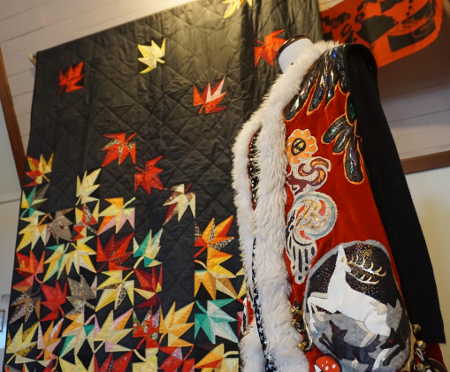
The show also features clothing, such as Janis Eckert's woven shawl which won best of show for amateur weaving at this year's Lake County Fair, and the “Pagan Santa” vest, with deer and other motifs sewn on red velvet, by Christalene Loren.
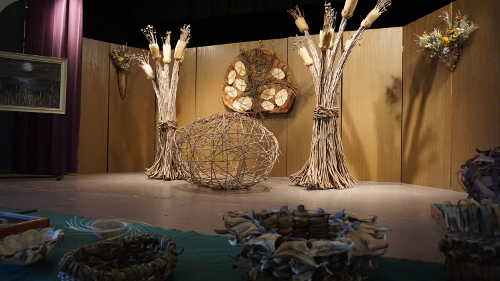
On the auditorium's stage is a collection of basketry by local artist Sherry Harris and her students, including Stephanie Rodriguez.
On a wall near the stage are several framed pieces of needlepoint by Mara Bosnar.
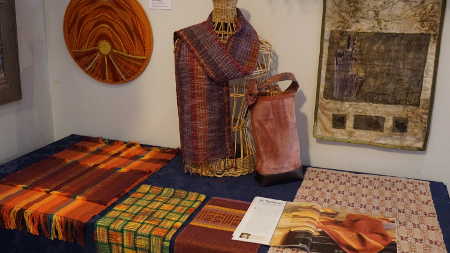
Among the weaving displays is O'Hara's own work and that of her students.
One particularly eye-catching piece is the woven wall hanging titled “Egyptian Magic,” inspired by a trip O'Hara took to Egypt 10 years ago as part of a weaving-related job.
The show runs through Oct. 15.
The Lower Lake Historic Schoolhouse Museum is located at 16435 Main St.
Hours are 11 a.m. to 4 p.m., Wednesday through Saturday.
Email Elizabeth Larson at

 NORTHERN CALIFORNIA – Mercury is an odd element: it is liquid under normal conditions, it forms amalgams with many other metals such as gold and silver, and it is over 13 times denser than water.
In natural waters, mercury is a concern because of the potential toxic effects of one form, methylmercury, to humans and wildlife.
Methylmercury forms as a byproduct of certain bacteria metabolizing mercury under conditions such as those found in wetlands.
Its toxicity is difficult to comprehend – one standard thermometer’s volume worth of methylmercury is enough to pollute over 3,000 Olympic-size swimming pools worth of water.
Exposure to methylmercury comes largely from eating fish that have accumulated it through their diet. Methylmercury is linked to developmental problems in fetuses and children, and effects the nervous system in adults. Similar affects are observed in wildlife.
Today, mercury is the most common cause of contaminated water bodies in the Cache Creek and Putah Creek watersheds, which drain from the Inner Coast Range eastward from Colusa, Lake and Napa counties into Yolo and Solano counties.
The state’s Office of Environmental Health Hazard Assessment has issued several fish consumption warnings ( www.oehha.ca.gov/node/412 ). A recent US Geological Survey study of mercury concentrations in grebes (a common fish-eating bird) at 25 lakes statewide found the highest levels at Lake Berryessa.
The Inner Coast Range is a complex mixture of rock types: sedimentary, volcanic and the delicate green- and black-flecked serpentine, the California state rock.
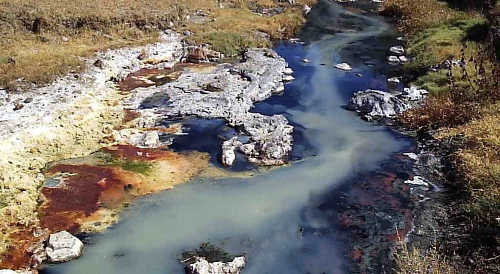
Areas rich in serpentine tend to contain relatively high concentrations of mercury. These bare surface soils naturally erode into local creeks, and mineral springs discharge waters rich in mercury.
Even more broadly, reactive mercury in global emissions of oil and coal contaminate even pristine watersheds worldwide.
There have been three eras of mercury mining in these watersheds: the Gold Rush (second half of the 19th century), two world wars (first half of the 20th century), and the Industrial Revolution (1950s to early 1970s).
Mercury mining activity fluctuated with economic demand due to developments in gold mining in the Sierra Nevada and Nevada Comstock Lode, medicine, explosives, gasoline additives and atomic energy research.
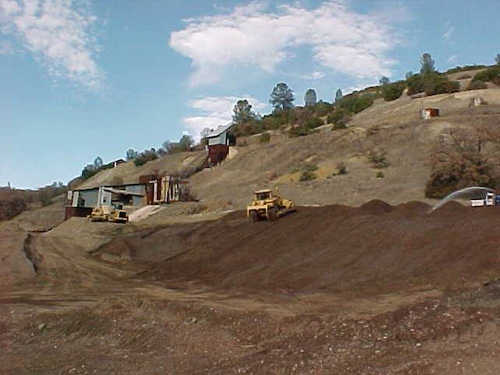
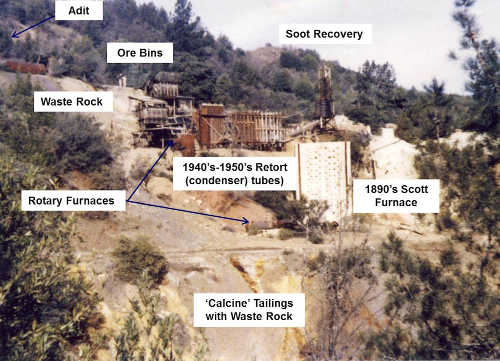
We are now left with the legacy of about 80 abandoned mercury mines in the upper Cache Creek and Putah Creek watersheds, and many thousands of other abandoned mines statewide.
The vast majority of this mining predated two important developments: major water projects damming and diverting large proportions of the runoff from the two watersheds, and modern environmental laws such as the Clean Water Act.
Consequently, enterprising miners simply dumped their contaminated waste downhill to be swept away in the next storm, and that contaminated material still blankets floodplains and the San Francisco Bay-Delta.
A key challenge to cleaning up mine sites is often, ironically, environmental laws.
Common concerns for any organization interested in improving a site include: (1) “Touch it and you own it” meaning you are liable for ongoing contamination from a site even if all you did there was try to fix the problem; and (2) “Perfect is the enemy of good” meaning the law doesn’t easily allow only inexpensive improvements if standards are still being exceeded.
It can take years (and too much budget) to complete an adequate environmental assessment and obtain the necessary federal, state, and local permits for cleaning up a mine site. Nonetheless, several organizations are taking on the challenge.
The Delta Tributaries Mercury Council ( www.sacriver.org/aboutwatershed/mercury/dtmc ), which morphed from a Cache Creek stakeholders group in 1995, is guided by its 2002 Strategic Plan to reduce the risk of mercury within the larger Sacramento River watershed. The council hosts quarterly meetings which are announced to its nearly 500 members.
The federal Brownfields program provides liability protection, funds, and technical assistance (not enforcement) to assess and clean up contaminated sites (including “mine-scarred” lands).
Water managers representing four of the counties encompassing the Cache and Putah creeks watersheds recently formed a coalition to assess the mercury mines in the region as brownfields in order to improve them ( www.westsideirwmbrownfields.org ).
Stephen McCord is president of McCord Environmental, based in Davis, Calif. As a registered professional engineer, he has more than 25 years of consulting, research and teaching experience in the environmental engineering field throughout the US and internationally. The local nonprofit Tuleyome is a regional leader in cleaning up abandoned mercury mine sites ( www.tuleyome.org/projects/mercury-mine-remediation-program ). Tuleyome is currently implementing a three-year, $2.4 million grant from the California Department of Fish and Wildlife's Ecosystem Restoration Program to clean up the Corona and Twin Peaks mercury mines in northwest Napa County, which drain into Lake Berryessa.
Caltrans and the California Department of Fish and Wildlife (CDFW) remind motorists to remain alert for wildlife on roadways during Watch Out for Wildlife Week, which runs Sept. 18 to 24.
“We urge motorists to remain alert and be cautious when traveling through wildlife areas, so our roadways will remain as safe as possible,” said Caltrans Director Malcolm Dougherty. “Drivers can really make a difference in avoiding wildlife collisions, simply by being aware while driving and watching for wildlife crossing signs.”
According to Defenders of Wildlife, a national nonprofit organization dedicated to protecting native species and their natural communities, there are 725,000 to 1.5 million wildlife-vehicle collisions in the U.S. every year, resulting in more than 200 human fatalities.
In California, between eight and 10 drivers and as many as 20,000 deer die in wildlife-vehicle collisions each year.
“Between now and December, deer and other wildlife are highly susceptible to vehicle collisions,” said Marc Kenyon, CDFW’s Human-Wildlife Conflict Program Manager. “Deer will soon start their annual migrations to winter range, bucks will be preoccupied competing for mates, and bears will be searching for food in preparation for hibernation. Such natural behaviors can lead these animals into the way of unsuspecting drivers. Drivers can prevent collisions with animals by being careful and paying attention.”
The Watch Out for Wildlife campaign is supported by Caltrans, CDFW, Defenders of Wildlife and the Road Ecology Center at the University of California, Davis.
Wildlife experts from these organizations offer the following tips for motorists:
• Be especially alert when driving in areas frequented by wildlife, and reduce your speed so you can react safely.
• Pay particular attention when driving during the morning and evening, as wildlife are most active during these times.
• If you see an animal cross the road, know that another may be following.
• Don’t litter. The odors may entice animals to venture near roadways.
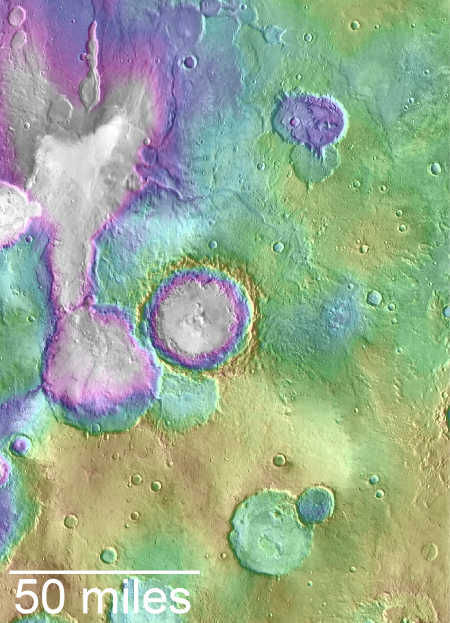
Lakes and snowmelt-fed streams on Mars formed much later than previously thought possible, according to new findings using data primarily from NASA's Mars Reconnaissance Orbiter.
The recently discovered lakes and streams appeared roughly a billion years after a well-documented, earlier era of wet conditions on ancient Mars.
These results provide insight into the climate history of the Red Planet and suggest the surface conditions at this later time may also have been suitable for microbial life.
"We discovered valleys that carried water into lake basins," said Sharon Wilson of the Smithsonian Institution, Washington, and the University of Virginia, Charlottesville. "Several lake basins filled and overflowed, indicating there was a considerable amount of water on the landscape during this time."
Wilson and colleagues found evidence of these features in Mars' northern Arabia Terra region by analyzing images from the Context Camera and High Resolution Imaging Science Experiment camera on the Mars Reconnaissance Orbiter and additional data from NASA's Mars Global Surveyor and the European Space Agency's Mars Express.
"One of the lakes in this region was comparable in volume to Lake Tahoe," Wilson said, referring to a California-Nevada lake that holds about 45 cubic miles of water. "This particular Martian lake was fed by an inlet valley on its southern edge and overflowed along its northern margin, carrying water downstream into a very large, water-filled basin we nicknamed 'Heart Lake.'"
The chain of lakes and valleys that are part of the Heart Lake valley system extends about 90 miles. Researchers calculate Heart Lake held about 670 cubic miles of water, more than in Lake Ontario of North America's Great Lakes.
Wilson and co-authors of the report in the Journal of Geophysical Research, Planets, map the extent of stream-flow in "fresh shallow valleys" and their associated former lakes. They suggest that the runoff that formed the valleys may have been seasonal.
To bracket the time period when the fresh shallow valleys in Arabia Terra formed, scientists started with age estimates for 22 impact craters in the area.
They assessed whether or not the valleys carved into the blankets of surrounding debris ejected from the craters, as an indicator of whether the valleys are older or younger than the craters. They concluded that this fairly wet period on Mars likely occurred between two and three billion years ago, long after it is generally thought that most of Mars' original atmosphere had been lost and most of the remaining water on the planet had frozen.
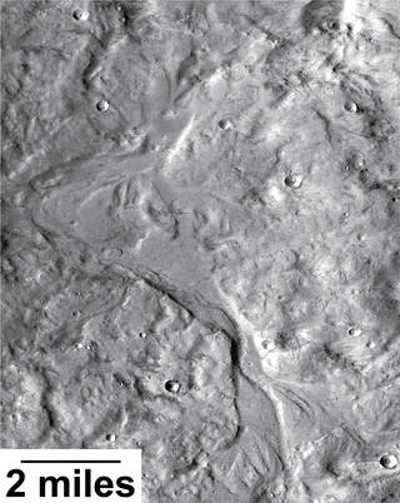
The characteristics of the valleys support the interpretation that the climate was cold: "The rate at which water flowed through these valleys is consistent with runoff from melting snow," Wilson said, "These weren't rushing rivers. They have simple drainage patterns and did not form deep or complex systems like the ancient valley networks from early Mars."
They note that similar valleys occur elsewhere on Mars between about 35 and 42 degrees latitude, both north and south of the equator.
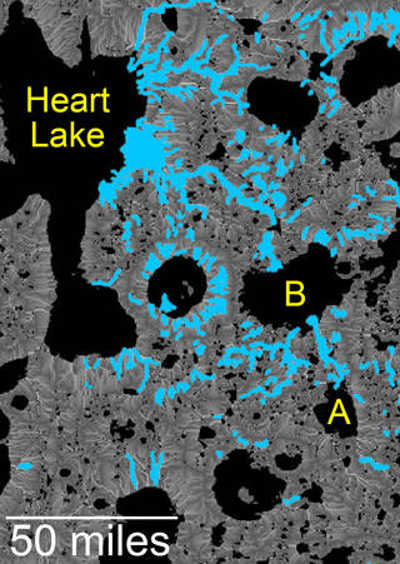
The similar appearance and widespread nature of these fresh, shallow valleys on Mars suggest they formed on a global scale rather than a local or regional scale.
"A key goal for Mars exploration is to understand when and where liquid water was present in sufficient volume to alter the Martian surface and perhaps provide habitable environments," said Mars Reconnaissance Orbiter Project Scientist Rich Zurek of NASA's Jet Propulsion Laboratory, Pasadena, California. "This paper presents evidence for episodes of water modifying the surface on early Mars for possibly several hundred million years later than previously thought, with some implication that the water was emplaced by snow, not rain."
The findings will likely prompt more studies to understand how conditions warmed enough on the frozen planet to allow an interval with flowing water. One possibility could be an extreme change in the planet's tilt, with more direct illumination of polar ice.
Wilson's co-authors are Alan Howard of the University of Virginia; Jeffrey Moore of the NASA Ames Research Center, Moffett Field, California; and John Grant of the Smithsonian.
NASA's Mars orbiter missions are advancing understanding about the Red Planet that serves in preparation for human-crew missions to Mars beginning in the 2030s.
For more about NASA's Journey to Mars, visit http://www.nasa.gov/content/nasas-journey-to-mars .
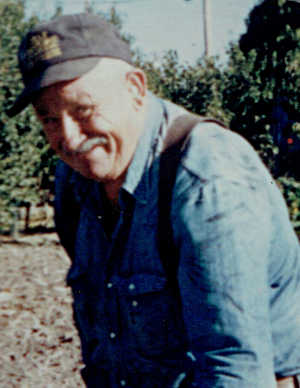
KELSEYVILLE, Calif. – William Bradford Hukkanen, 92, of Kelseyville, died on Monday, Sept. 12, 2016 at his residence.
Bill joined the Navy after the bombing of Pearl Harbor on Dec. 7, 1941. He served on five ships in the Pacific campaign: USS South Dakota where he saw action in three sea battles, USS McCawley which was torpedoed and sunk, USS President Hayes as a coxswain on Higgins landing boats putting the 2nd Marine Division on the beaches of Bougainville, USS Bering Strait as a coxswain on motor whale boats rescuing B-29 crews and the USS Tamalpais, the first American ship to enter Tokyo Harbor.
After World War II Bill came home and worked a few jobs, ending up at Masonite from which he retired after 35 years.
Bill was a lifelong hunter and outdoorsman. Evidence of his skill is reflected in massive deer mounts and antlers. He kept a garden that fed half of Sylar Lane and read voraciously, preferring history.
He was preceded in death by his parents, William Hukkanen and Esther Crawford Hukkanen (McNeily), and many friends and shipmates.
Bill is survived by his daughter, Kristine (Rick) Lefeber of Fond du Lac, Wis.; his son, Sammy (Shelly) Hukkanen of Dayton, Nev.; grandchildren, Gina (Keith) Civey, Allyson (Ryan) Welnetz, Teresa Hukkanen, Erika Hukkanen-Stark (Kevin Stark), Karen (Terry) Rehn and Corinne (Nathan) Shumacher; great-grandchildren, Jordan (Karey) Civey, Krista and Ethan Civey, Myles and Cole Welnetz, Jaeda, Leah and Eli Rehn and Zachary Stark; and great-great-grandchildren Kyndra and Jax Civey.
A memorial service with military honors will be held at Chapel of the Lakes Mortuary in Lakeport on Wednesday, Sept. 21, at 1 p.m.
For further information please contact Chapel of the Lakes Mortuary at 707-263-0357 or 994-5611 or visit www.chapelofthelakes.com .

LAKE COUNTY, Calif. – The California State Controller’s Property Tax Postponement Program is available again, after being suspended by the Legislature in 2009.
The program allows homeowners who are at least 62, or who are blind, or have a disability to defer current-year property taxes on their primary place of residence if they meet certain criteria, including 40-percent equity in the home and an annual household income of $35,500 or less.
The filing period is Oct. 1, 2016, through Feb. 10, 2017, and applications will be processed on a first-come, first-served basis.
Funding is limited for the program, and the interest rate for taxes postponed is 7 percent per year.
Applications and information are available online at www.sco.ca.gov/ardtax_prop_tax_postponement.html or by calling 800-952-5661.
To learn more about local resources for those 60 and older, call Community Care’s Senior Information & Assistance Program at 707-468-5132 or toll-free 1-800-510-2020, or visit www.SeniorResourceDirectory.org .
Community Care’s Senior Information & Assistance Program is a free service for older adults in Lake and Mendocino counties, funded largely through the local Area Agency on Aging.