 How to resolve AdBlock issue?
News
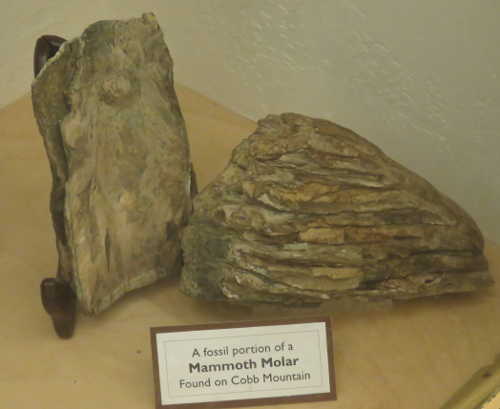 LAKEPORT, Calif. – During a visit to the Historic Courthouse Museum in Lakeport I revisited a mammoth discovery. Literally, a mammoth molar, which is on display in the museum's geology room.
Thanks to Curator Tony Pierucci and his top-notch research team, I learned that the mammoth molar (fossil portion) was found at Alder Creek, off Bottle Rock Road, on Cobb Mountain in 1962.
It was taken to San Francisco and identified by a geologist at the Division of Mines and Minerals as a Mammoth Molar, prehistoric.
Try this: Picture Lake County as it was in the past. Now, go much farther than that, to the Pleistocene era two million years ago.
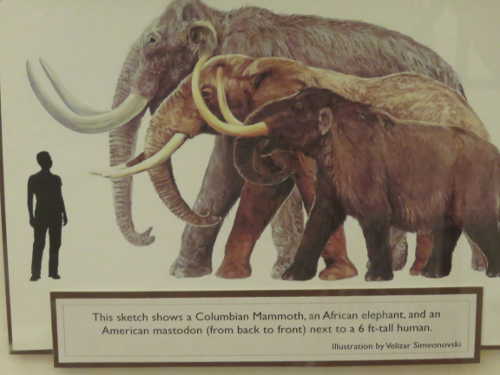
Next, picture a herd of Columbian mammoths (Mammuthus columbi) roaming what is now Lake County and the Bay Area. A herd could consist of seven to 20 animals.
According to E. Breck Parkman, RPA, senior state archaeologist, California State Parks, Bay Area and Sonoma-Mendocino Coast Districts, the mammoths averaged a lifespan of 50 years. These gargantuan animals are believed to have weighed in at up to 16,000 pounds.
In a paper Parkman generously shared with me, entitled, “California Serengeti,” he described the area, in the North Bay in the late Pleistocene era as, “... grander than anything imaginable.”
He compares the land then “to the famous Serengeti Plains of East Africa as described in early historic times.”
Parkman hypothesized that a great grassy valley lay where the bay is now located, and that there was an array of grazing wildlife, including mammoth, mastodon, camel, horse, bison and other herbivores.
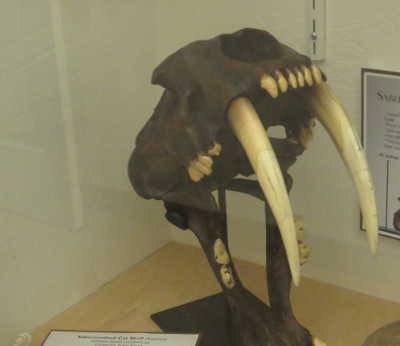
There were also ferocious predators like saber-tooth cat, short-faced bear, lions and more. The flying exotics, such as huge vultures and condors, cast their shadows over the prairie.
Parkman has been interviewed by the BBC, Discovery Channel, innumerable journalists, and other worthy organizations regarding his discoveries that have led to his hypothesis that mammoths used what is now the Sonoma Coast and other areas as rubbing rocks thought to be used for grooming (see his paper on the subject at https://www.parks.ca.gov/?page_id=23566 ).
The following is my interview with Breck Parkman.
Q: Could it have been a mastodon molar instead of a mammoth molar that was found, or are there vast differences in the species?
A: We had both the Columbian mammoth (Mammuthus columbi) and the American Mastodon (Mammut americanum) in our area during the Late Pleistocene. However, we did NOT have the woolly mammoth (Mammuthus primigenius) here in California. They occurred further north and in the interior, where the climate was colder and more harsh. The molars of mammoth and mastodon are very different in appearance and easy to distinguish from one another.
Q: Have you studied the mammoth species, in your work elsewhere? If so, can you please elaborate?
A: I’m interested in the mammoth due to my work with the so-called “rubbing rocks” here in Sonoma County, unique features I discovered back in 2001. I’ve examined the literature from around the world, partly to inform my theoretical construct I’ve termed “The California Serengeti.” Last summer, my son visited The Mammoth Site in Hot Springs, South Dakota, as part of my research interest.
Q: I understand that mammoths lost their molars repeatedly, throughout their lives. Do you think we can expect to ever find more molars here in Lake County?
A: Yes, absolutely you can! Referring to one of his scholarly papers, he added: “... In Zoofacts, which estimates a total of four million mammoths resided in our area over the two million years they were here. That’s a lot of molars somewhere out there!
Q: What led to your mammoth rubbings finds in Sonoma County?
A: In 2001, I conducted a week-long survey of the Sonoma Coast (Kortum Trail), in order to try and identify paleontological resources. I was accompanied by Raj Naidu, a paleontologist friend of mine.
We began our survey on Sept. 12, 2001, the day after 9/11. It was windy that day, and we took our lunch break behind a large rockstack on the coastal terrace. It was our first real opportunity to discuss the incidents of the previous day, so we lingered in our lunch break.
The longer we sat there, the more we began to notice the unique polish on the rocks around us. Slowly, but surely, the topic of conversation turned from who was responsible for the previous day’s terrorism to who was responsible for the rock polish we were seeing.
Q: What is one of the great joys of being an archaeologist?
A: I have a great curiosity about the past, present and future. Being an archaeologist allows me ample opportunity to explore the connections between now and then and tomorrow.
Q: What is one of your most interesting finds as an archaeologist?
A: I’ve been an archaeologist for over 40 years and have worked on five continents during my career. I’ve worked with 2,000 year old mummies on the South Coast of Peru and with even more ancient “buffalo rocks” on the Canadian Plains, old rock art in the Red Centre of Australia, and Paleolithic sites on the shores of Lake Baikal in Siberia. I have seen interesting finds to fill many books if I had the time to write them!
Once, I went running across the rocky beach so as to jump into Lake Baikal (we had a sauna on the shore and part of the ritual was to get good and hot inside and then run out and jump in the painfully cold lake!) and I cut my foot on a still-sharp Paleolithic blade. I cut myself bad enough to bleed. I thought that was rather interesting!
In Peru, I had to walk through a vandalized cemetery dating to about the time of Christ. Beginning in the 1500s with the Conquistadors, and going right up to the present, people dug up the mummies to rob them of their funerary objects. There were almost 2,000 vandalized mummies on the surface of the cemetery.
Because this is the driest place in the world, preservation was astounding. I saw the mummies of young women with red ribbons in their hair. Tattoos looked fresh, even when on sun-kissed flesh.
There was this one grandmother who I walked by every day. She had a wool bag and I kept wondering what was in the bag with her, what had she taken to the next world. Finally, one day I apologized to her and then carefully opened the bag. It was filled with the botanical detritus expected of a doctor or herbalist. Roots, leaves, twigs, etc. She is there caring for people in the afterworld.
Another woman was buried with a great undecorated pot. I looked inside and counted six dried chile peppers.
For me, the interesting things are those small things forgotten, those little things that really tell us about people. Like the vinyl records I recovered from the fire debris of the hippie commune at Olompali.
Q: In your experience, are you aware of any mammoth tusk art which may have been created?
A: If you include the Old World, then, yes, I know of a lot of tusk art from France, Russia, etc. While we’ve seen remnants of worked ivory in North American sites, I’m not sure I’ve heard of any specimens that conjure up the feeling of being art. In Siberia, I looked at the worked mammoth tusk ivory that came from the famous site of Mal’ta. They are wonderful little carvings.
Q: Thank you very much. Is there anything else to add?
A: Archaeology is important to society, but the benefits are not always well understood. It’s not a matter of going in search of “treasure.” That’s what most people seem to think we do. The treasure is the knowledge we gain from the endeavor. And that knowledge is only relevant if we find ways to share it with the public.
Kathleen Scavone, M.A., is a retired educator, potter, writer and author of “Anderson Marsh State Historic Park: A Walking History, Prehistory, Flora, and Fauna Tour of a California State Park” and “Native Americans of Lake County.” She also writes for NASA and JPL as one of their “Solar System Ambassadors.” She was selected “Lake County Teacher of the Year, 1998-99” by the Lake County Office of Education, and chosen as one of 10 state finalists the same year by the California Department of Education.
NORTHERN CALIFORNIA – A bill created in response to the sentence in the controversial Stanford rape case has been signed into law.
Assembly Bill 2888 by Assemblymembers Bill Dodd (D-Napa) and Evan Low (D-Silicon Valley) was signed by Gov. Jerry Brown on Friday.
The new law requires that those convicted of sexually assaulting unconscious or severely intoxicated victims are sentenced to prison.
AB 2888 was introduced in response to what the bill's authors called the “shockingly lenient” sentence of six months given to Brock Turner by Judge Aaron Persky in the recent Stanford rape case.
The legislators worked closely with Santa Clara District Attorney Jeff Rosen in crafting the proposal.
“Sexually assaulting an unconscious or intoxicated victim is a reprehensible crime, and now our laws better reflect that. Sentences like those in the Brock Turner case discourage other survivors from coming forward and sends the message that raping incapacitated victims is no big deal,” said Dodd, whose district includes Lake County. “I want to thank Gov. Brown and my fellow legislators for standing with victims and building a culture that will help prevent these appalling crimes. Thanks to this law, convicted felons like Brock Turner will no longer be able to avoid state prison.”
Prior to the bill being signed into law, not all forms of sexual assault involving penetration were included in the list of offenses that would trigger a mandatory denial of probation.
For example, a perpetrator at a college party who chose to forcibly rape a conscious victim would go to prison.
However, a different perpetrator at the same party who chose to watch and wait for a victim to pass out from intoxication before sexually assaulting her was eligible for probation. With AB 2888 being signed into law, that loophole has been closed.
“The national awakening about campus sexual assaults started by Emily Doe’s powerful letter continues to grow, changing our minds and our laws,” Rosen said. “While prisons are not appropriate for every person convicted of a crime, rapists belong in prison.”
“I want to thank Gov. Brown for his signing AB 2888. This sends the strongest possible message that rape is rape and in California, if you do the crime, you're going to do the time," Assemblymember Low said. "Judge Persky’s ruling was unjustifiable and morally wrong, however, under current state law it was within his discretion. While we can’t go back and change what happened, we have made sure it never happens again.”
Turner was convicted earlier this year on three felony counts of sexually assaulting Emily Doe, as she lay unconscious on the ground after a Stanford fraternity party.
Her 12-page letter went internationally viral when a judge sentenced the Stanford swimmer to only six months in county jail sentence, despite the fact that Turner was eligible for a sentence of up to 14 years in prison.
Had this law been in place when Turner was sentenced, he would have been required to serve time in state prison, Dodd and Low reported.

NORTH COAST, Calif. – Jack London State Historic Park and the Sonoma Community Center will mark their mutual 2016 centennial celebrations with the presentation of the Jack London Classic Film Fest Nov. 3, 4 and 5 at Sonoma Community Center.
The festival will feature screenings of Call of the Wild (1935) starring Clark Gable and Loretta Young, Sea Wolf (1941) starring Edward G. Robinson and Ida Lupino and White Fang (1991) starring Ethan Hawke.
The three-day festival experience features themed dinners, receptions and celebrity speakers.
A special highlight of the Jack London Film Fest will be the exclusive first-time showing of recently discovered vintage footage of Hollywood celebrities such as Edward G. Robinson, John Garfield and Ronald Reagan joining Charmian London and local Sonoma dignitaries attending the 1941 film debut of Sea Wolf at the Sebastiani Theatre in Sonoma.
Another highpoint of the festival will be the display of select items from Darius Anderson’s seldom-seen, world-renowned collection of Jack London memorabilia.
Prior to each film there will be a themed dinner, catered by Ramekins, featuring some of Jack London’s favorite dishes.
Each night at the pre-show dinner a speaker will lead conversations to Illuminate more deeply the story to be shown on screen.
Following each film is a post-show discussion led by Jack London State Historic Park docents.
Details of the showings are as follows.
Nov. 3: Call of the Wild
Film presenter: Darius Anderson, Jack London aficionado and owner of an internationally acclaimed collection of Jack London papers and memorabilia.
Nov. 4: Sea Wolf
Film presenter: Author Cecilia Tichi, renowned professor and expert on Jack London, whose book “Jack London: A Writer’s Fight for a Better America” has just been released.
Nov. 5: White Fang
Film presenter: Adam Burke, Pixar film producer; Pixar’s parent company Disney produced the 1991 version of White Fang starring Ethan Hawke; As a seasoned film producer, Mr. Burke brings his perspective regarding adapting novels and other source material for the cinema.
Also for this evening's presentation and dinner, Ramekins will be joined by writer and culinary historian Kathleen Hill who will talk about some of the dishes Jack and Charmian London would have served guests at events at Beauty Ranch.
Tickets range from $25 to $100. There are discounted package prices available for attending all three films.
More details on the Jack London Film Fest are available at www.jacklondonpark.com . Please note: There is limited seating availability and tickets are now on sale at http://www.svbo.org .
The Sonoma Community Center is located at 276 E Napa St.
LAKE COUNTY, Calif. – Lake County Animal Care and Control continues to offer for adoption several Clayton fire dogs plus new dogs taken in from other parts of the county.
The week's available dogs at Lake County Animal Care and Control include mixes of border collie, boxer, chow chow, Great Dane, hound, Labrador Retriever, Rottweiler and pit bull.
Clayton fire dogs are listed at the top, followed by dogs not taken in from the fire area.
Dogs that are adopted from Lake County Animal Care and Control are either neutered or spayed, microchipped and, if old enough, given a rabies shot and county license before being released to their new owner. License fees do not apply to residents of the cities of Lakeport or Clearlake.
If you're looking for a new companion, visit the shelter. There are many great pets hoping you'll choose them.
The following dogs at the Lake County Animal Care and Control shelter have been cleared for adoption (additional dogs on the animal control Web site not listed are still “on hold”).
CLAYTON FIRE DOGS

Labrador Retriever mix
This female Labrador Retriever mix has a short black coat.
She was found in the Clearlake area on Aug. 15.
She's in kennel No. 19, ID No. 5862.

Labrador Retriever mix
This female Labrador Retriever mix has a short white coat.
She was found in the Clearlake area on Aug. 15.
She's in kennel No. 20, ID No. 5860.

Pit bull terrier mix
This female pit bull terrier mix has a short black and white coat.
She was found in the Lower Lake area on Aug. 20.
She's in kennel No. 33, ID No. 5878.
NON-FIRE DOGS AVAILABLE

Border collie mix
This young male border collie mix has a medium-length black and white coat.
He's in kennel No. 6a, ID No. 6198.

Border collie mix
This young female border collie mix has a medium-length black and white coat. She already has been spayed.
Shelter staff said she has a great disposition and needs an active owner.
She's in kennel No. 7, ID No. 5943.

Hound mix
This young female hound mix has a short brindle and white coat.
She's in kennel No. 8, ID No. 6133.

Boxer-pit bull mix
This female boxer-pit bull mix has a short brindle and white coat.
She's already been altered, shelter staff reported.
She's in kennel No. 14, ID No. 6194.

Border collie-chow chow mix
This male border collie-chow chow mix has a short tan and white coat.
He's in kennel No. 16, ID No. 6195.

'Cinnamon'
“Cinnamon” is a female hound-pit bull terrier mix.
She has a short brown and white coat, and already has been spayed.
She's in kennel No. 17, ID No. 6156.
Rottweiler mix
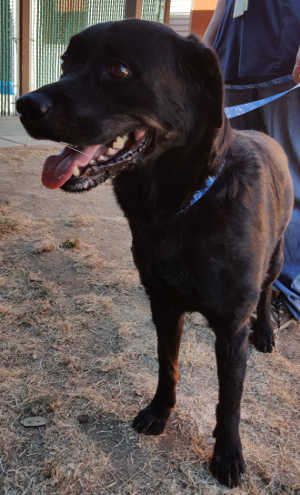
This male Rottweiler mix has a short black and tan coat.
He's in kennel No. 24a, ID No. 3557.

Rottweiler mix
This female Rottweiler mix has a black coat with some brindle markings.
Shelter staff said she need some training and is manageable on a leash. They said she is a very nice dog and knows not to jump when excited. After proper introductions, she has gotten along with other dogs she has met, including off-leash play. She would do best in a home with no cats.
She's in kennel No. 25, ID No. 5947.
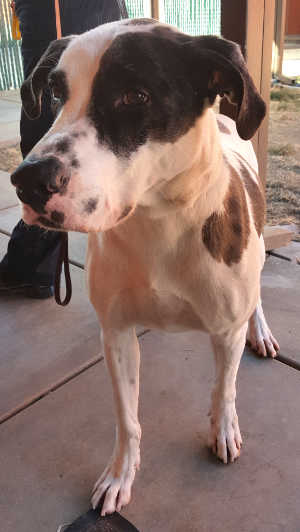
'Lucky'
“Lucky” is a male hound and Great Dane mix with a short black and white coat.
He's in kennel No. 30, ID No. 6026.

'Flor'
“Flor” is a female Labrador Retriever mix with a short black and white coat.
She already has been spayed, which should lower her adoption cost.
She is in kennel No. 30b, ID No. 6041.
To fill out an adoption application online visit http://www.co.lake.ca.us/Government/Directory/Animal_Care_And_Control/Adopt/Dog___Cat_Adoption_Application.htm .
Lake County Animal Care and Control is located at 4949 Helbush in Lakeport, next to the Hill Road Correctional Facility.
Office hours are Monday through Friday, 11 a.m. to 5 p.m., and 11 a.m. to 3 p.m., Saturday. The shelter is open from 11 a.m. to 4 p.m. Monday through Friday and on Saturday from 11 a.m. to 3 p.m.
Visit the shelter online at http://www.co.lake.ca.us/Government/Directory/Animal_Care_And_Control.htm .
For more information call Lake County Animal Care and Control at 707-263-0278.
Email Elizabeth Larson at
California’s 2016 Water Year drew to a close Friday, ending a fifth consecutive year marked by meager precipitation that fell more often as rain than snow.
Record warm temperatures created an early and below-average runoff that was in large part absorbed by parched soil before ever reaching the State’s reservoirs.
The water content of the California Sierra snowpack, often referred to as “the state’s largest reservoir,” flows each spring into a series of above ground storage reservoirs that essentially serve as California’s water savings accounts in order to meet the growing demands of an uncertain climate future.
These all-too-familiar dry, warming conditions have led state water officials to describe the situation as a California “snow drought.”
The California Department of Water Resources, or DWR, explains the term in its recently released Drought and Water Year 2016: Hot and Dry Conditions Continue, a water year wrap-up delivered with detailed historical context.
A “water year,” a 12-month time period during which precipitation totals are measured, runs from Oct. 1 to Sept. 30 of the following year. The year is designated by the calendar year in which it ends.
Water Year 2016 is officially listed in the record books as “dry” statewide, even though parts of Northern California experienced average to slightly above average precipitation.
The forecast for Water Year 2017 is uncertain.
The National Oceanic and Atmospheric Administration’s Climate Prediction Center currently sees slightly better than even odds that weak La Niña conditions will develop this fall and winter.
La Niña refers to the periodic cooling of sea-surface temperatures across the east-central equatorial Pacific.
It represents the cold phase of the El Niño/Southern Oscillation cycle, nature’s year-to-year variations in oceanic and atmospheric conditions.
La Niña is the opposite phase of the warm, El Niño phase that California experienced last year. There are no guarantees for substantial La Niña rainfall.
Water officials warn that making seasonal forecasts of precipitation – the ability to predict now if 2017 will be wet or dry (and how wet or dry) – is scientifically difficult, and the accuracy of such predictions is very low; much less than that of a seven-day weather forecast.
Historical records are the only source of facts to study for any indication of what California may see in the form of precipitation in coming months.
Of the 18 La Niña winters since 1950-51, 16 have provided below average precipitation for Southern California’s coastal region, and 15 winters have resulted in below average precipitation for Southern California’s interior region.
Above average precipitation was recorded in 11 winters for the Northern Sierra and in eight years for the Central and Southern Sierra. Water year 2011 brought the only significantly wet La Niña event in this time period.
Sixty percent of the state currently remains in severe or extreme drought. While mandatory water restrictions today vary across California, making water conservation a California way of life remains a statewide goal and a top priority in Gov. Jerry Brown’s State Water Action Plan.
Furthermore, responding to climate change is vital to minimizing conditions that likely lead to more frequent, prolonged and severe droughts, state officials said.
To learn about all the actions the state has taken to manage our water system and cope with the impacts of the drought, visit www.Drought.CA.Gov . Every Californian should take steps to conserve water. Find out how at www.SaveOurWater.com .

Ever since NASA’s New Horizons spacecraft flew by Pluto last year, evidence has been mounting that the dwarf planet may have a liquid ocean beneath its icy shell.
Now, by modeling the impact dynamics that created a massive crater on Pluto’s surface, a team of researchers has made a new estimate of how thick that liquid layer might be.
The study, led by Brown University geologist Brandon Johnson and published in Geophysical Research Letters, finds a high likelihood that there’s more than 100 kilometers of liquid water beneath Pluto’s surface.
The research also offers a clue about the composition of that ocean, suggesting that it likely has a salt content similar to that of the Dead Sea.
“Thermal models of Pluto’s interior and tectonic evidence found on the surface suggest that an ocean may exist, but it’s not easy to infer its size or anything else about it,” said Johnson, who is an assistant professor in Brown’s Department of Earth, Environmental and Planetary Sciences. “We’ve been able to put some constraints on its thickness and get some clues about composition.”
The research focused on Sputnik Planum, a basin 900 kilometers across that makes up the western lobe the famous heart-shaped feature revealed during the New Horizons flyby. The basin appears to have been created by an impact, likely by an object 200 kilometers across or larger.
The story of how the basin relates to Pluto’s putative ocean starts with its position on the planet relative to Pluto’s largest moon, Charon. Pluto and Charon are tidally locked with each other, meaning they always show each other the same face as they rotate.
Sputnik Planum sits directly on the tidal axis linking the two worlds. That position suggests that the basin has what’s called a positive mass anomaly – it has more mass than average for Pluto’s icy crust.
As Charon’s gravity pulls on Pluto, it would pull proportionally more on areas of higher mass, which would tilt the planet until Sputnik Planum became aligned with the tidal axis.
But a positive mass anomaly would make Sputnik Planum a bit of an odd duck as craters go.
“An impact crater is basically a hole in the ground,” Johnson said. “You’re taking a bunch of material and blasting it out, so you expect it to have negative mass anomaly, but that’s not what we see with Sputnik Planum. That got people thinking about how you could get this positive mass anomaly.”
Part of the answer is that, after it formed, the basin has been partially filled in by nitrogen ice. That ice layer adds some mass to the basin, but it isn’t thick enough on its own to make Sputnik Planum have positive mass, Johnson says.
The rest of that mass may be generated by a liquid lurking beneath the surface.
Like a bowling ball dropped on a trampoline, a large impact creates a dent on a planet’s surface, followed by a rebound.
That rebound pulls material upward from deep in the planet’s interior. If that upwelled material is denser than what was blasted away by the impact, the crater ends up with the same mass as it had before the impact happened. This is a phenomenon geologists refer to as isostatic compensation.
Water is denser than ice. So if there were a layer of liquid water beneath Pluto’s ice shell, it may have welled up following the Sputnik Planum impact, evening out the crater’s mass. If the basin started out with neutral mass, then the nitrogen layer deposited later would be enough to create a positive mass anomaly.
“This scenario requires a liquid ocean,” Johnson said. “We wanted to run computer models of the impact to see if this is something that would actually happen. What we found is that the production of a positive mass anomaly is actually quite sensitive to how thick the ocean layer is. It’s also sensitive to how salty the ocean is, because the salt content affects the density of the water.”
The models simulated the impact of an object large enough to create a basin of Sputnik Planum’s size hitting Pluto at a speed expected for that part in the solar system. The simulation assumed various thicknesses of the water layer beneath the crust, from no water at all to a layer 200 kilometers thick.
The scenario that best reconstructed Sputnik Planum’s observed size depth, while also producing a crater with compensated mass, was one in which Pluto has an ocean layer more than 100 kilometers thick, with a salinity of around 30 percent.
“What this tells us is that if Sputnik Planum is indeed a positive mass anomaly – and it appears as though it is – this ocean layer of at least 100 kilometers has to be there,” Johnson said. “It’s pretty amazing to me that you have this body so far out in the solar system that still may have liquid water.”
As researchers continue to look at the data sent by New Horizons, Johnson is hopeful that a clearer picture of Pluto’s possible ocean will emerge.
Johnson’s co-authors on the paper were Timothy Bowling of the University of Chicago and Alexander Trowbridge and Andrew Freed from Purdue University.