 How to resolve AdBlock issue?
News
LAKEPORT, Calif. – The Lake County Horse Council is hosting its inaugural “Equine and Wine” horse expo and entertainment event on Friday, Jan. 20.
The event will be held from 5 to 9 p.m. at the Lake County Fairgrounds, 401 Martin St.
Admission is free for the public.
There will be food and drinks, wine tasting, a tack swap, raffles, live entertainment, and many other fun things for children and their parents to do and see.
In addition, there will be information boots with representatives from many of the local horse groups, boarding and training facilities, tack stores, local businesses a 50/50 raffle and a “Shabby Chic” furniture raffle.
The Lake County Horse Council’s mission is to support the horse industry in Lake County.
The council puts on safety events such as “Stay Safe,” provides wagon rides at “Grillin’ on the Green” in Lakeport, hosts social events, serves as liaison for equine advocacy with local government agencies and sponsors the Horse Faire at the Kelseyville Pear Festival every year.
For more information, please contact Lake County Horse Council President Debbie James at 707-338-1014.
A first-of-its-kind analysis of California’s water resources shows that bringing local groundwater basins into sustainable balance – as state law demands – will require investments and innovations in integrated water management including conservation, stormwater capture, recycling, desalination, water transfers, diversion, conveyance and storage.
These actions, all pursued by Go. Jerry Brown's administration under a five-year Water Action Plan, will help minimize potential urban and agricultural water shortages as local agencies implement historic legislation enacted by Brown in 2014.
The Sustainable Groundwater Management Act requires groundwater-dependent regions to halt overdraft and bring basins into sustainable levels of pumping and recharge by 2040.
Groundwater supplies between 30 percent and 60 percent of the water Californians use in any year. Bringing basins into balance will eliminate the worst effects of overpumping, including the dewatering of streams and sinking of land that damages bridges, roads, canals, and other infrastructure.
Developed with extensive stakeholder involvement, the new draft report by the California Department of Water Resources separates the state into 10 regions and analyzes water supply and demand in each region in order to estimate how much surface water could be available to replenish groundwater basins.
The “Water Available for Replenishment” report is required by the Sustainable Groundwater Management Act and will be used by the leaders of newly-formed local sustainable groundwater management agencies as they draft sustainability plans that are due in 2020 for critically overdrafted basins and two years later for all remaining high-and medium-priority basins
Development of new water resources needs to consider practicality and the financial feasibility of capturing rare flood events and evolving technologies.
The new report shows that limited water is available for aquifer recharge in many regions, except in years of high precipitation.
To capture more peak storm flow for the sake of groundwater recharge will require infrastructure, including diversion, storage, and conveyance.
Recharge will need to be integrated with potential sources and can be accomplished using percolation, injection or in-lieu management, where current groundwater users effectively switch to a new source of supply.
The draft “Water Available for Replenishment” report, available here, provides a visual depiction of supply and demand in each region.
It shows, for example, that demand for water, conveyed imports of water from other regions and groundwater pumping is highest in the Tulare Basin of the southern San Joaquin Valley. Runoff, natural recharge, and outflow are highest in the North Coast.
The estimated water available for replenishing groundwater basins is highest in the Sacramento River Region, approximately 640,000 acre-feet a year. (An acre-foot is roughly enough water to supply the needs of two average households for a year or to irrigate a third of an acre of cropland.)
By comparison, the amount of water estimated available for recharge annually in the Tulare Basin is 50,000 acre-feet.
The report takes into account the existing flow requirements for streams and considers potential new infrastructure to divert water based upon the capacity of existing facilities.
An uncertain future is acknowledged using a range of potential instream flow required and project capacity, as the report analysis includes scenarios in which both flow requirements and diversion capacity are doubled in each region.
The primary factors for these estimates are instream flow requirement and potential project capacity.
The report also examines the reliability of the statewide water projects that supply one-third of the state’s irrigated farmland and two-thirds of the state’s population.
The State Water Project and the federal Central Valley Project both capture water from northern rivers, including the Sacramento River and Feather River watersheds, and move water from major reservoirs to the San Francisco Bay Area, the San Joaquin Valley, and Southern California.
Water deliveries from these projects has reduced groundwater overdraft in many basins in the state; however, the average deliveries of water has declined in recent years due to drought and as state and federal agencies address the challenges of balancing water supply and competing needs.
Project operators restrict pumping and provide flows to protect water quality and species listed under the state and federal endangered species acts in the Sacramento-San Joaquin Delta and tributaries. Climate change is expected to further exacerbate these challenges.
The DWR analysis shows that by providing more flexibility to capture additional storm runoff, construction of additional storage north and south of the Delta plus improvements in Delta pumping infrastructure as proposed with California WaterFix would limit the decline of water project deliveries and would provide a more efficient system for environmental protection compared to the existing 50-year-old infrastructure.
The report also recognizes that water may be available through conservation, recycling, desalination, water transfers, and other water management strategies. Guidance associated with these methods is included in appendices to the report.
These tools can help regions diversify their water supply portfolio in ways that will ease any water shortages tied to bringing groundwater pumping and recharge into balance.
These measures also are the foundation of the Brown administration’s five-year Water Action Plan, which aims to build regional resiliency against drought, flood, population growth, and climate change.
Together, the Water Action Plan and the Water Available for Replenishment report show that to achieve sustainable water resources, California must embrace conservation as a way of life and continue to invest in integrated water diversion, storage and conveyance projects including a wide array of local, regional, and statewide projects that safeguard existing supplies, capture high flows when available, restore important habitats, and expand efficiency and recycling.
DWR seeks public comment on the draft Water Available for Replenishment report through
March 10, 2017. Comments may be submitted at
For more information on the development of the report and stakeholder involvement, go to http://www.water.ca.gov/groundwater/sgm/wafr.cfm .
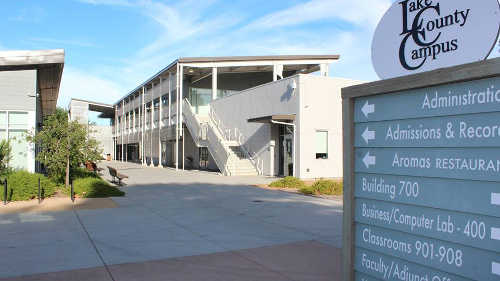 CLEARLAKE, Calif. – Lake County Campus of Woodland Community College is preparing to start the Spring 2017 semester.
The semester begins on Jan. 23 and classes are filling up quick.
The college offers a large assortment of classes that allows students to pursue Career Technical Education certificates or degrees. From welding, water treatment, culinary arts, or early childhood education there are many CTE pathways to choose from.
Or if you are seeking to obtain a degree and transfer on to a four-year university, Lake County Campus allows for many possible pathways to choose from.
College is a great stepping stone towards making your dreams come true.
For those of you seeking to obtain a professional office job, you may be interested in the Business Computer Applications classes being offered such as Microsoft Outlook, Desktop Publishing, Microsoft Access, Windows, Beginning Keyboarding, Word Processing, and Machine Calculation. These are all classes that will help solidify your job prospects in this county.
Culinary Arts is a popular field on Lake County Campus. With classes such as basic and advanced food prep, beginning and professional baking, restaurant operations, and foods and catering, a student can take this pathway to either join an up and coming restaurant or learn the ropes to create their own culinary arts enterprise.
These are just a few of the possible classes and pathways that you can follow at Lake County Campus of Woodland Community College.
To register for classes, contact the admissions office at 707-995-7900, visit the campus at 15880 Dam Road Extension in Clearlake, or visit http://lcc.yccd.edu .
LAKEPORT, Calif. – On Saturday, Jan. 14, the Clear Lake Cardinals hosted their fifth annual Michael Kroppmann Memorial Wrestling Tournament.
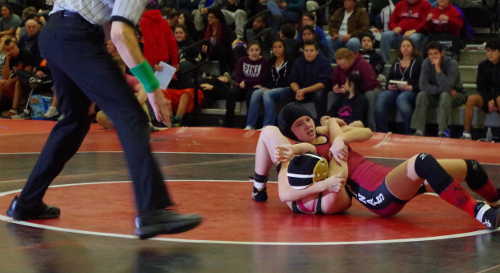
Even with injuries and illnesses throughout the team, the Cards were still able to enter 13 wrestlers – six boys and seven girls – into their home tournament.
The girls placed fourth as a team, just points away from third.
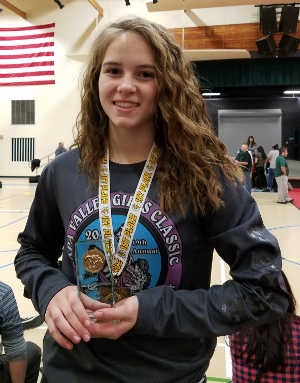
Mavis Pyorre (girls 111 lbs.) went 3-0 with three pins to win a gold medal and was also awarded the Outstanding Wrestler of the Girls tournament, as voted on by the participating teams’ coaches.
Silver medals went to Justin Cantrell (boys 152 lbs.) who was 2-1, beating both the third and fourth placers along the way and Shelby Butcher (girls 189 lbs.).
Merari Alvarez (girls 160 lbs.) took home a bronze medal and Kally Vinson (girls 235 lbs.) placed fourth, going 1-2 with one pin.
Placing fifth at 2-2 were Frankie Sturr (boys 132 lbs.), Scarlett Ballard (girls 126 lbs.), each with two pins, along with Samantha Bruno (girls 235 lbs.) with one pin, Mackenzie Markham (girls 106 lbs.) at 1-2 and Ozod Ermatov (boys 138 lbs.). Frank Weiler (boys 220 lbs.) placed sixth going 1-3 with one pin.
Also wrestling for the Cardinals was Thomas Lairson and Hayden Eastham, both at 126 lbs.
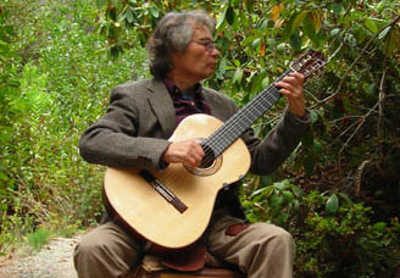
LAKEPORT, Calif. – The first of a four-part Contemporary Chamber Music Series produced by Beth Aiken and Jeff Ives takes place on Sunday, Jan. 22, at 3 p.m. at the Soper Reese Theatre.
January's program features Barbara D'Augelli (flute) and Sergei Bassehes (guitar).
They will perform pieces from composers Emile Desportes, Mauro Guiliani, Radames Gnattali and Mario Castelnuovo-Tedesco.
The series is presented under the auspices of the Soper Reese Theatre. All seats are reserved. Tickets are $20 and $15. Children 18 and under are free.
Three more concerts follow in February, March and April.
On Feb. 19 Luiz Coelho is the featured performer for chamber pieces that will include quintets and trios in various combinations of strings, piano, and clarinet.
On March 19 Tammie Dyer and distinguished associates from the North Bay present a wide range of classics from the string repertoire of Walton, Handel and Bach.
The season ends on April 23 with critically acclaimed “Trois Bois” performing pieces from the 20th century.
In addition to individual concert tickets, a four-concert season ticket is now on sale for $70 and $50. Go to www.SoperReeseTheatre.com to purchase individual or season tickets.
Tickets also available at The Travel Center, 1265 S. Main, Lakeport, Monday through Friday, from 9 a.m. to 5 p.m.
LAKE COUNTY, Calif. – Born Aug. 10, 1951, Bobbi died of complications of pneumonia on Dec. 23, 2016, in her home in Lucerne.
Bobbi is survived by Gary Sharpe, her husband of nearly 43 years, as well as her daughter Connie Sharpe, son Steve Sharpe, and her two sisters, Janet Gardner and Barbara Fielding, along with two grandchildren, six nieces and nephews. She was preceded in death by her parents, Bob and Jennie Shrader.
Bobbi was born Roberta Lee Sharpe in Jerome, Idaho, on Aug. 10, 1951. Her parents later moved to Colorado.
She graduated from Billy Mitchell High School in 1969 and then took classes for a year at the local community college. After that she went to barber college in Pueblo, Colo., and became the first female men’s hair stylist in Canon City, Colo., in 1973.
There, she met Gary Sharpe. They fell in love and married in 1974 and remained so until her passing in 2016.
Gary worked for the Bureau of Land Management and as a private bookkeeper/accountant so they lived in several different parts of the West. Their daughter Connie was born in Canon City, Colo., and their son Steve was born in Roseburg, Ore.
Other places they lived and raised their family included Colorado Springs and Pueblo, Colo.; Phoenix and Mohave Valley, Ariz.; and in California, Potter Valley, Blue Lakes and, finally, Lucerne. No matter where she lived, Bobbi made it their home.
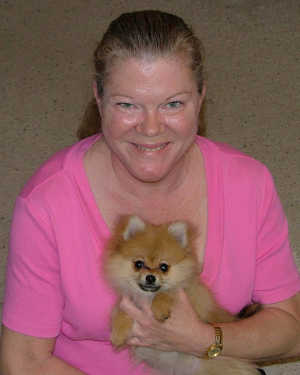
Bobbi was a kind and loving person who enjoyed family, friends and life. She loved animals, particularly her beautiful little Pomeranian named Suzy. She enjoyed cooking, baking, traveling, adventures, old movies, and watching beautiful sunsets.
She loved her family with all her heart … as we loved her.
A memorial service will be held at Clearlake First Assembly of God on Saturday, Jan. 21, at 11 a.m. A catered celebration of life will follow at the downstairs fellowship hall of the church, located at 4472 Snook Ave. in Clearlake.