 How to resolve AdBlock issue?
News
NORTHERN CALIFORNIA – End-of-life health care often is difficult and stressful for an individual and their family.
More than 79 percent of individuals needing end-of-life care require hospitalizations. For the 79 individuals who participated in Partnership HealthPlan of California’s (PHC) Partners in Palliative Care pilot program, less than half required hospitalization.
In September 2015, PHC launched Partners in Palliative Care, which focused on patient and family-centered care by anticipating, preventing and treating suffering during end-of-life care.
For every dollar spend to administer the pilot, three dollars were saved in hospital costs.
Four organizations – ResolutionCare (Humboldt County), Collabria Care (Napa County), Interim Healthcare (Shasta County), and Yolo Hospice Care (Yolo County) – provided care that included assessment, pain management services, care coordination, access to care giver support and case management.
From enrollment to death, 55 percent those participating in the pilot avoided hospitalization, compared to 21 percent of matched comparison beneficiaries.
Only 35 percent of pilot participants died within 30 days of a hospital admission versus more than 70 percent of comparison beneficiaries.
A UCSF study from 2010 to 2013 showed that 76 percent of safety-net patients, individuals with disabilities, low-income, and/or uninsured, were hospitalized in the last six months of life. Of those, 45 percent were hospitalized in the last month of life, 33 percent died in the hospital and 21 percent had multiple admissions in the last month of life.
Although the pilot is now over, the Partners in Palliative Care pilot will guide PHC’s implementation of palliative cares services and hospice services for those with cancer, end stage liver disease, congestive heart failure and chronic obstructive disease.
PHC is a nonprofit community based health care organization that contracts with the State to administer Medi-Cal benefits through local care providers ensuring Medi-Cal recipients have access to comprehensive, cost-effective health care. PHC provides quality health care to over 565,000 Medi-Cal members.
Beginning in Solano County in 1994 PHC now provides services to 14 Northern California counties – Del Norte, Humboldt, Lake, Lassen, Marin, Mendocino, Modoc, Napa, Shasta, Siskiyou, Solano, Sonoma, Trinity and Yolo.
This article has been updated, the age of the victim was first reported as 20 while the correct age is 18.
LAKEPORT, Calif. – A young Lakeport man suffered major injuries on Tuesday evening when he was hit by a vehicle while riding his bicycle.
Oscar Dominguez, 18, was injured in the crash, which occurred at approximately 6:16 p.m. Tuesday, according to the California Highway Patrol.
The CHP said the driver in the crash was Amanda Gonzalez, 23, of Lucerne.
Gonzalez was driving a 2010 Jeep Liberty westbound on 11th Street and preparing to turn left onto southbound Highway 29, while at the same time Dominguez was riding his Greg Lemond bicycle eastbound, approaching the intersection with the southbound Highway 29 onramp, the CHP said.
As Gonzalez made her left turn, Dominguez struck the right front of Gonzalez’s vehicle. The CHP said he was thrown from his bike, struck the Jeep’s windshield and then landed on the asphalt roadway.
Lakeport Fire and the CHP responded to the scene, requesting a REACH air ambulance, according to the report.
The CHP said Dominguez was flown to Santa Rosa Memorial Hospital with a broken left femur, broken left hand, broken rib, bruised lung and several contusions.
No alcohol or drugs are suspected to have contributed to the collision, which remains under investigation by Officer Randy Forslund, the CHP said.
Email Elizabeth Larson at

KELSEYVILLE, Calif. – One of Lake County’s well-known wineries has new owners.
Myron and Marilyn Holdenried of Wildhurst Winery welcome Michael and Tanya Hat to the Kelseyville community with their recent purchase of the winery and tasting room business.
This transaction caps the long winery industry career for Myron Holdenried.
In 1966, Holdenried, along with his cousin Reid Dorn – both fifth-generation Lake County farmers – along with his neighbor Walt Lyon and his Big Valley friend, Floyd Silva, planted winegrapes within a week of each other, thus beginning the rebirth of the wine industry for Lake County.
Holdenried planted Zinfandel in the pasture on Gaddy Lane. He sold his grapes to John Parducci and Barney Fetzer of Ukiah, and to Jess Jackson at his Lakeport winery, Kendall-Jackson.
By 1991, Holdenried, with the partnership of the four Collin brothers from the Central Valley, took the leap to establish Wildhurst Winery.
The first winery and tasting room were located in Lower Lake at the former Stuermer Winery location. The first winemaker was Kathy Redmond, a native of South Africa. Jed Steele also made his first wines there, and served as a consultant to Redmond.
At the time, the Lake County wine industry included only three other wineries: Konocti Guenoc, and Kendall-Jackson. With the addition of Wildhurst and Steele Wines, the total number of wineries in the county grew to five.
Wildhurst Winery made the permanent move to Kelseyville in 1997, with the opening of the tasting room on Main Street, in the old, historic I.O.O.F. Hall. Their wines were produced at the winery facility on Benson Lane, Kelseyville.
Today, there are more than 30 wineries in Lake County, with five tasting rooms now in Kelseyville.
Holdenried was a founding member of the Lake County Winegrape Commission, and worked on the creation of the well-known Clear Lake and Big Valley appellations.
“Over the past 25 years, it has been exciting to be part of the Lake County wine industry,” Holdenried said. “Marilyn and I have enjoyed and appreciated being in our home town and watching the industry grow. We are thankful for all of the support from our friends and customers. It is a pleasure to see the tasting room venue continue with the Hats, both of whom have the passion and energy.”
The Holdenrieds thank their Wildhurst team for their continued loyalty and support.
“We have been very fortunate, through our many years, to have had talented, dedicated and loyal staff members from winemakers, cellar masters, office personnel, outside sales, and tasting room employees. They are the ones who helped build the quality reputation that Wildhurst has enjoyed,” Holdenried said.
Michael Hat, a third-generation grape grower, and his wife, Tanya, live in Manteca, but look forward to working in the Lake County area and participating in the many winery events.
“We were amazed, and continue to be, by the Holdenrieds’ long history in this area and the sincere respect they have earned,” Michael Hat said.
The Hats invite the community to stop in for a visit, taste the new wines, and enjoy the new colors and ambiance.
“We have wonderful surprises in store for our wine club members and new friends,” Tanya Hat said. “The same friendly Wildhurst staff looks forward to pouring the new wines for you.”
Myron and Marilyn Holdenried continue to produce winegrapes in their vineyard on Gaddy Lane and Clark Drive in Kelseyville.
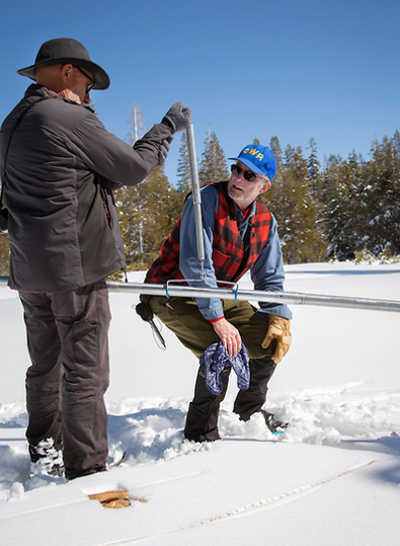
NORTHERN CALIFORNIA – The latest state snow survey on Wednesday showed that the Sierra Nevada snowpack continues to build during one of the wettest winters in California’s recorded history.
Wednesday’s manual snow survey by the Department of Water Resources, or DWR, at Phillips Station in the Sierra Nevada found a snow water equivalent of 43.4 inches.
February’s Phillips survey found 28 inches of snow water equivalent, and January’s reading was 6 inches. The March 1 average at Phillips is 24.3 inches, officials said.
Snow water equivalent is the depth of water that theoretically would result if the entire snowpack melted instantaneously. That measurement is more important than depth in evaluating the status of the snowpack.
On average, the snowpack supplies about 30 percent of California’s water needs as it melts in the spring and early summer, the DWR reported.
More telling than a survey at a single location are DWR’s electronic readings from 98 stations scattered throughout the Sierra Nevada.
Statewide, the snowpack today holds 45.5 inches of snow water equivalent, or 185 percent of the March 1 average (24.6 inches), the DWR said.
On Jan. 1 before a series of January storms, the snow water equivalent of the statewide snowpack was 6.5 inches, just 64 percent of the New Year’s Day average. On Feb. 1, the statewide snow water equivalent was 30.5 inches, 174 percent of average for that date, according to the DWR.
Measurements indicate the water content of the northern Sierra snowpack is 39.2 inches, 159 percent of the multi-decade March 1 average. The central and southern Sierra readings are 49.0 inches (191 percent of average) and 46.4 inches (201 percent of average) respectively.
Separately, in the Mendocino National Forest, snow levels also are much improved.
According to the California Data Exchange Center, the snow depth at Anthony Peak – at 6,200 feet elevation – on Feb. 1 was 71 inches, with 21 percent water content. A more recent measurement hasn’t yet been posted.
That’s the most snow at that site since March 2011, when snow depth measured 135.8 inches and 50.1 percent water content, based on the state data.
Measurements for Plaskett Meadows, the other site monitored for snow in the Mendocino National Forest, haven’t yet been posted.
State Climatologist Michael Anderson said the winter season has been “historic,” especially in the central and southern Sierra where elevations are higher and where snowfall has been near the 1983 record amount.
The Phillips snow course, near the intersection of Highway 50 and Sierra-at-Tahoe Road, is one of hundreds surveyed manually throughout the winter. Manual measurements augment the electronic readings from about 100 sensors in the state’s mountains that provide a current snapshot of the water content in the snowpack.
Frank Gehrke, chief of the California Cooperative Snow Surveys Program, conducted Wednesday’s survey at Phillips.
“It’s not the record, the record being 56.4 (inches), but still a pretty phenomenal snowpack … January and February came in with some really quite phenomenal atmospheric river storms, many of which were cold enough to really boost the snowpack,” he said.
Gehrke said the central and southern regions in the Sierra Nevada are tracking close to 1983, which had the maximum recorded snowpack statewide.
“Most of the snow courses are well over their April 1 accumulations, which at (Phillips) is 25 inches,” Gehrke said, “so we’ve busted through April 1 values pretty much at all snow courses throughout the state.”
Water Year 2017’s heavy precipitation is particularly remarkable because of the five dry years that preceded it.
Since Oct. 1, the Northern California, San Joaquin and Tulare Basin indices’ rainfall totals are, respectively, 76.5 inches (average is 34.7), 60.7 inches (average is 27.4) and 41.0 inches (average is 19.4). Collectively, the three regions had a total of 178.2 inches of rainfall, or 218 percent of the five-month average (81.5 inches), DWR reported.
Many Californians continue to experience the effects of drought, and some Central Valley communities still depend on water tanks and bottled water. DWR said groundwater – the source of at least a third of the supplies Californians use – will take much more than even an historically wet water year to be replenished in many areas.
California’s climate is the most variable of any state, according to DWR. Historically, it swings from drought to flood and back to drought.
In addition, as global warming drives up average temperatures in California, more precipitation will fall as rain, not as snow stored in the Sierra Nevada and other mountains.
To help prepare for these ever-wider extremes, Californians can learn ways to save water every day by visiting www.SaveOurWater.com .
On Wednesday, Northern California Representatives John Garamendi (D-CA) and Doug LaMalfa (R-CA) introduced H.R. 1241, the “American Food for American Schools” Act.
The bill is designed to bring more accountability and transparency to the “Buy American” provisions of the National School Lunch Act.
Under current law, school districts are required to use domestically-sourced products for school lunches wherever practical but may request a waiver from the Department of Agriculture if the cost of domestic sourcing is significantly higher. Unfortunately, these waiver requests do not always occur.
This bipartisan legislation would legally require school nutrition providers to seek a waiver in order to use taxpayer dollars to purchase foreign commodities and products.
Additionally, waiver requests must be made available to the public to ensure accountability and provide American farmers and food providers an opportunity to seek out school districts that need affordable American-grown food.
“Northern California produces some of the highest quality food in the world, unfortunately, school districts too often look elsewhere to provide students with foreign food that is not held to the same standards of safety and quality,” Congressman LaMalfa said. “The Buy American provisions of the National School Lunch Act were created to ensure our children enjoy fresh, local produce instead of potentially less healthy alternatives from overseas.”
He added, “This bill increases transparency for schools who request a waiver to use foreign products in school lunches and helps to ensure our tax dollars are used to buy American produce and to support American agriculture. I appreciate the work of my colleague, Mr. Garamendi, on this issue and I hope we can continue to gather bi-partisan support for buying American products and improving child nutrition.”
“One of the best ways to make sure our kids have local produce is to enforce the existing Buy American provisions of the National School Lunch Act,” said Congressman Garamendi. “These provisions are designed to ensure taxpayer dollars support U.S. jobs and businesses, and they have the added benefit of increasing the amount of American-grown food our children enjoy through the school lunch program.”
Garamendi continued, “We have seen too many instances of school districts, including some in my district, importing foreign food unnecessarily without the proper disclosure. Recently, we’ve even seen recalls of imported foods owing to disease outbreaks when that same produce could have been sourced locally right here in California, subject to the highest food safety standards in the world. That’s why my colleague Doug LaMalfa and I have written legislation that will increase transparency and strengthen enforcement of these important standards.”
The legislation has already earned support from key agricultural groups. "When local school districts use taxpayer dollars to purchase and import food products that are readily available here, it is a real slap in the face to American farmers who are required to comply with a host of laws and regulations to ensure they are producing the safest supply of food in the world,” said Rich Hudgins, president and CEO of the California Canning Peach Association. “Yet China is notorious for environmental, human rights and food safety violations so why are we using taxpayer dollars to buy their food products and risk the health and safety of our children?”
Rob Larew, senior vice-president of Public Policy and Communications for the National Farmers Union, said, “The school lunch laws were designed to ensure all school-age children have access to high quality, nutritious food products, like those grown and produced by U.S. farmers and ranchers. By improving transparency and enforcement of the Buy American provisions, through the American Food for American Schools Act, we can better support both American agriculture and child nutrition.”
Commercial and sport anglers have received unwelcome news on the predicted return of Chinook salmon this year to California waters.
State and federal fishery scientists presented updates on the numbers of spawning Chinook and the expected abundance for the upcoming fishing season at the annual Ocean Salmon Information Meeting held in Santa Rosa on Wednesday.
Forecasts suggest there are 230,700 Sacramento River fall run Chinook adults in the ocean this year, along with 54,200 Klamath River fall run adults.
Both forecasts are lower than those of recent years, with the forecast for Klamath fall run being among the lowest on record.
Salmon from these runs typically comprise the majority of salmon taken in California’s ocean and inland fisheries.
“With a poor forecast for Klamath fall run and continued concerns over the winter run, California anglers will see reduced Chinook fishing opportunity as compared to last year,” said Brett Kormos, a senior environmental scientist with the California Department of Fish and Wildlife, or CDFW.
Chinook that will be harvested in ocean fisheries in 2017 hatched two to four years ago, and were deeply affected by poor river conditions driven by California’s recent drought.
CDFW and federal fish agency partners have expended millions of dollars on measures to minimize the impacts of the drought.
These efforts have included trucking the majority of hatchery salmon smolts to acclimation pens in the lower Delta, improving hatchery infrastructure to keep juvenile fish alive under poor water quality conditions and partnering with sport and commercial fishermen to increase smolt survival.
Though all of these efforts helped, other environmental factors – such as unusually warm water conditions in the ocean – were beyond human control.
The 2017 forecasts, in addition to information on endangered Sacramento River winter Chinook, will be used over the next two months by fishery managers to set sport and commercial fishing season dates, commercial quotas, and size and bag limits.
Season dates and other regulations will be developed by the Pacific Fishery Management Council and California Fish and Game Commission over the next two months.
For more information on the salmon season setting process or general ocean salmon fishing information, please visit the Ocean Salmon Project Web site or call the salmon fishing hotline at 707-576-3429.