How to resolve AdBlock issue?
News

A front porch is very much like a stage, and this poem by Marilyn Nelson is like watching a little play. The poet, who has published books of poetry and prose for young and old alike, lives in Connecticut and her most recent book is My Seneca Village (Namelos, 2015).
Daughters 1900
Five daughters, in the slant light on the porch,
are bickering. The eldest has come home
with new truths she can hardly wait to teach.
She lectures them: the younger daughters search
the sky, elbow each other's ribs, and groan.
Five daughters, in the slant light on the porch
and blue-sprigged dresses, like a stand of birch
saplings whose leaves are going yellow-brown
with new truths. They can hardly wait to teach,
themselves, to be called "Ma'am," to march
high-heeled across the hanging bridge to town.
Five daughters. In the slant light on the porch
Pomp lowers his paper for a while, to watch
the beauties he's begotten with his Ann:
these new truths they can hardly wait to teach.
The eldest sniffs, "A lady doesn't scratch."
The third snorts back, "Knock, knock: nobody home."
The fourth concedes, "Well, maybe not in church . . . "
Five daughters in the slant light on the porch.
American Life in Poetry does not accept unsolicited submissions. It is made possible by The Poetry Foundation ( www.poetryfoundation.org ), publisher of Poetry magazine. It is also supported by the Department of English at the University of Nebraska-Lincoln. Poem copyright ©1990 by Marilyn Nelson, “Daughters 1900,” from The Homeplace, (Louisiana State Univ. Press, 1990). Poem reprinted by permission of Marilyn Nelson and the publisher. Introduction copyright © 2017 by The Poetry Foundation. The introduction's author, Ted Kooser, served as United States Poet Laureate Consultant in Poetry to the Library of Congress from 2004-2006.
LAKE COUNTY, Calif. – The Lake County Department of Public Works, or DPW, will soon be starting its annual Roadside Weed Abatement Program through the application of herbicides along certain county-maintained roads.
Should residents or property owners with frontage along roads previously noticed as well as the roads listed below desire that no weed abatement occur adjacent to their residence or property, they must contact DPW prior to March 24, unless a previous request for “no spray” was submitted to DPW.
If you would like to remove an existing “no spray” status, you must contact DPW at 707-263-2341.
As a reminder, property owners who do not wish their property frontage to be sprayed are responsible for maintaining their frontage in such a way that does not create nuisance conditions.
While property owners can request that their frontage not be sprayed, they must otherwise maintain their frontage to avoid creating a public nuisance that could be caused by overgrown weeds such as fire hazard, aesthetics, sight distances, etc.
To assist those property owners who object to spraying, DPW will review their proposed maintenance plans at no charge and issue a no-fee encroachment permit to perform the maintenance as necessary.
One or more of the herbicides “Roundup Pro Max,” “Krouar I D F,” “Esplanade 200SC,” Landmark XP and an nonionic surfactant may be used on already noticed roads and the following roads which are being added this year: Carson Avenue, Collier Avenue, Crystal Lake Way, Floyd Way, Hammond Avenue, Harrington Flat Road, Hendricks Road, Howard Avenue, Keck Road, Keeling Avenue, Martin Street, Scotts Valley Road and Stokes Avenue.
CLEARLAKE, Calif. – Soroptimist International of Clear Lake will gather on Thursday, March 23, for a luncheon meeting at 11:45 a.m. at Howard's Grotto in Clearlake.
The cost for lunch is $14 and can be paid at the door. Agenda items include details on the annual signature fundraising event "Spring Fling" chaired by Vice President Brenda Crandall and supported by all the members.
Indications are that the Spring Fling was very successful and will help keep the many current projects going.
Soroptimist International of Clear Lake is a proud supporter of Soroptimist/LiveYourDream.org global program for girls. “Dream It, Be It: Career Support for Girls” will help girls grow up to be strong, successful, happy adults.
Dream It, Be It targets girls in secondary school who face obstacles to their future success. It provides girls with access to professional role models, career education and the resources to live their dreams.
Soroptimist clubs will work in partnership with girls in small groups or a conference setting to provide them with the information and resources they want and need to be successful.
The topics covered include career opportunities, setting and achieving goals, overcoming obstacles to success and how to move forward after setbacks or failures.
Dream It, Be It joins Soroptimist's long-running program Live Your Dream: Education and Training Awards for Women (formerly the Women’s Opportunity Awards).
The Soroptimist Dream Programs ensure women and girls have access to the education and training they need to reach their full potential and live their dreams.
Soroptimist is an international organization for women who volunteer to work to improve the lives of women and girls, in local communities and in the world.
More than 80,000 Soroptimist in about 120 countries and territories contribute time and financial support to community based and international projects to benefit women and girls.
The group meets for lunch on the second and fourth Thursdays each month in Clearlake.
Membership is open to anyone with the desire to help women and girls locally, nationally and internationally and is pleased to announce that three male members have recently joined the group.
For more information about the luncheon or joining Soroptimist International of Clear Lake please contact Membership Chair Wanda Harris at 707-225-5800 or
March is here, and that means spring break is right around the corner.
Spring break is the perfect time to take a break from work or school and enjoy some time in the sun.
If you want to take more than a stay-cation this year and do some traveling, there are a few things you should be aware of to avoid a burn.
In 2016, consumers nationwide reported hundreds of travel/vacation scams to BBB Scam Tracker. BBB Scam Tracker also received more than 2,000 reports of sweepstakes/prize scams in 2016, some of which involved winning a “free trip.”
Even if you avoid a scam, you could still run in to problems when booking your trip. In 2016, BBB received around 7,000 complaints about travel agencies and bureaus, and more than 2,000 complaints about online travel agencies.
Want to have a fun and stress-free spring break? Follow these tips from your BBB:
Do your research
Common complaints about travel agencies and Web sites allege issues with guarantees, problems with refunds/exchanges and poor customer service.
Make sure to use a travel agent or online booking site that you can trust. Look up any business or Web site you plan on using on www.bbb.org . There you can find its rating, complaint history and reviews from past customers.
Make sure to also thoroughly research destinations and activities so that you’re prepared and don’t encounter any surprises when you arrive.
Be diligent
Be careful and pay attention to details when you make any purchase or sign any contract – before or during your trip.
Read the fine print, ask about additional fees and get everything in writing. Before leaving, verify all of your reservations for lodging and activities by calling the hotel or company directly.
Print out any confirmation emails and pages and take them with you in case you run in to any issues and don’t have Internet access.
Always pay with a credit card, as they offer more protection than debit and prepaid cards, and let your bank know that you’re traveling beforehand.
Watch out for travel scams
In 2016, the median loss for a travel scam reported to BBB Scam Tracker was around $850 – so be careful.
If you receive an unsolicited email or call claiming you’ve won a free trip, it’s probably a scam. You’ll never have to pay to receive a free prize.
Avoid click-bait ads for cheap vacations you see on the Internet. These may lead you to fraudulent Web sites in an attempt to steal your personal or financial information.
It’s also important to watch out for fake rentals when trying to find a place to stay. Phony landlords collect an advance deposit then avoid contact with renters, who may be left with nothing but a fake reservation or a rental that doesn’t resemble the photos in the online listing. Only deal with rental companies you can trust – look them up on www.bbb.org first.
Protect yourself, your information and your valuables while away
Be careful connecting to public Wi-Fi, and never use it to online bank or enter personal or financial information while using it.
It’s also best to wait to post vacation pictures on social media until you return home, otherwise potential thieves will know your house is empty.
Make sure to lock up any valuables in a safe when you’re not in your hotel room. Keep important items, like your passport and wallet, close to your body while out and about and watch out for pickpockets.
Consider travel insurance
Travel insurance is designed to cover things like trip cancellations or medical emergencies.
There are different plans with different levels of coverage. Before buying ask a lot of questions, and always read the fine print to see what’s covered and what’s not.
If you want to purchase travel insurance, use the BBB Accredited Business Directory on www.bbb.org to find an insurance agent you can trust.
Rebecca Harpster is public relations specialist for the BBB serving the San Francisco Bay Area and Northern Coastal California.
UPPER LAKE, Calif. – A motorcyclist injured in a Saturday afternoon crash in the Mendocino National Forest had to be rescued with the help of a helicopter.
The crash, which was reported about the middle of Saturday afternoon, occurred about a mile and a half from the Upper Deer Valley Road and a mile and a half down the Sled Ridge Trail above Upper Lake, according to Northshore Fire Chief Jay Beristianos.
Beristianos said the male motorcyclist crashed and suffered a leg injury.
Because of the remoteness of the location, Beristianos said it was going to be a long, uncomfortable ride out to the hospital for the injured rider.
So Northshore Fire requested Kelseyville Fire respond with its all-terrain rescue vehicle, although Beristianos said that would still have been a bad ride.
Then, “The clouds kind of cleared a little bit and we were able to get a helicopter in,” he said.
The Sonoma County Sheriff’s Office’s Henry-1 helicopter responded and did a long line rescue, and then flew the rider to Middle Creek Campground, Beristianos said.
From there, Beristianos said a Northshore Fire ambulance took the rider to Sutter Lakeside Hospital.
Meantime, Kelseyville Fire used its all-terrain vehicle to take other people from the location and down the hill, which Beristianos said was a huge help.
In addition to Northshore Fire, Kelseyville Fire and Henry-1, Mendocino National Forest units responded to the incident, Beristianos said.
Radio reports indicated firefighters cleared the scene just after 4:45 p.m.
Email Elizabeth Larson at
This week in history features America’s (not quite) first bank robbery and the horrible disaster that sparked a worker safety revolution.
March 19, 1831
America’s first great bank robbery wasn’t actually America’s first. No one really knows what historian or reporter first claimed that the City Bank of New York robbery of 1831 was the nation’s first, but lazy journalists and even lazier historians rehashed the claim time and again.
In actuality, the dubious honor probably goes to the 1798 robbery of a bank in Philadelphia. Oddly enough, the 1798 robbery and the one that happened on this day in 1831 were both achieved using the same method: creating a duplicate key.
The story of America’s (not so) first bank robbery begins with two men: James Honeyman and William Murray.
Well-known thieves and ne’er-do-wells, Honeyman and Murray had spent their lives ripping people off. For all their rough edges, they had picked up a thing or two in their day.
Rather than try and break into the City Bank of New York by force, somehow the culprits had been able to make a wax impression of the key from the lock to the front door. Returning to the bank during the night of the 19th, Honeyman and Murray simply unlocked the front doors and sauntered inside.
For the next several hours, the men systematically packed sacks with roughly $245,000 in banknotes and coins. That was an enormous sum of money, roughly equivalent to $52 million today. Certainly the score of a lifetime.
They exited the bank just as easily as they entered it. No one was the wiser until the tellers returned to work the next day to find their vault and safety deposits ransacked.
By the time their dirty deed had been discovered, Honeyman and Murray were safely back in their hotel rooms, dividing the loot between themselves. Honeyman took his share in several trunks and rented a room at a nearby boarding house, where he sat on it for the next several days.
Meanwhile, rumor over the theft of so much money raced across the region, sped along by newspaper articles that advertised a reward in the several thousands of dollars. Everyone seemed completely flabbergasted as to who could have perpetrated such a crime.
Well, not everyone. Chief Constable Jacob Hays knew immediately that James Honeyman was behind the deed. Apparently, Honeyman was suspected of a theft of a Brooklyn store and several other misdeeds about the area. He was well known to say the least. However, when he went to search his home, Hays could find hide nor hair of Honeyman. The case might have dragged on from there had the landlord of the boarding house Honeyman was hiding out in not become suspicious of his new tenant and his several heavy traveling trunks.
On March 24, Honeyman took one of the trunks with him as he left the boardinghouse that morning, telling the landlord he would return for the others.
By now convinced that something was off about the man, the landlord contacted Chief Constable Hays, who came to the boardinghouse to investigate. Together with the landlord, Hays opened the trunks in the room and discovered most of the loot.
Lying in wait for the return of Honeyman, Hays apprehended the man when he returned to his room to retrieve the by now discovered trunks. A quick description of a man that routinely visited Honeyman at the boardinghouse convinced Hays that William Murray was his accomplice. Hays tracked Murray down in Philadelphia and returned him for trial.
In the end, the two men were convicted of the robbery and sentenced to five years in prison. Despite months of search, over $40,000 of the stolen money was never recovered.
While it was never really America’s first bank robbery, the story behind the robbery of March 19, 1831 certainly sounds like it ought to have been.
The vast sum of money stolen, the audacity of the thieves and the open-ended conclusion all make for the sort of story that reporters and historians just can’t ignore.
March 25, 1911
These days they are common features of all public spaces: fire extinguishers, exit signs, and fire alarms.
Like most innovations, however, events have to transpire that hit home the need for change before change itself is implemented.
Humanity is a dense pupil – we tend to take several harsh lessons before getting the point. One-hundred and six years ago to the day, the Triangle Shirtwaist Co. in New York City was the scene of one of these harsh lessons.
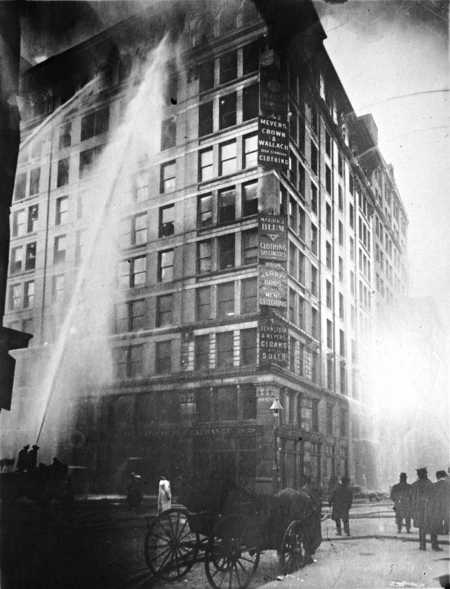
The Triangle factory was located in the top three floors of the Asch Building in Manhattan. Owned by Max Blanck and Isaac Harris, it was a sweatshop, plain and simple. Working in cramped, low-lighted spaces, young women sat hunched over lines of sewing machines.
The building had three elevators, but only one of them was operational on the fateful day of March 25 and access to it was only available down a narrow corridor, the women having to walk single-file to get to it.
Fortunately, the elevators were not the only means of egress from the building, with two rickety stairways also available.
Unfortunately, the door to one of these stairways was locked to prevent stealing and the other only opened inward.
Despite knowing the danger of fire in the building (fires had broken out in the Asch building only nine years earlier), the owners never installed fire sprinklers.
Fate can only be chanced so many times before the inevitable happens. For the 600 workers toiling away in the Asch building on Saturday, March 25, the odds finally came up against them when a fire started in a rag bin.
It didn’t take long for the blaze to get out of control and panic to set in among the frightened – and trapped – workers.
The manager on the floor where the fire broke out attempted to extinguish the fire with a nearby hose – the only safety measure the building had. Like every other feature of the building, however, the hose was faulty and could not put the fire out.
Chaos ensued. The lone working elevator was only able to make a few trips up and down before the blaze became too intense.
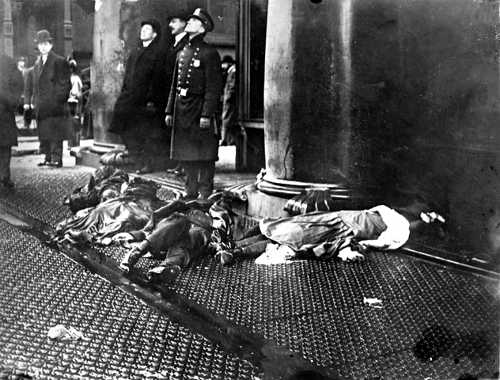
By the time firefighters arrived on the scene, women were jumping to their deaths out of windows to escape the fate of burning alive. They were far better off than the unfortunates who were caught in the stairway with the locked door.
The horror was over in just 18 minutes, but the death toll was staggering. In all, 49 people had burned to death or been suffocated by the smoke, 36 lay dead in the elevator shaft and 58 bent and scattered on the streets below.
That day 145 people died because the owners of the building placed the safety of people below that of profit.
The horror of the fire galvanized the nation and reintroduced the issue of worker safety into the public debate. In the state of New York, the Sullivan-Hoey Fire Prevention Law passed that October and required owners to install fire sprinklers inside factories.
One-hundred and forty-five lives is a steep price to pay for a lesson in the need for safety regulations. It is a far higher price when we consider that corners continued to be cut.
The Triangle Shirtwaist Fire of 1911 was not the end to the problem, but it was the beginning of recognizing we had one in the first place.
Antone Pierucci is the former curator of the Lake County Museum and a freelance writer whose work has been featured in such magazines as Archaeology and Wild West as well as regional California newspapers.