 How to resolve AdBlock issue?
News
KING ARTHUR: LEGEND OF THE SWORD (Rated PG-13)
Once upon a time, in a far-away kingdom, director Guy Ritchie had an exciting signature style for his crime dramas, notably “Lock, Stock and Two Smoking Barrels” and “Snatch,” the latter starring Brad Pitt and British tough guys Jason Statham and Vinnie Jones.
Then Ritchie married Madonna, and it seemed that his work started to go downhill, especially since his then-spouse was cast in the leading role of the execrable romantic comedy “Swept Away,” a title that was oddly prophetic if you think about it.
Now if only Ritchie could reunite with action stars like Statham or Jones, maybe he would get back in the game. Yet, getting Charlie Hunnam, who captured attention on cable TV as a biker in a motorcycle gang in the long-running “Sons of Anarchy,” was a coup, of sorts.
The trouble, of course, is that “King Arthur: Legend of the Sword” is a medieval adventure, and the swagger of an outlaw biker may not be the best fit for a would-be monarch, but at least Hunnam gives Arthur a gritty, modern edge that Ritchie evidently had in mind.
At a minimum, everyone has a vague perception of the Arthurian legend, one that involves the king’s identity revealed by his ability to extract the Excalibur sword from stone and leading the Knights of the Round Table on chivalrous missions.
This being a Guy Ritchie film, “King Arthur” does not resist its rudimentary impulse for epic fantasy action that is realized right from the start when elephants the size of oil tankers rampage across the kingdom in a path of utter destruction.
In the opening scenes, the young child Arthur bears somber witness to the murder of his kind-hearted father, King Uther Pendragon (Eric Bana), at the hands of the monarch’s treacherous brother Vortigern (Jude Law, suitably slimy and villainous).
Dispatched to Londinium to be raised far from the reach of a vengeful Vortigern, the child Arthur is a ruffian and street urchin living in a brothel, running the streets, learning to fight and dodging the law with his mates.
Growing up poor and scrapping for every bit of advantage, the young Arthur is completely unaware of his true provenance, until he’s shipped off to Camelot where he, like every man of a certain age, is to put to a test to pull a sword from stone.
The premise boils down to taking a shrewd street thug with an irreverence for authority, yanking out of his barebones existence and surrounding him with otherworldly magic and colossal creatures, and then thrusting him into the uncomfortable position of having royal blood.
Pulling the Excalibur from the hunk of stone is the closest thing to a death sentence, as Vortigern set up this test to find his long-lost nephew only for the purpose of removing the most serious threat to the throne.
Well, Arthur may be a reluctant hero but ending up in prison with a date for execution motivates a dedicated group to topple the illegitimate king, and so Arthur gets help from the mysterious Mage (Astrid Berges-Frisbey) and Sir Bedivere (Djimon Hounsou), among others.
Naturally, there will be a raging battle between Arthur’s ragtag bunch and Vortigern’s well-equipped army and his willingness to conjure up mystical forces to fend off Arthur’s claim to what is rightfully his.
“King Arthur” is full of special effects, including grotesque creatures ranging from giant dragons to venomous snakes larger than New York subway trains. Guy Ritchie simply can’t resist going over the top to dazzle the audience with sword and sorcery nonsense.
One gets the feeling that Ritchie’s version of the King Arthur legend and the mystical origin story of the Excalibur sword’s sway and the resulting struggle for power were heavily influenced by many late-night viewings of “Game of Thrones.”
Jude Law, though, steals the show, proving that an actor who can truly deliver on being convincingly evil and treacherous has a leg up on any competition. The others pale in comparison, if only because they are either too virtuous or just don’t loom large in the grand scheme.
A fair argument can be made that “King Arthur” is a somewhat noble experiment by Ritchie to come up with a summer popcorn entertainment that asks little of the audience other than to sit back and enjoy the ride.
A loud and boisterous mindless adventure can be rewarding in some respects, but in the end “King Arthur: Legend of the Sword” is too much noise and not enough story with the necessary nuance to be intriguing or compelling.
Tim Riley writes film and television reviews for Lake County News.

“What I am interested in with birds, just as I am with spiders or monkeys, is what they do and why they do it.” – David Attenborough
LAKE COUNTY, Calif. – Wilderness is one of the most prominent features of Lake County, and that's why we have an open invitation to view birds in all of their various habitats year round.
A walk in an oak woodland awakens one’s senses with the rat-a-tat sounds of woodpeckers in action, or you may discern an unforgettable hawk's cry.
Strolling a stony stream's bank you may sight industrious flycatchers and swifts. Listen for their distinct calls interspersed with the sonorous sounds of the stream as it bounds over rocks, or as the creek's clear and bright waters chortle purposefully along.
As Vincent Van Gogh said, “One can never study nature too much and too hard.”
We live in the Pacific Flyway – the north-to-south migratory path that draws birds – and birders to our fair county.

With more than 300 species of birds viewed on Clear Lake alone, and, according to the Department of Fish and Wildlife, over 51 million birdwatchers in America, there is a lot of potential pleasure to experience here.
During your pursuit of passage into the valleys of Lake County you will encounter jewel-like hummingbirds, turkey vultures surfing the thermals, bluebirds, blue jays and a myriad of other avian species.
Clear Lake is a supreme source of bird watching. That fact was underscored recently, with a fantastic excursion on Ed Legan's pontoon boat ride up Cache Creek during Lake County's own Redbud Audubon Heron Days.
My husband and I boarded the boat along with other bird lovers at Shaw's Campground – a perfect place to launch your kayak, by the way – and toured up Cache Creek's oxbows along Anderson Marsh State Historic Park and Slater Island.
Our local Audubon Society, called Redbud Audubon, has been hosting Heron Days for 22 years. As stated on the group’s Web site, “If you have attended this event in past years, you know what a wonderful celebration of nature this event offers. The boat tours are a rare opportunity to see nature up close on beautiful Clear Lake.”
The National Audubon Society, a nonprofit, is thoroughly devoted to conservation, utilizing three components to bring forth its mission: education, science and grassroots support.
Named for John James Audubon, the famed ornithologist who wrote and illustrated “Birds of America,” there are about 500 local Audubon chapters in the United States who involve the public in the important Christmas Bird Count annually, along with Cornell Lab of Ornithology's Great Backyard Bird Count. Now you can find online avian data bases such as Audubon's eBird for observation and education.
Our cruise on the creek netted an impressive amount and variety of bird life. We were even privy to the sight of an otter who was as surprised to see us as we were, when we spotted it!

A juvenile green heron was sighted, along with many Great Blue Herons nesting, soaring above the cottonwoods majestically, and tending to their juveniles. Also seen were Canada geese, cormorants and white egrets who compose a stark contrast to the surroundings with their dazzling, angelic white feathers.
We saw grebes galore – both Western and Clark's grebes. They were seen diving for green strands of lake vegetation, which they then offer to their mate as ideal nesting material, we saw grebes “rushing” or dancing across the water, but mainly we saw Grebes gathered in large colonies, nesting.
These floating houses must not be disturbed during nesting time in the spring, as they may be home to between one and seven eggs.
The Western Grebe can be differentiated from another species of grebe found on Clear Lake, Clark's Grebe, by the black cap that extends along and below the eye.
The Western Grebe also has a more pointy, longer beak than that of the Clark's. Western Grebes have a wingspan of about 32 inches, and grow 21-29 inches in length.
Grebes are found not only in lakes, but also ponds and marshes. Their habitat includes estuaries and sea coasts in the winter season. According to ornithologists, there are 22 species of grebes found in the world.
For further information visit Redbud Audubon’s Web site or its Facebook page.
Kathleen Scavone, M.A., is a retired educator, potter, writer and author of “Anderson Marsh State Historic Park: A Walking History, Prehistory, Flora, and Fauna Tour of a California State Park” and “Native Americans of Lake County.” She also writes for NASA and JPL as one of their “Solar System Ambassadors.” She was selected “Lake County Teacher of the Year, 1998-99” by the Lake County Office of Education, and chosen as one of 10 state finalists the same year by the California Department of Education.

LAKE COUNTY, Calif. – Lake County Animal Care and Control has just two dogs available for adoption as this week begins.
The dogs available this week include a little dachshund and a bigger pit bull.
Lake County Animal Care and Control is adopting out dogs this week with a $50 discount – waiving the county adoption fee portion and costs for microchipping. There will will be costs for spaying and neutering dogs.
Dogs that are adopted from Lake County Animal Care and Control are either neutered or spayed, microchipped and, if old enough, given a rabies shot and county license before being released to their new owner. License fees do not apply to residents of the cities of Lakeport or Clearlake.
If you're looking for a new companion, visit the shelter. There are many great pets hoping you'll choose them.
In addition to the animals featured here, all adoptable animals in Lake County can be seen here: http://bit.ly/Z6xHMb .
The following dogs at the Lake County Animal Care and Control shelter have been cleared for adoption (additional dogs on the animal control Web site not listed are still “on hold”).

Female dachshund
This older female dachshund has a friendly grin and a short brindle and brown coat.
She already has been spayed.
She’s in kennel No. 9, ID No. 7521.

‘Ice’
“Ice” is a young male pit bull terrier.
He has a short black coat.
He’s in kennel No. 21, ID No. 7452.
To fill out an adoption application online visit http://www.co.lake.ca.us/Government/Directory/Animal_Care_And_Control/Adopt/Dog___Cat_Adoption_Application.htm .
Lake County Animal Care and Control is located at 4949 Helbush in Lakeport, next to the Hill Road Correctional Facility.
Office hours are Monday through Friday, 11 a.m. to 5 p.m., and 11 a.m. to 3 p.m., Saturday. The shelter is open from 11 a.m. to 4 p.m. Monday through Friday and on Saturday from 11 a.m. to 3 p.m.
Visit the shelter online at http://www.co.lake.ca.us/Government/Directory/Animal_Care_And_Control.htm .
For more information call Lake County Animal Care and Control at 707-263-0278.
Email Elizabeth Larson at
NASA’s annual survey of changes in Arctic ice cover greatly expanded its reach this year in a series of flights that wrapped up on May 12.
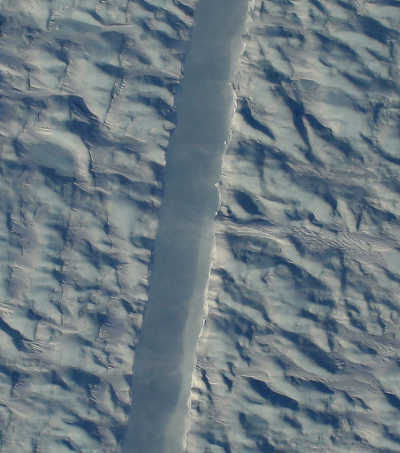
It was the most ambitious spring campaign in the region for NASA’s Operation IceBridge, an airborne mission to monitor ice changes at Earth’s poles, which also included a rapid-response flight over a new crack in Petermann Glacier, one of the largest and fastest-changing glaciers in Greenland.
“This has easily been our best year ever for surveying sea ice,” said Nathan Kurtz, IceBridge’s project scientist and a sea ice researcher at NASA’s Goddard Space Flight Center in Greenbelt, Maryland. “Geographically, we covered a wider area than ever before, and the new instruments we deployed during this campaign have given us denser and more accurate measurements.”
IceBridge explored for the first time the Eurasian half of the Arctic Basin through two research flights departing from Svalbard, a Norwegian archipelago in the northern Atlantic Ocean. The mission also took measurements of a recently formed crack on the ice shelf of Petermann Glacier.
This Arctic season, IceBridge completed all of its sea and land ice baseline flights –surveys that are repeated year after year to measure regions that have been evolving rapidly over the last decades. In total, the mission carried out 39 eight-hour flights in 10 weeks.
Of those, 13 focused on surveying sea ice, while the remaining 26 flights targeted land ice. Several flights included collaborations with international Ice, Cloud and land Elevation Satellite (ICESat) missions teams to collect and compare measurements of snow and ice.
The largest one was with CryoVEx, a campaign dedicated to validating data gathered by ESA’s (the European Space Agency) CryoSat-2 satellite, but IceBridge also coordinated data collection with a group of European adventurers collecting snow depth data while doing a traverse toward the North Pole, with ESA’s Sentinel-3A satellite, and with a GPS survey near Summit Station, Greenland, designed to validate future measurements by the upcoming Ice, Cloud, and land Elevation Satellite-2 (ICESat-2) mission, among other collaborations.
IceBridge's first research flight took place on March 9 onboard NASA’s Wallops Flight Facility’s P-3 Orion aircraft. As with every year, the first part of the campaign was dedicated to overflying the Arctic Ocean’s sea ice cover, plus several fast-changing land ice areas from two sites: Thule Air Base in northwest Greenland and Fairbanks, Alaska.
But this campaign, the IceBridge team added an extra base: Longyearbyen, Svalbard. From there, the mission was able to reach areas of the Eurasian side of the Arctic Ocean that had not been explored by IceBridge before.
While analyzing preliminary data, Kurtz said that he was intrigued to see that the layer of snow on sea ice in the Eurasian side of the Arctic is currently thinner than what snow depth climatology models based on older measurements predict.
“The new snow measurements will help better understand changes in the Arctic sea ice cover and help constrain satellite measurements to make sure they’re accurate,” Kurtz said.
IceBridge also expanded its scope westward with a flight to the western side of the Chukchi Sea, a sea situated between Alaska and Russia. It was the first time the mission ever crossed the International Date Line.
In mid-April, the IceBridge team was alerted to a crack on the floating ice shelf of Petermann Glacier. Stef Lhermitte, an associate professor at Delft University of Technology in the Netherlands, had just discovered the rift while going through satellite imagery.
Lhermitte wrote about his observations on Twitter and the NASA manager for the cryospheric sciences program learned about the tweets. Serendipitously, IceBridge was then planning on flying one last mission over Petermann.
“The day before the flight, we worked late into the evening to redesign our Petermann flight plan to overfly the new rift according to the coordinates Stef [Lhermitte] sent us,” said John Sonntag, IceBridge mission scientist. “This achievement was only possible because of the long-standing culture of international scientific openness and cooperation. IceBridge and other NASA missions, which make their data freely available to all comers worldwide, go a very long way to perpetuate and strengthen this culture.”
The new rift intrigues scientists because it is much further upstream from the glacier's front than other cracks, which could create a large iceberg when it finishes tearing through the ice and potentially make the ice shelf and the glacier it buttresses unstable. Whether this happens or not, the new measurements of the rift IceBridge collected will help researchers better understand the evolution of cracks.
“Getting fresh data on this newly developed rift is exciting. Because it’s so new, we’ll have a better handle on its evolution,” said Joe MacGregor, IceBridge deputy project scientist and glaciologist at Goddard. “I look forward to seeing what comes out of these measurements.”
The final part of the campaign was based in Kangerlussuaq, in west Greenland, and focused on land ice.
As with every Arctic campaign, IceBridge hosted a teacher from the Arctic Research Consortium of the United States’ PolarTREC program. This year, the participant was Adeena Teres, a science teacher at Stoneman Douglas High School in Parkland, Florida.
Teres wrote a blog on her IceBridge experience and participated in live chats from the airplane with K-12 classes across the U.S. In total, the IceBridge team conducted 65 classroom chats from the P-3 and from the ground during this campaign that reached 1414 students in 14 U.S. states, plus Mexico and Canada.
This summer, IceBridge will carry out two additional campaigns to gauge how the melt season impacts Arctic sea and land ice. The first survey will take place in late July and will be based out of Thule, focusing on the multi-year sea ice cover north of Greenland and in the Canadian Archipelago.
The second one, starting in early September, will operate from Kangerlussuaq and replicate land ice missions that IceBridge completed this spring. Both campaigns will use smaller planes with a more limited set of instruments than the regular springtime flights.
The mission of Operation IceBridge is to collect data on changing polar land and sea ice and maintain continuity of measurements between ICESat missions. The original ICESat mission ended in 2009, and its successor, ICESat-2, is scheduled for launch in 2018.
Operation IceBridge is currently funded until 2019. The planned overlap with ICESat-2 will help scientists validate the satellite’s measurements.
For more about Operation IceBridge, visit: http://www.nasa.gov/icebridge .
Maria-José Viñas works for NASA’s Goddard Space Flight Center, Greenbelt, Md.
Driving near Monterey, Calif., recently, I stopped at a roadside stand to buy some freshly-picked strawberries.
May is high season for California strawberries, and the fields were exploding with beautiful, ripe fruit.
The gentleman working the stand, Jack, asked what I do for a living. When I told him I work for Medicare, he said he was having difficulty paying for his prescription drugs. So we talked for a while about ways he might be able to reduce his drug costs.
If you have Medicare and you’re having trouble paying for prescription drugs, signing up for Medicare’s Part D prescription drug coverage may help, even if you have to pay a late-enrollment penalty.
There are other ways you may be able to save. Consider switching to drugs that cost less. Ask your doctor if there are generic, over-the-counter, or less expensive brand-name drugs that could work just as well as the ones you’re taking now.
Switching to lower-cost drugs can save you hundreds or possibly thousands of dollars a year. Visit the Medicare Plan Finder at www.medicare.gov/find-a-plan to get information on ways to save money in your Medicare drug plan. Or call 1-800-MEDICARE (1-800-633-4227) and ask our customer service representatives.
You may also be able to lower your Medicare prescription drug costs by:
· Exploring national- and community-based programs that may help you with your drug costs, like the National Patient Advocate Foundation or the National Organization for Rare Disorders. Get information on federal, state, and private assistance programs in your area on the Benefits Check Up Web site at www.benefitscheckup.org . The help you get from some of these programs may count toward your true out-of-pocket (TrOOP) costs. TrOOP costs are the expenses that count toward your Medicare drug plan out-of-pocket expenses – up to $4,950 in 2017. These costs determine when your catastrophic coverage will begin.
· Looking into Manufacturer’s Pharmaceutical Assistance Programs (sometimes called Patient Assistance Programs) offered by the makers of the drugs you take. Many major drug manufacturers offer assistance for people enrolled in a Medicare drug plan.
Find out whether the manufacturers of the drugs you take offer assistance by visiting www.medicare.gov/pharmaceutical-assistance-program or calling 1-800-MEDICARE (1-800-633-4227). TTY users should call 1-877-486-2048. Such assistance programs aren’t part of Medicare Part D, so any help you get from this type of program won’t count toward your TrOOP costs.
· Applying for Extra Help paying for your Medicare prescription drugs. If you have Medicare and have limited income and resources, you may qualify for Extra Help. To apply for Extra Help, contact Social Security by visiting www.socialsecurity.gov or by calling 1-800-772-1213. TTY users should call 1-800-325-0778. Extra Help can save you thousands of dollars on drug costs.
If you need help finding resources like the ones described above, call your State Health Insurance Assistance Program (SHIP) and ask for free personalized counseling for people with Medicare.
To get the phone number for your state’s SHIP, visit www.shiptacenter.org , or call 1-800-MEDICARE.
And if you’re wondering whether Jack charged me for the strawberries, he did offer them for free. But since helping people with Medicare is a big part of my job, I told him I preferred to pay despite his kind offer.
We settled on a fair price, along with some freshly baked shortcake.
Greg Dill is Medicare’s regional administrator for Arizona, California, Hawaii, Nevada, and the Pacific Territories. You can always get answers to your Medicare questions by calling 1-800-MEDICARE (1-800-633-4227).
WASHINGTON, DC – On Friday, Reps. Mike Thompson (D-CA-05), Gregg Harper (R-MS-03), Diane Black (R-TN-06), and Peter Welch (D-VT-AL) introduced two pieces of bipartisan legislation to expand access to telehealth services under Medicare.
Rural and underserved communities often struggle with inadequate access to health care due to provider shortages and lack of resources. Metropolitan areas can face similar challenges because of urban isolation and cultural barriers.
The representatives introduced a package of bills to combat these issues and improve access to care by taking advantage of ongoing advancements in telemedicine.
The Medicare Telehealth Parity Act and CONNECT for Health Act of 2017 would expand the list of providers eligible to provide telehealth services, remove geographic barriers to telehealth care, and expand the services eligible to be offered via telehealth.
The bill would also allow remote patient monitoring for patients with chronic conditions, allowing them to more easily receive in-home dialysis, hospice care, home health services, tele-stroke services, and eligible outpatient mental health services.
“Telehealth saves lives and reduces costs; it’s a win-win for both patients and providers,” said Thompson. “We’ve all seen how technology has made us more connected in our daily lives. These same advances allow physicians to provide more patients with better health care – especially patients in rural, difficult-to-access, and underserved communities. Unfortunately, regulations haven’t kept pace with the times. These commonsense, bipartisan policies will allow us to make sure every American gets the best care and the best treatment – no matter where they live. The Caucus will give us a venue to collaborate with our interested colleagues to advance the delivery of care via telemedicine.”
“With an aging population that is placing an unprecedented demand on the health care delivery systems, there is a growing need for finding alternative solutions to deliver quality and affordable health care to underserved and rural areas, like my home state of Mississippi,” said Harper. “This quality, bipartisan legislation will help reshape the way we think about access to health care in Mississippi and throughout our country and will contribute to the twenty-first century innovations that will bring down costs and tighten the access gap for those who need it most. I am honored to continue to work with Reps. Mike Thompson, Diane Black, and Peter Welch on these important issues.”
“My many years as a nurse, especially my time spent working in long term care, taught me that if Medicare is to provide real benefit to seniors while ensuring real efficiency for taxpayers, it must embrace the advances in technology and innovation that are already taking place across the health care sector.” said Black. “That is what telehealth is all about – promoting cost savings and quality care through the use of technology like remote patient monitoring services. Harnessing the power of telemedicine is a win for seniors, a win for providers, a win for taxpayers, and a win for rural Tennessee.”
“All Americans need access to quality, affordable health care no matter where they live. Federal policy must keep pace with advancements in telemedicine technology,” Welch said. “Our caucus will strongly advocate for the expansion of cost effective and convenient telehealth services that ensure access to quality health care in rural America.”
The Medicare Telehealth Parity Act would phase in the expansion of telehealth services by:
– Removing the geographic barriers under current law and allow for the provision of telehealth services in rural, underserved, and metropolitan areas.
– Expanding the list of providers and related covered service that are eligible to provide telehealth services to include respiratory therapist, physical therapist, occupational therapist, speech language pathologist, and audiologist.
– Expanding access to telestroke services, regardless of where the patient is located.
– Allowing remote patient monitoring (RPM) for patients with chronic conditions such as heart failure, chronic obstructive pulmonary disease (COPD) and diabetes.
– Allowing the beneficiary’s home to serve as a site of care for home dialysis, hospice care, eligible outpatient mental health services and home health services.
The CONNECT for Health Act of 2017 would:
– Expand originating sites for telehealth care.
– Create a Medicare Remote Patient Monitoring benefit for certain high-risk, high-cost patients.
– Lift restriction on the use of telehealth in Accountable Care Organizations, and Medicare Advantage.
– Urge the Secretary of Health and Human Services to evaluate the applicability of telehealth in projects before the Center for Medicare and Medicaid Innovation.
– Authorize a study on the use of telehealth services once restrictions have been lifted.
Thompson, Harper, Black and Welch also announced the formation of the Congressional Telehealth Caucus.
This bipartisan group will discuss how best to improve remote care to Americans who need it most.