NORTHERN CALIFORNIA – Although they’re both “wasps,” there are some significant differences between yellow jackets (Vespula sp.) and paper wasps (Polistes sp.) – even though we non-entomologist folks may often confuse the two.
Unlike the irritable yellow jackets, you might actually want to keep those more docile paper wasps around (unless you’re allergic to them).
Both yellow jackets and many species of paper wasps are black and yellow, but the paper wasps also come in a rusty-red and yellow variation.
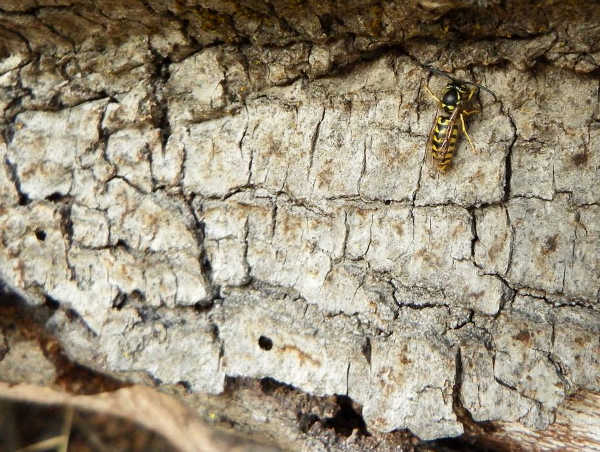
Paper wasps’ wings are narrower and have more of a black tinge to them than the yellow jackets, and side-by-side comparisons also show that the yellow jackets are stouter and thicker and rather look like “thugs” beside the more elongated and narrow-wasted paper wasps.
Another way to tell the species apart is by watching them in flight: Yellow jackets tend to hold their legs up when they’re flying while Paper Wasps let their long legs dangle down and trail behind them.
Bear in mind that the females of both species can sting you. (The stinger is actually an adapted ovipositor, so only the females sting.)
The yellow jacket is far touchier about intruders and far more aggressive than the paper wasp and often attack en masse.
That yellow-and-black insect invading your trash can or picnic is most likely a yellow jacket. They have a varied diet that consists of anything from fruit, to nectar and tree sap, to insects, to human food and garbage – and this sometimes gives way to their erroneous nickname: “meat-eating bees.”
Yellow jackets aren’t bees, of course, and unlike bees, they will go after human sources of food when there isn’t enough nectar or insects around them to feed to their larvae.
They’ll often try to take over picnic foods, garbage, and roadkill carcasses looking for sources of protein and sugar… and they will violently defend any food source they find. This can lead to lots of painful interactions between yellow jackets and humans. And unlike honey bees who lose their stingers after a single strike, yellow jackets can sting repeatedly.
This queen paper wasp built the first section of her nest completely by herself. It’s only after the larvae (show inside the chambers) grow to adults that she has help increasing the side of her nest and tending to more offspring. Paper wasps are generally not as aggressive as yellow jackets. This queen let the photographer get to within inches of her nest (as long as she didn’t touch it). Photo by Mary K. Hanson.
Paper wasps, on the other hand, are far less belligerent, and usually only sting if their nest or they themselves are being physically mishandled. They also generally stick to insect prey, and have them with a side nectar.
These are the wasps that can actually be boon to your backyard – keeping the insect populations down as they feed their young. And they’re great pollinators, too.
Where and how these flying creature build their nests also varies. Both paper wasp and yellow jacket nests are made of “paper,” the chewed up pulp of plant material that is bound together with the insect’s own saliva and then laid out in specific forms.
Each nest construction is started by a single queen who does all of the work herself – building the foundation and the first egg chambers, laying the eggs, feeding and nurturing the larvae – until the first generation of offspring hatches and becomes her personal labor force, helping her enlarge the nest and her colony.
Yellow jackets tend to build massive structures (that can hold up to 5,000 workers and 15,000 chambers) and prefer to build underground, although they will also sometimes build the nests in buildings or trees, like hornets do, if the conditions are right.
The yellow jacket nest usually consists of multiple “hanging chandeliers” of egg repositories built layer upon layer, something like a wasp condo with many different floors. Then the whole thing is covered with a paper shell to conceal the floors and chandeliers inside of it.
Paper wasps, on the other hand, usually build their much smaller nests under overhangs or in tight corners (usually with only about 100 chambers in them). Each nest usually consists of only one “chandelier” (or “umbrella”) of egg repositories, and is open to the air (without the paper covering the Yellow Jackets use.)
For both yellow jackets and paper wasps, each nest, regardless of its size, is vacated in the winter when all but the queens die off.
Mated queens overwinter by hibernating (usually in the ground or some other “hibernaculum” like a crevice in a tree or building) and then emerge in the spring.
Regardless of how successful their previous nest was, the queens of both species will ignore their old nests and build brand new ones each year.
So, once the colony has died off and the queen has vacated the premises, the nests are safe to handle.
The next time you’re outside and see a yellow-and-black wasp flying around, take a closer look. Is it a yellow jacket or a paper wasp?
Mary K. Hanson is a Certified California Naturalist, author and nature photographer. She will be co-teaching a naturalist course for the public through Tuleyome in early 2018. Tuleyome is a501(c)(3) nonprofit conservation organization based in Woodland, Calif. For more information visit www.tuleyome.org.
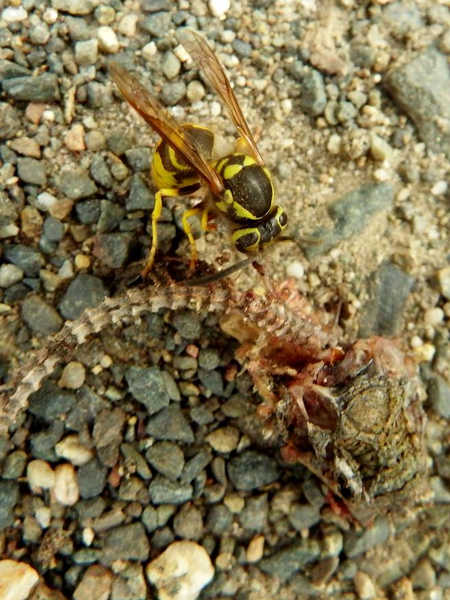
Yellow jackets are often erroneously referred to as “meat-eating bees,” but they’re not bees at all, of course, they are wasps. This worker is gathering tidbits of protein from the carcass of a lizard to take back to its nest and feed to the larvae there. Photo by Mary K. Hanson.
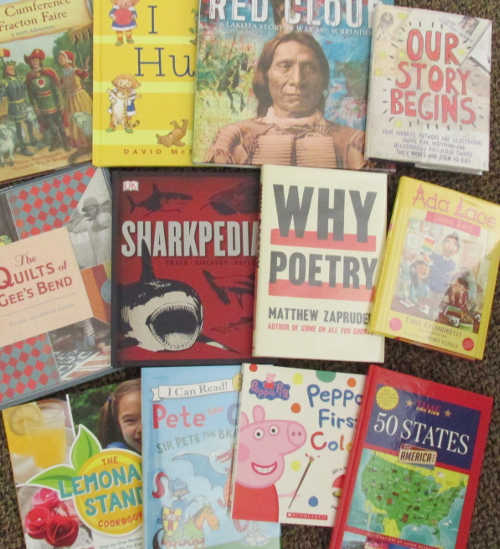
Middletown Library’s children’s collection will be greatly enhanced by a $10,000 donation from the Friends of Middletown Library in Middletown, Calif. Courtesy photo. LAKEPORT, Calif. – The public is invited to celebrate all the new books purchased for the Middletown Library with a generous $10,000 donation from the Friends of Middletown Library.
The New Books Party will happen Tuesday, Sept. 19, from noon to 4 p.m. at the Middletown branch of Lake County Library, located at 21256 Washington St.
The party will feature games, prizes, music, snacks and, of course, books.
From the donated funds $2,000 will be allocated for juvenile picture books, $2,000 for juvenile chapter books, $2,000 for juvenile nonfiction, $3,000 for young adult books, and $1,000 for audiovisual materials.
The group has donated thousands of dollars for various library needs, but this time they wanted to earmark their gift to the children of Middletown and to give a substantial gift that would really make a difference.
The goal was to raise $5,000 that the group would then match, so that the Friends would donate $10,000 for books and other materials.
The Board of Supervisors accepted the donation on behalf of the library on Aug. 8, as Lake County News has reported.
"Technology can be our best friend, and technology can also be the biggest party pooper of our lives. It interrupts our own story, interrupts our ability to have a thought or a daydream, to imagine something wonderful, because we're too buys bridging the walk from the cafeteria back to the office on the cell phone."– Steven Spielberg
LAKE COUNTY, Calif. – The amazing device we all depend on today, for so many tasks – the telephone, was no less important in the 19th century, albeit in a much different way.
Phones of yesteryear required a switchboard to operator, and operators – human beings who were hired to help make your telephone connections.
According to the display in Lakeport's Courthouse Museum: “In 1878, the first manual telephone switching board was introduced in New Haven, Connecticut. This allowed many phones to be connected through a single exchange. With this invention, exchanges opened up rapidly all over the country. The first operators were teenage boys, who turned out to be impatient, rude, (often swearing at subscribers), and full of pranks, including disconnecting customers and misdirecting their calls. When bored, they would whittle away at the wooden switchboards.... Within a few years the boys were completely replaced by women, who proved to be calm and gracious with the subscribers. Their quiet voices, deft fingers and patient courtesy and attentiveness were precisely what the telephone company required in its attendants."
Telephone exchange service for the public came about, as many inventions do, in a roundabout way.
It happened that a man in Boston called E.T. Holmes (Could that be where the phrase originated in the movies, "E.T. phone home"?), whose father was an inventor who designed protection for property that utilized electric wires. Holmes decided to connect telephones to a wire inside the alarm office, then, later discovered that he could connect six telephones all in a row, which then led to the home telephone service.
In the time around the 1890s a device called a drop magneto switchboard was in use.
Drop magneto boards did not allow for much in the way of a private telephone call, since the operators often knew people by their voices, and sometimes even knew your schedule and whether or not you were home!
Then, the wooden wall phone was cranked by turning the crank on the magneto and a current that ran the distance of the line would ring and drop a small metal plate that identified the caller and her telephone number.
After the small plate fell, an operator would then plug a cord into the jack for that specific person.
Next, the operator would ring the phone, and after it was answered, the conversation could commence.
It wasn't long before “the telephone story” carried on and on with many different styles of telephones over the decades, leading eventually to your pocket cell phone that can do everything but wash the dishes!
Kathleen Scavone, M.A., is a retired educator, potter, writer and author of “Anderson Marsh State Historic Park: A Walking History, Prehistory, Flora, and Fauna Tour of a California State Park” and “Native Americans of Lake County.” She also formerly wrote for NASA and JPL as one of their “Solar System Ambassadors.” She was selected “Lake County Teacher of the Year, 1998-99” by the Lake County Office of Education, and chosen as one of 10 state finalists the same year by the California Department of Education.
A drop magneto switchboard at the Courthouse Museum in Lakeport, Calif. Photo by Kathleen Scavone.
Caltrans and the California Department of Fish and Wildlife remind motorists to remain alert for wildlife on roadways during Watch Out for Wildlife Week, which runs Sept. 18 to 24.
"Drivers can improve their own safety by simply slowing down and remaining alert while driving," said Caltrans Director Malcolm Dougherty. "We are committed to safety while being mindful of the environment, using signage, fencing and undercrossings to reduce wildlife-vehicle collisions along roadways, especially in wildlife corridors."
"Between now and December, deer and other wildlife are more susceptible than usual to vehicle collisions," said Marc Kenyon, CDFW's Human-Wildlife Conflict Program manager. "Soon, deer will start their annual migrations to winter range, bucks will be preoccupied competing for mates, and bears will be searching for food in preparation for hibernation. Such natural behaviors can lead these animals into the way of unsuspecting drivers. Drivers can prevent collisions with animals by being careful and paying attention."
Wildlife experts offer the following tips for motorists:
- Be especially alert when driving in wildlife areas, and reduce your speed so you can react safely. - Pay particular attention when driving during the morning and evening, as wildlife are most active during these times. - If you see an animal cross the road, know that others may be following. - Don't litter. The odors may entice animals to venture near roadways.
The Watch Out for Wildlife campaign is supported by Caltrans, CDFW, Defenders of Wildlife, and the Road Ecology Center at the University of California, Davis.
NASA's Mars rover Curiosity has begun the steep ascent of an iron-oxide-bearing ridge that's grabbed scientists' attention since before the car-sized rover's 2012 landing.
"We're on the climb now, driving up a route where we can access the layers we've studied from below," said Abigail Fraeman, a Curiosity science-team member at NASA's Jet Propulsion Laboratory in Pasadena, Calif.
"Vera Rubin Ridge" stands prominently on the northwestern flank of Mount Sharp, resisting erosion better than the less-steep portions of the mountain below and above it. The ridge, also called "Hematite Ridge," was informally named earlier this year in honor of pioneering astrophysicist Vera Rubin.
"As we skirted around the base of the ridge this summer, we had the opportunity to observe the large vertical exposure of rock layers that make up the bottom part of the ridge," said Fraeman, who organized the rover's ridge campaign. "But even though steep cliffs are great for exposing the stratifications, they’re not so good for driving up."
The ascent to the top of the ridge from a transition in rock-layer appearance at the bottom of it will gain about 213 feet (65 meters) of elevation – about 20 stories.
The climb requires a series of drives totaling a little more than a third of a mile (570 meters). Before starting this ascent in early September, Curiosity had gained a total of about 980 feet (about 300 meters) in elevation in drives totaling 10.76 miles (17.32 kilometers) from its landing site to the base of the ridge.
Curiosity's telephoto observations of the ridge from just beneath it show finer layering, with extensive bright veins of varying widths cutting through the layers.
"Now we'll have a chance to examine the layers up close as the rover climbs," Fraeman said.
Curiosity Project Scientist Ashwin Vasavada of JPL said, "Using data from orbiters and our own approach imaging, the team has chosen places to pause for more extensive studies on the way up, such as where the rock layers show changes in appearance or composition. But the campaign plan will evolve as we examine the rocks in detail. As always, it's a mix of planning and discovery."
In orbital spectrometer observations, the iron-oxide mineral hematite shows up more strongly at the ridge top than elsewhere on lower Mount Sharp, including locations where Curiosity has already found hematite.
Researchers seek to gain better understanding about why the ridge resists erosion, what concentrated its hematite, whether those factors are related, and what the rocks of the ridge can reveal about ancient Martian environmental conditions.
"The team is excited to be exploring Vera Rubin Ridge, as this hematite ridge has been a go-to target for Curiosity ever since Gale Crater was selected as the landing site," said Michael Meyer, lead scientist of NASA's Mars Exploration Program at the agency's Washington headquarters.
During the first year after its landing near the base of Mount Sharp, the Curiosity mission accomplished a major goal by determining that billions of years ago, a Martian lake offered conditions that would have been favorable for microbial life.
Curiosity has since traversed through a diversity of environments where both water and wind have left their imprint.
Vera Rubin Ridge and layers above it that contain clay and sulfate minerals provide tempting opportunities to learn even more about the history and habitability of ancient Mars.
LAKE COUNTY, Calif. – It has been 24 months since California’s third-most damaging fire, the Valley fire, swept through the Lake County communities of Cobb, Middletown and Hidden Valley.
More than 1,300 residences were lost in the Valley fire and homeowners were immediately faced with a myriad of duties and tasked outside of ordinary day-to-day life – filing insurance claims, finding temporary housing, rebuilding, replacing lost items, and trying to bring some semblance of order to their lives.
Parents were overwhelmed with the countless administrative duties to rebuild their lives, but school-aged children were faced with their own disruptions, including school closures that lasted two weeks.
“The impacts of natural disasters are not just economic,” said Superintendent of Schools Brock Falkenberg of the Lake County Office of Education. “The psychological impacts can persist for years. Not only are disasters themselves stressful and frightening, but children can experience psychological struggles due to the damage to their homes and possessions; from seeing parents, caregivers and/or the community undergo stress; and from breakdowns in social networks, neighborhoods, and local economies.”
This is where the Healthy Start program stepped in to help Lake County students deal with the stressors from the 2015 Valley fire – in particular, Wendy Gattoni, Lake County Office of Education employee assigned to serve as the Healthy Start Family Advocate for the Middletown Unified School District.
“Middletown Unified was blessed to have Healthy Start, and Wendy Gattoni in particular, working with us after the Valley fire,” said Middletown Unified Superintendent Catherine Stone. “Wendy was invaluable not only for us, but for all of the families she worked with. She helped put the pieces back together for so many students and their families. She provided a wealth of resources, a shoulder to lean on, and a deep well of caring and connection for all she touched.”
Healthy Start is a statewide initiative placing comprehensive support services for children and families at individual school sites.
It gives schools, in partnership with public and private service providers, an opportunity to restructure systems to better meet the needs of children and families, and has been operating successfully in Lake County for over 20 years.
Healthy Start is funded by the Lake County Office of Education, School Districts, First 5, the Lake County Department of Social Services and the Lake County Department of Behavioral Health.
It’s received national recognition for its Oral Health Program and Family Positive Results & Outcomes program. It’s also known for its foster youth services and its nurturing families parent education programs, and provides numerous other services for low-income, homeless, and at-risk youths in Lake County.
Although Healthy Start predominately serves at-risk youth, after the Valley fire, many families not typically familiar to using Healthy Start services, were immediately considered “at-risk.”
Ana Santana, the director of Healthy Start, explained the difference between Lake County’s social service programs and Healthy Start. “Social Work enables children, adults, families, groups and communities to function, participate and develop in society. Healthy Start has an academic focus which enables children to function, participate and develop in school.”
Gattoni, who has worked for the Lake County Office of Education serving as the Healthy Start Family Advocate for Middletown Unified for many years, has an office located on the Middletown Middle School campus.
The location became a base for numerous site visits to shelters and temporary housing during the Valley fire.
Gattoni and other members of the Healthy Start team provided services to 260 students, many that Gattoni had known throughout her tenure at Healthy Start.
She was a friendly, well-known face who had an established connection with many of the Valley fire survivors. She provided consistency to students and their families in an ever-changing situation.
Initially separated from her own family during the onset of the Valley fire, Gattoni was able to meet up her husband and daughter in Calistoga at the Red-Cross shelter at the Napa County Fairgrounds, where they spent nine days hearing reports that their own home had burned to the ground. It did not.
Gattoni explained, “When we were able to leave the shelter, and the schools re-opened we had to hit the ground running. The first thing we needed to do was coordinate with all the schools to see who needed help. We become a hub for basic needs. There was such a need for so many things.”
Students were immediately faced with the loss and routine that their homes and schools provided. They were also faced with the instant need of clothing, toiletries and school supplies. The Healthy Start program helped made sure these needs were met.
Members of the Healthy Start team worked with families at the local assistance centers to help families replace birth certificates and get signed up for other social service programs.
They also worked as liaisons with the families to the numerous local, state and federal agencies involved in the recovery efforts.
Although Gattoni is not bilingual herself, she was able to go to the Federal Emergency Management Agency with a Spanish-speaking family and clear up a simple misunderstanding, allowing the family to get the services they needed.
“It was a simple task that yielded great results,” said Gattoni.
The Hidden Valley Lake Campground became a home to numerous Middletown Unified students in the aftermath of the Valley fire.
Gattoni would arrive home after work and take care of the needs of her own family, only to leave again to visit the campground in the evening to make sure Valley fire survivors were okay and their needs were being met.
“When the weather changed and it started raining, I needed to get the families rain ponchos. Simple things that were really important,” said Gattoni.
Although it’s been two years since the Valley fire, Gattoni said she still sees students dealing with the effects of it.
“Over the last few weeks, I’ve seen several students who have concerns about the smoke blowing in from Southern Oregon and the Northern California fires. I let them know that everything is okay and they are safe,” Gattoni said.
“Now, two years past the Valley fire, Wendy continues this important work in this community,” Stone said. “She is still helping families who were impacted by the fire, and helps maintain the strong home-school connection for those she serves. We are so thankful that we have Healthy Start and Wendy.”
“There are families out there who still do not have a home of their own. But the students are resilient. They are thriving,” Gattoni said.
Healthy Start is a program offered to Lake County students and their families, through the Lake County Office of Education.
The program offers a wide variety of services that focus on supporting academic success, and building personal strengths for children, youth and families.
The program assists students so they can come to school ready to learn.
For more information on this program, please go to www.lakecoe.org and search for “Healthy Start.”
 How to resolve AdBlock issue?