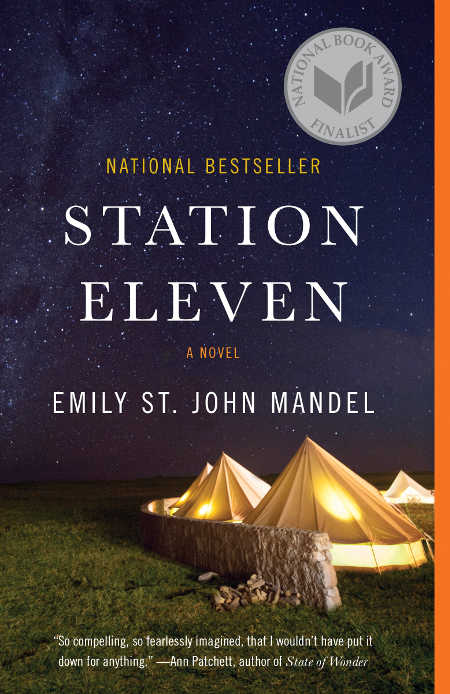
Free copies of the Big Read’s “Station Eleven” by Emily St. John Mandel are available at Lake County Library branches and at Big Read events in October 2017 while supplies last. See www.lakecountybigread.com to sign up and to learn more about the Big Read in Lake County, Calif. Courtesy photo.
LAKE COUNTY, Calif. – All during October the NEA Big Read in Lake County will feature “Station Eleven” by Emily St. John Mandel.
The NEA Big Read is a communitywide reading program where community members are all encouraged to read and discuss the same book.
The public is invited to join the Lake County Library’s Big Read to discuss Mandel’s post-apocalyptic novel that examines life and death, faith and fate, music and drama, arts and technology, and power and control.
Recurring images from the book include graphic novels, Shakespeare, classical music, tattoos and museums.
Free copies of the book will be available at all four Lake County Library branches beginning Sept. 26 and at Big Read events in October while supplies last.
Free versions of “Station Eleven” are available for download on the library’s online catalog as well as print and audio copies.
Learn more about the book selection and planned events, and sign up for the Big Read email updates on the Web site, www.lakecountybigread.com.
A century ago the Spanish Flu killed 3 to 5 percent of the world’s population. Seven centuries ago the Black Death killed 30 to 60 percent of Europe’s population, disturbing society’s balance for generations.
Now imagine what might happen if a plague were to kill 99 percent of humanity, if only 650 people remained in Lake County or only 40,000 in California.
What of our culture and knowledge would survive in such a time? What skills would people have to re-learn if modern commerce and production cease to exist? What would it mean to be human in a world with so few people?
Author Emily St. John Mandel imagined such a world in “Station Eleven,” her post-apocalyptic novel which is centered on the theme “survival is insufficient.”
“Station Eleven” is a haunting, elegiac novel about the events preceding and after a pandemic destroys civilization as we know it.
Shifting back and forth in time and viewing events from multiple perspectives, it primarily follows a Shakespeare troupe that travels by horse and buggy.
The performers survive by performing for the small towns and outposts that have formed in the 20 years that have passed since the pandemic devastated society.
With beautiful, insightful prose “Station Eleven” examines the purpose of art, the meaning of survival, and what it means to remember and be remembered.
“Station Eleven” has won many awards including the Arthur C. Clarke Award and the Toronto Book Award. The novel was also a finalist for the National Book Award and the PEN/Faulkner Award.
Mandel found her theme in a bit of dialogue from an episode of the television program “Star Trek: Voyager.” The line, uttered first by Seven of Nine and later by The Doctor, says that it is better to live fully for a short time than to endure an existence devoid of hope and vitality.
NEA Big Read events around Lake County will explore various aspects of “Station Eleven” through visual and written works, musical and stage performances, food, demonstrations of forgotten skills, and more.
All of the Big Read events are free and open to the general public.
On Wednesday, Oct. 4, at 5:30 p.m. Lakeport Library’s Evening Book Club, which is open to the public, will discuss “Station Eleven.” The address is 1425 N. High St. in Lakeport.
Lakeport Library’s Little Read Storytime on Friday, Oct. 6, at 10:15 a.m. will explore themes of art, music and theatre for toddlers and elementary school children as part of the Big Read.
On Oct. 6 from 6 to 8 p.m., the Lake County Arts Council’s First Friday Fling will feature artworks related to Station Eleven and a discussion of the importance of art even in dire times. The Arts Council Gallery is located at 325 N. Main St. in Lakeport. The phone number is 707-263-6658.
Saturday, Oct. 7, will be the Forgotten Skills Fair at the Courthouse Museum, 255 N. Main St. in Lakeport, from 1 to 5 p.m. Local artisans will demonstrate old skills such as spinning yarn, washing clothes on a washboard, butter churning, pottery making, and flint knapping, just like the survivors in “Station Eleven.” This event is free.
A graphic novel is one of the recurring themes of “Station Eleven.” The Middletown Arts Center at 21456 Highway 175 in Middletown will host a free graphic novel and storyboarding workshop for ages 12 and up on Sunday, Oct. 8, noon to 5 p.m.
“Station Eleven” will be the jumping-off point for the workshop projects. Register for the workshop at middletownartcenter.org/resilience.html. Call 707-809-8118 for more details.
“Station Eleven” described the devastating consequences of a worldwide epidemic, a pandemic.
On Wednesday, Oct. 11, from 5:30 to 6:30 p.m. at Lakeport Library learn how your local Public Health department detects and takes action to prevent the spread of disease and what everyone can do to help. Dr. Karen Tait will present this free program.
The culinary program at the Lake County Campus of Woodland College will prepare and sell “survival-camp food”, a delicious venison stew at noon on Tuesday, Oct. 17. Come for lunch and a presentation featuring “Station Eleven.” A Shakespeare skit and an activity that focuses on “more than survival” will follow lunch.
The campus is located at 15880 Dam Rd. Extension in Clearlake. For information call Pamela Bordisso at 707-995-7914.
Middletown Library’s book club will discuss “Station Eleven” on Wednesday, Oct. 18, at 2:30 p.m. The meeting is open to the public at the library, 21256 Washington St.
The Lake County Arts Council’s Poets & Writers group will explore the book’s beautiful poetic prose on Oct. 18 from 6:30 to 8:30 p.m. at the Lake County Arts Council, 325 N. Main St. in Lakeport. The public is invited to this free event. O’Meara Brothers Brewery has created a special beer called “Station Eleven” that will be served at this event.
Two local breweries, O’Meara Brothers Brewing Co. at 901 Bevins St. in Lakeport and Kelsey Creek Brewing Co. at 3945 Main St. in Kelseyville have created “Station Eleven” brews in honor of the Lake County Big Read.
The Soper Reese Theatre at 275 S. Main St. in Lakeport will host “Traveling Symphony: Shakespeare from ‘Station Eleven’,” a free afternoon of music and Shakespeare on Saturday, Oct. 21, from 2 to 4 p.m. Members of the Lake County Symphony will perform a variety of musical selections and the Shakespeare in the Park troupe will perform a Shakespeare piece.
On Sunday, Oct. 22, from 2 to 3:30 p.m. at the Lake Center of Mendocino College, 2565 Parallel Drive in Lakeport, join the Big Read’s keynote speaker, novelist, playwright and Mendocino College professor Jody Gehrman in a free facilitated discussion, “Because Survival is Insufficient: A Community Discussion of ‘Station Eleven’ and Why we Persist with this Crazy Thing called Art.” Add your thoughts as they explore this beautifully constructed love letter to art, theatre and our persistent need to create.
On Wednesday, Oct. 25, from 5 to 6:30 p.m. Lakeport Library will screen “Survival Instinct”, the episode of “Star Trek: Voyager” that inspired Emily St. John Mandel to create “Station Eleven.”
In “Station Eleven” the motto of the traveling Shakespeare troupe is “Survival is Insufficient” which is a quote from an episode of “Star Trek: Voyager.” Come watch “Star Trek: Voyager” for free at the library and explore what it means for survival to be “insufficient.”
The Redbud Library Book Discussion of “Station Eleven” will happen on Oct. 25 at 5 p.m. at the library, 14785 Burns Valley Road in Clearlake. The free discussion is open to all.
“Surviving the Apocalypse: Fact and Fiction” will be the topic on Saturday, Oct. 28, at 2 p.m. at Lakeport Library when Tammy Carter of Sutter Lakeside Hospital’s Infectious Disease Division helps sort out fact from fiction while discussing the pandemic that forever alters civilization in “Station Eleven.”
Join Susan Krones and county librarian Christopher Veach Oct. 28 at 4 p.m. for an on-air discussion of “Station Eleven” in a special Big Read edition of “Book Ends” on KPFZ Community Radio 88.1 FM.
A program of the National Endowment for the Arts, the NEA Big Read broadens our understanding of our world, our communities, and ourselves through the joy of sharing a good book.
Lake County Library is one of 77 nonprofit organizations across the country to receive a grant to host an NEA Big Read project between Sept. 1, 2017, and June 30, 2018.
Lake County Library is hosting the NEA Big Read with the help of the following partners: Lake County Friends of Mendocino College, Friends of the Mendocino College Library, Lake County Office of Education, Lake County Campus Woodland Community College, KPFZ 88.1FM Lake County Local Radio, the Lake County Museums, Lake County Arts Council, Middletown Art Center, Sutter Lakeside Hospital, O’Meara Brothers Brewing Company and Kelsey Creek Brewing Co.
Jan Cook is a technician with the Lake County Library.
"Jack and Jill went up the hill to fetch a pail of water."– Traditional English nursery rhyme
LAKE COUNTY, Calif. – Lake County is renowned for its wild landscape with an abundance of flora and fauna.
Our lands are home to a wide variety of fauna, including bear, deer, elk, mountain lion, bobcat and smaller creatures like grey squirrel, ground squirrel and the ever-present jackrabbit.
The jackrabbit that makes its home here is the black-tailed jackrabbit.
That being said, a jackrabbit is actually a hare, which is not a rabbit, but a relative within the order Lagomorpha.
An outstanding difference between a hare and a rabbit is that a hare will freeze in place when threatened, while a rabbit will make a bee-line to its burrow to escape a predator.
The still-life pose that the hare assumes lasts until its attacker gets too close for comfort. Then, the hare will make use of its gangly-looking long legs which are truly lithe and nimble, and it will swerve and outmaneuver – if it's lucky – its attacker.
These remarkable animals often hop for 5 to 10 feet, rather than walk. During its fourth or fifth jump, it often hops higher to observe its surroundings.
If a predator, such as a fox, coyote, raptor or bobcat is on the prowl the jackrabbit can reach a speed of up to 35 miles per hour!
When threatened, it shows off its white, furry underside and sometimes thumps its hind feet, possibly as a warning to other jackrabbits that danger is nearby.
Both the jackrabbit female, known as a jill, along with the male, known as a jack, have long, satellite antennae-like ears – the better to hear you with!
Jackrabbits have burnished beige fur, speckled with black, and black-edged ears. Jackrabbits grow to reach a length of approximately 2 feet, and weigh in at 3 to 6 pounds.
These wily critters are not the largest of the North American hares, since the antelope jackrabbit, along with the white-tailed jackrabbit hold the distinction of being larger animals.
Breeding season, when they give chase and participate in frenzied skirmishes, is January to August.
It is common for the mammals to give birth to a litter of four young, which are born complete with fur and eyes wide open.
Becoming more active in late afternoon, the black-tailed jackrabbit usually rests, hidden in vegetation during the daylight hours.
Their diet consists mainly of grasses and shrubs. It is in the consumption of all of this plant matter that it obtains enough water to survive, requiring an equivalent water-to-body weight ratio to thrive.
Kathleen Scavone, M.A., is a retired educator, potter, writer and author of “Anderson Marsh State Historic Park: A Walking History, Prehistory, Flora, and Fauna Tour of a California State Park” and “Native Americans of Lake County.” She also formerly wrote for NASA and JPL as one of their “Solar System Ambassadors.” She was selected “Lake County Teacher of the Year, 1998-99” by the Lake County Office of Education, and chosen as one of 10 state finalists the same year by the California Department of Education.
LAKE COUNTY, Calif. – Lake County Animal Care and Control has a group of mostly herding and working dogs available for adoption this week.
This week’s available dogs include mixes of cattle dog, Doberman Pinscher, German Shepherd, heeler, hound, Labrador Retriever, pit bull and terrier.
Dogs that are adopted from Lake County Animal Care and Control are either neutered or spayed, microchipped and, if old enough, given a rabies shot and county license before being released to their new owner. License fees do not apply to residents of the cities of Lakeport or Clearlake.
If you're looking for a new companion, visit the shelter. There are many great pets hoping you'll choose them.
The following dogs at the Lake County Animal Care and Control shelter have been cleared for adoption (additional dogs on the animal control Web site not listed are still “on hold”).
This female heeler puppy is in kennel No. 2, ID No. 8553. Photo courtesy of Lake County Animal Care and Control. Female heeler puppy
This female heeler puppy has a short red and white coat.
She is in kennel No. 2, ID No. 8553.
This female terrier mix is in kennel No. 3, ID No. 8515. Photo courtesy of Lake County Animal Care and Control. Terrier mix
This female terrier mix has a short white coat.
She already has been altered.
Shelter staff said she is deaf.
She is being offered for a low adoption fee.
Find her in kennel No. 3, ID No. 8515.
This female hound is in kennel No. 18, ID No. 8537. Photo courtesy of Lake County Animal Care and Control. Female hound
This female hound has a short tan and white coat.
She is in kennel No. 18, ID No. 8537.
This male German Shepherd is in kennel No. 19, ID No. 8551. Photo courtesy of Lake County Animal Care and Control. German Shepherd
This male German Shepherd has a long black and tan coat.
He’s in kennel No. 19, ID No. 8551.
This male pit bull terrier is in kennel No. 24, ID No. 8516. Photo courtesy of Lake County Animal Care and Control. Male pit bull terrier
This male pit bull terrier has a short white coat with black spots and floppy ears.
Shelter staff said he is offered free for adoption to the first approved applicant.
He’s very people-friendly, and good with medium-sized and large dogs; potential adopters will need to bring in their dogs for a meet and greet. He is not recommended for homes with small dogs or cats.
He’s in kennel No. 24, ID No. 8516.
This male Doberman Pinscher-cattle dog mix is in kennel No. 26, ID No. 8478. Photo courtesy of Lake County Animal Care and Control. Doberman Pinscher-cattle dog
This male Doberman Pinscher-cattle dog mix has a short blue, black, tan and white coat.
He’s in kennel No. 26, ID No. 8478.
This female adult cattle dog is in kennel No. 27, ID No. 8480. Photo courtesy of Lake County Animal Care and Control. Female cattle dog
This female adult cattle dog has a short red coat.
She’s in kennel No. 27, ID No. 8480.
This female cattle dog is in kennel No. 28, ID No. 8479. Photo courtesy of Lake County Animal Care and Control. Female cattle dog
This female cattle dog has a short black and white coat.
She’s in kennel No. 28, ID No. 8479.
This female cattle dog is in kennel No. 29, ID No. 8464. Photo courtesy of Lake County Animal Care and Control. Female cattle dog
This female cattle dog has a short brown coat.
She’s in kennel No. 29, ID No. 8464.
This male cattle dog-hound mix is in kennel No. 31, ID No. 8462. Photo courtesy of Lake County Animal Care and Control. Cattle dog-hound mix
This male cattle dog-hound mix has a short gray coat.
He’s in kennel No. 31, ID No. 8462.
This female cattle dog is in kennel No. 32, ID No. 8476. Photo courtesy of Lake County Animal Care and Control. Female cattle dog
This female cattle dog has a short red coat.
She’s in kennel No. 32, ID No. 8476.
This female Labrador Retriever in kennel No. 33, ID No. 8477. Photo courtesy of Lake County Animal Care and Control. Female Labrador Retriever
This female Labrador Retriever has a short black coat.
She’s in kennel No. 33, ID No. 8477.
Lake County Animal Care and Control is located at 4949 Helbush in Lakeport, next to the Hill Road Correctional Facility.
Office hours are Monday through Friday, 11 a.m. to 5 p.m., and 11 a.m. to 3 p.m., Saturday. The shelter is open from 11 a.m. to 4 p.m. Monday through Friday and on Saturday from 11 a.m. to 3 p.m.
For more information call Lake County Animal Care and Control at 707-263-0278.
Email Elizabeth Larson at This email address is being protected from spambots. You need JavaScript enabled to view it.. Follow her on Twitter, @ERLarson, or Lake County News, @LakeCoNews.
At more than 10 billion miles away from Earth, there is no day and night.
Time and space are fathomless and our Sun is a distant point of starlight – a faint reminder of the home NASA’s twin Voyagers, humanity’s farthest and longest-lived spacecraft, left behind 40 years ago.
Voyager 1, which launched on Sept. 5, 1977, and Voyager 2, launched on Aug. 20, 1977, continue to return data that shape our view and understanding of our place in the universe.
We often think of space as empty, but even the vacuum of space is filled with the remnants of stellar explosions from millions of years ago and dominated by invisible magnetic forces.
Such magnetic forces carve out unique space environments throughout the galaxy, each one like a neighborhood with its own distinct feel.
Voyager has helped scientists define the boundaries of our own stellar neighborhood – which scientists call the heliosphere – by returning observations about the conditions where the Sun’s influence wanes and interstellar space begins.
“Voyager is seeking out our place in the galaxy: How does the solar system interact with the rest of the galaxy and how does that affect us?” said Eric Christian, a space scientist at NASA’s Goddard Space Flight Center in Greenbelt, Maryland. “If anything embodies the spirit of discovery, it’s Voyager.”
Christian served as Voyager program scientist for NASA Headquarters between 2002 and 2008, and continues to do scientific work with the mission.
These questions are key to understanding our own star and enabling human space exploration, but they could also shed light on the workings and potential habitability of other star systems.
The heliosphere is generated by the Sun’s constant outward flow of magnetic solar material, called the solar wind.
This high-speed wind fills the solar system and forms a vast bubble, more than 20 billion miles across, where the space inside is different from space outside.
Within the heliosphere, space is influenced by the dynamic properties of the Sun carried in the solar wind – including magnetic fields, energetic particles and ionized gases called plasma. The Sun and entire heliosphere move through interstellar space, and this relative motion shapes the heliosphere.
Exploring our interstellar backyard
Traveling at speeds of more than 35,000 mph, the Voyagers travel about 900,000 miles farther from Earth each day, a distance equal to roughly 36 times Earth’s circumference.
Five years ago, in August 2012, Voyager 1 crossed the edge of the heliosphere, called the heliopause, venturing for the first time into the space between stars, where no spacecraft had gone before.
The mission has informed researchers that inside the heliosphere, Earth and the rest of the solar system are shielded from cosmic radiation and wisps of hot hydrogen and helium gases composing what’s known as the Local Fluff – a series of massive clouds, each one several light-years wide, of interstellar medium through which the heliosphere is currently traveling.
No longer cocooned by the heliosphere, Voyager 1 is currently exploring our interstellar backyard, measuring one of these clouds and searching the Fluff for clues to our origins, and those of nascent solar systems.
“We’re not in a typical part of the galaxy, if there is a typical part of the galaxy,” Christian said. “We’re in a bubble where multiple supernovas blew up, and it’s amazing to be traveling through that. It would almost make you feel insignificant, if there wasn’t also plenty of things to learn here.”
Studying the nature of space itself
The probes’ planetary instruments were turned off after they passed the outer planets, but a suite of instruments carries out their interstellar mission.
Voyager 1 currently has four working instruments that measure the magnetic fields, charged energetic particles (two instruments are responsible for this) and low-frequency radio waves of its surroundings.
Voyager 2 also has these four, and additionally a working plasma sensor, which directly measures the solar wind.
Day in and day out, both Voyagers constantly beam data back to Earth. This feed of data is only received, however, when NASA’s Deep Space Network locks onto the spacecraft.
The project goal is to acquire at least 16 hours of real-time data per spacecraft each day, but the actual amount of time varies depending on the network’s resources.
Voyager 1, now almost 13 billion miles from Earth, travels through interstellar space north out of the plane of the planets, while Voyager 2, almost 11 billion miles away, travels south and is expected to enter interstellar space in the next few years.
The different locations of the two Voyagers allow scientists to compare two regions of space where the heliosphere interacts with the surrounding interstellar medium.
Once Voyager 2 crosses into the interstellar medium, they will also be able to sample this space from two different locations simultaneously.
The final frontier
Throughout their 40 years in space, the pioneering Voyagers have redefined what scientists consider the final frontier.
“Decades ago, the joke among scientists was that the estimation of the edge of the heliosphere was moving out at the same rate that Voyager was,” Christian said.
Their scientific legacy is unparalleled, and the mission still enables fascinating discoveries. More recently, Voyager 1 hinted that the magnetic field of the local interstellar medium is wrapped around the heliosphere.
Data from the probes also suggested an entirely new picture of the heliosphere – one that is much more compact and rounded than previously thought.
Communications with the spacecraft will be maintained until the Voyagers' nuclear power sources can no longer supply enough electricity to operate the satellites. Engineers expect each spacecraft to continue operating at least one science instrument until around 2025.
However, even after the spacecraft go silent, thanks to remarkable engineering, they’ll otherwise be in good condition.
Barring catastrophic collisions, the Voyagers are expected to continue to prosper on their lonely, boundless journeys, cruising at their present speed and completing an orbit around the center of the Milky Way every 225 million years.
The Voyager spacecraft were built by NASA’s Jet Propulsion Laboratory in Pasadena, California, which continues to operate both. The Voyager Interstellar Mission is currently part of the NASA Heliophysics System Observatory, sponsored by the Heliophysics Division of the Science Mission Directorate.
Lina Tran works for NASA’s Goddard Space Flight Center in Greenbelt, Md.
LAKE COUNTY, Calif. – Fall is officially under way, but there are still concerns about fire danger, with the National Weather Service issuing a fire weather watch for portions of Northern California including Lake County due to winds forecast over the next several days.
The agency said the watch is in effect from 2 p.m. Saturday through 5 a.m. Tuesday.
A fire weather watch means that critical fire weather conditions are forecast to occur, the National Weather Service said.
The forecast calls for gusty northerly or offshore winds to develop with warming and drying conditions beginning Saturday over the region – with high winds particularly expected over the Sacramento Valley and southern Lake County.
The winds are then expected to expand southeastward late Sunday across portions of the Sierra Nevada, continuing through Monday night.
Forecasters said the combination of offshore winds and dry day and night air mass may generate critical fire weather conditions. Low daytime humidity of 12 to 20 percent with minimal humidity recovery overnight also is anticipated.
The specific Lake County forecast calls for clear condition and cooler daytime and nighttime temperatures this weekend and into next week.
Daytime temperatures across Lake County on Saturday are forecast to be in the high 70s, rising to the low 80s on Sunday and then into the high 80s through Thursday. Nighttime lows are expected to range from the high 40s into the mid 50s in that same timeframe.
The forecast calls for light winds in the Lakeport area and higher winds particularly in the south county, where north and north northeast winds are forecast to range up to 21 miles per hour – with up to 31-mile-per-hour gusts – on Saturday and 15 miles per hour on Saturday night, with gusts of up to 23 miles per hour.
On Sunday, winds are expected to continue, ranging up to around 16 miles per hour during the day, with gusts of up to 24 miles per hour, according to the forecast. At night, the winds are forecast to range between 10 and 14 miles per hour, with gusts of up to 21 miles per hour.
Weather condition updates will be posted as they become available.
Email Elizabeth Larson at This email address is being protected from spambots. You need JavaScript enabled to view it.. Follow her on Twitter, @ERLarson, or Lake County News, @LakeCoNews.
LAKEPORT, Calif. – The Lake County Arts Council’s “Arts in School” effort has received a boost thanks to a donation from District 4 Supervisor Tina Scott.
Scott presented a check for $1,000 to Lake County Arts Council President Conni Lemen-Kosla for the Arts in School program.
The funds are the proceeds of Scott’s winnings from the recent Lake County Chamber of Commerce’s “Kiss My Clear Lake Bass” contest, plus her own generous matching donation.
Arts in School is working to bring more arts education into Lake County’s schools.
Research has proven that arts education increases test scores across every subject area, lowers dropout rates and closes the achievement gap regardless of socioeconomic status.
Most importantly, is it the basis for developing the top attributes sought by today's and future employers – innovation and creativity.
Arts in School is a part of a larger project, the Arts Council’s Rural Arts Initiative, which will use the arts as a way to both support children’s’ success, and the economy of Lake County.
The “economy” part of the Rural Arts Initiative is supporting and promoting Lake County as an art destination.
Becoming an art destination is a proven way to create economic success, bringing tourism – as well as revenue and jobs – and attracting new people and businesses.
As part of that effort, be on the lookout for the Lake County Arts Council’s mural contest, which will kick off the “Mural Trail.”
The Mural Trail will have sponsored, Lake County-themed murals that, along with the county’s quilt trail and existing murals, will be a unique attraction as part of making Lake County an arts destination.
 How to resolve AdBlock issue?