 How to resolve AdBlock issue?
News
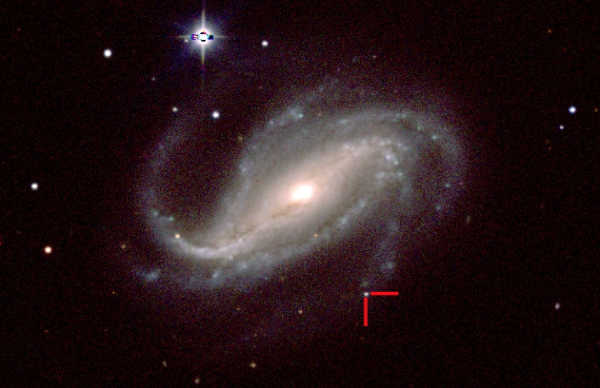
BERKELEY, Calif. – Thanks to lucky snapshots taken by an amateur astronomer in Argentina, scientists have obtained their first view of the initial burst of light from the explosion of a massive star.
During tests of a new camera, Víctor Buso captured images of a distant galaxy before and after the supernova's "shock breakout" – when a supersonic pressure wave from the exploding core of the star hits and heats gas at the star’s surface to a very high temperature, causing it to emit light and rapidly brighten.
To date, no one has been able to capture the "first optical light" from a normal supernova – that is, one not associated with a gamma-ray or x-ray burst – since stars explode seemingly at random in the sky, and the light from shock breakout is fleeting. The new data provide important clues to the physical structure of the star just before its catastrophic demise and to the nature of the explosion itself.
"Professional astronomers have long been searching for such an event," said UC Berkeley astronomer Alex Filippenko, who followed up the discovery with observations at the Lick and Keck observatories that proved critical to a detailed analysis of the explosion, called SN 2016gkg. "Observations of stars in the first moments they begin exploding provide information that cannot be directly obtained in any other way."
"Buso’s data are exceptional," he added. "This is an outstanding example of a partnership between amateur and professional astronomers."
The discovery and results of follow-up observations from around the world will be published in the Feb. 22 issue of the journal Nature.
On Sept. 20, 2016, Buso, of Rosario, Argentina, was testing a new camera on his 16-inch telescope by taking a series of short-exposure photographs of the spiral galaxy NGC 613, which is about 80 million light years from Earth and located within the southern constellation Sculptor.
Luckily, he examined these images immediately and noticed a faint point of light quickly brightening near the end of a spiral arm that was not visible in his first set of images.
Astronomer Melina Bersten and her colleagues at the Instituto de Astrofísica de La Plata in Argentina soon learned of the serendipitous discovery and realized that Buso had caught a rare event, part of the first hour after light emerges from a massive exploding star. She estimated Buso's chances of such a discovery, his first supernova, at one in 10 million or perhaps even as low as one in 100 million.
“It’s like winning the cosmic lottery,” said Filippenko.
Star shed three-quarters of its mass before exploding
Bersten immediately contacted an international group of astronomers to help conduct additional frequent observations of SN 2016gkg over the next two months, revealing more about the type of star that exploded and the nature of the explosion.
Filippenko and his colleagues obtained a series of seven spectra, where the light is broken up into its component colors, as in a rainbow, with the Shane 3-meter telescope at the University of California’s Lick Observatory near San Jose, California, and with the twin 10-meter telescopes of the W. M. Keck Observatory on Maunakea, Hawaii.
This allowed the international team to determine that the explosion was a Type IIb supernova: the explosion of a massive star that had previously lost most of its hydrogen envelope, a species of exploding star first observationally identified by Filippenko in 1987.
Combining the data with theoretical models, the team estimated that the initial mass of the star was about 20 times the mass of our sun, though it lost most of its mass, probably to a companion star, and slimmed down to about 5 solar masses prior to exploding.
Filippenko’s team continued to monitor the supernova’s changing brightness over two months with other Lick telescopes: the 0.76-meter Katzman Automatic Imaging Telescope and the 1-meter Nickel telescope.
“The Lick spectra, obtained with just a 3-meter telescope, are of outstanding quality in part because of a recent major upgrade to the Kast spectrograph, made possible by the Heising-Simons Foundation as well as William and Marina Kast,” Filippenko said.
Filippenko’s group, which included numerous undergraduate students, is supported by the Christopher R. Redlich Fund, Gary and Cynthia Bengier, the TABASGO Foundation, the Sylvia and Jim Katzman Foundation, many individual donors, the Miller Institute for Basic Research in Science and NASA through the Space Telescope Science Institute. Research at Lick Observatory is partially supported by a generous gift from Google.
The W. M. Keck Observatory is operated as a scientific partnership among the California Institute of Technology, the University of California and NASA; the observatory was made possible by the generous financial support of the W. M. Keck Foundation.
Robert Sanders writes for the UC Berkeley News Center.
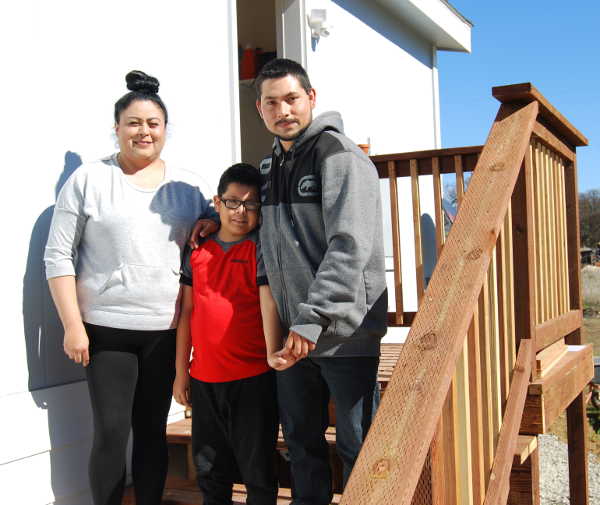
LOWER LAKE, Calif. – On Feb. 17, Habitat for Humanity Lake County celebrated another housewarming dedication with the Torres-Guerrero family.
Alberto, Angelica and their son Brayan lost their home during the Clayton fire and came to Habitat for Humanity for help soon after.
Now, thanks to their hard work and that of their family, friends, and Habitat staff and volunteers, they once again have a home on their Lower Lake lot and are so relieved and grateful to be home.
“At times we wanted to give up; it was all too much, the couple said. “But Habitat was so supportive through everything we’ve endured and we are grateful to have a safe home we can pass on to our son.”
If you or someone you know lost their residence in any of the Lake County wildfires, please contact Habitat for Humanity Lake County at 707-994-1100, Extension 106, or come by the office at 15312 Lakeshore Drive in Clearlake for a preapplication.
CLEARLAKE, Calif. – With the resignation of Councilman Russell Perdock on Feb. 1, the Clearlake City Council is seeking applications from citizens of the city of Clearlake to fill his term, which expires in November.
"There are many exciting projects coming forward for the city, and a new councilmember has the opportunity to be a part of a great team," said City Manager Greg Folsom.
The city of Clearlake is a general law city of the state of California operating under the council/manager plan.
The council is the legislative body and its members are the community’s decision makers.
The city council approves the city’s budget and determines the public services and focuses on the community’s goals, major projects and such long term considerations as community growth, financing and strategic planning.
Applicants must be a registered voter of the city of Clearlake. Councilmembers receive a stipend of $300 per month.
Applications can be found on the city’s Web site at www.clearlake.ca.us or by contacting the City Clerk Melissa Swanson at 707-994-8201, Extension 106.
"While we will miss the leadership exhibited by Councilmember Perdock, we look forward to continuing our strategic plan with a new member on our team offering fresh ideas on how we can better serve our community," said Mayor Sabatier.
"There are many exciting projects coming forward for the city, and a new councilmember has the opportunity to be a part of a great team," said City Manager Greg Folsom.
The city of Clearlake is a general law city of the state of California operating under the council/manager plan.
The council is the legislative body and its members are the community’s decision makers.
The city council approves the city’s budget and determines the public services and focuses on the community’s goals, major projects and such long term considerations as community growth, financing and strategic planning.
Applicants must be a registered voter of the city of Clearlake. Councilmembers receive a stipend of $300 per month.
Applications can be found on the city’s Web site at www.clearlake.ca.us or by contacting the City Clerk Melissa Swanson at 707-994-8201, Extension 106.
"While we will miss the leadership exhibited by Councilmember Perdock, we look forward to continuing our strategic plan with a new member on our team offering fresh ideas on how we can better serve our community," said Mayor Sabatier.
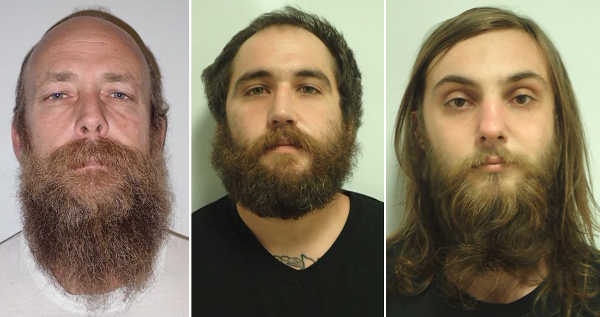
LAKE COUNTY, Calif. – The discovery of a honey oil lab this week led to the arrests of three men.
Dustin Lee Brey, 44, of Kelseyville, was arrested for manufacturing a controlled substance while Cody Alan Harrell, 30, of Springfield, Missouri and Justin Michael Richardson, 21, of Summerfield, Florida, were taken into custody on warrants, according to Lt. Corey Paulich of the Lake County Sheriff’s Office.
Paulich said that on Feb. 21 detectives from Lake County Sheriff’s Office Narcotics Unit served a search warrant at an office/shop space located on Skypark Drive in Lakeport.
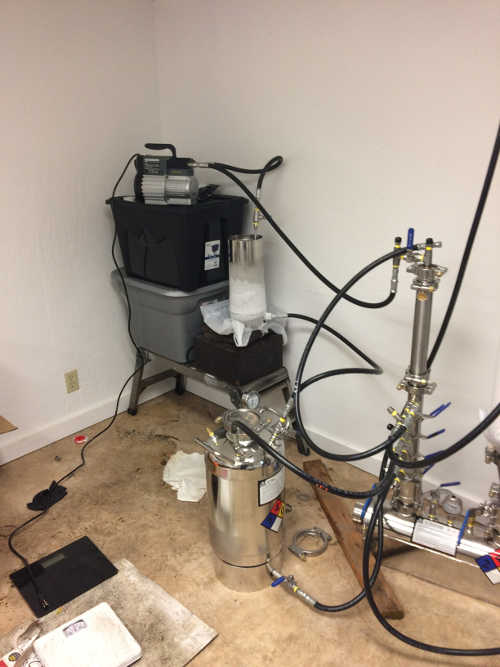
There, he said detectives located an active butane honey oil lab, also called a BHO. Detectives contacted and detained four male subjects inside of the office/shop area.
Detectives evacuated the structure and spoke with all four males, Paulich said.
He said Brey admitted to purchasing the BHOGART BHO lab and taking several classes to learn how to properly operate the closed loop butane honey oil extraction lab. Detectives had Brey shut the lab down.
Brey admitted to using the BHOGART BHO lab to produce butane honey oil, Paulich said. Brey said the other males at the location were not responsible for the lab.
Paulich said Brey admitted to renting the office space to run the BHO lab. Detectives with the assistance of the Lakeport Fire Protection District were able to dismantle the BHO lab.
Detectives located and seized approximately 10 pounds of marijuana shake, 92 grams of concentrated cannabis and additional concentrated cannabis was located inside of the BHO lab which could not be extracted until the cylinder containing it was rendered safe, according to Paulich.
Brey was arrested for manufacturing a controlled substance and booked into custody at the Lake County Jail where he remains with bail set at $100,000, Paulich said.
Harrell also was arrested. Paulich said Harrell, who had a fugitive from justice warrant out of Missouri, told detectives that he had fled Missouri after violating parole.
Richardson was arrested for an outstanding warrant out of Florida. Paulich said Richardson’s warrant included charges related to possession of marijuana.
Paulich said both Harrell and Richardson remain in custody on their warrants with no bail.
The fourth male contacted at the location was released with no charges, Paulich said.
What is the difference between a will and a living trust? This is a basic question people want answered.
Let us examine the primary differences between wills and trusts.
These differences relate to the following issues: (1) whether a probate is involved; (2) what assets and legal affairs are implicated; and (3) when does the instrument take effect?
The Will, it is a “legal instrument” that allows you to name an executor to act as the personal representative of your estate. A will only takes effect after you die.
Under court supervision, the personal representative will process and settle creditor claims, transact unfinished legal matters, and distribute what remains to your named beneficiaries according to the written terms of the will after you die.
A will controls so-called probate assets – such as interests in real property, personal property, assets and financial accounts – if interests in these are held in the deceased person’s name individually.
It does not control assets that pass automatically to designated beneficiaries (e.g., persons inheriting under insurance, joint tenancy, or retirement plans); nor does it control assets held in Trust.
That said, in California a will must be “probated” if the total probate estate exceeds $150,000 in gross value (i.e., debts are not subtracted).
Probate requires a petition for probate to admit the will and to authorize the personal representative to administer the estate.
Probate then proceeds with the inventory and appraisal of assets, the notification of creditors, the payment of all taxes, and the settling of creditor claims. It ends with a petition to distribute assets pursuant to the terms of the will.
The foregoing process often takes around five to six months at a minimum and can take much more if there are complications (such as creditor disputes, controversy over the terms of the will, and asset valuation issues, etc.).
A will is necessary, even if one has a trust, for a number of reasons. Perhaps the decedent had unfinished legal business (a lawsuit for example) pending at the time of death that requires a court-appointed personal representative to finish. Perhaps some assets were not transferred into the decedent’s trust prior to death, leaving more than $150,000 outside the trust.
A trust is a contract between the “settlor” (the person who establishes the trust) and the “trustee,” the person who agrees to hold certain property “in trust” for the benefit of “beneficiaries” according to the terms of the trust.
A trust controls those assets that are legally transferred to the trustee. Typically this includes one’s home, rentals, and nonretirement investment accounts.
Unlike the will, the trust commences once funded. When the settlor later becomes disabled, resigns, or dies, a new trustee (whom the settlor nominated) becomes trustee. He or she manages the trust assets and uses or distributes them according to the trust.
Assets inside a trust do not require conservatorships or probates if the settlor is incapacitated or dies, respectively.
So, when would you want a will instead of a trust?
Simply put, a will is preferable for anyone with under $150,000 in probate assets – this excludes pay on death accounts.
Under $150,000, the decedent’s tangible personal property, financial assets and mobile home can be transferred using the “affidavit procedure.” Incapacity planning involves the power of attorney.
Over $150,000 a trust is usually preferred because settling a trust estate is usually less expensive, time-consuming and aggravating than settling a court-supervised probate estate.
Also, assets held in trusts now avoid Medi-Cal Estate recovery which since Jan. 1, 2017, only apply a decedent’s probate estate.
Lastly, a trust may be needed because the beneficiary is a minor, receives SSI/Medical, is susceptible to undue influence, or is incapable of managing money.
The beneficiary’s inheritance would be held in further trust for their lifetime in irrevocable trusts designed to meet the beneficiary’s own needs and circumstances.
Dennis A. Fordham, attorney, is a State Bar-Certified Specialist in estate planning, probate and trust law. His office is at 870 S. Main St., Lakeport, Calif. He can be reached at
The planet Mars has fascinated scientists for over a century. Today, it is a frigid desert world with a carbon dioxide atmosphere 100 times thinner than Earth’s.
But evidence suggests that in the early history of our solar system, Mars had an ocean’s worth of water. NASA’s James Webb Space Telescope will study Mars to learn more about the planet’s transition from wet to dry, and what that means about its past and present habitability.
Mars will be targeted as part of a Guaranteed Time Observation (GTO) project led by Heidi Hammel, a planetary astronomer and executive vice president of the Association of Universities for Research in Astronomy (AURA) in Washington, D.C.
The GTO program provides dedicated time to the scientists who have worked with NASA to craft the science capabilities of Webb throughout its development.
Hammel was selected by NASA as a JWST Interdisciplinary Scientist in 2003. Mars will be visible to Webb from May to September 2020 during its first year of operations, known as Cycle 1.
“Webb will return extremely interesting measurements of chemistry in the Martian atmosphere,” noted Hammel. “And most importantly, these Mars data will be immediately available to the planetary community to enable them to plan even more detailed Mars observations with Webb in future cycles.”
“We are all looking forward to Webb’s observations of Mars. I just know they will be fantastic, with the potential for immediate scientific discoveries,” said Jim Green, director of NASA’s Planetary Science Division, NASA Headquarters, Washington, D.C.
Webb’s advantages and challenges
Mars has been visited by more missions than any other planet in our solar system. It is currently orbited by six active spacecraft, while two rovers trundle across its surface. Webb offers several capabilities that complement these up-close missions.
One key asset is Webb’s ability to take a snapshot of the entire disk of Mars at once. Orbiters, in contrast, take time to make a full map and therefore can be affected by day-to-day variability, while rovers can only measure one location.
Webb also benefits from excellent spectral resolution (the ability to measure small differences in wavelengths of light) and a lack of interfering atmosphere that plagues ground-based measurements from Earth.
That said, observing Mars with Webb will not be easy. “Webb is designed to be able to detect extremely faint and distant targets, but Mars is bright and close,” explained Geronimo Villanueva of NASA’s Goddard Space Flight Center, Mars lead on the GTO project. As a result, the observations will be carefully designed to avoid swamping Webb’s delicate instruments with light.
“Very importantly, observations of Mars will also test Webb’s capabilities in tracking moving objects across the sky, which is of key importance when investigating our solar system,” said Stefanie Milam at NASA’s Goddard Space Flight Center, Greenbelt, Md. who is coordinating the solar system program with Webb.
Water and methane
Much of the water Mars once held was lost over time due to ultraviolet light from the Sun breaking apart water molecules.
Researchers can estimate how much water vanished by measuring the abundance of two slightly different forms of water in Mars’ atmosphere – normal water (H2O) and heavy water (HDO), in which one hydrogen atom is replaced by naturally occurring deuterium.
The preferential escape of lighter hydrogen over time would then lead to a skewed ratio of H2O to HDO on Mars, indicative of how much water has escaped into space. Webb will be able to measure this ratio at different times, seasons and locations.
“With Webb, we can obtain a real and accurate measurement of the ratio of H2O to HDO across Mars, permitting us to determine how much water was truly lost. We also can determine how water is exchanged between polar ice, the atmosphere, and the soil,” said Villanueva.
Although most of the water on Mars is locked up in ice, the possibility remains that some liquid water could exist in underground aquifers. These potential reservoirs could even host life. This intriguing idea received a boost in 2003, when astronomers detected methane in the Martian atmosphere. Methane could be generated by bacteria, although it could also come from geological processes. Data from Webb could provide new clues to the origin of these methane plumes.
The James Webb Space Telescope is the world’s premier infrared space observatory of the next decade. Webb will solve mysteries of our solar system, look beyond to distant worlds around other stars, and probe the mysterious structures and origins of our universe and our place in it. Webb is an international program led by NASA with its partners, the European Space Agency and the Canadian Space Agency.
For more information about Webb, visit www.nasa.gov/webb or www.webbtelescope.org.
Christine Pulliam works for the Space Telescope Science Institute in Baltimore, Md.