 How to resolve AdBlock issue?
News
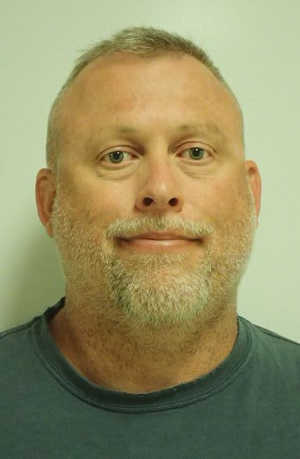
HIDDEN VALLEY LAKE, Calif. – The Lake County District Attorney’s Perjury Intervention Unit has made another arrest, this time of a Hidden Valley Lake man involved in a child custody dispute.
District Attorney Don Anderson said that on Thursday perjury unit investigators arrested Russell Earl Ellis, 46, for one count of perjury and one count of perjury by affidavit. The arrest was made at a Hidden Valley Lake area coffee shop without incident.
The Perjury Intervention Unit alleges that Russell Earl Ellis committed perjury in an affidavit filed with the court on Dec. 12, 2017, and then again from the witness stand on March 2, 2018. Anderson said Ellis is involved in a custody dispute with his estranged girlfriend with a child they have in common.
Ellis had obtained restraining orders against his former girlfriend by submitting an affidavit under oath that he was accosted by the former girlfriend and her attorney in the hall way of the courthouse, Anderson said.
Anderson said Ellis also stated that two bailiffs had to come out of the courtroom and escorted the girlfriend and attorney away. Then at a hearing on the same matter, Ellis testified on the stand to the same set of facts.
Investigators from the District Attorney’s Office reviewed the videotape of the incident from the courthouse video system and interviewed witnesses to the incident. Anderson said it was determined that the attorney did not accost Ellis and the former girlfriend never came within 12 feet of him.
The District Attorney’s Office obtained an arrest warrant for Ellis based on the investigations, Anderson said.
Ellis was booked into the Lake County jail for perjury, with bail set at $20,000. He later posted bail and was released, based on jail records.
Anderson said Ellis faces a maximum sentence of four years and eight months if convicted.
Anderson established the Perjury Investigative Unit in June of 2016 in an attempt to curb false testimony in all types of court cases.
Since the inception of the unit, the District Attorney’s Office have made several arrests and have received conviction in every case, according to Anderson.
“Perjury is a serious crime that affects the effectiveness of our judicial system and the public confidence in the courts. Every time a witness purposely commits perjury it is an insult to every person who takes the stand and tells the truth,” Anderson said.
On Friday Gov. Edmund G. Brown Jr. on Friday released a revised state budget proposal that his office said boosts education funding to an all-time high, fills the Rainy Day Fund to the brim and directs billions of dollars in one-time surplus funding to combat homelessness, improve mental health services and rebuild crumbling infrastructure.
“We’re nearing the longest economic recovery in modern history, and as Isaac Newton observed: What goes up must come down,” said Gov. Brown. “This is a time to save for our future, not to make pricey promises we can’t keep. I said it before and I’ll say it again: Let’s not blow it now.”
As California’s economy has recovered from the Great Recession, the state has continued to invest in its core priorities, including: increasing K-12 education funding to record levels; raising the minimum wage; expanding health care coverage to millions more Californians; improving transportation and water systems; and paying down debts.
Significant details of the revised budget include the following.
Counteracting the effects of poverty
Since 2012, California has committed approximately $21 billion in new annual funding to maintain a strong safety net for those with the greatest needs.
The Governor’s Office said the May Revision builds on this commitment by expanding the state’s Earned Income Tax Credit program to workers between the ages of 18-25 and above 64, and adjusts income limits to reflect the minimum wage increase to $12 per hour in 2019.
The budget also continues to provide billions of dollars to pay for: the expansion of health care coverage; the restoration of low-income health benefits eliminated during the recession; the repeal of the maximum family grant rule in CalWORKs; and increases in child care and early education provider rates and the number of children served.
Saving for uncertain times
In 2014, voters created a Rainy Day Fund to save money when the economy is strong for uncertain times ahead.
The May Revision maintains the January budget commitment to fully fill the fund. By the end of the current fiscal year, this fund will have a total balance of $9.4 billion growing to $13.8 billion by the end of 2018-19.
Additionally, to further protect against the next economic downturn, the budget proposes to direct an extra $3.2 billion into the state’s traditional budget reserve fund.
Combating homelessness and investing in infrastructure
California anticipates $8 billion in higher revenues through 2018-19 compared to the January budget projection.
As a result, the state will keep its existing commitments to increase funding for Medi-Cal, Cal Grants, child care, In-Home Supportive Services and foster care reform, among other programs, while focusing the majority of the remaining funding on one-time expenditures in three areas:
Infrastructure ($2 billion) – The state has huge liabilities from years of deferred maintenance and would use these funds for universities, courts, state facilities and flood control.
Homelessness ($359 million) – The state will assist local governments to immediately address homelessness across the state, bridging the gap until new funding flows from new housing measures signed by Governor Brown last year.
Mental Health Services ($312 million) – The state will provide funding for programs that help people with mental illness, including training for mental health professionals and early identification of mental health problems. This includes $254 million to help counties serve youth with mental illness.
To help address the state’s housing shortage, the May Revision also proposes to place the $2 billion “No Place Like Home” bond on the November ballot, which would expand housing opportunities for Californians with mental illness.
Supporting students
This budget proposal increases K-12 school funding by about $4,600 per student compared to 2011-12 levels.
The state will fully implement the Local Control Funding Formula, correcting historical inequities in school district funding, and permanently increase the minimum per pupil funding school districts receive to help offset rising costs.
The May Revision maintains the 3 percent increase in funding for higher education proposed in January while continuing to keep tuition levels unchanged at both the University of California and California State University systems.
Since the end of the Great Recession, the UC system has received $1.2 billion in new funding, the California State University system has received $1.6 billion and community colleges have received $2.4 billion. The May Revision also provides each university system with $100 million in new, one-time funding for deferred maintenance.
The May Revision also refines the state’s California Online College plan and the new funding formula for community colleges.
Fighting climate change
To date, the state has appropriated $6.5 billion in cap-and-trade auction proceeds to programs benefiting people across California. Earlier this year, the Administration allocated $1.25 billion in cap-and-trade auction funds to continue the state’s efforts to aggressively reduce greenhouse gas emissions and combat climate change.
The May Revision proposes $96 million, which includes additional auction proceeds and other funds, to implement the Forest Carbon Plan and take other actions to protect California’s forests against the increasing threat of disastrous wildfires. This $96 million comes in addition to $160 million proposed in January’s cap-and-trade expenditure plan to support forest improvements and fire protection.
Sen. Mike McGuire, who represents Lake County in the state Senate, said the governor’s cautious budget “reflects both the need for California to continue to advance strategic investments in our shared priorities — education, health care, funding for homelessness services and climate protection – while also increasing the state’s reserves by bolstering our rainy day fund.”
McGuire added, “We have witnessed the worst fire season in history and we have been working hand-in-hand with local leaders and the Governor’s Office to secure desperately needed relief funding. We are grateful that today’s budget revision, after numerous meetings with the Governor’s Office, includes $29.1 million to waive the local match for North Bay counties to cover the costs of debris removal, which has been a top priority for hard hit counties.”
He said the budget also includes $21.8 million to backfill property tax revenue losses that local governments will incur due to the 2017 wildfires.
“These funds, and other investments the state is making, will help North Bay counties continue the long recovery process with desperately needed services that will benefit residents in their greatest time of need,” McGuire said.
Additional details about the Governor’s May Revision can be found at www.ebudget.ca.gov.
“We’re nearing the longest economic recovery in modern history, and as Isaac Newton observed: What goes up must come down,” said Gov. Brown. “This is a time to save for our future, not to make pricey promises we can’t keep. I said it before and I’ll say it again: Let’s not blow it now.”
As California’s economy has recovered from the Great Recession, the state has continued to invest in its core priorities, including: increasing K-12 education funding to record levels; raising the minimum wage; expanding health care coverage to millions more Californians; improving transportation and water systems; and paying down debts.
Significant details of the revised budget include the following.
Counteracting the effects of poverty
Since 2012, California has committed approximately $21 billion in new annual funding to maintain a strong safety net for those with the greatest needs.
The Governor’s Office said the May Revision builds on this commitment by expanding the state’s Earned Income Tax Credit program to workers between the ages of 18-25 and above 64, and adjusts income limits to reflect the minimum wage increase to $12 per hour in 2019.
The budget also continues to provide billions of dollars to pay for: the expansion of health care coverage; the restoration of low-income health benefits eliminated during the recession; the repeal of the maximum family grant rule in CalWORKs; and increases in child care and early education provider rates and the number of children served.
Saving for uncertain times
In 2014, voters created a Rainy Day Fund to save money when the economy is strong for uncertain times ahead.
The May Revision maintains the January budget commitment to fully fill the fund. By the end of the current fiscal year, this fund will have a total balance of $9.4 billion growing to $13.8 billion by the end of 2018-19.
Additionally, to further protect against the next economic downturn, the budget proposes to direct an extra $3.2 billion into the state’s traditional budget reserve fund.
Combating homelessness and investing in infrastructure
California anticipates $8 billion in higher revenues through 2018-19 compared to the January budget projection.
As a result, the state will keep its existing commitments to increase funding for Medi-Cal, Cal Grants, child care, In-Home Supportive Services and foster care reform, among other programs, while focusing the majority of the remaining funding on one-time expenditures in three areas:
Infrastructure ($2 billion) – The state has huge liabilities from years of deferred maintenance and would use these funds for universities, courts, state facilities and flood control.
Homelessness ($359 million) – The state will assist local governments to immediately address homelessness across the state, bridging the gap until new funding flows from new housing measures signed by Governor Brown last year.
Mental Health Services ($312 million) – The state will provide funding for programs that help people with mental illness, including training for mental health professionals and early identification of mental health problems. This includes $254 million to help counties serve youth with mental illness.
To help address the state’s housing shortage, the May Revision also proposes to place the $2 billion “No Place Like Home” bond on the November ballot, which would expand housing opportunities for Californians with mental illness.
Supporting students
This budget proposal increases K-12 school funding by about $4,600 per student compared to 2011-12 levels.
The state will fully implement the Local Control Funding Formula, correcting historical inequities in school district funding, and permanently increase the minimum per pupil funding school districts receive to help offset rising costs.
The May Revision maintains the 3 percent increase in funding for higher education proposed in January while continuing to keep tuition levels unchanged at both the University of California and California State University systems.
Since the end of the Great Recession, the UC system has received $1.2 billion in new funding, the California State University system has received $1.6 billion and community colleges have received $2.4 billion. The May Revision also provides each university system with $100 million in new, one-time funding for deferred maintenance.
The May Revision also refines the state’s California Online College plan and the new funding formula for community colleges.
Fighting climate change
To date, the state has appropriated $6.5 billion in cap-and-trade auction proceeds to programs benefiting people across California. Earlier this year, the Administration allocated $1.25 billion in cap-and-trade auction funds to continue the state’s efforts to aggressively reduce greenhouse gas emissions and combat climate change.
The May Revision proposes $96 million, which includes additional auction proceeds and other funds, to implement the Forest Carbon Plan and take other actions to protect California’s forests against the increasing threat of disastrous wildfires. This $96 million comes in addition to $160 million proposed in January’s cap-and-trade expenditure plan to support forest improvements and fire protection.
Sen. Mike McGuire, who represents Lake County in the state Senate, said the governor’s cautious budget “reflects both the need for California to continue to advance strategic investments in our shared priorities — education, health care, funding for homelessness services and climate protection – while also increasing the state’s reserves by bolstering our rainy day fund.”
McGuire added, “We have witnessed the worst fire season in history and we have been working hand-in-hand with local leaders and the Governor’s Office to secure desperately needed relief funding. We are grateful that today’s budget revision, after numerous meetings with the Governor’s Office, includes $29.1 million to waive the local match for North Bay counties to cover the costs of debris removal, which has been a top priority for hard hit counties.”
He said the budget also includes $21.8 million to backfill property tax revenue losses that local governments will incur due to the 2017 wildfires.
“These funds, and other investments the state is making, will help North Bay counties continue the long recovery process with desperately needed services that will benefit residents in their greatest time of need,” McGuire said.
Additional details about the Governor’s May Revision can be found at www.ebudget.ca.gov.
NORTHERN CALIFORNIA – Congressman Mike Thompson (CA-05) is urging the president to maintain royalty payments to counties for geothermal energy production that help boost clean energy development and support local economies in counties like Lake and Sonoma counties in his district.
Geothermal royalty payments are eliminated in the White House’s budget proposal for Fiscal Year 2019. He was joined by seven other Democrats and Republicans.
“Counties in my district are leading the way in geothermal development that results in cleaner energy sources and these investments can be costly for our communities. So it is fair that royalty payments from that energy production be returned to the very communities that host them,” said Thompson. “That’s why I wrote to the president urging him not to cut those payments. Our district could lose out on valuable resources used to pay for public safety, infrastructure investment, and law enforcement services, while diminishing our capacity to continue investing in local clean energy. This proposal is shortsighted and must be reversed.”
Last year, Lake County received more than $733,000 and Sonoma County received over $1.3 million in geothermal royalties, Thompson’s office reported.
“Elimination of federal geothermal royalties will result in the loss of $700,000 per year to rural Lake County, at a time when more cuts simply cannot be borne without major reductions in vital community services including local law enforcement, roads, libraries, parks and services to seniors. These funds are used to mitigate the impacts of the geothermal industry, providing vital services and resources to our citizens,” said Lake County Administrative Officer Carol Huchingson.
“Lake County has been ravaged by wildfire, with five major wildfire disasters over the past three summers and 22 percent of the county’s land mass burned. As a result, the county is already facing a financial crisis. On a per capita basis, Lake County has lost almost double the amount of housing stock than Sonoma did in the North Bay Firestorm of 2017. As a rural county already struggling to recover from the recession, the additional losses brought on by wildfires are pushing an already cash-strapped local government to the brink of financial disaster. The additional loss of geothermal royalties will be devastating to Lake County,” said Lake County Supervisor Rob Brown.
“Sonoma County appreciates the Congressman’s continued leadership on this issue,” said Sonoma County Supervisor James Gore. “This elimination would come at a time when we are dealing with revenue reductions, and increased needs, from the 2017 wildfires.”
Full text of the letter is below.
April 27, 2018
The President
The White House
Washington, DC 20500
Dear Mr. President:
We are disappointed that geothermal royalty payments to counties were eliminated in Fiscal Year 2019 budget request. We understand and support the need to propose a fiscally prudent budget, but repealing geothermal royalty payments to counties is a short sighted method that does little to address fiscal challenges.
In the bipartisan Energy Policy Act of 2005, Congress decided that, because of the high burdens geothermal production places on the counties where geothermal development is located, these counties should share in the revenue of the federal receipts. In turn, counties have used these revenues to pay for critical governmental services, such as road maintenance, public safety and law enforcement, and conservation easements. This revenue sharing has also made counties vested partners, and ultimately champions, in the continued development of geothermal energy—a clean, renewable, and domestic energy source that provides well-paying jobs in rural areas.
Ending the geothermal revenue sharing plan will have a significant negative impact on our districts, while the overall effect on our nation’s fiscal well-being would be miniscule— less than $4 million in 2019. Many of the counties that receive revenue from geothermal receipts are small, rural communities facing precarious budget situations. The loss of such revenue for these counties could result in the elimination or reduction of essential services. We strongly support geothermal revenue sharing with counties and we encourage you to consider it in future budget proposals.
We appreciate your attention to this issue and look forward to working with you to promote geothermal energy production and provide support for the surrounding communities.
Geothermal royalty payments are eliminated in the White House’s budget proposal for Fiscal Year 2019. He was joined by seven other Democrats and Republicans.
“Counties in my district are leading the way in geothermal development that results in cleaner energy sources and these investments can be costly for our communities. So it is fair that royalty payments from that energy production be returned to the very communities that host them,” said Thompson. “That’s why I wrote to the president urging him not to cut those payments. Our district could lose out on valuable resources used to pay for public safety, infrastructure investment, and law enforcement services, while diminishing our capacity to continue investing in local clean energy. This proposal is shortsighted and must be reversed.”
Last year, Lake County received more than $733,000 and Sonoma County received over $1.3 million in geothermal royalties, Thompson’s office reported.
“Elimination of federal geothermal royalties will result in the loss of $700,000 per year to rural Lake County, at a time when more cuts simply cannot be borne without major reductions in vital community services including local law enforcement, roads, libraries, parks and services to seniors. These funds are used to mitigate the impacts of the geothermal industry, providing vital services and resources to our citizens,” said Lake County Administrative Officer Carol Huchingson.
“Lake County has been ravaged by wildfire, with five major wildfire disasters over the past three summers and 22 percent of the county’s land mass burned. As a result, the county is already facing a financial crisis. On a per capita basis, Lake County has lost almost double the amount of housing stock than Sonoma did in the North Bay Firestorm of 2017. As a rural county already struggling to recover from the recession, the additional losses brought on by wildfires are pushing an already cash-strapped local government to the brink of financial disaster. The additional loss of geothermal royalties will be devastating to Lake County,” said Lake County Supervisor Rob Brown.
“Sonoma County appreciates the Congressman’s continued leadership on this issue,” said Sonoma County Supervisor James Gore. “This elimination would come at a time when we are dealing with revenue reductions, and increased needs, from the 2017 wildfires.”
Full text of the letter is below.
April 27, 2018
The President
The White House
Washington, DC 20500
Dear Mr. President:
We are disappointed that geothermal royalty payments to counties were eliminated in Fiscal Year 2019 budget request. We understand and support the need to propose a fiscally prudent budget, but repealing geothermal royalty payments to counties is a short sighted method that does little to address fiscal challenges.
In the bipartisan Energy Policy Act of 2005, Congress decided that, because of the high burdens geothermal production places on the counties where geothermal development is located, these counties should share in the revenue of the federal receipts. In turn, counties have used these revenues to pay for critical governmental services, such as road maintenance, public safety and law enforcement, and conservation easements. This revenue sharing has also made counties vested partners, and ultimately champions, in the continued development of geothermal energy—a clean, renewable, and domestic energy source that provides well-paying jobs in rural areas.
Ending the geothermal revenue sharing plan will have a significant negative impact on our districts, while the overall effect on our nation’s fiscal well-being would be miniscule— less than $4 million in 2019. Many of the counties that receive revenue from geothermal receipts are small, rural communities facing precarious budget situations. The loss of such revenue for these counties could result in the elimination or reduction of essential services. We strongly support geothermal revenue sharing with counties and we encourage you to consider it in future budget proposals.
We appreciate your attention to this issue and look forward to working with you to promote geothermal energy production and provide support for the surrounding communities.
When the solar wind – which is really a driving rain of charged particles from the sun – strikes Earth’s protective magnetic field, the shock generates roiling, turbulent magnetic fields that enshroud the planet and stretch for hundreds of thousands of miles.
Where does all that turbulent energy go?
One of NASA’s space weather missions, called Magnetospheric Multiscale or MMS, has discovered one surprising way this turbulent energy is dissipated: The magnetic energy is converted into high-speed jets of electrons as the magnetic fields break and reconnect.
The discovery will help scientists understand the role magnetic reconnection plays elsewhere in space, for example, in heating the inexplicably hot solar corona — the sun’s outer atmosphere — and accelerating the supersonic solar wind. NASA’s upcoming Parker Solar Probe mission will be launched directly toward the sun this summer to investigate exactly those phenomena, armed with this new understanding of magnetic reconnection near Earth.
And since magnetic reconnection occurs throughout the universe, what scientists learn about it around our planet — which is easier to examine — can be applied to other processes farther away.
“MMS discoveredelectron magnetic reconnection, a new process much different from the standard magnetic reconnection that happens in calmer areas around Earth,” said Tai Phan, a senior fellow in the Space Sciences Laboratory at the University of California, Berkeley. “This finding helps scientists understand how turbulent magnetic fields dissipate energy throughout the cosmos.”
Phan is lead author of a paper describing the findings that will be published today in the journal Nature.
“Turbulence occurs everywhere in space: on the sun, in the solar wind, interstellar medium, dynamos, accretion disks around stars, in active galactic nuclei jets, supernova remnant shocks and more,” said Michael Shay of the University of Delaware, a co-author of the paper.
Turbulent magnetic fields are different
Standard magnetic reconnection is observed in Earth’s relatively placid magnetosphere, which is like a magnetic force field that protects the planet from the intense solar wind. Within this region, undulating magnetic fields can cross, break and reconnect; the rejoined magnetic field lines snap like a rubber band and fling ionized atoms at high velocity throughout the magnetosphere.
The ion jets, wedges of ionized hydrogen atoms speeding off in opposite directions, heat up the gases surrounding Earth and drive space weather. Some of the charged particles are funneled to the north and south poles, where they collide with atoms in the atmosphere and create the auroras.
The new process takes place farther from Earth’s surface, in a turbulent zone where the solar wind hits a shock wave surrounding Earth and drastically slows. Twice the width of the Earth itself, this zone – the magnetosheath – is highly turbulent.
“The turbulence in the magnetosheath contains a lot of magnetic energy,” Phan said. “People have been debating how this energy is dissipated, and magnetic reconnection is one of the possible processes.”
Phan and his colleagues used data from the MMS to prove that the new electron magnetic reconnection process happens on a smaller scale in turbulence and creates jets of electrons instead of ions. The electrons move about 40 times faster than ions accelerated by standard reconnection.
“We now have evidence that reconnection does happen to dissipate turbulent energy in the magnetosheath, but it is a new kind of reconnection,” said Shay.
Can magnetic fields be too turbulent to reconnect?
Magnetic reconnection has been observed innumerable times in the magnetosphere but always under calm conditions. The new event occurred in the magnetosheath just outside the outer boundary of the magnetosphere. Previously, scientists didn’t know if reconnection could occur there, because the plasma is highly chaotic in that region, Phan said.
MMS found that it does, but on scales much smaller than previous spacecraft could probe and theory would predict. Because it involves only electrons, it remained hidden from scientists looking for the telltale signature of standard magnetic reconnection: ion jets.
“We think this is because the electrons are fast and light and can easily participate, but the slow and heavy protons cannot,” said Jonathan Eastwood, a lecturer at Imperial College London and a co-author of the paper. “Overall, this result opens up new areas of research into turbulent reconnection.”
MMS consists of four identical spacecraft flying in a pyramid or tetrahedral formation to study magnetic reconnection around Earth in three-dimensions. Because the spacecraft fly incredibly close together — at an average separation of just four and a half miles — they are able to observe phenomena no one has seen before. Furthermore, MMS’s instruments are designed to capture data at speeds 100 times faster than previous missions.
Even though the instruments aboard MMS are incredibly fast, they are still too slow to capture turbulent reconnection in action, which requires observing narrow layers of fast-moving particles hurled by the recoiling field lines. Compared to standard reconnection, in which broad jets of ions stream out from the site of reconnection, turbulent reconnection ejects narrow jets of electrons only a couple miles wide.
But MMS scientists were able to leverage the design of one instrument, the Fast Plasma Investigation, to create a technique that allowed them to read between the lines and gather extra data points in order to resolve the jets.
“The key event of the paper happens in 45 milliseconds. This would be one data point with the regular data,” said Amy Rager, a graduate student at Catholic University of America in Washington, D.C., who worked at NASA’s Goddard Space Flight Center to develop the technique. “But instead we can get six to seven data points in that region with this method, allowing us to understand what is happening.”
With the new method, the MMS scientists are hopeful they can comb through existing datasets to find more of these events, and potentially other unexpected discoveries as well.
Robert Sanders writes for the UC Berkeley News Center.
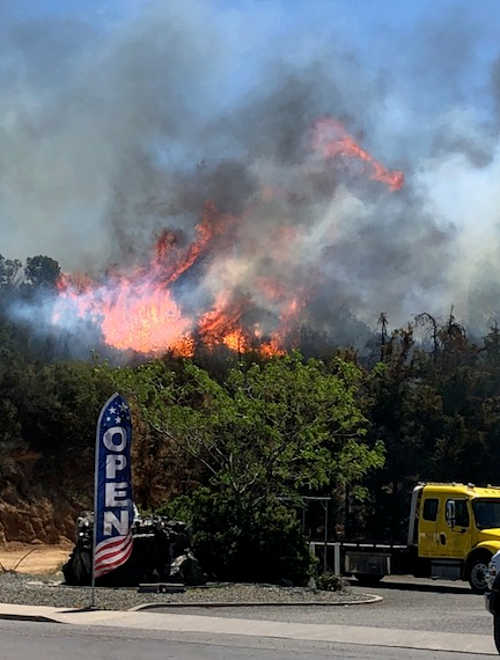
CLEARLAKE, Calif. – Firefighters on Friday afternoon were able to contain two small fires that threatened businesses along Lakeshore Drive and homes in nearby neighborhoods in Clearlake.
The fires were reported to have started shortly before 12:45 p.m. Friday in the 15200 block of Lakeshore Drive behind Big O Tires.
Initially reported as 100 feet by 150 feet in the brush, shortly after 1 p.m. the cumulative fire size had grown to between three and five acres, according to reports from the scene.
The Clearlake Police Department quickly called for mandatory evacuations of Yarrington Court, Mason Street, Konocti Avenue and Konocti View, which are located behind Lakeshore Drive.
Lake County Fire Chief Willie Sapeta said the evacuations were in effect for about an hour and a half due to the fire threat.
Fire units from Lake County Fire, Kelseyville Fire and Cal Fire responded, along with Clearlake Police and Lake County Sheriff’s deputies, according to reports from the scene.
Altogether, Sapeta said the firefighting response included six engines, a water tender, two medic units, two Konocti Conservation Camp crews and two chief officers, along with the law enforcement agencies.
Winds were hitting the fire, raising concerns that the fire would move toward nearby businesses, including Big O Tires, Moran’s Pharmacy and the Best Western El Grande Inn, which line nearby Lakeshore Drive.
Sapeta said the wind was a big contributing factor to the incident.
From her vantage point, Denise Loustalot, who along with husband Pete owns Big O Tires, said the situation looked serious.
“It’s big. It’s really big,” she said of the fire as it was burning on the hill behind her business at around 1 p.m.
Loustalot said the fire had started at the top of a hill next to her business, and that there was a lot of ammunition going off.
She said the fire engulfed the hillside on one side of her business before jumping the two tire buildings in the back of the property.
Loustalot said her husband was hosing things down to keep the fire from spreading to their buildings and equipment.
Just before 1:15 p.m., Clearlake Police reported a flare up had occurred behind firefighters in the area of Yarrington Court, but fire command said they were aware of it.
Shortly after 1:15 p.m., incident command reported they had made good progress, had stopped forward progress on one of the fires and was working on the second. At that point, they reported there was no need for air attack from Cal Fire.
The total fire size was reported at three acres, according to incident command.
Firefighters continued their work as law enforcement implemented traffic control at Lakeshore Drive and Old Highway 53, according to radio reports.
Just before 2 p.m., incident command reported that forward progress on both fires had been stopped and no further evacuations were needed. However, anyone evacuated at that point was expected to be unable to return home for about an hour.
At 2:45 p.m., the Clearlake Police Department said all evacuations had been lifted, but the agency urged people to use caution on Lakeshore between Highway 53 and Old Highway 53 due to fire personnel still working in the area.
Sapeta said shortly before 3 p.m. that there had been no homes lost and no injuries.
He said there were a few hours of overhaul set to take place, and investigators still had to work on the fire’s cause and origin.
Sapeta pointed out that it’s May and even though there is some green grass, Friday’s fast-moving fire should be a warning to people about fire danger.
“Fire season is here,” he said.
Email Elizabeth Larson at

CLEARLAKE OAKS, Calif. – The 35th annual Catfish Derby Committee anticipates another record year.
“With entries coming in fast and furious, this year’s event promises to be another memorable Derby,” said Derby Committee Chairman Dennis Locke. “Pre-entries continue to arrive, at about the same pace as last year, a good indicator of a record turn out.”
The Derby starts on Thursday, May 17, and concludes on Sunday, May 20.
Derby headquarters is the Northshore Fire Protection District station at 12655 E. Highway 20 in Clearlake Oaks.
The schedule is unchanged from prior years. Registration and check-in begins at noon on Thursday, fishing starts at noon on Friday and ends at noon on Sunday. The awards ceremony kicks off at 1 p.m.
The Northshore Firefighters Association will host breakfast and a barbecue lunch on Saturday and Sunday.
An important news item this year is the sidewalk construction project in Clearlake Oaks.
Lane restriction and traffic control will be in effect and parking along Highway 20 in the construction area will not be allowed. Parking at the fire station will be limited to fish weigh-ins.
“We’ve been working closely with county officials and local derby supporters to make sure our participants, their families and visitors know where to park. Our committee has been hard at work on alternative parking and other details, so as to minimize inconvenience,” said Locke. “Each participant will be issued a parking plan upon registration. Traffic controllers will also direct folks to the designated parking areas.”
Participants compete for cash and merchandise awards totaling $10,000. Last year, more than 1,000 visitors converged on the Oaks, filling up hotels, campgrounds and other lodging places throughout the county. More than 60 percent of the entries were from outside Lake County – as far away as Florida in the east and Hawaii in the west.
“We look forward to welcoming regulars as well as new participants,” said Locke. “Everyone is welcome to drop in to visit and pick up a derby t-shirt, hat or travel mug. And don’t forget, there are separate divisions for two kids age groups. It’s a family affair!”
Weather conditions for next week and through the derby weekend are favorable. Leaderboard updates will be available during the derby at www.clearlakeoaks.org/derbystandings, on Twitter, @clogba or at the Derby hotline, 707-596-0248.