How to resolve AdBlock issue?
News
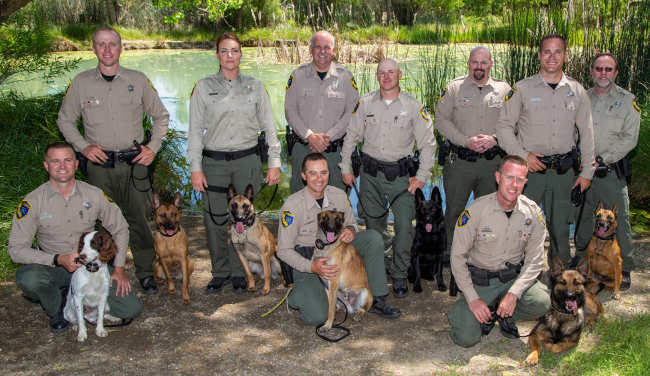
May is graduation season and the California Department of Fish and Wildlife Law Enforcement Division K-9 Academy is no exception.
Six new K-9s graduated from the program today and are now ready to put their skills in law enforcement and environmental protection to work.
All of the dogs are trained to detect illegally taken wildlife, invasive species, hidden firearms, expended casings and other evidence or articles.
About half of CDFW's K-9s are dual purpose, meaning they do detection work but also protect their handlers, other law enforcement officers, and the public and aid in the apprehension of suspects.
The new teams and their upcoming assignments are as follows:
– Warden Shane Embry and K-9 Link. Link is a 2-year-old Belgian Malinois. Dual Purpose team assigned to Humboldt County.
– Warden Michael Hampton and K-9 Leeloo. Leeloo is a 3-year-old German Shepherd. Detection team assigned to Humboldt County.
– Warden Michael Beals and K-9 Rage. Rage is a 2-year-old Belgian Malinois. Dual purpose team assigned to Glenn County.
– Warden Jeffrey Moran and K-9 Tess. Tess is a 6-year-old Belgian Malinois. Detection team assigned to Stanislaus County.
– Warden Casey Thomas and K-9 Canna. Canna is a 2-year-old Belgian Malinois. Dual purpose team assigned to marijuana permitting.
– Warden Nick Molsberry and K-9 Scout. Scout is a 2-year-old English Springer Spaniel. Detection team assigned to Orange County.
Friday's graduation followed eight weeks of intensive training to bring the dogs' behavior and field responses up to the standards of detection and handler protection required by CDFW and California Peace Officers Standards and Training.
"Our Warden K-9 teams have dramatically increased the officer safety during some very dangerous missions in the backcountry, and have helped us track down and arrest hundreds of felony suspects," said Lt. Bob Pera, CDFW K-9 program coordinator. "Then the next day, they may put on a demonstration at a public event or school function where they inevitably garner the attention of all present and help gain support for CDFW law enforcement programs."
Notably, the teams have already begun to show their mettle in the field.
Just after their formal certification May 22, Warden Beals and his new K-9 partner Rage joined two veteran K-9 teams, Warden Aaron Galway and K-9 partner Ghille and Warden Nick Buckler and K-9 partner Beedo, for a first patrol.
Just nine minutes into the shift, they observed a vehicle committing several driving violations on Highway 36 near Red Bluff. The driver made some headway before they could make the stop.
It took some investigative effort to realize a passenger had hopped out of the vehicle earlier and ran off to hide in the brush. Rage deployed and soon located a lighter and a hat off the side of the road 400 yards from where the vehicle came to a stop.
Rage immediately started directly on the track while Ghille came in from a different angle. Warden Buckler and Beedo deployed in an adjacent canyon to cut off any possible escape. Rage tracked the suspect to his hiding place about the same time Warden Galway and Ghille established visual contact.
The suspect quickly surrendered for fear of sustaining a bite. He had outstanding warrants for 15 felony violations in North Carolina and had been on the run for more than 12 years.
"CDFW K-9s are selected for drive, determination and obedience. Then they are intensively trained for work specific to wildlife law enforcement," said David Bess, CDFW deputy director and chief of the CDFW Law Enforcement Division. "The dogs absolutely love what they do, as do their handlers. And at the end of the day, they ask for nothing in return other than a favorite rubber ball, lavish praise and belly scratches."
CDFW's K-9 program is funded largely by private donations through the California Wildlife Officers Foundation and handlers thank them for their continued support.
Living trusts provide many advantages when properly drafted and administered. However, they can be misused.
A dishonest trustee can cause great harm when the trustee embezzles the trust assets. What can be done to minimize the risk and to reduce the harm if embezzlement occurs?
A settlor should avoid nominating clearly unfit candidates as trustee: When the settlor of a trust nominates a person(s) to act as their successor trustee the settlor should carefully consider whether the person(s) they nominate is likely to fulfill his or her duty faithfully and competently. The settlor should make an informed and considered decision.
A suitable candidate is successful in their own life, has demonstrated good judgment and a trustworthy character. Conversely persons whom you never want to consider include persons who are described by any of the following characteristics: scraping by in life, cannot pay their debts, are addicted to drugs, alcohol or gambling, are dishonest, or cannot resist temptation.
If a suitable candidate is not available then the settlor should consider a professional private fiduciary – and in the case of much larger estates (with liquid assets of at least $500,000) a trust company (such as a bank’s trust department).
In California many private fiduciaries can be found through the Professional Fiduciary Association of California organization whose mission is, “to advance excellence in fiduciary standards and practices.”
Before selecting a fiduciary it is good practice to get references, look them up on the Internet, and require (in the trust document) that the trustee have a fiduciary bond.
A fiduciary bond protects the trust estate if the trustee embezzles or otherwise harms the trust estate in a way that is protected under the bond. The bond company will replace what the trust lost in value due to the trustee’s covered bad acts.
Nonetheless, sometimes unfit persons are still chosen as trustee. Why? The settlor may have been vulnerable and wanting for assistance and social support. The person may have befriended the settlor and/or provided him or her with care and support.
The settlor thereby came to rely upon and trust the advice of the friend as the “go to” person in the settlor’s life. The settlor would then for emotional reasons – and not rational reasons – select the friend as trustee.
How can this situation be avoided? If true friends and family remain close to dependent adults they can monitor their social contacts to prevent unscrupulous persons (interlopers) taking advantage. They should encourage dependent adults to seek a qualified estate planning attorney to be prepared in the event of their incapacity and death.
Once a settlor is incapacitated or deceased, the beneficiaries of a trust should enforce their right to be kept informed by the trustee regarding the trust administration. If the person acting as Trustee is not properly administering the trust the beneficiary may petition the court for instructions, for an accounting and for the removal and replacement of the trustee.
If a dependent adult (i.e., a person who cannot provide for his or her necessities of life) becomes incapacitated and/or cannot resist undue influence then interested persons may petition the court for a conservatorship in order to prevent or to end abuse of the dependent adult. A conservatorship can also be used to do estate planning for the conservatee’s estate by substituted judgment.
If a trustee is caught embezzling trust assets, the trust beneficiaries can petition to recover what was embezzled and also to impose a surcharge (penalty) due to harm caused by dishonest acts of the trustee. The beneficiaries can also go to the district attorney’s office to seek criminal prosecution and restitution.
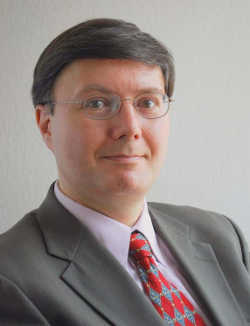
Dennis A. Fordham, attorney, is a State Bar-Certified Specialist in estate planning, probate and trust law. His office is at 870 S. Main St., Lakeport, Calif. He can be reached at
One hundred years ago this week, on May 29, 1919, measurements of a solar eclipse offered verification for Einstein’s theory of general relativity.
Even before that, Einstein had developed the theory of special relativity, which revolutionized the way we understand light.
To this day, it provides guidance on understanding how particles move through space – a key area of research to keep spacecraft and astronauts safe from radiation.
The theory of special relativity showed that particles of light, photons, travel through a vacuum at a constant pace of 670,616,629 miles per hour – a speed that’s immensely difficult to achieve and impossible to surpass in that environment.
Yet all across space, from black holes to our near-Earth environment, particles are, in fact, being accelerated to incredible speeds, some even reaching 99.9% the speed of light.
One of NASA’s jobs is to better understand how these particles are accelerated. Studying these superfast, or relativistic, particles can ultimately help protect missions exploring the solar system, traveling to the moon, and they can teach us more about our galactic neighborhood: A well-aimed near-light-speed particle can trip onboard electronics and too many at once could have negative radiation effects on space-faring astronauts as they travel to the Moon – or beyond.
Here are three ways that acceleration happens.
Electromagnetic fields
Most of the processes that accelerate particles to relativistic speeds work with electromagnetic fields – the same force that keeps magnets on your fridge. The two components, electric and magnetic fields, like two sides of the same coin, work together to whisk particles at relativistic speeds throughout the universe.
In essence, electromagnetic fields accelerate charged particles because the particles feel a force in an electromagnetic field that pushes them along, similar to how gravity pulls at objects with mass. In the right conditions, electromagnetic fields can accelerate particles at near-light-speed.
On Earth, electric fields are often specifically harnessed on smaller scales to speed up particles in laboratories.
Particle accelerators, like the Large Hadron Collider and Fermilab, use pulsed electromagnetic fields to accelerate charged particles up to 99.99999896 percent the speed of light.
At these speeds, the particles can be smashed together to produce collisions with immense amounts of energy. This allows scientists to look for elementary particles and understand what the universe was like in the very first fractions of a second after the Big Bang.
Magnetic explosions
Magnetic fields are everywhere in space, encircling Earth and spanning the solar system. They even guide charged particles moving through space, which spiral around the fields.
When these magnetic fields run into each other, they can become tangled. When the tension between the crossed lines becomes too great, the lines explosively snap and realign in a process known as magnetic reconnection.
The rapid change in a region’s magnetic field creates electric fields, which causes all the attendant charged particles to be flung away at high speeds. Scientists suspect magnetic reconnection is one way that particles – for example, the solar wind, which is the constant stream of charged particles from the Sun – is accelerated to relativistic speeds.
Those speedy particles also create a variety of side-effects near planets. Magnetic reconnection occurs close to us at points where the Sun’s magnetic field pushes against Earth’s magnetosphere – its protective magnetic environment.
When magnetic reconnection occurs on the side of Earth facing away from the Sun, the particles can be hurled into Earth’s upper atmosphere where they spark the auroras. Magnetic reconnection is also thought to be responsible around other planets like Jupiter and Saturn, though in slightly different ways.
NASA’s Magnetospheric Multiscale spacecraft were designed and built to focus on understanding all aspects of magnetic reconnection. Using four identical spacecraft, the mission flies around Earth to catch magnetic reconnection in action.
The results of the analyzed data can help scientists understand particle acceleration at relativistic speeds around Earth and across the universe.
Wave-particle interactions
Particles can be accelerated by interactions with electromagnetic waves, called wave-particle interactions. When electromagnetic waves collide, their fields can become compressed. Charged particles bouncing back and forth between the waves can gain energy similar to a ball bouncing between two merging walls.
These types of interactions are constantly occurring in near-Earth space and are responsible for accelerating particles to speeds that can damage electronics on spacecraft and satellites in space. NASA missions, like the Van Allen Probes, help scientists understand wave-particle interactions.
Wave-particle interactions are also thought to be responsible for accelerating some cosmic rays that originate outside our solar system. After a supernova explosion, a hot, dense shell of compressed gas called a blast wave is ejected away from the stellar core.
Filled with magnetic fields and charged particles, wave-particle interactions in these bubbles can launch high-energy cosmic rays at 99.6 percent the speed of light. Wave-particle interactions may also be partially responsible for accelerating the solar wind and cosmic rays from the Sun.
Mara Johnson-Groh works for NASA's Goddard Space Flight Center in Greenbelt, Md.
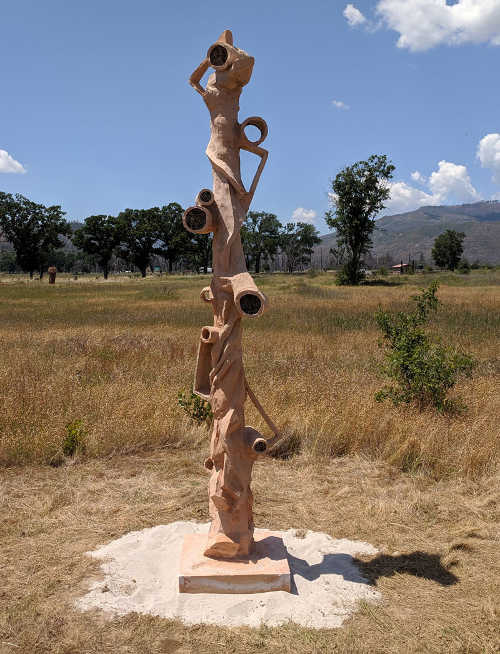
MIDDLETOWN, Calif. – The Middletown Art Center invites the public to join in festivities to celebrate the reopening and 14th season of the EcoArts Sculpture Walk at the Middletown Trailside Park.
“We have been waiting nearly four years for this moment and are very excited,” said Lisa Kaplan, programs director at the Middletown Art Center. “Although the Valley fire devastated the park and the 2015 Sculpture Walk, regrowth is happening throughout the park with young Manzanitas, oak shrubs, grasses and wildflowers coming up everywhere. There is more work to be done to continue to help restore the natural environment, but things are coming back much better than I expected.”
EcoArts Sculpture Walk was a popular Lake County destination before the fire. MAC has worked closely with the county of Lake’s Public Services Department in the past few months to set parameters for artwork, and to prepare the trails. The walk now has a new location at the southeast section of the park.
“We called this year’s exhibit ‘Locus’ to honor the sense of place that is emerging as we continue to recover and rebuild here in South Lake County,” added Kaplan. “Reopening the Sculpture Walk and through it, increased public use of the park, is a milestone in our recovery.”
The Sculpture Walk will officially open at 4 p.m. Saturday, June 1.
The exhibit includes sculptures that reflect on the natural environment or address ecosystem restoration by artists who participated in the Sculpture Walk in the past, as well as new eco-artists.
Cobb Mountain Elementary students also are participating in with bat boxes installed high up along the trail. Poetry readings from 5 to 5:30 p.m., music and wish making for the park will be part of the celebration.
The Middletown Art Center encourages the public to visit the Trailside Park and re-engage with what was, what is and what will come in the future.
The 14th Annual EcoArts Sculpture Walk will remain on view through Oct. 15. The park is open dawn to dusk daily free to the public. Hiking shoes, hats, and water bottles are advised. Middletown Trailside Park is located off Highway 175 at 21435 Dry Creek Cutoff.
“Locus” is supported in part by an award to Middletown Art Center from the National Endowment for the Arts. Additional support was given by Greg Clouse – Art by Design, the county of Lake, Hardester’s Market, Locus workshop participants and volunteers.
Stay up-to-date on all classes, exhibits and events happening at MAC, and consider a membership to support this valuable Lake County arts and culture resource at www.middletownartcenter.org .
LAKEPORT, Calif. – Following a stormy Thursday, Lake County could still be facing more thunderstorms through the weekend, according to the latest forecast.
The National Weather Service said Lake County is facing the potential for daytime thunderstorms on Friday, Saturday and Sunday, before conditions give way to sunny and warm temperatures next week.
On Friday and Saturday, new rainfall totals are expected to be about a tenth of an inch each day, based on the forecast.
Calm winds topping out at about 8 miles per hour are expected both days, while weekend temperatures will range into the high 80s during the day and high 50s at night, the National Weather Service said.
Next week, conditions are expected to be calm, with daytime highs into the low 90s and nighttime highs in the high 50s, the forecast said.
Thunderstorms on Thursday brought brief periods of torrential rain to some areas of Lake County and resulted in a flash flood warning from the National Weather Service, as Lake County News has reported.
The National Weather Service’s observation stations recorded the following 24-hour rainfall totals, in inches, through 2 a.m. Friday:
– Bartlett Springs: 0.06.
– Boggs Mountain: 0.06.
– High Glade Lookout (above Upper Lake): 0.07.
– Kelseyville: 0.12.
– Knoxville Creek: 0.01.
– Lake Pillsbury: 0.22.
– Lakeport: 0.49.
– Lower Lake: 0.13.
– Mendocino National Forest portable station: 0.76.
Email Elizabeth Larson atThis email address is being protected from spambots. You need JavaScript enabled to view it. . Follow her on Twitter, @ERLarson, or Lake County News, @LakeCoNews.
The National Weather Service said Lake County is facing the potential for daytime thunderstorms on Friday, Saturday and Sunday, before conditions give way to sunny and warm temperatures next week.
On Friday and Saturday, new rainfall totals are expected to be about a tenth of an inch each day, based on the forecast.
Calm winds topping out at about 8 miles per hour are expected both days, while weekend temperatures will range into the high 80s during the day and high 50s at night, the National Weather Service said.
Next week, conditions are expected to be calm, with daytime highs into the low 90s and nighttime highs in the high 50s, the forecast said.
Thunderstorms on Thursday brought brief periods of torrential rain to some areas of Lake County and resulted in a flash flood warning from the National Weather Service, as Lake County News has reported.
The National Weather Service’s observation stations recorded the following 24-hour rainfall totals, in inches, through 2 a.m. Friday:
– Bartlett Springs: 0.06.
– Boggs Mountain: 0.06.
– High Glade Lookout (above Upper Lake): 0.07.
– Kelseyville: 0.12.
– Knoxville Creek: 0.01.
– Lake Pillsbury: 0.22.
– Lakeport: 0.49.
– Lower Lake: 0.13.
– Mendocino National Forest portable station: 0.76.
Email Elizabeth Larson at

LAKEPORT, Calif. – A Lakeport Police officer this week arrested a Kelseyville man following a traffic stop after finding a stash of cocaine and a large number of opioid pills, as well as cash.
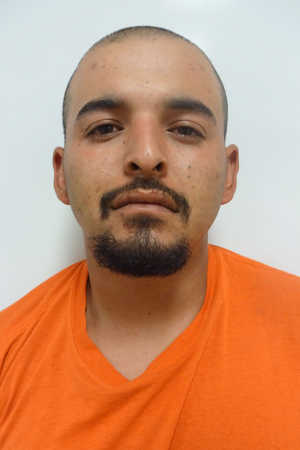
Leopoldo Bravo, 25, was arrested Wednesday evening, according to Lt. Jason Ferguson.
Ferguson said Officer Casey Debolt pulled Bravo over for a vehicle equipment violation.
During the stop, Bravo acknowledged to Debolt that he is on searchable probation out of Los Angeles County for selling heroin, Ferguson said.
Debolt searched Bravo’s car, finding more than an ounce of cocaine, 100 opioid tablets and approximately $1,968 in cash, according to Ferguson.
Based on the denominations on many of the monetary bills, combined with the amount of drugs, led authorities to determine that Bravo was in possession of the drugs for sales.
Debolt arrested Bravo shortly after 6 p.m. Wednesday, with Bravo booked into the Lake County Jail later that night on felony charges of possession or purchase for sale of narcotics or a controlled substance, possession of a controlled substance for sale, sale or transfer of non-narcotic controlled substance, and transportation or sales of narcotics and controlled substances, with bail set at $35,000, according to booking records.
Bravo, whose booking sheet lists him as being unemployed, is tentatively scheduled to appear in Lake County Superior Court for arraignment on Friday.
Debolt has received recognition both from his department and from Mothers Against Drunk Driving for his enforcement efforts related to drugs and alcohol, as Lake County News has reported.
Email Elizabeth Larson at