 How to resolve AdBlock issue?
News
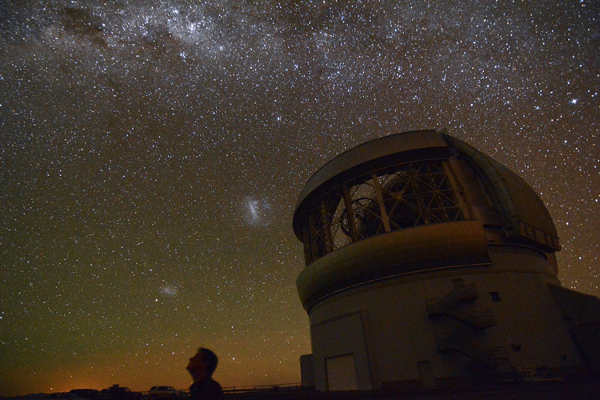
BERKELEY, Calif. – As planets form in the swirling gas and dust around young stars, there seems to be a sweet spot where most of the large, Jupiter-like gas giants congregate, centered around the orbit where Jupiter sits today in our own solar system.
The location of this sweet spot is between 3 and 10 times the distance Earth sits from our sun (3-10 astronomical units, or AU). Jupiter is 5.2 AU from our sun.
That’s just one of the conclusions of an unprecedented analysis of 300 stars captured by the Gemini Planet Imager, or GPI, a sensitive infrared detector mounted on the 8-meter Gemini South telescope in Chile.
The GPI Exoplanet Survey, or GPIES, is one of two large projects that search for exoplanets directly, by blocking stars’ light and photographing the planets themselves, instead of looking for telltale wobbles in the star — the radial velocity method — or for planets crossing in front of the star — the transit technique.
The GPI camera is sensitive to the heat given off by recently-formed planets and brown dwarfs, which are more massive than gas giant planets, but still too small to ignite fusion and become stars.
The analysis of the first 300 of more than 500 stars surveyed by GPIES, published June 12 in the The Astronomical Journal, “is a milestone,” said Eugene Chiang, a UC Berkeley professor of astronomy and member of the collaboration’s theory group. “We now have excellent statistics for how frequently planets occur, their mass distribution and how far they are from their stars. It is the most comprehensive analysis I have seen in this field.”
The study complements earlier exoplanet surveys by counting planets between 10 and 100 AU, a range in which the Kepler Space Telescope transit survey and radial velocity observations are unlikely to detect planets.
It was led by Eric Nielsen, a research scientist at the Kavli Institute for Particle Astrophysics and Cosmology at Stanford University, and involved more than 100 researchers at 40 institutions worldwide, including the University of California, Berkeley.
One new planet, one new brown dwarf
Since the GPIES survey began five years ago, the team has imaged six planets and three brown dwarfs orbiting these 300 stars. The team estimates that about 9 percent of massive stars have gas giants between 5 and 13 Jupiter masses beyond a distance of 10 AU, and fewer than 1 percent have brown dwarfs between 10 and 100 AU.
The new data set provides important insight into how and where massive objects form within planetary systems.
“As you go out from the central star, giant planets become more frequent. Around 3 to 10 AU, the occurrence rate peaks,” Chiang said. “We know it peaks because the Kepler and radial velocity surveys find a rise in the rate, going from hot Jupiters very near the star to Jupiters at a few AU from the star. GPI has filled in the other end, going from 10 to 100 AU, and finding that the occurrence rate drops; the giant planets are more frequently found at 10 than 100. If you combine everything, there is a sweet spot for giant planet occurrence around 3 to 10 AU.”
“With future observatories, particularly the Thirty-Meter Telescope and ambitious space-based missions, we will start imaging the planets residing in the sweet spot for sun-like stars,” said team member Paul Kalas, a UC Berkeley adjunct professor of astronomy.
The exoplanet survey discovered only one previously unknown planet — 51 Eridani b, nearly three times the mass of Jupiter – and one previously unknown brown dwarf – HR 2562 B, weighing in at about 26 Jupiter masses. None of the giant planets imaged were around sun-like stars. Instead, giant gas planets were discovered only around more massive stars, at least 50 percent larger than our sun, or 1.5 solar masses.
“Given what we and other surveys have seen so far, our solar system doesn't look like other solar systems,” said Bruce Macintosh, the principal investigator for GPI and a professor of physics at Stanford. “We don't have as many planets packed in as close to the sun as they do to their stars and we now have tentative evidence that another way in which we might be rare is having these kind of Jupiter-and-up planets.”
“The fact that giant planets are more common around stars more massive than sun-like stars is an interesting puzzle,” Chiang said.
Because many stars visible in the night sky are massive young stars called A stars, this means that “the stars you can see in the night sky with your eye are more likely to have Jupiter-mass planets around them than the fainter stars that you need a telescope to see,” Kalas said. “That is kinda cool.”
The analysis also shows that gas giant planets and brown dwarfs, while seemingly on a continuum of increasing mass, may be two distinct populations that formed in different ways.
The gas giants, up to about 13 times the mass of Jupiter, appear to have formed by accretion of gas and dust onto smaller objects – from the bottom up.
Brown dwarfs, between 13 and 80 Jupiter masses, formed like stars, by gravitational collapse – from the top down – within the same cloud of gas and dust that gave rise to the stars.
“I think this is the clearest evidence we have that these two groups of objects, planets and brown dwarfs, form differently,” Chiang said. “They really are apples and oranges.”
Direct imaging is the future
The Gemini Planet Imager can sharply image planets around distant stars, thanks to extreme adaptive optics, which rapidly detects turbulence in the atmosphere and reduces blurring by adjusting the shape of a flexible mirror. The instrument detects the heat of bodies still glowing from their own internal energy, such as exoplanets that are large, between 2 and 13 times the mass of Jupiter, and young, less than 100 million years old, compared to our sun’s age of 4.6 billion years. Even though it blocks most of the light from the central star, the glare still limits GPI to seeing only planets and brown dwarfs far from the stars they orbit, between about 10 and 100 AU.
The team plans to analyze data on the remaining stars in the survey, hoping for greater insight into the most common types and sizes of planets and brown dwarfs.
Chiang noted that the success of GPIES shows that direct imaging will become increasingly important in the study of exoplanets, especially for understanding their formation.
“Direct imaging is the best way at getting at young planets,” he said. “When young planets are forming, their young stars are too active, too jittery, for radial velocity or transit methods to work easily. But with direct imaging, seeing is believing.”
Other UC Berkeley team members are postdoctoral fellows Ian Czekala, Gaspard Duchêne, Thomas Esposito, Megan Ansdell and Rebecca Jensen-Clem, professor of astronomy James Graham and undergraduates Jonathan Lin, Meiji Nguyen and Yilun Ma. Other team members include Nielsen, a former Berkeley undergraduate, Franck Marchis, a former assistant researcher, and Marshall Perrin, Mike Fitzgerald, Jason Wang, Eve Lee and Lea Hirsch, former graduate students.
The research was supported by the National Science Foundation (AST-1518332), National Aeronautics and Space Administration (NNX15AC89G) and the Nexus for Exoplanet System Science (NExSS), a research coordination network sponsored by NASA’s Science Mission Directorate (NNX15AD95G).
Robert Sanders writes for the UC Berkeley News Center.
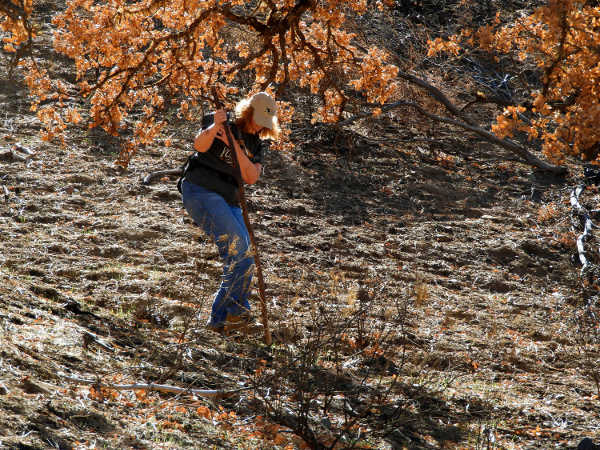
NORTHERN CALIFORNIA – In June the second of two wildfire seasons start in California.
The first fire season is between October and April when the Santa Ana winds are most prevalent, and the second season typically runs from June through September when heat and lots of dried ground cover provide breeding grounds for the flames.
This is a good time, then, to reiterate some of our tips for hikers who are going out during the hotter summer months when wildfires can be a factor.
Taking reasonable precautions during fire season before going out on a hike is the first best defense against getting trapped in a remote area with a wildfire on the way.
Before heading out, check with the local fire services for notices about possible burns or risk concerns in the area. Take the time to not only plot the course of your hike, but also to plot escape routes.
Remember: Getting away from the burn is more important than getting back to your car or the trailhead.
Tell friends and family where you’re going and when you expected to be back, so they’ll know where to direct emergency personnel to start looking if you don’t come home on time.
Bring something shiny with you, like a mirror, to signal with if your trapped by the fire. Wear bright clothing, so you’re easy to spot at a distance or from above. Don’t wear synthetic clothing, as synthetics can melt directly onto your skin if the fire overtakes you.
Watching for signs of fire is another good defense against getting trapped by a wildfire. The acrid scent of smoke or seeing smoke are obvious indicators that a fire is nearby. If you see ash or sparks in the air, it means the fire is probably less than a mile away from you and you should take immediate measures to safely leave the area. Even small fires can loom large in just a short amount of time, so don’t underestimate the danger of tiny floating sparks.
When trying to escape a fire, face the wind and move downhill whenever possible. Remember, heat rises, so fire will run up the side of a hill or embankment much quicker than it will move down it.
Moving down into shadier areas also moves you down into spots where streams and groundwater may help to keep the plant-cover more moist. Be careful of canyons and deep ravines, however. These landscape features can actually act like giant chimneys and draw the fire and smoke up into them.
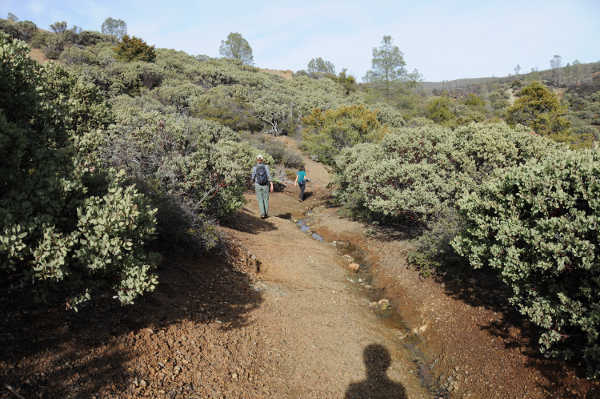
Also be aware of the plant life around you. Some plants are highly flammable: manzanita, for example. Its roots are shallow and vulnerable to heat, and the bark is thin and peels off with age, so it offers the shrubs little protection from wildfires.
Whenever possible, move along areas that won’t provide the fire with any additional tinder, such as wide dirt trails or fire breaks, paved roads, or rocky and gravelly areas.
Some believe that going back over areas that have already been burned may provide some protection because the fuel there has already been consumed.
Be aware, however, that such areas may still be extremely hot to walk on, and extra heat on an already hot day is not your friend. Also, some fire-remnants can often smolder deep in the root cavities of the burned shrubs and trees and can reignite without warning.
Never try to outrun an oncoming wildfire; it can move as quickly as 14 miles per hour.
If you do find yourself trapped by the fire, and you can’t get out into a large water source (such as a deep stream or lake) do NOT douse your clothes with water. If the fire reaches you, it can cause the water on your clothes to super-heat and turn to scalding steam.
If the fire is going to overtake you, find a relatively clear space on the ground, pull up any weeds or brush you can, and create a shallow depression to lie in. The bigger the space you can clear for yourself, the better. Take off your backpack but keep it nearby in case you need to use it as a heat shield. Then lay face-down in the depression with your feet in the direction of the fire.
As horrifying as being trapped by a wildfire may seem, keep in mind that if one does overtake you, it may pass over you in less than a minute or so. The heat will make it difficult to breathe but try to keep yourself low to the ground and as calm as you can.
To avoid situations like this, however, it’s always best to arm yourself with as much information as you can before going out on the trail.
Stay alert and stay safe.
Mary K. Hanson is a Certified California Naturalist, author, nature photographer and blogger ( https://chubbywomanwalkabout.com/ ) who is living with terminal cancer. She also teaches naturalist classes through Tuleyome, a 501(c)(3) nonprofit conservation organization based in Woodland, Calif. For more information, visit www.tuleyome.org .
CLEARLAKE, Calif. – The Clearlake City Council on Thursday held the swearing-in for a new member and approved its new fiscal year budget.
The council met at 4 p.m. to hold a budget workshop ahead of its regular evening meeting.
At the start of the workshop, City Clerk Melissa Swanson administered the oath of office to Russell Perdock, who the council voted last week to appoint to succeed former Mayor Nick Bennett, who resigned in May due to health reasons, ahead of a move to South Dakota.
Perdock previously had served on the council but resigned in February 2018 to pursue the city’s police chief job, which ultimately went to Andrew White. Perdock also ran unsuccessfully for the council in November.
He said at Thursday’s meeting that it was Bennett who had called and encouraged him to apply for the vacancy. The term has 18 months remaining.
Following the swearing-in, Mayor Russ Cremer shook Perdock’s hand. “Welcome back,” Cremer said.
One of the main items of business on Thursday was budgeting work, both during the workshop and later during the meeting.
This year’s budget has $17.6 million in appropriations – with transfers, appropriations total $23.6 million across all funds – with $6.6 million in the general fund, according to City Manager Alan Flora.
During the budget workshop, ahead of the final approval that took place during the regular meeting, Flora went over some of the city’s key economic indicators that impact the budget.
Inflation is the lowest in four years at 1.8 percent, which he said is primarily due to falling fuel prices and used vehicle sales. Wages are flat.
Flora said interest rates are expected to decline, and despite national trends California continues to add jobs, with construction and manufacturing leading the way.
He said the city’s residential property values have been doing pretty well, and are showing a 13 percent increase, which is better than Lakeport and county as a whole. “We’re making up a little bit of ground.”
Key city revenue sources are property and sales tax. He told the council during the budget workshop that sales tax projections have been up and down.
Flora’s written report explained that city revenues remain stable, “but the same growth seen over the past few years is not anticipated to continue.”
Sales tax – which he said supports community services – have shown meager growth over the past year, a trend which Flora’s written report said isn’t unique to Clearlake or Lake County but is being seen across Northern California. He said the opening of Big 5 and Tractor Supply last year helped smooth the overall decline in retail sales.
“While there is not a current reason for concern, fiscal restraint must be used in General Fund expenditures as well as Measure P (police sales tax) and Measure V (road sales tax),” he wrote in his budget message.
Flora’s budget focuses on two key categories of investment for the new fiscal year – infrastructure and investment.
In infrastructure, the Measure V road tax is projected to generate $2 million for road work in the coming year.
The design plans for both Austin and Highlands Parks are expected to be completed within the next month, and Flora reported that the priority focus for the year is starting the Austin Park project. It’s expected to cost between $1.5 to $2 million to complete both phases, and the budget includes $1.8 million to complete.
The city also is working to maintain existing staffing levels, as well as fund an additional police dispatcher, and planned upgrades to city facilities and technology.
Flora also wants to address the city’s image, which he proposes to tackle through investments such as $120,000 for vehicle and property abatements and $75,000 to hire a public relations or strategy firm to help the city “share its message of success and change with a focus on attracting investment,” according to the budget narrative. There also is $65,000 set aside for economic development and marketing collaborative efforts.
After doing the bulk of the budget review during the workshop, the council accepted it as proposed during the meeting.
The council also unanimously approved its appropriations, or Gann, limit for the new fiscal year as well as the city fee schedule.
In other business, the council held a public hearing and approved the first reading of an ordinance requiring registration of vacant, abandoned or foreclosed commercial buildings. A second reading and final adoption of the ordinance is anticipated to take place on June 27.
The ordinance requires that any commercial building vacant for 30 consecutive days must register for an initial cost of $100 plus a pro-rated cost of $12.50 per month. The penalty for failing to register after notice by an enforcement official is set at $500 for the first violation and $1,000 for every 30 days the property remains unregistered.
Buildings subject to registration must have posted on them a sign providing the name and phone number of the owner or agent responsible for inspections and, for foreclosures, the contact information for the lender; liability insurance for the property in the amount of $1 million except as approved by the city manager; be secured from trespassers; and monthly inspections by the owner or their agency with submission of an inspection report to the police department.
The council also began discussing traffic calming measures, voting to have staff identify trial locations for speed reduction efforts; updated the mayor’s appointments for the year by having Perdock step into committee positions Bennett had held; approved an agreement between the county of Lake and city of Clearlake regarding a road maintenance program for 40th Avenue, Davis Avenue and Moss Avenue for Fiscal Year 2018-19 through FY 2023-24; presented a proclamation declaring June as LGBT Pride Month; and tabled discussion of a two-year agreement between the county of Lake, city of Lakeport and city of Clearlake for support of Lake County PEG TV station.
Email Elizabeth Larson at
CLEARLAKE, Calif. – The Lakeshore Lions Club of Clearlake is sponsoring its 62nd annual Redbud Parade and Festival.
The parade will start at Redbud Park at 11 a.m. Saturday, July 6, and will proceed down Lakeshore Drive to Austin Park.
The theme of this year's parade is “Lake County Roots.”
This year the parade will feature local marchers, decorated floats, vintage cars, parade and show horses, fire and police vehicles, and much more.
The Lakeshore Lions Club will also sponsor the firework display at dark.
Come on down to Austin Park and enjoy an assortment of food, cold drinks and beer.
There also will be the 20th annual Show and Shine Car Show, arts and craft vendors, games and entertainment for all.
The Clearlake Chamber of Commerce will sponsor the 51st annual International Worm Races.
The Midway of Fun Carnival will run from July 3 to 7. Advance tickets are available at Tatonka Land and Clearlake Automotive.
This is the largest fundraiser for the Lakeshore Lions Club, so show your community spirit and support by helping raise money for all the many causes Lakeshore Lions Club aids in the community.
The club supports the eyeglasses and vision care for the needy, high school sports, scholarships and many other school activities, South Shore Little League, our Fire and Police Departments, the senior center, community, Boy Scouts and Cub Scouts, and many more very worthy causes.
Anyone who wishes to enter the parade or car show can pick up an entry form at the Clear Lake Chamber of Commerce office, Bob's Vacuum, Clearlake Automotive, Kevin Ness Jewelers and Tatonka Land.
Any and all Arts and Craft venders interested in booths, please call Bob Kiel at 707-994-9752.
For more information about the parade, please call 707-994-3070 and for the car show call Kevin Ness at 707-994-2307.
The parade will start at Redbud Park at 11 a.m. Saturday, July 6, and will proceed down Lakeshore Drive to Austin Park.
The theme of this year's parade is “Lake County Roots.”
This year the parade will feature local marchers, decorated floats, vintage cars, parade and show horses, fire and police vehicles, and much more.
The Lakeshore Lions Club will also sponsor the firework display at dark.
Come on down to Austin Park and enjoy an assortment of food, cold drinks and beer.
There also will be the 20th annual Show and Shine Car Show, arts and craft vendors, games and entertainment for all.
The Clearlake Chamber of Commerce will sponsor the 51st annual International Worm Races.
The Midway of Fun Carnival will run from July 3 to 7. Advance tickets are available at Tatonka Land and Clearlake Automotive.
This is the largest fundraiser for the Lakeshore Lions Club, so show your community spirit and support by helping raise money for all the many causes Lakeshore Lions Club aids in the community.
The club supports the eyeglasses and vision care for the needy, high school sports, scholarships and many other school activities, South Shore Little League, our Fire and Police Departments, the senior center, community, Boy Scouts and Cub Scouts, and many more very worthy causes.
Anyone who wishes to enter the parade or car show can pick up an entry form at the Clear Lake Chamber of Commerce office, Bob's Vacuum, Clearlake Automotive, Kevin Ness Jewelers and Tatonka Land.
Any and all Arts and Craft venders interested in booths, please call Bob Kiel at 707-994-9752.
For more information about the parade, please call 707-994-3070 and for the car show call Kevin Ness at 707-994-2307.
Ready, SET, go – NASA’s Space Environment Testbeds, or SET, will launch this month on its mission to study how to better protect satellites in space.
SET will get a ride to space on a U.S. Air Force Research Lab spacecraft aboard a SpaceX Falcon Heavy rocket from NASA’s Kennedy Space Center in Florida.
SET studies the very nature of space itself — which isn’t completely empty, but brimming with radiation — and how it affects spacecraft and electronics in orbit.
Energetic particles from the Sun or deep space can spark memory damage or computer upsets on spacecraft, and over time, degrade hardware.
SET seeks to better understand these effects in order to improve spacecraft design, engineering, and operations, and avoid future anomalies. Spacecraft protection is a key part of NASA’s mission as the agency’s Artemis program seeks to explore the Moon and beyond.
“Since space radiation is one of the primary hazards space missions encounter, researching ways to improve their abilities to survive in these harsh environments will increase the survivability of near-Earth missions as well as missions to the Moon and Mars,” said Reggie Eason, SET project manager at NASA Headquarters in Washington.
SET aims its sights on a part of near-Earth space called the slot region: the gap between two of Earth’s vast radiation belts, also known as the Van Allen belts. The doughnut-shaped Van Allen belts seethe with radiation trapped by Earth’s magnetic field.
Where SET orbits is thought to be calmer, but known to vary during extreme space weather storms driven by the Sun. How much it changes exactly, and how quickly, remains uncertain.
“There haven’t been too many measurements to tell us how bad things get in the slot region,” said Michael Xapsos. Xapsos is one of two members on the SET Project Scientist Team alongside astrophysicist Yihua Zheng at NASA’s Goddard Space Flight Center in Greenbelt, Maryland. “That’s why we’re going there. Before we put satellites there, you have to be aware of how variable the environment is,” Xapsos said.
The slot region is an attractive one for satellites – especially navigation and communications satellites – because from about 12,000 miles up, it offers not only a relatively friendly radiation environment, but also a wide view of Earth. During intense magnetic storms, however, energetic particles from the outer belt can surge into the slot region.
SET will survey the slot region, providing some of the first day-to-day weather measurements of this particular neighborhood in near-Earth space. The mission also studies the fine details of how radiation damages instruments and tests different methods to protect them, helping engineers build parts better suited for spaceflight.
“Electronic devices these days are so small, complicated and fast,” Xapsos said. The smaller a device is, the more vulnerable it is to radiation damage, and the more challenging it is to predict its performance in space. “SET will allow us to better understand what happens when an ion hits a device, and to improve models for how often these upsets occur.”
There are two kinds of radiation damage that SET studies. The first are known as single event effects – that is, what happens when a high-energy ion accelerated by a solar eruption or from a galactic cosmic ray pierces electronics.
These strikes happen at random, one particle at a time, and load a circuit with extra electric charge. The result can be a data flip – in binary code, for example, flipping a 0 to a 1 – that affects stored memory or the programs that run spacecraft.
Many spacecraft are equipped to recover from these snags, but at worst, they can cause system crashes and catastrophic damage.
But these dramatic blows aren’t the only concern – milder radiation over time degrades circuits too. Charged particles trapped in the radiation belts weather electronics, gradually reducing their performance the longer they’re in orbit.
SET is equipped with a space weather monitor and three circuit board experiments – each no larger than a postcard – to study both types of damage.
CREDANCE – short for the Cosmic Radiation Environment Dosimetry and Charging Experiment – is SET’s space weather monitor, built to survey cosmic rays and particles in the radiation belts. These are the high-energy fragments of atoms that can pierce the walls of spacecraft, damaging electronics.
Two circuit board experiments also study single event effects. COTS-2 – standing for Commercial Off the Shelf – collects information on the frequency of single event effects and how to mitigate them, especially in specialized computer chips.
DIME – short for the Dosimetry Intercomparison and Miniaturization Experiment – consists of two separate boards that together demonstrate six different ways to measure space radiation using affordable, commercially available parts. The experiment can help future missions decide the best way to monitor radiation for their spacecraft.
Another circuit board experiment focuses on total radiation dose. ELDRS – short for Enhanced Low Dose Rate Sensitivity – is named for the mystery it studies: the ELDRS effect.
This is what engineers call the intensified damage that certain types of electronics face when exposed to mild radiation over time – as opposed to the lesser damage experienced if exposed to the same total dose all at once. Information from this experiment will help improve test methods on Earth to make electronics space-ready.
Together, the SET experiments will expand our understanding of the near-Earth space environment and how its radiation impacts instruments. “SET data will directly go into improving our models so we can better evaluate the radiation environment future missions will encounter,” said Goddard aerospace engineer Megan Casey. Models are a key component in selecting and testing any electronics destined for spaceflight.
SET is part of the Space Environment Effects (SFx) experiment, one of three experiments on board the Demonstration and Science Experiments, or DSX, spacecraft being launched by the U.S. Air Force.
DSX is launching as part of the Space Test Program-2 (STP-2) mission, managed by the U.S. Air Force Space and Missile Systems Center (SMC). SET is one of four NASA missions on this STP-2 launch – all of which are dedicated to improving technology in space. DSX separates from the launch vehicle approximately 3.5 hours after launch.
SET is the latest addition to NASA’s fleet of heliophysics observatories. NASA heliophysics missions study a vast interconnected system from the Sun to the space surrounding Earth and other planets, and to the farthest limits of the Sun’s constantly flowing stream of solar wind. SET’s observations provide key information on the Sun’s effects on our spacecraft, enabling further exploration of space.
SET is part of NASA’s Living with a Star program, which explores aspects of the Sun-Earth system that directly affect human life and society. The Living with a Star flight program is managed by Goddard.
Lina Tran works for NASA's Goddard Space Flight Center in Greenbelt, Maryland.
LAKEPORT, Calif. – The long-running Middle Creek Restoration Project, which is designed to massively reduce sedimentation and nutrient load in order to improve Clear Lake’s health, took another step forward this week.
On Tuesday morning, Lake County Water Resources Department Director David Cowan presented to the Board of Supervisors a contract between the Lake County Watershed Protection District and the California Department of Water Resources to fund a portion of the contract. The discussion begins at the 2:19:00 mark in the video above.
The contract provides $15 million – or $5 million per year for three years – for the purchase and maintenance of properties as part of the Middle Creek Flood Damage Reduction and Ecosystem Restoration Project.
During last week’s budget hearings, Cowan had updated the board on the pending arrival of the revised contract.
The project’s purpose is to remove failing levees and return about 1,600 acres of farmland between the Nice-Lucerne Cutoff and Upper Lake to Clear Lake in an effort to remove sedimentation and phosphorus loading.
Cowan said that on July 17, 2018, the board adopted a resolution to accept $15 million in grant funds from the California Department of Water Resources.
Since then the terms of the contract have been updated, the most significant of them relating to the clarification of funding sources, specifically, that the Department of Water Resources will fund the project through direct expenditure and grants from the Safe Drinking Water, Clean Water, Watershed Protection, and Flood Protection Act, and the Disaster Preparedness and Flood Prevention Bond Act of 2006, according to Cowan.
Cowan said when the original agreements were drawn up, maintenance of the properties to be purchased through the program weren’t considered. He said that has since been revised.
Other changes include clarification of the state’s total contribution, which through this latest agreement and a previous contract total $27,954,000; changing of the grantee from the Lake County Flood Control and Water Conservation District to the Lake County Watershed Protection District; and removal of a $240,000 district cost share.
Cowan said that, once the board approved the agreement, the district would begin to purchase more flood-prone properties from willing sellers in the project area.
His written report to the board noted that his department’s current staff allocation doesn’t provide for a project manager, but the 2019-20 Water Resources Department budget proposal includes the addition of a Water Resources coordinator and technician. If approved by the board, Cowan’s report said those positions would be partially allocated to the project, with Cowan to serve as the project manager in the interim.
Coalition advocates for project
Along with Cowan, Peter Windrem, a member of the steering committee for the 160-member Middle Creek Restoration Coalition, spoke to the board about the project, giving them an update on the progress and praising Cowan for his efforts.
“The coalition wholeheartedly supports this contract,” said Windrem.
He explained that the Scotts Creek and Middle Creek watershed are the main water sources for the project. The water coming from those watersheds are the source of 70 percent of the sediment in Clear Lake, which feeds algae.
“What I first want to emphasize is the urgency of this project,” said Windrem,
Showing them a map of how the US Army Corps of Engineers will construct the project, he explained that the watersheds’ historic channels will be restored. The levees will then be breached and water will spread out over the entire area.
“Here is the urgency: The levees are by all accounts about to fail,” he said.
If they fail, it will be in the southern project area. Windrem said the project is designed so that, farther to the north, the water from Middle and Scotts creeks will enter the restoration area, it will slow down, and the sediment – which contains phosphorus, a nutrient that it’s important to reduce – will drop out. “That’s the hydraulics of it.”
However, if the levee breaches to the south, there will be no sedimentation capture because water is not being diverted into the area, which will become a bayou.
If that happens, Windrem said the county couldn’t take advantage of the water filtering and nutrient reduction that experts say needs to happen in order to help Clear Lake.
In order to fix such a scenario, the levees would have to be rebuilt and “staggering quantities” of water would have to be pumped out of the area, Windrem said. It would then need to dry out, the channels would need to be restored and the levees would have to be breached again, as they were supposed to be.
Such a process, he said, would be “horrifically expensive” and there’s no money to pay for it. Windrem called such a scenario an “ecological disaster” that the county would be stuck with for decades – if not forever.
“That could happen next winter,” said Windrem, noting the project has had its ups and downs for 20 years, and can’t wait another 20 for it to be completed.
He said it’s really audacious that the county has taken custody of Clear Lake, a national treasurer. “This is not a local issue. This is not a state issue. This is a national issue. That’s what that lake is. We tend to think of it in terms of local consequences, but it is much more than that.”
Windrem said that, in 2004, the water district signed a contract with the US Army Corps of Engineers for breach of levees and restoration of what was historically called Robinson Lake to its pre-levee condition.
The contract says the Army Corps will do this work and pay for 65 percent of the cost of restoring those levees, but the district is responsible for the “LERRDs” – land, easements, rights of way, relocation of people within the district and disposal of excavated material, he said
Windrem said there are 99 parcels in the project area, with more than 60 property owners. The initial
He said the Lake County Watershed Protection District also is responsible for seeing that Highway 20 is raised between the casino and Upper Lake, about a quarter of a mile of roadway. There also are seven towers for high transmission Pacific Gas and Electric power lines that must have their foundations reinforced, at an estimated cost of $1 million per tower, plus the bridge on the Nice-Lucerne Cutoff must be replaced due to the anticipated channel change.
The project has three phases, Windrem said: Predesign, where the project is currently; the design phase; and construction phase. Estimated design costs are $3.2 million, with the district required to raise 25 percent, or $800,000.
A total of $33.8 million must be raised for the project, Windrem said, of which $18.8 million is secured. The California Department of Water Resources has covered the land purchase, Caltrans may handle the Highway 20 improvements, but it’s not yet clear what the source of the money is for the PG&E towers, the new bridge or design.
“The district must provide the leadership for this project. No one else does,” said Windrem, explaining that there are federal, state and local officials that need to be engaged in the work.
He also emphasized that for the project to happen, there must be a dedicated project manager for the district, someone who can work on the government relationships.
Windrem said time is of the essence, as the district only has three and a half years to buy the remaining properties and spend the $15 million. It took 14 years to spend the previous $12 million from the state.
Cowan said the coalition has done the lion’s share of the work on the LERRDs.
“The project is the hook that everyone’s hanging their hat on as far as reduction of phosphorus levels,” Cowan said, adding, “It’s not just a standalone project, it fits well with many other projects that are ongoing in the lake to improve water quality.”
Supervisor EJ Crandell asked if a project manager is needed immediately or if the county can develop more of a discussion.
Windrem suggested the project manager be someone hired on a contract basis, not a county employee.
“The project cannot succeed without someone to be able to take on that responsibility,” he said, adding, “We’ll do our part to support it, but it’s big.”
Supervisor Rob Brown said the amount of hours put in by volunteers on the project over the years is unbelievable, and the county couldn’t have afforded it. He thanked Windrem for the work the coalition has done.
Crandell moved to approve the agreement, which the board approved 5-0.
That discussion was followed by a related item – approval of a bid for $87,927.52 from Lamassu Utility Services Inc. from Benicia to clean and inspect 40 culverts within the Middle Creek flood control system. The project is grant funded.
The board approved the bid with a 5-0 vote.
Email Elizabeth Larson at